
Verwandte Artikel zu Say Nothing: A True Story of Murder and Memory in Northern...
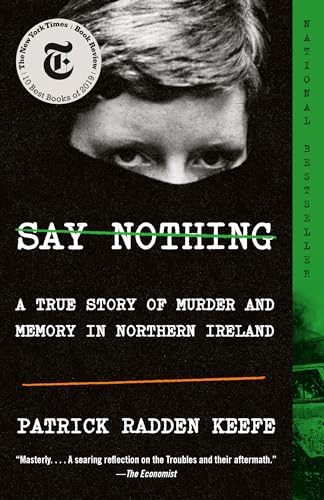
Inhaltsangabe
NEW YORK TIMES BESTSELLER • SOON TO BE AN FX LIMITED SERIES STREAMING ON HULU • NATIONAL BOOK CRITICS CIRCLE AWARD WINNER • From the author of Empire of Pain—a stunning, intricate narrative about a notorious killing in Northern Ireland and its devastating repercussions.
"Masked intruders dragged Jean McConville, a 38-year-old widow and mother of 10, from her Belfast home in 1972. In this meticulously reported book—as finely paced as a novel—Keefe uses McConville's murder as a prism to tell the history of the Troubles in Northern Ireland. Interviewing people on both sides of the conflict, he transforms the tragic damage and waste of the era into a searing, utterly gripping saga." —New York Times Book Review
"Reads like a novel ... Keefe is ... a master of narrative nonfiction. . .An incredible story."—Rolling Stone
A Best Book of the Year: The New York Times, The Washington Post, The Wall Street Journal, TIME, NPR, and more!
Jean McConville's abduction was one of the most notorious episodes of the vicious conflict known as The Troubles. Everyone in the neighborhood knew the I.R.A. was responsible. But in a climate of fear and paranoia, no one would speak of it. In 2003, five years after an accord brought an uneasy peace to Northern Ireland, a set of human bones was discovered on a beach. McConville's children knew it was their mother when they were told a blue safety pin was attached to the dress--with so many kids, she had always kept it handy for diapers or ripped clothes.
Patrick Radden Keefe's mesmerizing book on the bitter conflict in Northern Ireland and its aftermath uses the McConville case as a starting point for the tale of a society wracked by a violent guerrilla war, a war whose consequences have never been reckoned with. The brutal violence seared not only people like the McConville children, but also I.R.A. members embittered by a peace that fell far short of the goal of a united Ireland, and left them wondering whether the killings they committed were not justified acts of war, but simple murders.
From radical and impetuous I.R.A. terrorists such as Dolours Price, who, when she was barely out of her teens, was already planting bombs in London and targeting informers for execution, to the ferocious I.R.A. mastermind known as The Dark, to the spy games and dirty schemes of the British Army, to Gerry Adams, who negotiated the peace but betrayed his hardcore comrades by denying his I.R.A. past--Say Nothing conjures a world of passion, betrayal, vengeance, and anguish.
Die Inhaltsangabe kann sich auf eine andere Ausgabe dieses Titels beziehen.
Über die Autorin bzw. den Autor
PATRICK RADDEN KEEFE is a staff writer at The New Yorker, an Eric and Wendy Schmidt Fellow at the New America Foundation and the author of The Snakehead and Chatter. His work has also appeared in The New York Times Magazine, Slate, New York, and The New York Review of Books, among others and he is a frequent commentator on NPR, the BBC, and MSNBC. Patrick received the 2014 National Magazine Award for Feature Writing, for his story "A Loaded Gun," was a finalist for the National Magazine Award for Reporting in 2015 and 2016, and is also the recipient of a Guggenheim Fellowship.
Auszug. © Genehmigter Nachdruck. Alle Rechte vorbehalten.
Book Two
Human Sacrifice
11
Close England!
THE CROCUSES WERE ALREADY in bloom around London’s parks and monuments on March 8, 1973. It was a Thursday, a crisp, crystalline early-spring morning. After a wet English winter, people were venturing outdoors, beckoned by the sun. The Queen left Buckingham Palace to inspect the first blooms in her garden. There was a transit strike that day, and with train service suspended, commuters were forced to drive into the city. As a result, central London was overrun with automobiles. In order to accommodate the surge of vehicles, the city had suspended parking restrictions for the day. Cars were everywhere—in loading zones and other areas that were usually off-limits, or at meters that had long since expired.
Just after lunchtime, at around 2 p.m., a phone rang at the headquarters of The Times of London. A young woman named Elizabeth Curtis, who had just started working on the news desk at the paper, picked up the call. She heard a man’s voice, speaking very quickly, with a thick Irish accent. At first she couldn’t make out what he was saying, then she realized that he was reeling off the descriptions and locations of a series of cars. He spoke for just over a minute, and, though she was still confused, she transcribed as much as she could. Before hanging up, the man said, “The bombs will go off in one hour.”
A journalist named Martin Huckerby was on duty that day in the newsroom. He overheard Curtis dictating details about the bombs to one of her colleagues. The nearest of the locations she mentioned was the Old Bailey, the central criminal court in London, just a short walk from The Times. Huckerby bolted out of the office. He was looking for a green Ford Cortina Estate with a license plate that, assuming Curtis had transcribed it correctly, read YNS 649K. Huckerby left the office at 2 p.m. and arrived at the monumental stone courthouse a few minutes later. Built at the turn of the century, the Old Bailey had been the site of many celebrated trials. A great dome sat atop the heavy masonry, with a bronze figure of Justice, her arms outstretched, holding a sword and a set of scales.
Dozens of cars were parked around the building, and Huckerby began checking them to see if he could find the Cortina. Before long, he spotted it, parked right in front of the courthouse: a green Cortina Estate with the license plate YFN 469K, close enough to what he was looking for that he was sure this was it. Peering through the glass at the car’s interior, he saw a pair of black gloves on the floor and an aerosol can. Huckerby waited for the police to come, and eventually, after what seemed like an eternity, two uniformed officers arrived at 2:33 and inspected the Cortina. They started evacuating people in the area, cordoning off the road. Huckerby took cover in a doorway, about twenty-five yards from the Cortina, and waited.
The plan to bring the bombing campaign to England had been, at least in part, Dolours Price’s idea. The IRA had detonated hundreds of bombs in commercial centers throughout Northern Ireland. If the goal was to cripple the economy, this effort had been a success. But the collateral damage was considerable. For civilians in Northern Ireland, whether Catholic or Protestant, the routine bombings could make life impossible: suddenly you were taking your life into your hands when you went to the shop for a dozen eggs. It might not have been the intention of the IRA to create civilian casualties, but there were civilian casualties, lots of them, and they were borne by Catholics and Protestants alike. Bloody Friday was an especially grave debacle, but it was hardly unique—countless smaller bombing operations had claimed limbs and lives, steadily eroding support for a violent campaign among moderate Irish nationalists. Worst of all, because the toll of all this bombing was largely confined to Northern Ireland, it did not appear to be registering all that strongly with the intended target—the British. The English public, removed on the other side of the Irish Sea, seemed only dimly aware of the catastrophe engulfing Northern Ireland. It was a case study in strategic insanity: the Irish were blowing up their own people in a misguided attempt to hurt the English, and the English hardly even noticed. It bothered Price. “This is half their war,” she would say to Wee Pat McClure, the head of the Unknowns, as they sat around call houses between operations. “Only half of it is our war. The other half is their war, and some of it should be fought on their territory.” She became convinced that “a short, sharp shock—an incursion into the heart of the Empire—would be more effective than twenty car bombs in any part of the North of Ireland.”
After making the case to Seán Mac Stíofáin, who approved of the idea, Price worked with McClure and Gerry Adams on an initial plan, to firebomb London. The firebombs were made and smuggled into London, and the idea was that a team of girls would fly over and deposit them in department stores on Oxford Street. But before they could put the bombs in place, they discovered that the acid in the devices had leaked, ruining them. So Price, who was already in London, abandoned the mission and walked down to the banks of the Thames, where she gently slid each faulty bomb into the river.
When firebombs didn’t work, they resolved to plant car bombs instead. The idea took shape within the Belfast Brigade. When it came time to recruit a team for the mission, volunteers from different units assembled at a call house in the Lower Falls. Gerry Adams explained that they were planning a very dangerous job. Any volunteers who signed up for it would have to be away from home for a while. As Adams spoke, Price sat perched on the arm of his chair. In the interests of operational security, Adams was vague about the mission when he spoke to this larger group, offering few details, but he stressed that anyone who participated must be prepared to face the full wrath of the state. “This could be a hanging job,” he said. “If anyone doesn’t want to go, they should up and leave now.” He instructed them to exit through the back door, at ten-minute intervals, so as not to attract attention.
Price thought Adams was being melodramatic. She suspected he might have picked up that flourish about ten-minute intervals from a book about Michael Collins. But, sure enough, people started to get up and walk out. “Don’t knock me down in the rush, lads,” Price said drily.
When this small exodus had concluded, about ten people remained: there was Price’s friend and fellow Unknown Hugh Feeney. He was erudite, bespectacled, in his early twenties. Feeney would be the quartermaster, in charge of all the money for the operation; he was armed with a thick roll of five-pound notes. There was Gerry Kelly, a handsome young man from the Lower Falls, whom Price was meeting for the first time. Kelly had been on the run, after escaping from prison, where he was serving a sentence for bank robbery. Price thought he was a grand lad. And there was Marian, of course. There was always Marian.
They were all very young. Kids, really. The oldest member of the crew, William Armstrong, a window cleaner with slicked-back hair, was twenty-nine. The youngest member was Roisin McNearney, a wide-eyed eighteen-year-old. She had been working as a typist before she joined the Provos six months earlier. She still lived with her parents.
As head of the Unknowns, Wee Pat wanted smart people running the operation. So he selected Dolours to take the lead. She was appointed, in her own words, “the OC of the whole shebang.” Reporting to her would be two...
„Über diesen Titel“ kann sich auf eine andere Ausgabe dieses Titels beziehen.
Suchergebnisse für Say Nothing: A True Story of Murder and Memory in Northern...

Foto des Verkäufers
Say Nothing: A True Story of Murder and Memory in Northern Ireland
Anbieter: Dream Books Co., Denver, CO, USA
Verkäuferbewertung 5 von 5 Sternen

Zustand: acceptable. This copy has clearly been enjoyedâ"expect noticeable shelf wear and some minor creases to the cover. Binding is strong, and all pages are legible. May contain previous library markings or stamps. Artikel-Nr. 4EKGRJ007A2S_ns
Gebraucht kaufen
EUR 7,41
Versand gratis
Versand innerhalb von USA
Versand innerhalb von USA
Anzahl: 1 verfügbar
Foto des Verkäufers
Say Nothing: A True Story of Murder and Memory in Northern Ireland
Anbieter: Goodwill of Ventura and Santa Barbara Counties, Oxnard, CA, USA
Verkäuferbewertung 5 von 5 Sternen
Zustand: acceptable. Acceptable: The book has obvious wear. It may have some damage to the cover, but its integrity is intact. The binding may be slightly damaged, but its integrity is still intact. There may be possible writing in the margins and underlining and highlighting of text, but there are no missing pages or anything that would compromise the legibility or understanding of the text. See the seller's listing for full details and a description of any imperfections. Artikel-Nr. VSBV.0307279286.A
Gebraucht kaufen
EUR 5,25
EUR 4,47 Versand
Versand innerhalb von USA
Versand innerhalb von USA
Anzahl: 1 verfügbar
Beispielbild für diese ISBN
Say Nothing: A True Story of Murder and Memory in Northern Ireland
Anbieter: Wonder Book, Frederick, MD, USA
Verkäuferbewertung 5 von 5 Sternen
Zustand: Good. Good condition. A copy that has been read but remains intact. May contain markings such as bookplates, stamps, limited notes and highlighting, or a few light stains. Artikel-Nr. Q06V-00824
Gebraucht kaufen
EUR 11,87
Versand gratis
Versand innerhalb von USA
Versand innerhalb von USA
Anzahl: 1 verfügbar
Beispielbild für diese ISBN
Say Nothing: A True Story of Murder and Memory in Northern Ireland
Anbieter: World of Books (was SecondSale), Montgomery, IL, USA
Verkäuferbewertung 5 von 5 Sternen
Paperback. Zustand: Fair. NEW YORK TIMES BESTSELLER * NOW AN FX LIMITED SERIES STREAMING ON HULU * NATIONAL BOOK CRITICS CIRCLE AWARD WINNER * From the author of London Falling--a stunning, intricate narrative about a notorious killing in Northern Ireland and its devastating repercussions. One of The New York Times's 20 Best Books of the 21st Century * A Kirkus Reviews Best Nonfiction Book of the Century * A Los Angeles Times Best Nonfiction Book of the Last 30 Years "Masked intruders dragged Jean McConville, a 38-year-old widow and mother of 10, from her Belfast home in 1972. In this meticulously reported book--as finely paced as a novel--Keefe uses McConville's murder as a prism to tell the history of the Troubles in Northern Ireland. Interviewing people on both sides of the conflict, he transforms the tragic damage and waste of the era into a searing, utterly gripping saga." --New York Times Book Review "Reads like a novel. . . . Keefe is . . . a master of narrative nonfiction. . . . An incredible story."--Rolling Stone A Best Book of the Year: The New York Times, The Washington Post, The Wall Street Journal, TIME, NPR, and more! Jean McConville's abduction was one of the most notorious episodes of the vicious conflict known as The Troubles. Everyone in the neighborhood knew the I.R.A. was responsible. But in a climate of fear and paranoia, no one would speak of it. In 2003, five years after an accord brought an uneasy peace to Northern Ireland, a set of human bones was discovered on a beach. McConville's children knew it was their mother when they were told a blue safety pin was attached to the dress--with so many kids, she had always kept it handy for diapers or ripped clothes. Patrick Radden Keefe's mesmerizing book on the bitter conflict in Northern Ireland and its aftermath uses the McConville case as a starting point for the tale of a society wracked by a violent guerrilla war, a war whose consequences have never been reckoned with. The brutal violence seared not only people like the McConville children, but also I.R.A. members embittered by a peace that fell far short of the goal of a united Ireland, and left them wondering whether the killings they committed were not justified acts of war, but simple murders. From radical and impetuous I.R.A. terrorists such as Dolours Price, who, when she was barely out of her teens, was already planting bombs in London and targeting informers for execution, to the ferocious I.R.A. mastermind known as The Dark, to the spy games and dirty schemes of the British Army, to Gerry Adams, who negotiated the peace but betrayed his hardcore comrades by denying his I.R.A. past--Say Nothing conjures a world of passion, betrayal, vengeance, and anguish. Artikel-Nr. CIN0307279286A
Gebraucht kaufen
EUR 16,36
Versand gratis
Versand innerhalb von USA
Versand innerhalb von USA
Anzahl: 2 verfügbar
Beispielbild für diese ISBN
Say Nothing: A True Story of Murder and Memory in Northern Ireland
Anbieter: World of Books (was SecondSale), Montgomery, IL, USA
Verkäuferbewertung 5 von 5 Sternen
Paperback. Zustand: Very Good. NEW YORK TIMES BESTSELLER * NOW AN FX LIMITED SERIES STREAMING ON HULU * NATIONAL BOOK CRITICS CIRCLE AWARD WINNER * From the author of London Falling--a stunning, intricate narrative about a notorious killing in Northern Ireland and its devastating repercussions. One of The New York Times's 20 Best Books of the 21st Century * A Kirkus Reviews Best Nonfiction Book of the Century * A Los Angeles Times Best Nonfiction Book of the Last 30 Years "Masked intruders dragged Jean McConville, a 38-year-old widow and mother of 10, from her Belfast home in 1972. In this meticulously reported book--as finely paced as a novel--Keefe uses McConville's murder as a prism to tell the history of the Troubles in Northern Ireland. Interviewing people on both sides of the conflict, he transforms the tragic damage and waste of the era into a searing, utterly gripping saga." --New York Times Book Review "Reads like a novel. . . . Keefe is . . . a master of narrative nonfiction. . . . An incredible story."--Rolling Stone A Best Book of the Year: The New York Times, The Washington Post, The Wall Street Journal, TIME, NPR, and more! Jean McConville's abduction was one of the most notorious episodes of the vicious conflict known as The Troubles. Everyone in the neighborhood knew the I.R.A. was responsible. But in a climate of fear and paranoia, no one would speak of it. In 2003, five years after an accord brought an uneasy peace to Northern Ireland, a set of human bones was discovered on a beach. McConville's children knew it was their mother when they were told a blue safety pin was attached to the dress--with so many kids, she had always kept it handy for diapers or ripped clothes. Patrick Radden Keefe's mesmerizing book on the bitter conflict in Northern Ireland and its aftermath uses the McConville case as a starting point for the tale of a society wracked by a violent guerrilla war, a war whose consequences have never been reckoned with. The brutal violence seared not only people like the McConville children, but also I.R.A. members embittered by a peace that fell far short of the goal of a united Ireland, and left them wondering whether the killings they committed were not justified acts of war, but simple murders. From radical and impetuous I.R.A. terrorists such as Dolours Price, who, when she was barely out of her teens, was already planting bombs in London and targeting informers for execution, to the ferocious I.R.A. mastermind known as The Dark, to the spy games and dirty schemes of the British Army, to Gerry Adams, who negotiated the peace but betrayed his hardcore comrades by denying his I.R.A. past--Say Nothing conjures a world of passion, betrayal, vengeance, and anguish. Artikel-Nr. 00110713876
Gebraucht kaufen
EUR 16,36
Versand gratis
Versand innerhalb von USA
Versand innerhalb von USA
Anzahl: 14 verfügbar
Beispielbild für diese ISBN
Say Nothing: A True Story of Murder and Memory in Northern Ireland
Anbieter: World of Books (was SecondSale), Montgomery, IL, USA
Verkäuferbewertung 5 von 5 Sternen
Paperback. Zustand: Good. NEW YORK TIMES BESTSELLER * NOW AN FX LIMITED SERIES STREAMING ON HULU * NATIONAL BOOK CRITICS CIRCLE AWARD WINNER * From the author of London Falling--a stunning, intricate narrative about a notorious killing in Northern Ireland and its devastating repercussions. One of The New York Times's 20 Best Books of the 21st Century * A Kirkus Reviews Best Nonfiction Book of the Century * A Los Angeles Times Best Nonfiction Book of the Last 30 Years "Masked intruders dragged Jean McConville, a 38-year-old widow and mother of 10, from her Belfast home in 1972. In this meticulously reported book--as finely paced as a novel--Keefe uses McConville's murder as a prism to tell the history of the Troubles in Northern Ireland. Interviewing people on both sides of the conflict, he transforms the tragic damage and waste of the era into a searing, utterly gripping saga." --New York Times Book Review "Reads like a novel. . . . Keefe is . . . a master of narrative nonfiction. . . . An incredible story."--Rolling Stone A Best Book of the Year: The New York Times, The Washington Post, The Wall Street Journal, TIME, NPR, and more! Jean McConville's abduction was one of the most notorious episodes of the vicious conflict known as The Troubles. Everyone in the neighborhood knew the I.R.A. was responsible. But in a climate of fear and paranoia, no one would speak of it. In 2003, five years after an accord brought an uneasy peace to Northern Ireland, a set of human bones was discovered on a beach. McConville's children knew it was their mother when they were told a blue safety pin was attached to the dress--with so many kids, she had always kept it handy for diapers or ripped clothes. Patrick Radden Keefe's mesmerizing book on the bitter conflict in Northern Ireland and its aftermath uses the McConville case as a starting point for the tale of a society wracked by a violent guerrilla war, a war whose consequences have never been reckoned with. The brutal violence seared not only people like the McConville children, but also I.R.A. members embittered by a peace that fell far short of the goal of a united Ireland, and left them wondering whether the killings they committed were not justified acts of war, but simple murders. From radical and impetuous I.R.A. terrorists such as Dolours Price, who, when she was barely out of her teens, was already planting bombs in London and targeting informers for execution, to the ferocious I.R.A. mastermind known as The Dark, to the spy games and dirty schemes of the British Army, to Gerry Adams, who negotiated the peace but betrayed his hardcore comrades by denying his I.R.A. past--Say Nothing conjures a world of passion, betrayal, vengeance, and anguish. Artikel-Nr. 00108496746
Gebraucht kaufen
EUR 16,36
Versand gratis
Versand innerhalb von USA
Versand innerhalb von USA
Anzahl: Mehr als 20 verfügbar
Beispielbild für diese ISBN
Say Nothing: A True Story of Murder and Memory in Northern Ireland
Anbieter: Robinson Street Books, IOBA, Binghamton, NY, USA
Verkäuferbewertung 4 von 5 Sternen

Trade Paperbac. Zustand: Good. Prompt Shipment, shipped in Boxes, Tracking PROVIDEDTrue Crime Biographies: GOOD TRADE PAPERBACK, SOME NICKS AND CREASES, CLEAN PAGES, PROMPT SHIPPING WITH TRACKING. Artikel-Nr. NTWARE698KG016
Gebraucht kaufen
EUR 12,46
EUR 8,51 Versand
Versand innerhalb von USA
Versand innerhalb von USA
Anzahl: 1 verfügbar
Beispielbild für diese ISBN
Say Nothing: A True Story of Murder and Memory in Northern Ireland
Anbieter: Roundabout Books, Greenfield, MA, USA
Verkäuferbewertung 4 von 5 Sternen
paperback. Zustand: New. Condition Notes: New from the publisher. Artikel-Nr. 1699492
Beispielbild für diese ISBN
Say Nothing: A True Story of Murder and Memory in Northern Ireland
Anbieter: Kennys Bookstore, Olney, MD, USA
Verkäuferbewertung 5 von 5 Sternen
Zustand: New. 2020. Illustrated. Paperback. . . . . . Books ship from the US and Ireland. Artikel-Nr. V9780307279286
Neu kaufen
EUR 29,83
EUR 9,41 Versand
Versand innerhalb von USA
Versand innerhalb von USA
Anzahl: Mehr als 20 verfügbar
Beispielbild für diese ISBN
Say Nothing: A True Story of Murder and Memory in Northern Ireland
Anbieter: Majestic Books, Hounslow, Vereinigtes Königreich
Verkäuferbewertung 4 von 5 Sternen
Zustand: New. Artikel-Nr. 390231795
Neu kaufen
EUR 31,98
EUR 7,69 Versand
Versand von Vereinigtes Königreich nach USA
Versand von Vereinigtes Königreich nach USA
Anzahl: 3 verfügbar