
Verwandte Artikel zu SEND: Why People Email So Badly and How to Do It Better
Inhaltsangabe
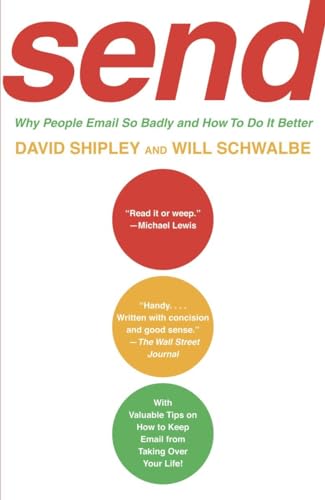
The essential guide or anyone navigating the often overwhelming world of email.
Send—the classic guide to email for office and home—has become indispensable for readers navigating the impersonal, and at times overwhelming, world of electronic communication. Filled with real-life email success (and horror) stories and a wealth of useful and entertaining examples, Send dissects all the major minefields and pitfalls of email. It provides clear rules for constructing effective emails, for handheld etiquette, for handling the “emotional email,” and for navigating all of today’s hot-button issues. It offers essential strategies to help you both better manage the ever-increasing number of emails you receive and improve the ones you send. Send is now more than ever the essential book about email for businesspeople and professionals everywhere.
Die Inhaltsangabe kann sich auf eine andere Ausgabe dieses Titels beziehen.
Über die Autorin bzw. den Autor
DAVID SHIPLEY is the deputy editorial page editor and Op-Ed page editor of The New York Times. Previously, he was a senior presidential speechwriter in the Clinton administration. He lives in New York.
WILL SCHWALBE is the founder and CEO of Cookstr.com. Prior to that, he was editor in chief of Hyperion Books and a journalist, writing for such publications as The New York Times, Insight for Asian Investors, and Business Traveller. He lives in New York.
Auszug. © Genehmigter Nachdruck. Alle Rechte vorbehalten.
CHAPTER 1
When Should We Email?
Would you carry a violin in a damp knapsack? Would you wrap your fiancée's birthday present in used cheesecloth? Would you mail your grandmother's stemware in a paper bag?
How you send something can have a profound impact on what you're sending. Your method of delivery sends a message of its own.
Here's the verbatim text of an electronic message sent to the phone of Katy Tanner, age twenty-one, who worked for a hip fashion store in Wales:
We've reviewed your sales figures and they are not really up to the level we need. As a result, we will not require your services anymore. Thank you for your time with us.
There's a trend here. Radio Shack did the same thing recently, telling about four hundred workers by email that they were being fired.
The workforce reduction notification is currently in progress. Unfortunately your position is one that has been eliminated.
Nice. We need to remind ourselves that just because we have email, we shouldn't use it for everything. Because of the speed and the seeming urgency of the new forms of communication available to us, many people simply grab the closest thing at hand. Or they get lured into eye-for- an-eye exchanges: if they get an email, they reply by email; if they get a letter, they feel compelled to respond by letter. We can do better than that. It's really a matter of taking the time to consider the strengths and weaknesses of each form of communication before committing to one.
That said, figuring out what medium is right for what message can be confusing. Today there are more ways to communicate than ever before. When should you email? And when is a text message more effective? How about a letter, or picking up the phone? (You remember those?) Or even a personal visit?
Or-and this seems to be one of the most effective and least used options-simply doing nothing at all.
Match Game
Take one item from each column. Which of these go together? Try to mix and match:
Email Boss Casual Request
Text Friend Urgent Solicitation
Mail Colleague Routine Thank-you
Phone Assistant Unexpected Critique
Fax Mentor Emotional Apology
It's not clear-cut, is it? Do you text a friend a routine thank-you? Or do you phone? Do you fax a colleague an unexpected critique? Or will email work for all of the above? To find your way to the best decision, you need to understand the communication technologies at your disposal. Let's start with the strengths and weaknesses of the one that many of us use the most and understand the least.
Email
Seven Big Reasons to Love Email
1. Email is the best medium ever created for exchanging essential information. What time is the movie? Where is the restaurant? Who's coming to the meeting?
Before email, any one of these questions would have involved at minimum a call, often to someone who wasn't there, necessitating a message (possibly garbled by a third party on one of those awful pink message slips). The return call might meet a similar fate.
And say your call wasn't one of the 70 percent that, according to Bill Gates, wind up in voice mail, and that you did manage to connect easily. Etiquette demands that you enter into a far longer exchange than the answer to your question strictly requires. At the very least, you are obligated to engage in several minutes of pleasant but not particularly productive conversation, whether or not you have time to spare.
Email has been blamed for the death of the letter. We think that's unfair. Email is responsible for the death of the useless phone call. (And, by the way, it was the telephone that killed the letter.)
When Will was editor in chief of a publishing house in the early 1990s, he used to receive fifty to sixty phone calls a day-and not one email. Twenty years later, at a different publishing house, he received only ten to fifteen calls daily. Much of what used to require a phone call can now be taken care of more efficiently with email.
But as the Cat in the Hat says, "That's not all!"
2. You can reach almost anyone on email-and not just businesspeople. Recently, Duncan Watts, a sociologist at Columbia University, updated for email the famous "six degrees of separation" study, which demonstrated that anyone can be connected to any other person through a chain of no more than six acquaintances. Watts asked the people participating in his study to see if they could get an email message to someone they didn't know: "a professor at an Ivy League university, an archival inspector in Estonia, a technology consultant in India, a policeman in Australia, and a veterinarian in the Norwegian Army." The catch was that you could forward a message only to someone you knew. The forwarded messages that hit their targets did so after an average of only four connections.
Another clear benefit: You can get your message to a list of a half- dozen or one thousand people as easily and inexpensively as you can get it to one person. And most email addresses can be easily found or sleuthed.
3. Email knows no time zones-it's an efficient and economical way to communicate with people around the world. You can also write an email any time of the day or night and have it sent the minute it's finished- or, if you are moderately clever, program it to be sent hours, or even days, later.
4. Email gives you a searchable record. Even if you do make an efficient phone call, there's no record of it. Are you going to trust the other person's "notes"?
5. Email allows you to craft your message-or your response-on your terms and on your own schedule. Unlike a conversation, email gives you time to think about what...
„Über diesen Titel“ kann sich auf eine andere Ausgabe dieses Titels beziehen.
Suchergebnisse für SEND: Why People Email So Badly and How to Do It Better

Beispielbild für diese ISBN
SEND: Why People Email So Badly and How to Do It Better
Anbieter: World of Books (was SecondSale), Montgomery, IL, USA
Verkäuferbewertung 5 von 5 Sternen

Paperback. Zustand: Very Good. The essential guide or anyone navigating the often overwhelming world of email. Send--the classic guide to email for office and home--has become indispensable for readers navigating the impersonal, and at times overwhelming, world of electronic communication. Filled with real-life email success (and horror) stories and a wealth of useful and entertaining examples, Send dissects all the major minefields and pitfalls of email. It provides clear rules for constructing effective emails, for handheld etiquette, for handling the "emotional email," and for navigating all of today's hot-button issues. It offers essential strategies to help you both better manage the ever-increasing number of emails you receive and improve the ones you send. Send is now more than ever the essential book about email for businesspeople and professionals everywhere. Artikel-Nr. 00100094572
Gebraucht kaufen
EUR 4,01
Versand gratis
Versand innerhalb von USA
Versand innerhalb von USA
Anzahl: 7 verfügbar
Beispielbild für diese ISBN
SEND: Why People Email So Badly and How to Do It Better
Anbieter: World of Books (was SecondSale), Montgomery, IL, USA
Verkäuferbewertung 5 von 5 Sternen
Paperback. Zustand: Good. The essential guide or anyone navigating the often overwhelming world of email. Send--the classic guide to email for office and home--has become indispensable for readers navigating the impersonal, and at times overwhelming, world of electronic communication. Filled with real-life email success (and horror) stories and a wealth of useful and entertaining examples, Send dissects all the major minefields and pitfalls of email. It provides clear rules for constructing effective emails, for handheld etiquette, for handling the "emotional email," and for navigating all of today's hot-button issues. It offers essential strategies to help you both better manage the ever-increasing number of emails you receive and improve the ones you send. Send is now more than ever the essential book about email for businesspeople and professionals everywhere. Artikel-Nr. 00102788188
Gebraucht kaufen
EUR 4,01
Versand gratis
Versand innerhalb von USA
Versand innerhalb von USA
Anzahl: 5 verfügbar
Beispielbild für diese ISBN
SEND: Why People Email So Badly and How to Do It Better
Verlag:
Vintage (edition Reprint), 2010
ISBN 10: 030727599X
ISBN 13: 9780307275998
Gebraucht
Paperback
Anbieter: BooksRun, Philadelphia, PA, USA
Verkäuferbewertung 5 von 5 Sternen
Paperback. Zustand: Very Good. Reprint. It's a well-cared-for item that has seen limited use. The item may show minor signs of wear. All the text is legible, with all pages included. It may have slight markings and/or highlighting. Artikel-Nr. 030727599X-11-1
Gebraucht kaufen
EUR 4,74
Versand gratis
Versand innerhalb von USA
Versand innerhalb von USA
Anzahl: 1 verfügbar
Beispielbild für diese ISBN
Send : Why People Email So Badly and How to Do It Better
Verlag:
Knopf Doubleday Publishing Group, 2010
ISBN 10: 030727599X
ISBN 13: 9780307275998
Gebraucht
Softcover
Anbieter: Better World Books, Mishawaka, IN, USA
Verkäuferbewertung 5 von 5 Sternen
Zustand: Good. Pages intact with minimal writing/highlighting. The binding may be loose and creased. Dust jackets/supplements are not included. Stock photo provided. Product includes identifying sticker. Better World Books: Buy Books. Do Good. Artikel-Nr. 5679921-6
Gebraucht kaufen
EUR 6,19
Versand gratis
Versand innerhalb von USA
Versand innerhalb von USA
Anzahl: 2 verfügbar
Beispielbild für diese ISBN
SEND: Why People Email So Badly and How to Do It Better
Anbieter: Wonder Book, Frederick, MD, USA
Verkäuferbewertung 5 von 5 Sternen
Zustand: Very Good. Very Good condition. A copy that may have a few cosmetic defects. May also contain light spine creasing or a few markings such as an owner's name, short gifter's inscription or light stamp. Artikel-Nr. I21B-04407
Gebraucht kaufen
EUR 6,43
Versand gratis
Versand innerhalb von USA
Versand innerhalb von USA
Anzahl: 1 verfügbar
Beispielbild für diese ISBN
Send: Why People Email So Badly and How to Do It Better
Anbieter: ThriftBooks-Phoenix, Phoenix, AZ, USA
Verkäuferbewertung 5 von 5 Sternen
Paperback. Zustand: Very Good. No Jacket. May have limited writing in cover pages. Pages are unmarked. ~ ThriftBooks: Read More, Spend Less. Artikel-Nr. G030727599XI4N00
Gebraucht kaufen
EUR 6,74
Versand gratis
Versand innerhalb von USA
Versand innerhalb von USA
Anzahl: 1 verfügbar
Beispielbild für diese ISBN
Send: Why People Email So Badly and How to Do It Better
Anbieter: ThriftBooks-Atlanta, AUSTELL, GA, USA
Verkäuferbewertung 5 von 5 Sternen
Paperback. Zustand: Very Good. No Jacket. May have limited writing in cover pages. Pages are unmarked. ~ ThriftBooks: Read More, Spend Less. Artikel-Nr. G030727599XI4N00
Gebraucht kaufen
EUR 6,74
Versand gratis
Versand innerhalb von USA
Versand innerhalb von USA
Anzahl: 1 verfügbar
Beispielbild für diese ISBN
Send: Why People Email So Badly and How to Do It Better
Anbieter: ThriftBooks-Dallas, Dallas, TX, USA
Verkäuferbewertung 5 von 5 Sternen
Paperback. Zustand: Very Good. No Jacket. May have limited writing in cover pages. Pages are unmarked. ~ ThriftBooks: Read More, Spend Less. Artikel-Nr. G030727599XI4N00
Gebraucht kaufen
EUR 6,74
Versand gratis
Versand innerhalb von USA
Versand innerhalb von USA
Anzahl: 1 verfügbar
Beispielbild für diese ISBN
Send: Why People Email So Badly and How to Do It Better
Anbieter: ThriftBooks-Reno, Reno, NV, USA
Verkäuferbewertung 5 von 5 Sternen
Paperback. Zustand: Very Good. No Jacket. May have limited writing in cover pages. Pages are unmarked. ~ ThriftBooks: Read More, Spend Less. Artikel-Nr. G030727599XI4N00
Gebraucht kaufen
EUR 6,74
Versand gratis
Versand innerhalb von USA
Versand innerhalb von USA
Anzahl: 1 verfügbar
Beispielbild für diese ISBN
Send: Why People Email So Badly and How to Do It Better
Anbieter: WorldofBooks, Goring-By-Sea, WS, Vereinigtes Königreich
Verkäuferbewertung 5 von 5 Sternen
Paperback. Zustand: Very Good. The book has been read, but is in excellent condition. Pages are intact and not marred by notes or highlighting. The spine remains undamaged. Artikel-Nr. GOR005340726
Gebraucht kaufen
EUR 7,89
EUR 6,63 Versand
Versand von Vereinigtes Königreich nach USA
Versand von Vereinigtes Königreich nach USA
Anzahl: 3 verfügbar