
Verwandte Artikel zu Dispatches: Introduction by Robert Stone (Everyman's...
Dispatches: Introduction by Robert Stone (Everyman's Library Contemporary Classics Series, Band 318) - Hardcover
Inhaltsangabe
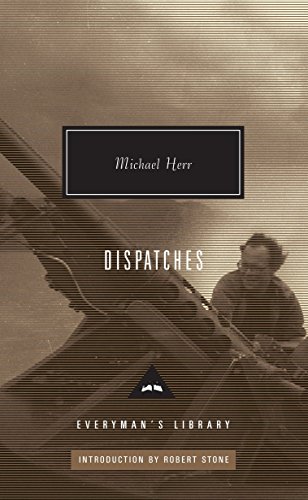
Written on the front lines in Vietnam, Dispatches became an immediate classic of war reportage when it was published in 1977.
From its terrifying opening pages to its final eloquent words, Dispatches makes us see, in unforgettable and unflinching detail, the chaos and fervor of the war and the surreal insanity of life in that singular combat zone. Michael Herr’s unsparing, unorthodox retellings of the day-to-day events in Vietnam take on the force of poetry, rendering clarity from one of the most incomprehensible and nightmarish events of our time.
Dispatches is among the most blistering and compassionate accounts of war in our literature.
Die Inhaltsangabe kann sich auf eine andere Ausgabe dieses Titels beziehen.
Über die Autorin bzw. den Autor
Michael Herr was a novelist and war correspondent. Born in Lexington, Kentucky in 1940, he began reporting from Vietnam for Esquire in the 1960s, during the height of the war. He later chronicled those experiences in his memoir, Dispatches. He is the author of three other books, The Big Room, Walter Winchell, and Kubrick, and coauthor of the screenplays for Apocalypse Now and Full Metal Jacket. He died in 2016.
Robert Stone, a National Book Award winner, lives in New York City.
Auszug. © Genehmigter Nachdruck. Alle Rechte vorbehalten.
INTRODUCTION
In 1971, during the rainy season, I was sitting in a room in an old-fashioned French hotel in Saigon, Republic of Vietnam. It was evening and darkness was settling with the suddenness of dimmed stage lighting over the noise and reek of the city. Beyond the groans of my ancient air-conditioner, there sounded the thunder that might always be, but rarely was, something else. The thunder persisted as the scattery silence of curfew came down.
That afternoon Judy Coburn, the Nation’s correspondent in Saigon, had given me a copy of the New American Review that contained a section of reportage by Michael Herr, who had come to Vietnam on assignment for Esquire. New American Review was a literary magazine in paperback-book form that favored the latest work of younger writers, and the passages of Herr’s work were entitled ‘‘Illumination Rounds.’’ The title itself seized the mind’s eye in a moment, moved a reader into a dark space inside himself where remembered parachute flares spread their whiter-than-white slow descending light and the red or green tracer rounds could suggest a celebration. The six syllables of Herr’s title evoked a nocturne at once explosive and uncannily calm, hypnotic in its prodigal light and color.
In the finished book, published in 1977 under the title Dispatches, Herr writes about some of the effects in question.
And at night it was beautiful. Even the incoming was beautiful at night, beautiful and deeply dreadful.
I remembered the way a Phantom pilot had talked about how beautiful the surface-to-air missiles looked as they drifted up toward his plane to kill him, and remembered myself how lovely .50-caliber tracers could be, coming at you as you flew at night in a helicopter, how slow and graceful, arching up easily, a dream, so remote from anything that could harm you. It could make you feel a total serenity, an elevation that put you above death, but that never lasted very long. One hit anywhere in the chopper would bring you back, bitten lips, white knuckles and all, and then you knew where you were.
Herr’s narrative in Dispatches is an unrelenting tale like the Ancient Mariner’s. He speaks with the Mariner’s stricken urgency and, like that figure, once he engages our attention he holds us fast so that we cannot choose but to hear. It is as though the writer moves like a magician over the unlucky country of Vietnam and in one blinding shell-burst after another reveals some new field of sorrow, disfigurement, or death. The scenes illuminated are often so gripping, and so precise in their rendering of humanity ensnared in the large and small hooks of war that they remain unforgettable.
‘‘There it is,’’ they used to say in Vietnam, a despairing catchphrase to signify the presence of some ineluctable force at the core of the situation. The force would appear suddenly out of whirl as if to explain everything, shimmer for an instant and be gone, a malign antic spirit. It never stayed in view long enough to disclose useful intelligence but people came to recognize it. ‘‘There it is,’’ they would say, just to let their friends know they had seen it and to be sure their friends had seen it too.
The setting of Dispatches takes in the entire theater of operations of what the Vietnamese call the American War. Its compass is set according to Herr’s self-directed wanderings over the length and breadth of the country. If ever a correspondent managed to be in the right places at the right times – the wrong places and the wrong times from the point of view of survival – it was Michael Herr in Vietnam. His reports come from just about all those famous killing fields whose Portuguese-Chinese diphthongs and unaspirated phonemes suffered on the palates of the American soldier-politicians of the time – the explainers, the spokespersons. From the streets of Saigon to the Delta, Tay Ninh and the Ho Bo Woods, Hue, A Shau, and the Rockpile to the DMZ.
Also the killer hills, left unnamed by our side, numbered by their altitude in meters: 881 North, 881 South. And Khe Sanh, where the unfortunate president Lyndon Johnson, a stranger to war, feared national defeat as his personal catastrophe, and where American defenders faced unprecedented numbers of the enemy supported by Russian-made tanks. Where Marines held out for two months unrelieved on the ground and where, five kilometers away, the North Vietnamese T-36 tanks broke through Langvei’s wire and actually took the base, officers’ club and all, and nearly effected a complete massacre of the U.S. Special Forces there along with their Montagnard troops.
About the time that Michael Herr began his journey through Vietnam, the mode of narrative that came to be called ‘‘New Journalism’’ had begun to appear in the American press. The unique claim of the New Journalism of that period was to present a pursuit of reality – we might very uneasily call it ‘‘truth’’ – in two authoritative dimensions. On the one hand it was journalism imbued with the authority of the press. It was the news, a recounting of facts theoretically subject to stern review by responsible authorities whose institutional reputations spoke for the accuracy of the matter contained. In an age perhaps more trusting of its institutions this seemed reassuring.
Yet the New Journalism made claims beyond the correct rendering of events. Along with its documentary accuracy it aspired to deliver the subjective observations, the tropes, witticisms, and insights, quite often unsympathetic, that even the most partisan standard feature story might leave to the reader’s inference. The result could be quite scandalous and attention getting, with some readers enraged by the insolence that the New Journalist might visit on his story’s embarrassed subjects, and others rejoicing not only in the public exposure of the enemies’ fatuities but in having the journalist’s observations echo their own judgments. So the New Journalism, liberty and license, dependent on the honor and perception of the reporter, was an unwieldy vehicle.
Dispatches, belonging to its time, was of the New Journalism. Herr’s journey to the heart of things began in the offices of Esquire, where he had been in discussions with the magazine’s Harold Hayes about writing some pieces. They agreed to a monthly column from the war’s various engagements and a chart outlining the Vietnamese War’s military power structure. Herr set out for Vietnam, arriving in Saigon in November 1967. Those familiar with the history of the war will recognize the imminent fatefulness of that date, for it was only two months later that the bloody Tet Offensive, the all-out push by the Vietnamese Communists to break the American presence in the country, erupted all over South Vietnam. That offensive nearly succeeded in capturing the American embassy in the capital and brought the noise of satchel charges and AK-47 fire to the bureau headquarters of American media. Some felt that Walter Cronkite’s comments on the effects of Tet, broadcast over his network news show, shattered the confidence of the American public, and obviated the informative usefulness of charts and regular columns, too.
Tet is what the Vietnamese call the Lunar New Year, a festive season of flowers and gift-giving during which thousands of Vietnamese are on the roads for visits home. It is also celebrated by the discharge of fireworks, fireworks that fill the sky, and echo off the mountains and...
„Über diesen Titel“ kann sich auf eine andere Ausgabe dieses Titels beziehen.
Suchergebnisse für Dispatches: Introduction by Robert Stone (Everyman's...

Beispielbild für diese ISBN
Dispatches: Introduction by Robert Stone
Anbieter: ThriftBooks-Atlanta, AUSTELL, GA, USA
Verkäuferbewertung 5 von 5 Sternen

Hardcover. Zustand: Good. No Jacket. Missing dust jacket; Pages can have notes/highlighting. Spine may show signs of wear. ~ ThriftBooks: Read More, Spend Less. Artikel-Nr. G0307270807I3N01
Gebraucht kaufen
EUR 14,97
Versand gratis
Versand innerhalb von USA
Versand innerhalb von USA
Anzahl: 1 verfügbar
Beispielbild für diese ISBN
Dispatches: Introduction by Robert Stone
Anbieter: World of Books (was SecondSale), Montgomery, IL, USA
Verkäuferbewertung 5 von 5 Sternen
Hardback. Zustand: Good. Written on the front lines in Vietnam, Dispatches became an immediate classic of war reportage when it was published in 1977. From its terrifying opening pages to its final eloquent words, Dispatches makes us see, in unforgettable and unflinching detail, the chaos and fervor of the war and the surreal insanity of life in that singular combat zone. Michael Herr's unsparing, unorthodox retellings of the day-to-day events in Vietnam take on the force of poetry, rendering clarity from one of the most incomprehensible and nightmarish events of our time. Dispatches is among the most blistering and compassionate accounts of war in our literature. Artikel-Nr. 00102616513
Gebraucht kaufen
EUR 14,99
Versand gratis
Versand innerhalb von USA
Versand innerhalb von USA
Anzahl: 2 verfügbar
Beispielbild für diese ISBN
Dispatches: Introduction by Robert Stone
Anbieter: World of Books (was SecondSale), Montgomery, IL, USA
Verkäuferbewertung 5 von 5 Sternen
Hardback. Zustand: Fair. Written on the front lines in Vietnam, Dispatches became an immediate classic of war reportage when it was published in 1977. From its terrifying opening pages to its final eloquent words, Dispatches makes us see, in unforgettable and unflinching detail, the chaos and fervor of the war and the surreal insanity of life in that singular combat zone. Michael Herr's unsparing, unorthodox retellings of the day-to-day events in Vietnam take on the force of poetry, rendering clarity from one of the most incomprehensible and nightmarish events of our time. Dispatches is among the most blistering and compassionate accounts of war in our literature. Artikel-Nr. CIN0307270807A
Gebraucht kaufen
EUR 14,99
Versand gratis
Versand innerhalb von USA
Versand innerhalb von USA
Anzahl: 1 verfügbar
Beispielbild für diese ISBN
Dispatches: Introduction by Robert Stone (Everyman's Library Contemporary Classics Series)
Verlag:
Everyman's Library (edition ), 2009
ISBN 10: 0307270807
ISBN 13: 9780307270801
Gebraucht
Hardcover
Anbieter: BooksRun, Philadelphia, PA, USA
Verkäuferbewertung 5 von 5 Sternen
Hardcover. Zustand: Very Good. With dust jacket. It's a well-cared-for item that has seen limited use. The item may show minor signs of wear. All the text is legible, with all pages included. It may have slight markings and/or highlighting. Artikel-Nr. 0307270807-11-1-29
Gebraucht kaufen
EUR 16,41
Versand gratis
Versand innerhalb von USA
Versand innerhalb von USA
Anzahl: 1 verfügbar
Beispielbild für diese ISBN
Dispatches (Everyman's Library Contemporary Classics Series)
Anbieter: Wonder Book, Frederick, MD, USA
Verkäuferbewertung 5 von 5 Sternen
Zustand: As New. Like New condition. Like New dust jacket. A near perfect copy that may have very minor cosmetic defects. Artikel-Nr. K01M-01620
Gebraucht kaufen
EUR 22,19
Versand gratis
Versand innerhalb von USA
Versand innerhalb von USA
Anzahl: 1 verfügbar
Beispielbild für diese ISBN
Dispatches: Introduction by Robert Stone (Everyman's Library Contemporary Classics)
Anbieter: WorldofBooks, Goring-By-Sea, WS, Vereinigtes Königreich
Verkäuferbewertung 5 von 5 Sternen
Paperback. Zustand: Very Good. The book has been read, but is in excellent condition. Pages are intact and not marred by notes or highlighting. The spine remains undamaged. Artikel-Nr. GOR012270095
Gebraucht kaufen
EUR 24,30
EUR 6,61 Versand
Versand von Vereinigtes Königreich nach USA
Versand von Vereinigtes Königreich nach USA
Anzahl: 1 verfügbar
Beispielbild für diese ISBN
Dispatches
Anbieter: Revaluation Books, Exeter, Vereinigtes Königreich
Verkäuferbewertung 5 von 5 Sternen
Hardcover. Zustand: Brand New. 280 pages. 8.25x5.00x1.00 inches. In Stock. Artikel-Nr. __0307270807
Neu kaufen
EUR 29,42
EUR 11,80 Versand
Versand von Vereinigtes Königreich nach USA
Versand von Vereinigtes Königreich nach USA
Anzahl: 1 verfügbar
Beispielbild für diese ISBN
Dispatches: Introduction by Robert Stone (Everyman's Library Contemporary Classics)
Anbieter: Kennys Bookstore, Olney, MD, USA
Verkäuferbewertung 5 von 5 Sternen
Zustand: New. 2009. hardcover. . . . . . Books ship from the US and Ireland. Artikel-Nr. V9780307270801
Neu kaufen
EUR 34,43
EUR 9,36 Versand
Versand innerhalb von USA
Versand innerhalb von USA
Anzahl: 1 verfügbar
Beispielbild für diese ISBN
Dispatches
Anbieter: Revaluation Books, Exeter, Vereinigtes Königreich
Verkäuferbewertung 5 von 5 Sternen
Hardcover. Zustand: Brand New. 280 pages. 8.25x5.00x1.00 inches. In Stock. Artikel-Nr. xr0307270807
Neu kaufen
EUR 33,07
EUR 11,80 Versand
Versand von Vereinigtes Königreich nach USA
Versand von Vereinigtes Königreich nach USA
Anzahl: 2 verfügbar
Beispielbild für diese ISBN
Dispatches
Anbieter: Revaluation Books, Exeter, Vereinigtes Königreich
Verkäuferbewertung 5 von 5 Sternen
Hardcover. Zustand: Brand New. 280 pages. 8.25x5.00x1.00 inches. In Stock. Artikel-Nr. 0307270807
Neu kaufen
EUR 40,55
EUR 11,80 Versand
Versand von Vereinigtes Königreich nach USA
Versand von Vereinigtes Königreich nach USA
Anzahl: 1 verfügbar