
Verwandte Artikel zu Fire in the Blood
Inhaltsangabe
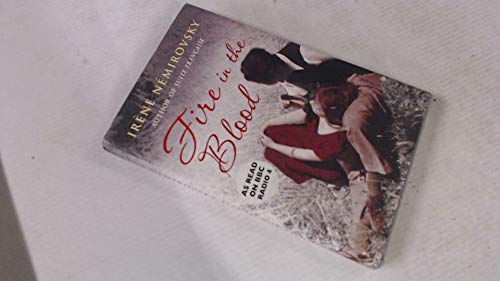
A recently discovered but never-before-published novel by an author who died in Auschwitz in 1942 captures life in a small French village in the years before the onset of World War II, as Silvio, a middle-aged man enjoying his wine and his solitude, is drawn back into the life of his family and the village by the arrival of a cousin and the revelation of long-hidden secrets. 75,000 first printing.
Die Inhaltsangabe kann sich auf eine andere Ausgabe dieses Titels beziehen.
Über die Autorin bzw. den Autor
Irène Némirovsky was born in Kiev in 1903 into a wealthy banking family and emigrated to France during the Russian Revolution. After attending the Sorbonne, she began to write and swiftly achieved success with an early novel, David Golder, which was followed by The Ball, Snow in Autumn, Dogs and Wolves, and The Courilof Affair, among others. She died in Auschwitz in 1942.
Auszug. © Genehmigter Nachdruck. Alle Rechte vorbehalten.
Chapter One
We were drinking a light punch, the kind we had when I was young, and all sitting around the fire, my Erard cousins, their children and I. It was an autumn evening, the whole sky red above the sodden fields of turned earth. The fiery sunset promised a strong wind the next day; the crows were cawing. This large, icy house is full of draughts. They blew in from everywhere with the sharp, rich tang of autumn. My cousin Hélène and her daughter, Colette, were shivering beneath the shawls I’d lent them, cashmere shawls that had belonged to my mother. They asked how I could live in such a rat hole, just as they did every time they came to see me, and Colette, who is shortly to be married, spoke proudly of the charms of the Moulin-Neuf where she would soon be living, and “where I hope to see you often, Cousin Silvio,” she said. She looked at me with pity. I am old, poor and unmarried, holed up in a farmer’s hovel in the middle of the woods. Everyone knows I’ve travelled, that I’ve worked my way through my inheritance. A prodigal son. By the time I got back to the place where I was born, even the fatted calf had waited for me for so long it had died of old age. Comparing their lot with mine, the Erards no doubt forgave me for borrowing money I had never returned and repeated, after their daughter, “You live like an animal here, you poor dear. You should go and spend the summer with Colette once she’s settled in.”
I still have happy moments, though they don’t realise it. Today, I’m alone; the first snow has fallen. This region, in the middle of France, is both wild and rich. Everyone lives in his own house, on his own land, distrusts his neighbours, harvests his wheat, counts his money and doesn’t give a thought to the rest of the world. No châteaux, no visitors. A bourgeoisie reigns here that has only recently emerged from the working classes and is still very close to them, part of a rich bloodline that loves everything that has its roots in the land. My family is spread over the entire province—an extensive network of Erards, Chapelains, Benoîts, Montrifauts; they are important farmers, lawyers, government officials, landowners. Their houses are imposing and isolated, built far from the villages and protected by great forbidding doors with triple locks, like the doors you find in prisons. Their flat gardens contain almost no flowers, nothing but vegetables and fruit trees trained to produce the best yield. Their sitting rooms are stuffed full of furniture and always shut up; they live in the kitchen to save money on firewood. I’m not talking about François and Hélène Erard, of course; I have never been in a home more pleasant, welcoming, intimate, warm and happy than theirs. But, in spite of everything, my idea of the perfect evening is this: I am completely alone; my housekeeper has just put the hens in their coop and gone home, and I am left with my pipe, my dog nestled between my legs, the sound of the mice in the attic, a crackling fire, no newspapers, no books, a bottle of red wine warming slowly on the hearth.
“Why do people call you Silvio?” asked Colette.
“A beautiful woman who was once in love with me thought I looked like a gondolier,” I replied. “That was over twenty years ago and, at the time, I had black hair and a handlebar moustache. She changed my name from Sylvestre to Silvio.”
“But you look like a faun,” said Colette, “with your wide forehead, turned-up nose, pointed ears and laughing eyes. Sylvestre, creature of the woods. That suits you very well.”
Of all of Hélène’s children, Colette is my favourite. She isn’t beautiful, but she has the quality that, when I was young, I used to value most in women: she has fire. Her eyes laugh like mine and her large mouth too; her hair is black and fine, peeping out in delicate curls from behind the shawl, which she has pulled over her head to keep the draught from her neck. People say she looks like the young Hélène. But I can’t remember. Since the birth of a third son, little Loulou, who’s nine years old now, Hélène has put on weight and the woman of forty-eight, whose soft skin has lost its bloom, obscures my memory of the Hélène I knew when she was twenty. She looks calm and happy now.
This gathering at my house was arranged to introduce Colette’s fiancé to me. His name is Jean Dorin, one of the Dorins from the Moulin-Neuf, who’ve been millers for generations. A beautiful river, frothy and green, runs past their mill. I used to go trout fishing there when Dorin’s father was still alive.
“You’ll make us some good fish dishes, Colette,” I said.
François refused a glass of punch: he drinks only water. He has a pointy little grey beard that he slowly strokes.
“You won’t miss the pleasures of this world when you’ve left it,” I remarked to him, “or rather once it has left you, as it has me . . .”
For I sometimes feel I’ve been rejected by life, as if washed ashore by the tide. I’ve ended up on a lonely beach, an old boat, still solid and seaworthy, but whose paint has faded in the water, eaten away by salt.
“No, since you don’t like wine, hunting or women, you’ll have nothing to miss.”
“I’d miss my wife,” he replied, smiling.
That was when Colette went and sat next to her mother.
“Mama, tell me the story of how you got engaged to Papa,” she said. “You’ve never said anything about it. Why’s that? I know it’s a very romantic story, that you loved each other for a long time . . . Why haven’t you ever told me about it?”
“You’ve never asked.”
“Well, I’m asking now.”
Hélène laughed. “It’s none of your business,” she protested.
“You don’t want to say because you’re embarrassed. But it can’t be because of Uncle Silvio: he must know all about it. Is it because of Jean? But he’ll soon be your son, Mama, and he should know you as well as I do. I so want Jean and me to live together the way you live with Papa. I’m positive you’ve never had a fight.”
“It’s not Jean I’m embarrassed about, but these great oafs,” said Hélène, nodding towards her sons with a smile. They were sitting on the floor, throwing pine cones into the fire; they had pockets full of them; the cones burst open in the flames with a loud, crackling sound.
Georges was fifteen and Henri thirteen. “If it’s because of us,” they replied, “go ahead, don’t be embarrassed.”
“We’re not interested in your love stories,” Georges said scornfully. He was at that age when a boy’s voice starts to change.
As for little Loulou, he’d fallen asleep.
But Hélène shook her head and was reluctant to speak.
“You have the perfect marriage,” Colette’s fiancé said shyly. “I hope that we too . . . one day . . .”
He was mumbling. He seemed a good lad, his face thin and soft, with the beautiful anxious eyes of a hare. Strange that Hélène and Colette, mother and daughter, should have sought out the same type of man to marry. Someone sensitive, considerate, easily dominated; almost feminine, but at the same time guarded and shy, with a kind of fierce modesty. Good Lord, I was nothing like that! Standing slightly apart, I looked at the seven of them. We’d eaten in the sitting room, which is the...
„Über diesen Titel“ kann sich auf eine andere Ausgabe dieses Titels beziehen.
Suchergebnisse für Fire in the Blood

Beispielbild für diese ISBN
Fire in the Blood
Anbieter: World of Books (was SecondSale), Montgomery, IL, USA
Verkäuferbewertung 5 von 5 Sternen

Zustand: Good. Item in good condition. Textbooks may not include supplemental items i.e. CDs, access codes etc. Artikel-Nr. 00050937303
Gebraucht kaufen
EUR 3,65
Versand gratis
Versand innerhalb von USA
Versand innerhalb von USA
Anzahl: 7 verfügbar
Beispielbild für diese ISBN
Fire in the Blood
Anbieter: World of Books (was SecondSale), Montgomery, IL, USA
Verkäuferbewertung 5 von 5 Sternen
Zustand: Acceptable. Item in acceptable condition! Textbooks may not include supplemental items i.e. CDs, access codes etc. Artikel-Nr. 00106476205
Gebraucht kaufen
EUR 3,65
Versand gratis
Versand innerhalb von USA
Versand innerhalb von USA
Anzahl: 1 verfügbar
Beispielbild für diese ISBN
Fire in the Blood
Anbieter: World of Books (was SecondSale), Montgomery, IL, USA
Verkäuferbewertung 5 von 5 Sternen
Zustand: Very Good. Item in very good condition! Textbooks may not include supplemental items i.e. CDs, access codes etc. Artikel-Nr. 00110326432
Gebraucht kaufen
EUR 3,65
Versand gratis
Versand innerhalb von USA
Versand innerhalb von USA
Anzahl: 1 verfügbar
Beispielbild für diese ISBN
Fire in the Blood
Verlag:
Knopf (edition First Edition), 2007
ISBN 10: 0307267482
ISBN 13: 9780307267481
Gebraucht
Hardcover
Erstausgabe
Anbieter: BooksRun, Philadelphia, PA, USA
Verkäuferbewertung 5 von 5 Sternen
Hardcover. Zustand: Fair. First Edition. With dust jacket. The item might be beaten up but readable. May contain markings or highlighting, as well as stains, bent corners, or any other major defect, but the text is not obscured in any way. Artikel-Nr. 0307267482-7-1-29
Gebraucht kaufen
EUR 5,03
Versand gratis
Versand innerhalb von USA
Versand innerhalb von USA
Anzahl: 1 verfügbar
Beispielbild für diese ISBN
Fire in the Blood
Anbieter: ThriftBooks-Atlanta, AUSTELL, GA, USA
Verkäuferbewertung 5 von 5 Sternen
Hardcover. Zustand: As New. No Jacket. Pages are clean and are not marred by notes or folds of any kind. ~ ThriftBooks: Read More, Spend Less. Artikel-Nr. G0307267482I2N00
Gebraucht kaufen
EUR 6,31
Versand gratis
Versand innerhalb von USA
Versand innerhalb von USA
Anzahl: 1 verfügbar
Beispielbild für diese ISBN
Fire in the Blood
Anbieter: ThriftBooks-Phoenix, Phoenix, AZ, USA
Verkäuferbewertung 5 von 5 Sternen
Hardcover. Zustand: As New. No Jacket. Pages are clean and are not marred by notes or folds of any kind. ~ ThriftBooks: Read More, Spend Less. Artikel-Nr. G0307267482I2N00
Gebraucht kaufen
EUR 6,31
Versand gratis
Versand innerhalb von USA
Versand innerhalb von USA
Anzahl: 1 verfügbar
Beispielbild für diese ISBN
Fire in the Blood
Anbieter: ThriftBooks-Reno, Reno, NV, USA
Verkäuferbewertung 5 von 5 Sternen
Hardcover. Zustand: As New. No Jacket. Pages are clean and are not marred by notes or folds of any kind. ~ ThriftBooks: Read More, Spend Less. Artikel-Nr. G0307267482I2N00
Gebraucht kaufen
EUR 6,31
Versand gratis
Versand innerhalb von USA
Versand innerhalb von USA
Anzahl: 1 verfügbar
Beispielbild für diese ISBN
Fire in the Blood
Anbieter: ThriftBooks-Dallas, Dallas, TX, USA
Verkäuferbewertung 5 von 5 Sternen
Hardcover. Zustand: As New. No Jacket. Pages are clean and are not marred by notes or folds of any kind. ~ ThriftBooks: Read More, Spend Less. Artikel-Nr. G0307267482I2N00
Gebraucht kaufen
EUR 6,31
Versand gratis
Versand innerhalb von USA
Versand innerhalb von USA
Anzahl: 1 verfügbar
Beispielbild für diese ISBN
Fire in the Blood
Anbieter: Wonder Book, Frederick, MD, USA
Verkäuferbewertung 5 von 5 Sternen
Zustand: As New. Like New condition. Like New dust jacket. A near perfect copy that may have very minor cosmetic defects. Artikel-Nr. V21E-02104
Gebraucht kaufen
EUR 6,32
Versand gratis
Versand innerhalb von USA
Versand innerhalb von USA
Anzahl: 4 verfügbar
Beispielbild für diese ISBN
Fire in the Blood
Verlag:
Knopf Doubleday Publishing Group, 2007
ISBN 10: 0307267482
ISBN 13: 9780307267481
Gebraucht
Hardcover
Erstausgabe
Anbieter: Better World Books, Mishawaka, IN, USA
Verkäuferbewertung 5 von 5 Sternen
Zustand: Very Good. First Edition. Pages intact with possible writing/highlighting. Binding strong with minor wear. Dust jackets/supplements may not be included. Stock photo provided. Product includes identifying sticker. Better World Books: Buy Books. Do Good. Artikel-Nr. 12359878-6
Gebraucht kaufen
EUR 6,46
Versand gratis
Versand innerhalb von USA
Versand innerhalb von USA
Anzahl: 1 verfügbar