
Verwandte Artikel zu Composing a Further Life: The Age of Active Wisdom
Inhaltsangabe
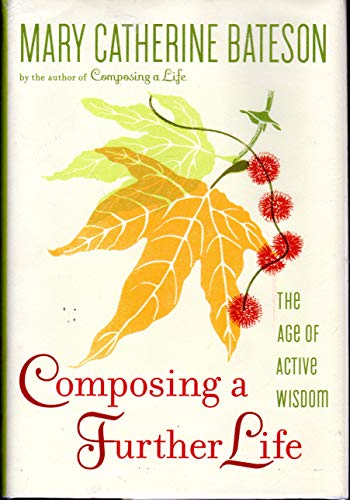
From the author of Composing a Life (first published in 1991 and still in print), an inspiring exploration of a new stage of the life cycle, “Adulthood II,” created by unprecedented levels of health, energy, time, and resources—of which we have barely begun to be fully conscious.
Mary Catherine Bateson sees aging today as an “improvisational art form calling for imagination and willingness to learn,” and in this ardent, affirming study, she relates the experiences of men and women—herself included—who, upon entering this second adulthood, have found new meaning and new ways to contribute, composing their lives in new patterns.
Among the people Bateson engages in open-ended, in-depth conversations are a retired Maine boatyard worker who has become a silversmith and maker of fine jewelry; an African American woman who explores the importance of grandmothering; two gay men finding contentment in mutual caring; the retired dean of a cathedral in New York City who exemplifies how a multiplicity of interests and connections lead to deeper unity; and Jane Fonda, who shares her ways of dealing with change and spiritual growth.
Here is a book that presents each of us—at any age—with an exhilarating challenge to think about and approach our later lives with the full force of imagination, curiosity, and enthusiasm. At the same time, it speaks to us as members of a larger society concerned about the world that our children and grandchildren, born and not yet born, will inherit. “We live longer,” she says, “but we think shorter.” As adults find themselves entering Adulthood II, making the choices that will affirm and complete the meaning of the lives they have lived, they can play a key role, contributing their perspectives and their experience of adapting to change. In our day, wisdom is no longer associated with withdrawal and passivity but with engagement with others and the contribution that Bateson calls “active wisdom.”
Die Inhaltsangabe kann sich auf eine andere Ausgabe dieses Titels beziehen.
Über die Autorinnen und Autoren
Mary Catherine Bateson was Clarence J. Robinson Professor in Anthropology and English at George Mason University from 1987 to 2002, when she became Professor Emerita. She is a Visiting Scholar at the Center on Aging and Work/Workplace Flexibility at Boston College and, until recently, was president of the Institute of Intercultural Studies in New York City. She is the author of Composing a Life; With a Daughter’s Eye: A Memoir of Margaret Mead and Gregory Bateson; Peripheral Visions: Learning Along the Way; Full Circles, Overlapping Lives: Culture and Generation in Transition; and Willing to Learn: Passages of Personal Discovery. She resides in Hancock, New Hampshire.
Mary Catherine Bateson was Clarence J. Robinson Professor in Anthropology and English at George Mason University from 1987 to 2002, when she became Professor Emerita. She is a Visiting Scholar at the Center on Aging and Work/Workplace Flexibility at Boston College and, until recently, was president of the Institute of Intercultural Studies in New York City. She is the author of Composing a Life; With a Daughter's Eye: A Memoir of Margaret Mead and Gregory Bateson; Peripheral Visions: Learning Along the Way; Full Circles, Overlapping Lives: Culture and Generation in Transition; and Willing to Learn: Passages of Personal Discovery. She resides in Hancock, New Hampshire.
Auszug. © Genehmigter Nachdruck. Alle Rechte vorbehalten.
Chapter I
Thinking About Longevity
Imagine a house that has been your home for a number of years, to which you unexpectedly have the resources to add a room. What will that room be? Will it serve a need that you were not aware of when you first moved in? You might, for instance, have decided that you now need a study or an exercise room. Or will it allow you to elaborate on something that has always been part of your life? Perhaps you have always cared about books and have bookshelves spread throughout your home, but now you want to gather those books together in a room you will call the library. You may not have had a room where a guest could stay but now want to offer hospitality to a married son or daughter with a new generation of children (will one room be enough?). You may want to take an avocation, like wood carving or work you have done for a cause you cared about, and develop it, so the new room will be a studio or an office. You may have become passionate about gourmet cooking and want a different kind of kitchen. Or you may simply want to use this opportunity to extend your traditional “living room” in some new and more inclusive way, with more space or wider windows or a hearth.
The first thing you will discover when you “add” a room to a house is that add is generally the wrong word, because the way you use all the rest of the house, the way you live and organize your time and even your relationships, will be affected by the change. Existing rooms will be used differently, sounds will echo in new ways, community and privacy will have new meanings. Gaps will open where familiar items have been shifted to the new space and new acquisitions will fill them. The new room is not simply tacked on to the east or west side of the house, it represents a new configuration of the entire building and the lives it shelters.
This is what longevity is like. In the United States, we have not “added” years to life (thirty in the twentieth century, twenty since World War II), tacked on at the end. We have changed the shape and meaning of a lifetime in ways we do not yet fully understand. Similarly, with increasing numbers of older citizens, we are changing as a population, becoming a rather different society, just as the Louisiana and Alaska purchases brought more than geographical space to the nation. Arguably, something even more profound has happened: we are evolving into a rather different species, inhabiting a new niche and challenged to adapt in new ways. Similar processes are occurring in other industrialized countries, but culture, legislation, and economy make them play out differently, so the examples in this book, drawn from the United States, need to be interpreted in the light of American conditions, particularly the continuing openness to immigration, the lack of mandatory retirement laws, and attitudes toward employment.
Here is the situation in which we find ourselves. Most Americans are aware that the retirement of the Baby Boom generation is creating a variety of new demands, so that “retirement” has changed its meaning. In fact, our assumptions about retirement already mask deep changes. Government retirement pensions were invented in Germany at the beginning of the twentieth century, at a time when sixty-five-year-olds were few and far between (life expectancy at birth was about forty-five), were mostly very limited in their ability to work, and would not be around for long. In other words, retirement was invented for people whose conditions were in some ways worse than those of eighty-five-year-olds in the United States today. Today’s sixty-five-year-olds are starting new careers or continuing old ones, traveling around the world, and eloping with new loves.
What is less widely understood is that this is happening at a time when both individual life cycles and populations have taken on radically new structures. We have not added decades to life expectancy by simply extending old age; instead, we have opened up a new space partway through the life course, a second and different kind of adulthood that precedes old age, and as a result every stage of life is undergoing change.
Different societies look at age-groups differently. In some places status is governed by small differences of age, in others all children or all old people may be grouped together. However, virtually every society does make distinctions between children and adults and does recognize changes in the participation of older adults, creating at least three major stages of life, which may be subdivided further, stages that ? cor?respond for many individuals to generations: childhood (not yet adults), parenthood (adults), and grandparenthood (elders). With the survival of many grandparents to become great-grandparents and the improved health conditions of older adults, we have in effect created the first four-generation society in history.
Here I am not using the term generation to refer to twenty-year cohorts with catchy nicknames, although cohorts do indeed share characteristics determined by the changing contexts in which they have grown up and lived. I am referring to the presence of three coexisting generations defined by their roles and activities, with individuals moving from one to the next as “the younger generation” becomes “the older generation” around the campfire or the table; children become parents, and parents become grandparents, often by about the age of forty, which was regarded as a fairly ripe old age through most of human history. Today’s grandparents, including a considerable proportion of Baby Boomers, are different from grandparents in the past and much healthier and more numerous.
This is new. Every society has some members who are not yet full participants—infants, children, and those approaching adulthood, whom we now call adolescents. And every society has adults who are simultaneously full participants in maintaining the society and in its perpetuation as they produce and rear children. And every society has at least a few older members who are past their reproductive and child-rearing years, often in declining health. This older generation typically withdraws from some kinds of participation, but the pattern always includes some continuing contribution, often of a sort that is not open to younger adults.
We know from cross-cultural studies that postreproductive adults—elders—have played a key role in human societies through time. Many of these elders have been grandparents and a few have been great-grandparents (a very scarce resource through most of history), but in terms of the ancient three-generation structure, they have played similar roles. This has been the human pattern: three generations or stages of life, diverse and changing through time, defined in relation to the others and to their forms of participation and only secondarily as age-groups.
Now, however, older adults, many of whom are grandparents but who have an unprecedented level of health and energy, time and resources, fit into society in new ways, often much like younger adults. And for the first time in history there are large numbers of great- grandparents, who look and act somewhat, but not precisely, the way grandparents used to. Biomedicine has once again created a profound change in the human condition. We have inserted a new developmental stage into the life cycle, a second stage of adulthood, not an extension tacked on to old age.
A decade ago some of us began calling this stage a second adulthood, but that phrase too easily evokes the second rate or secondhand—or even a second childhood of incompetence. I think we will need to think in terms of a first adult stage we can call Adulthood I, a very busy and productive time, which includes both our primary...
„Über diesen Titel“ kann sich auf eine andere Ausgabe dieses Titels beziehen.
Suchergebnisse für Composing a Further Life: The Age of Active Wisdom

Beispielbild für diese ISBN
Composing a Further Life: The Age of Active Wisdom
Anbieter: World of Books (was SecondSale), Montgomery, IL, USA
Verkäuferbewertung 5 von 5 Sternen

Zustand: Acceptable. Item in acceptable condition! Textbooks may not include supplemental items i.e. CDs, access codes etc. Artikel-Nr. 00102592251
Gebraucht kaufen
EUR 4,01
Versand gratis
Versand innerhalb von USA
Versand innerhalb von USA
Anzahl: 1 verfügbar
Beispielbild für diese ISBN
Composing a Further Life: The Age of Active Wisdom
Anbieter: World of Books (was SecondSale), Montgomery, IL, USA
Verkäuferbewertung 5 von 5 Sternen
Zustand: Very Good. Item in very good condition! Textbooks may not include supplemental items i.e. CDs, access codes etc. Artikel-Nr. 00108420060
Gebraucht kaufen
EUR 4,01
Versand gratis
Versand innerhalb von USA
Versand innerhalb von USA
Anzahl: 1 verfügbar
Beispielbild für diese ISBN
Composing a Further Life: The Age of Active Wisdom
Anbieter: World of Books (was SecondSale), Montgomery, IL, USA
Verkäuferbewertung 5 von 5 Sternen
Zustand: Good. Item in good condition. Textbooks may not include supplemental items i.e. CDs, access codes etc. Artikel-Nr. 00096727911
Gebraucht kaufen
EUR 4,01
Versand gratis
Versand innerhalb von USA
Versand innerhalb von USA
Anzahl: 2 verfügbar
Beispielbild für diese ISBN
Composing a Further Life: The Age of Active Wisdom
Anbieter: BooksRun, Philadelphia, PA, USA
Verkäuferbewertung 5 von 5 Sternen
Hardcover. Zustand: Fair. 1. With dust jacket. The item might be beaten up but readable. May contain markings or highlighting, as well as stains, bent corners, or any other major defect, but the text is not obscured in any way. Artikel-Nr. 0307266435-7-1-29
Gebraucht kaufen
EUR 4,59
Versand gratis
Versand innerhalb von USA
Versand innerhalb von USA
Anzahl: 1 verfügbar
Beispielbild für diese ISBN
Composing a Further Life: The Age of Active Wisdom
Anbieter: BooksRun, Philadelphia, PA, USA
Verkäuferbewertung 5 von 5 Sternen
Hardcover. Zustand: Very Good. 1. With dust jacket. It's a well-cared-for item that has seen limited use. The item may show minor signs of wear. All the text is legible, with all pages included. It may have slight markings and/or highlighting. Artikel-Nr. 0307266435-11-1-29
Gebraucht kaufen
EUR 4,82
Versand gratis
Versand innerhalb von USA
Versand innerhalb von USA
Anzahl: 1 verfügbar
Beispielbild für diese ISBN
Composing a Further Life: The Age of Active Wisdom
Anbieter: ThriftBooks-Atlanta, AUSTELL, GA, USA
Verkäuferbewertung 5 von 5 Sternen
Hardcover. Zustand: As New. No Jacket. Pages are clean and are not marred by notes or folds of any kind. ~ ThriftBooks: Read More, Spend Less. Artikel-Nr. G0307266435I2N00
Gebraucht kaufen
EUR 6,36
Versand gratis
Versand innerhalb von USA
Versand innerhalb von USA
Anzahl: 1 verfügbar
Beispielbild für diese ISBN
Composing a Further Life: The Age of Active Wisdom
Anbieter: ThriftBooks-Dallas, Dallas, TX, USA
Verkäuferbewertung 5 von 5 Sternen
Hardcover. Zustand: Very Good. No Jacket. Former library book; May have limited writing in cover pages. Pages are unmarked. ~ ThriftBooks: Read More, Spend Less. Artikel-Nr. G0307266435I4N10
Gebraucht kaufen
EUR 6,36
Versand gratis
Versand innerhalb von USA
Versand innerhalb von USA
Anzahl: 1 verfügbar
Beispielbild für diese ISBN
Composing a Further Life : The Age of Active Wisdom
Verlag:
Knopf Doubleday Publishing Group, 2010
ISBN 10: 0307266435
ISBN 13: 9780307266439
Gebraucht
Hardcover
Anbieter: Better World Books, Mishawaka, IN, USA
Verkäuferbewertung 5 von 5 Sternen
Zustand: Good. Former library copy. Pages intact with minimal writing/highlighting. The binding may be loose and creased. Dust jackets/supplements are not included. Includes library markings. Stock photo provided. Product includes identifying sticker. Better World Books: Buy Books. Do Good. Artikel-Nr. 2256691-6
Gebraucht kaufen
EUR 6,94
Versand gratis
Versand innerhalb von USA
Versand innerhalb von USA
Anzahl: 3 verfügbar
Beispielbild für diese ISBN
Composing a Further Life: The Age of Active Wisdom
Verlag:
Alfred A. Knopf, New York, 2010
ISBN 10: 0307266435
ISBN 13: 9780307266439
Gebraucht
Hardcover
Erstausgabe
Signiert
Anbieter: Abacus Bookshop, Pittsford, NY, USA
Verkäuferbewertung 5 von 5 Sternen
hardcover. Zustand: Fine copy in fine dust jacket. 1st. 8vo, 258 pp., Inscribed & signed by the author on the half-title page. Artikel-Nr. 113749
Gebraucht kaufen
EUR 18,19
EUR 3,53 Versand
Versand innerhalb von USA
Versand innerhalb von USA
Anzahl: 1 verfügbar
Beispielbild für diese ISBN
Composing a Further Life: The Age of Active Wisdom
Anbieter: WorldofBooks, Goring-By-Sea, WS, Vereinigtes Königreich
Verkäuferbewertung 5 von 5 Sternen
Paperback. Zustand: Very Good. The book has been read, but is in excellent condition. Pages are intact and not marred by notes or highlighting. The spine remains undamaged. Artikel-Nr. GOR009103931
Gebraucht kaufen
EUR 18,36
EUR 6,56 Versand
Versand von Vereinigtes Königreich nach USA
Versand von Vereinigtes Königreich nach USA
Anzahl: 4 verfügbar