
Verwandte Artikel zu Traffic: Why We Drive the Way We Do and What It Says...
Inhaltsangabe
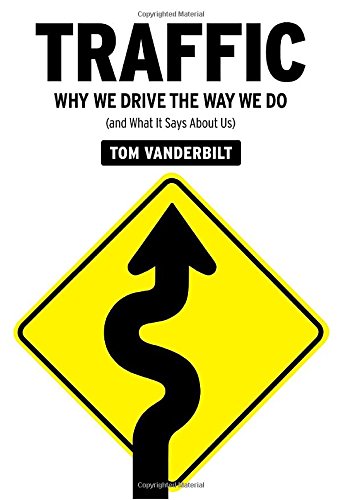
Would you be surprised that road rage can be good for society? Or that most crashes happen on sunny, dry days? That our minds can trick us into thinking the next lane is moving faster? Or that you can gauge a nation’s driving behavior by its levels of corruption? These are only a few of the remarkable dynamics that Tom Vanderbilt explores in this fascinating tour through the mysteries of the road.
Based on exhaustive research and interviews with driving experts and traffic officials around the globe,Traffic gets under the hood of the everyday activity of driving to uncover the surprisingly complex web of physical, psychological, and technical factors that explain how traffic works, why we drive the way we do, and what our driving says about us. Vanderbilt examines the perceptual limits and cognitive underpinnings that make us worse drivers than we think we are. He demonstrates why plans to protect pedestrians from cars often lead to more accidents. He shows how roundabouts, which can feel dangerous and chaotic, actually make roads safer—and reduce traffic in the bargain. He uncovers who is more likely to honk at whom, and why. He explains why traffic jams form, outlines the unintended consequences of our quest for safety, and even identifies the most common mistake drivers make in parking lots.
The car has long been a central part of American life; whether we see it as a symbol of freedom or a symptom of sprawl, we define ourselves by what and how we drive. As Vanderbilt shows, driving is a provocatively revealing prism for examining how our minds work and the ways in which we interact with one another. Ultimately, Traffic is about more than driving: it’s about human nature. This book will change the way we see ourselves and the world around us. And who knows? It may even make us better drivers.
Die Inhaltsangabe kann sich auf eine andere Ausgabe dieses Titels beziehen.
Über die Autorin bzw. den Autor
Tom Vanderbilt writes about design, technology, science, and culture for Wired, Slate, The New York Times, and many other publications. He lives in Brooklyn and drives a 2001 Volvo V40.
Auszug. © Genehmigter Nachdruck. Alle Rechte vorbehalten.
Why I Became a Late Merger
(and Why You Should Too)
Why does the other lane always seem to be moving faster?
It is a question you have no doubt asked yourself while crawling down some choked highway, watching with mounting frustration as the adjacent cars glide ahead. You drum the wheel with your fingers. You change the radio station. You fixate on one car as a benchmark of your own lack of progress. You try to figure out what that weird button next to the rearwindow
defroster actually does.
I used to think this was just part of the natural randomness of the highway. Sometimes fate would steer me into the faster lane, sometimes it would relinquish me to the slow lane.
That was until recently, when I had an experience that made me rethink my traditionally passive outlook on the road, and upset the careful set of assumptions that had always guided my behavior in traffic.
I made a major lifestyle change. I became a late merger.
Chances are, at some point you have found yourself driving along the highway when a sign announces that the left lane, in which you are traveling, will close one mile ahead, and that you must merge right.
You notice an opening in the right lane and quickly move over. You breathe a sigh, happy to be safely ensconced in the Lane That Will Not End. Then, as the lane creeps to a slow halt, you notice with rising indignation that cars in the lane you have vacated are continuing to speed ahead, out of sight. You quietly seethe and contemplate returning to the much faster left lane--if only you could work an opening. You grimly accept your condition.
One day, not long ago, I had an epiphany on a New Jersey highway. I was having a typical white-knuckle drive among the scenic oil-storage depots and chemical-processing plants of northern Jersey when suddenly, on the approach to the Pulaski Skyway, the sign loomed: LANE ENDS ONE MILE. MERGE RIGHT.
Seized by some rash impulse, I avoided the instinctual tickle at the back of my brain telling me to get in the already crowded right lane. Just do what the sign says, that voice usually counsels. Instead, I listened to another, more insistent voice: Don't be a sucker. You can do better. I plowed purposefully ahead, oblivious to the hostile stares of other drivers. From the corner of my eye I could see my wife cringing. After passing dozens of cars, I made it to the bottleneck point, where, filled with newfound swagger, I took my rightful turn in the small alternating "zipper" merge that had formed. I merged, and it was clear asphalt ahead. My heart was beating faster. My wife covered her face with her hands.
In the days after, a creeping guilt and confusion took hold. Was I wrong to have done this? Or had I been doing it wrong all my life? Looking for an answer, I posted an anonymous inquiry on Ask MetaFilter, a Web site one can visit to ask random questions and tap into the "hive mind" of an anonymous audience of overeducated and overopinionated geeks. Why should one lane move faster than the other, I wanted to know, and why are people rewarded for merging at the last possible moment? And was my new lifestyle, that of the late merger, somehow deviant?
I was startled by the torrent of responses, and how quickly they came. What struck me most was the passion and conviction with which people argued their various cases--and the fact that while many people seemed to think I was wrong, almost as many seemed to think I was right. Rather than easy consensus, I had stumbled into a gaping divide of irreconcilable
belief.
The first camp--let us name it after the bumper sticker that says practice random acts of kindness--viewed early mergers as virtuous souls doing the right thing and late mergers as arrogant louts. "Unfortunately, people suck," wrote one Random Acts poster. "They'll try whatever they can to pass you, to better enjoy the traffic jam from a few car lengths ahead of you. . . . People who feel that they have more pressing concerns and are generally more important than you will keep going, and some weak-spined schmuck will let them in further down, slowing your progress even more. This sucks; I'm afraid it's the way of the world."
Another camp, the minority camp-let's call them Live Free or Die, after the license-plate motto of the state of New Hampshire-argued that the late mergers were quite rationally utilizing the highway's maximum capacity, thus making life better for everyone. In their view, the other group's attempts toward politeness and fairness were actually detrimental to all.
It got more complicated. Some argued that late merges caused more accidents. Some said the system worked much better in Germany, and hinted that my dilemma perhaps revealed some national failing in the American character. Some said they were afraid of not being "let in" at the last moment; some said they would actively try to block someone from merging, the way truckers often do. So what was going on here? Are we not all driving the same road, did we not all pass the same driving tests? What was puzzling was not just the variety of responses but the sense of moral righteousness each person attributed to his or her highway behavior, and the vitriol each person reserved for those holding the opposite view. For the most part, people were not citing traffic laws or actual evidence but their own personal sense of what was right.
I even found someone claiming to have had a conversion experience exactly the opposite of mine. "Until very recently, I was a 'late merger,' " wrote the author, an executive with a software company, in a business magazine. Why had he become a born-again early merger? "Because I came to realize that traffic flowed faster the sooner people merged." He used this as a metaphor for successful team building in corporate America, in which "late mergers" were those who consistently put their own opinions and motives above the greater company. "Early mergers," he wrote, could help push companies to their "maximum communal speed." But did traffic flow faster when people merged sooner? Or did it just seem more noble to think that it did?
. . .
You may suspect that getting people to merge in a timely fashion, and without killing one another, is less of a traffic problem and more of a human problem. The road, more than simply a system of regulations and designs, is a place where many millions of us, with only loose parameters for how to behave, are thrown together daily in a kind of massive petri dish in which all kinds of uncharted, little-understood dynamics are at work. There is no other place where so many people from different walks of life--different ages, races, classes, religions, genders, political preferences, lifestyle choices, levels of psychological stability--mingle so freely.
What do we really know about how it all works? Why do we act the way we do on the road, and what might that say about us? Are certain people predisposed to drive certain ways? Do women behave differently than men? And if, as conventional wisdom has it, drivers have become progressively less civil over the past several decades, why is that so? Is the road a microcosm of society, or its own place with its own set of rules? I have a friend, an otherwise timorous Latin teacher, who once told me how, in a modest Toyota Corolla, he had defiantly "stuck it" to the driver of an eighteen-wheeler who he felt was hogging the road. Some mysterious force had turned this gentle suburban scholar into the Travis Bickle of the turnpike. (Are you tailgatin' me?) Was it traffic, or had the beast always been lurking within?
The more you think about it--or, rather, the more time you spend in traffic with time to think about it--the more these...
„Über diesen Titel“ kann sich auf eine andere Ausgabe dieses Titels beziehen.
Suchergebnisse für Traffic: Why We Drive the Way We Do and What It Says...

Beispielbild für diese ISBN
Traffic Why We Drive the Way W
Anbieter: World of Books (was SecondSale), Montgomery, IL, USA
Verkäuferbewertung 5 von 5 Sternen

Zustand: Good. Item in good condition. Textbooks may not include supplemental items i.e. CDs, access codes etc. Artikel-Nr. 00093654419
Gebraucht kaufen
EUR 4,36
Versand gratis
Versand innerhalb von USA
Versand innerhalb von USA
Anzahl: 14 verfügbar
Beispielbild für diese ISBN
Traffic Why We Drive the Way W
Anbieter: World of Books (was SecondSale), Montgomery, IL, USA
Verkäuferbewertung 5 von 5 Sternen
Zustand: Acceptable. Item in acceptable condition! Textbooks may not include supplemental items i.e. CDs, access codes etc. Artikel-Nr. 00096352131
Gebraucht kaufen
EUR 4,36
Versand gratis
Versand innerhalb von USA
Versand innerhalb von USA
Anzahl: 5 verfügbar
Beispielbild für diese ISBN
Traffic Why We Drive the Way W
Anbieter: World of Books (was SecondSale), Montgomery, IL, USA
Verkäuferbewertung 5 von 5 Sternen
Zustand: Very Good. Item in very good condition! Textbooks may not include supplemental items i.e. CDs, access codes etc. Artikel-Nr. 00102138466
Gebraucht kaufen
EUR 4,36
Versand gratis
Versand innerhalb von USA
Versand innerhalb von USA
Anzahl: 4 verfügbar
Beispielbild für diese ISBN
Traffic: Why We Drive the Way We Do (and What It Says About Us)
Anbieter: Wonder Book, Frederick, MD, USA
Verkäuferbewertung 5 von 5 Sternen
Zustand: Very Good. Very Good condition. Like New dust jacket. A copy that may have a few cosmetic defects. May also contain light spine creasing or a few markings such as an owner's name, short gifter's inscription or light stamp. Artikel-Nr. M14C-00428
Gebraucht kaufen
EUR 5,81
Versand gratis
Versand innerhalb von USA
Versand innerhalb von USA
Anzahl: 1 verfügbar
Beispielbild für diese ISBN
Traffic: Why We Drive the Way We Do (and What It Says About Us)
Anbieter: BooksRun, Philadelphia, PA, USA
Verkäuferbewertung 5 von 5 Sternen
Hardcover. Zustand: Very Good. 1. With dust jacket. It's a well-cared-for item that has seen limited use. The item may show minor signs of wear. All the text is legible, with all pages included. It may have slight markings and/or highlighting. Artikel-Nr. 0307264785-11-1-29
Gebraucht kaufen
EUR 5,81
Versand gratis
Versand innerhalb von USA
Versand innerhalb von USA
Anzahl: 1 verfügbar
Beispielbild für diese ISBN
Traffic: Why We Drive the Way We Do (and What It Says About Us)
Anbieter: ThriftBooks-Dallas, Dallas, TX, USA
Verkäuferbewertung 5 von 5 Sternen
Hardcover. Zustand: As New. No Jacket. Pages are clean and are not marred by notes or folds of any kind. ~ ThriftBooks: Read More, Spend Less. Artikel-Nr. G0307264785I2N00
Gebraucht kaufen
EUR 5,89
Versand gratis
Versand innerhalb von USA
Versand innerhalb von USA
Anzahl: 1 verfügbar
Beispielbild für diese ISBN
Traffic: Why We Drive the Way We Do (and What It Says About Us)
Anbieter: Wonder Book, Frederick, MD, USA
Verkäuferbewertung 5 von 5 Sternen
Zustand: Good. Good condition. Very Good dust jacket. A copy that has been read but remains intact. May contain markings such as bookplates, stamps, limited notes and highlighting, or a few light stains. Artikel-Nr. C12A-02008
Gebraucht kaufen
EUR 6,23
Versand gratis
Versand innerhalb von USA
Versand innerhalb von USA
Anzahl: 1 verfügbar
Beispielbild für diese ISBN
Traffic: Why We Drive the Way We Do (and What It Says About Us)
Anbieter: Wonder Book, Frederick, MD, USA
Verkäuferbewertung 5 von 5 Sternen
Zustand: Very Good. Very Good condition. Good dust jacket. A copy that may have a few cosmetic defects. May also contain light spine creasing or a few markings such as an owner's name, short gifter's inscription or light stamp. Artikel-Nr. Z07A-04670
Gebraucht kaufen
EUR 6,23
Versand gratis
Versand innerhalb von USA
Versand innerhalb von USA
Anzahl: 2 verfügbar
Beispielbild für diese ISBN
Traffic: Why We Drive the Way We Do (and What It Says About Us)
Anbieter: BooksRun, Philadelphia, PA, USA
Verkäuferbewertung 5 von 5 Sternen
Hardcover. Zustand: Very Good. 1. It's a well-cared-for item that has seen limited use. The item may show minor signs of wear. All the text is legible, with all pages included. It may have slight markings and/or highlighting. Artikel-Nr. 0307264785-11-1
Gebraucht kaufen
EUR 6,27
Versand gratis
Versand innerhalb von USA
Versand innerhalb von USA
Anzahl: 1 verfügbar
Beispielbild für diese ISBN
Traffic : Why We Drive the Way We Do (And What It Says about Us)
Verlag:
Knopf Doubleday Publishing Group, 2008
ISBN 10: 0307264785
ISBN 13: 9780307264787
Gebraucht
Hardcover
Anbieter: Better World Books, Mishawaka, IN, USA
Verkäuferbewertung 5 von 5 Sternen
Zustand: Good. o8 Edition. Former library copy. Pages intact with minimal writing/highlighting. The binding may be loose and creased. Dust jackets/supplements are not included. Includes library markings. Stock photo provided. Product includes identifying sticker. Better World Books: Buy Books. Do Good. Artikel-Nr. GRP81485401
Gebraucht kaufen
EUR 6,31
Versand gratis
Versand innerhalb von USA
Versand innerhalb von USA
Anzahl: 1 verfügbar