
Inhaltsangabe
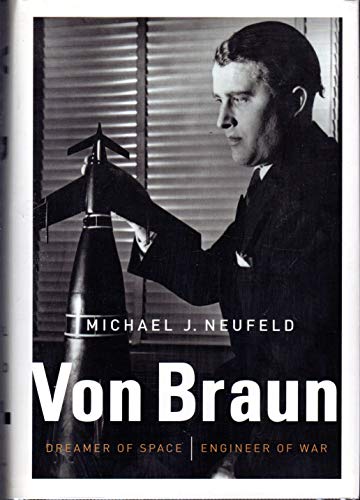
An in-depth biography of Wernher von Braun offers a multifaceted portrait of the visionary German scientist who became the chief rocket engineer of the Third Reich, creator of the V-2 rocket, reluctant SS officer, and one of the fathers of the U.S. space program.
Die Inhaltsangabe kann sich auf eine andere Ausgabe dieses Titels beziehen.
Über die Autorinnen und Autoren
Michael J. Neufeld is chair of the Space History Division of the Smithsonian's National Air and Space Museum.
Michael J. Neufeld is chair of the Space History Division of the Smithsonian’s National Air and Space Museum. Born and raised in Canada, he received his doctorate in history from The Johns Hopkins University in Baltimore. His second book, The Rocket and the Reich: Peenemünde and the Coming of the Ballistic Missile Era, won the American Institute of Aeronautics and Astronautics History Manuscript Award and the Society for the History of Technology Dexter Prize. He lives in Takoma Park, Maryland.
Auszug. © Genehmigter Nachdruck. Alle Rechte vorbehalten.
Chapter One: The Wheel of Progress
TO 1925
Demagoguery and democracy are brothers in etymology and spirit . . . for the German ear the word democracy awakens memories of complete chaos after the First [World] War.
—MAGNUS FREIHERR VON BRAUN[1]
When Wernher von Braun was about ten years old, his tall, elegant mother, Emmy Freifrau (Baroness) von Braun, asked him what he would like to do with his life. “I want to help turn the wheel of progress” was his answer, a response that sounded odd and surprising to her, coming out of the mouth of a small boy. An unusually abstract statement, it prefigured a lifetime of fascination with science and technology.[2]
Equally surprising, it came from the mouth of a true son of the Junkers—the noble caste that had once dominated the Prussian civil service, officer corps, and landowning elite. Engineering and science were not careers that Junker sons often chose, even in the 1920s. It seemed to reflect some inner compulsion of Wernher’s, but it also reflected the tenor of the times—a time of dramatic technological and political change. He had been born in 1912, in a traditional prewar world; his massively built, mustachioed father, Magnus Freiherr von Braun, had been a rapidly ascending civil servant in the empire of Kaiser Wilhelm II, while his intellectually gifted mother was the orphaned daughter of an estate owner. Less than ten years later his father would be forced out of the civil service in the political turmoil of the new Weimar Republic. The family moved to the modern world city of Berlin. Yet as much of a maverick and a Berliner as Wernher von Braun would turn out to be, his Prussian Junker upbringing influenced his values, his abilities, and his choices—more so, in fact, than his father would later be willing to credit.
Of his parents’ two families, the von Brauns and the von Quistorps, the former was of much older aristocratic stock. Magnus von Braun, who inherited from his father the hobby of genealogical research, eventually traced the male line back to 1285, although in all probability an ancestor had battled the Mongols at Liegnitz in 1241. The von Brauns arose from the soil of Silesia, a verdant and rolling province on both sides of the Oder River, east of the Czech heartland of Bohemia and Moravia. In 1573 the Holy Roman emperor elevated two of them to the rank of Reichsfreiherr (imperial baron) for their military accomplishments.[3]
Magnus von Braun came, however, from an even more distant outpost of Germandom, East Prussia—a province that would disappear from the map in 1945, when Stalin divided it between the Soviet Union and Poland. In 1738 one descendant of the family, Gotthard Freiherr von Braun, entered Prussian service as a lieutenant in the garrison of the province’s capital city of Königsberg (now Kaliningrad, Russia). There he married the daughter of a wealthy local burgher. His fifth child, Sigismund, also a Prussian officer, purchased the estate of Neucken, about thirty miles southwest of the city, in 1803 and erected a new house—Magnus von Braun’s ancestral home. One of the family’s close acquaintances in Königsberg had been the philosopher Immanuel Kant; the silver sugar spoon he gave to Sigismund as a wedding present was a holy object in the glass cabinet of the mansion, along with a golden snuffbox from Czar Alexander I of Russia. But in February 1807, not long after the house was finished, Napoleon fought the bloody and inconclusive Battle of Preussisch Eylau against the czar’s army around Neucken. Napoleon’s troops killed or stole all the farm animals, wrecked the estate buildings, and plundered the house, although valuables like Kant’s spoon were successfully carried away or hidden. It took the family years to recuperate economically from the damage—but the starvation and death inflicted on the estate’s enserfed peasantry were much worse.[4]
On the seventy-first anniversary of the battle, 7 February 1878, a boy, Magnus Alexander Maximilian, was born at Neucken. His father was Lieutenant Colonel Maximilian Freiherr von Braun, who had inherited the estate in part because no fewer than three of his brothers, as Prussian officers, were killed in the 1866 war against Austria- Hungary. Military values and a fervent loyalty to the Hohenzollern kings of Prussia—who, after 1871, became emperors of the new, Prussian-dominated Germany—were the heart of the values taught on the estate. Magnus was the youngest of five; his brothers Friedrich (Fritz) and Siegfried both became army officers. While Fritz had to terminate his career to take over Neucken shortly before World War I because of the failing health of their father, Siegfried served all through the war, ending as colonel of the Third Guards Regiment. He was forced into other employment only because of the military’s drastic downsizing as a result of the Versailles Treaty.[5]
Acceptable career choices for sons of the Prussian nobility were limited. Every able-bodied male was expected to at least serve a stint in the army before returning to estate agriculture, if there was a prospect of an inheritance—which in the nineteenth century was usually limited by primogeniture to the eldest son. Of course, a young man also had the possibility of marrying into an estate or, less often, accumulating enough wealth to buy one. As Prussia’s bureaucracy expanded from the eighteenth century on, however, the higher civil service and diplomatic corps opened up as employment possibilities for younger sons. Unlike the British aristocracy, all children of the Prussian aristocracy, male and female, inherited the father’s title, with the result that there were a lot of barons, countesses, and the like who usually lived well as a result of the privileges afforded them but had no landed property.
Daughters in this very patriarchal society inevitably faced even more limited choices. Outside of marriage, about the only prospects they had were to remain with the family as a maiden aunt and sister, or to become a nurse or administrator in a church-based hospital or charity institution. As the Junkers (outside of parts of Silesia) were aggressively Lutheran, the option of taking holy orders was unavailable. Magnus von Braun’s oldest sibling, Magdalene (born 1865), remained at Neucken her whole life, whereas Adele eventually became the head of a children’s sanatorium on the Baltic coast of East Prussia. Neither ever married.[6]
Old age often puts a nostalgic glow on one’s memories of childhood. Magnus von Braun’s memoirs, completed in American exile in the late 1940s and early 1950s, are no exception in that regard. He described Neucken as a patriarchal utopia: “the whole estate thought of itself as a large family. . . . Neighborly love . . . was natural and inevitable and at the same time Christian in nature. Patriarchal life on the land bound the people together into a tight community of fate.” The housing of Neucken’s laborers was, he conceded, “still primitive in my earliest youth,” but nonetheless it was better than the conditions he later witnessed in eastern Europe—not to mention those of blacks and Mexicans in Texas and Alabama. (Prussia had abolished serfdom in the early decades of the century, not necessarily to the benefit of the peasants, who often lost their land.) Raised in a stable, hierarchical, rural society in which dissent was rare, Magnus von Braun never saw any need to question a state of affairs in which the Junkers ran local government as their private preserve and most villages were wholly owned appendages of the estates. Indeed, his memoir forthrightly states his reactionary, monarchist, elitist politics—there had always been,...
„Über diesen Titel“ kann sich auf eine andere Ausgabe dieses Titels beziehen.
Weitere beliebte Ausgaben desselben Titels

Suchergebnisse für Von Braun: Dreamer of Space, Engineer of War (Rough...

Beispielbild für diese ISBN
Von Braun: Dreamer of Space, Engineer of War
Anbieter: ThriftBooks-Atlanta, AUSTELL, GA, USA
Verkäuferbewertung 5 von 5 Sternen

Hardcover. Zustand: Fair. No Jacket. Former library book; Readable copy. Pages may have considerable notes/highlighting. ~ ThriftBooks: Read More, Spend Less. Artikel-Nr. G0307262928I5N10
Gebraucht kaufen
EUR 6,33
Versand gratis
Versand innerhalb von USA
Versand innerhalb von USA
Anzahl: 1 verfügbar
Beispielbild für diese ISBN
Von Braun: Dreamer of Space, Engineer of War
Anbieter: BooksRun, Philadelphia, PA, USA
Verkäuferbewertung 5 von 5 Sternen
Hardcover. Zustand: Very Good. 1. With dust jacket. It's a well-cared-for item that has seen limited use. The item may show minor signs of wear. All the text is legible, with all pages included. It may have slight markings and/or highlighting. Artikel-Nr. 0307262928-11-1-29
Gebraucht kaufen
EUR 9,13
Versand gratis
Versand innerhalb von USA
Versand innerhalb von USA
Anzahl: 1 verfügbar
Beispielbild für diese ISBN
Von Braun : Dreamer of Space, Engineer of War
Verlag:
Knopf Doubleday Publishing Group, 2007
ISBN 10: 0307262928
ISBN 13: 9780307262929
Gebraucht
Hardcover
Erstausgabe
Anbieter: Better World Books: West, Reno, NV, USA
Verkäuferbewertung 5 von 5 Sternen
Zustand: Good. 1st Edition. Former library copy. Pages intact with minimal writing/highlighting. The binding may be loose and creased. Dust jackets/supplements are not included. Includes library markings. Stock photo provided. Product includes identifying sticker. Better World Books: Buy Books. Do Good. Artikel-Nr. 4080864-6
Gebraucht kaufen
EUR 10,28
Versand gratis
Versand innerhalb von USA
Versand innerhalb von USA
Anzahl: 1 verfügbar
Beispielbild für diese ISBN
Von Braun : Dreamer of Space, Engineer of War
Verlag:
Knopf Doubleday Publishing Group, 2007
ISBN 10: 0307262928
ISBN 13: 9780307262929
Gebraucht
Hardcover
Erstausgabe
Anbieter: Better World Books, Mishawaka, IN, USA
Verkäuferbewertung 5 von 5 Sternen
Zustand: Good. 1st Edition. Former library copy. Pages intact with minimal writing/highlighting. The binding may be loose and creased. Dust jackets/supplements are not included. Includes library markings. Stock photo provided. Product includes identifying sticker. Better World Books: Buy Books. Do Good. Artikel-Nr. 4080864-6
Gebraucht kaufen
EUR 10,28
Versand gratis
Versand innerhalb von USA
Versand innerhalb von USA
Anzahl: 2 verfügbar
Beispielbild für diese ISBN
Von Braun : Dreamer of Space, Engineer of War
Verlag:
Knopf Doubleday Publishing Group, 2007
ISBN 10: 0307262928
ISBN 13: 9780307262929
Gebraucht
Hardcover
Erstausgabe
Anbieter: Better World Books: West, Reno, NV, USA
Verkäuferbewertung 5 von 5 Sternen
Zustand: Good. 1st Edition. Pages intact with minimal writing/highlighting. The binding may be loose and creased. Dust jackets/supplements are not included. Stock photo provided. Product includes identifying sticker. Better World Books: Buy Books. Do Good. Artikel-Nr. 5359789-6
Gebraucht kaufen
EUR 10,28
Versand gratis
Versand innerhalb von USA
Versand innerhalb von USA
Anzahl: 1 verfügbar
Beispielbild für diese ISBN
Von Braun : Dreamer of Space, Engineer of War
Verlag:
Knopf Doubleday Publishing Group, 2007
ISBN 10: 0307262928
ISBN 13: 9780307262929
Gebraucht
Hardcover
Erstausgabe
Anbieter: Better World Books: West, Reno, NV, USA
Verkäuferbewertung 5 von 5 Sternen
Zustand: Very Good. 1st Edition. Pages intact with possible writing/highlighting. Binding strong with minor wear. Dust jackets/supplements may not be included. Stock photo provided. Product includes identifying sticker. Better World Books: Buy Books. Do Good. Artikel-Nr. 5271934-6
Gebraucht kaufen
EUR 10,28
Versand gratis
Versand innerhalb von USA
Versand innerhalb von USA
Anzahl: 1 verfügbar
Beispielbild für diese ISBN
Von Braun : Dreamer of Space, Engineer of War
Verlag:
Knopf Doubleday Publishing Group, 2007
ISBN 10: 0307262928
ISBN 13: 9780307262929
Gebraucht
Hardcover
Erstausgabe
Anbieter: Better World Books, Mishawaka, IN, USA
Verkäuferbewertung 5 von 5 Sternen
Zustand: Good. 1st Edition. Pages intact with minimal writing/highlighting. The binding may be loose and creased. Dust jackets/supplements are not included. Stock photo provided. Product includes identifying sticker. Better World Books: Buy Books. Do Good. Artikel-Nr. 5359789-6
Gebraucht kaufen
EUR 10,28
Versand gratis
Versand innerhalb von USA
Versand innerhalb von USA
Anzahl: 1 verfügbar
Beispielbild für diese ISBN
Von Braun: Dreamer of Space, Engineer of War
Anbieter: Anybook.com, Lincoln, Vereinigtes Königreich
Verkäuferbewertung 5 von 5 Sternen
Zustand: Fair. This is an ex-library book and may have the usual library/used-book markings inside.This book has hardback covers. Book contains pencil markings. In fair condition, suitable as a study copy. No dust jacket. Library sticker on front cover. Please note the Image in this listing is a stock photo and may not match the covers of the actual item,1050grams, ISBN:9780307262929. Artikel-Nr. 3718001
Gebraucht kaufen
EUR 18,60
EUR 15,73 Versand
Versand von Vereinigtes Königreich nach USA
Versand von Vereinigtes Königreich nach USA
Anzahl: 1 verfügbar
Beispielbild für diese ISBN
Von Braun: Dreamer of Space, Engineer of War
Anbieter: Revaluation Books, Exeter, Vereinigtes Königreich
Verkäuferbewertung 5 von 5 Sternen
Hardcover. Zustand: Brand New. 1st edition. 587 pages. 9.75x6.75x2.00 inches. In Stock. Artikel-Nr. 0307262928
Neu kaufen
EUR 68,97
EUR 14,46 Versand
Versand von Vereinigtes Königreich nach USA
Versand von Vereinigtes Königreich nach USA
Anzahl: 1 verfügbar