
Verwandte Artikel zu The Audacity of Hope: Thoughts on Reclaiming the American...
Inhaltsangabe
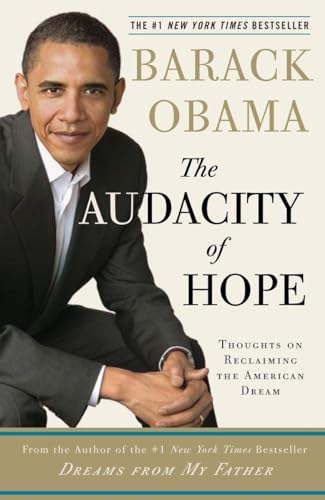
#1 NEW YORK TIMES BESTSELLER • Barack Obama’s lucid vision of America’s place in the world and call for a new kind of politics that builds upon our shared understandings as Americans, based on his years in the Senate
“In our lowdown, dispiriting era, Obama’s talent for proposing humane, sensible solutions with uplifting, elegant prose does fill one with hope.”—Michael Kazin, The Washington Post
In July 2004, four years before his presidency, Barack Obama electrified the Democratic National Convention with an address that spoke to Americans across the political spectrum. One phrase in particular anchored itself in listeners’ minds, a reminder that for all the discord and struggle to be found in our history as a nation, we have always been guided by a dogged optimism in the future, or what Obama called “the audacity of hope.”
The Audacity of Hope is Barack Obama’s call for a different brand of politics—a politics for those weary of bitter partisanship and alienated by the “endless clash of armies” we see in congress and on the campaign trail; a politics rooted in the faith, inclusiveness, and nobility of spirit at the heart of “our improbable experiment in democracy.” He explores those forces—from the fear of losing to the perpetual need to raise money to the power of the media—that can stifle even the best-intentioned politician. He also writes, with surprising intimacy and self-deprecating humor, about settling in as a senator, seeking to balance the demands of public service and family life, and his own deepening religious commitment.
At the heart of this book is Barack Obama’s vision of how we can move beyond our divisions to tackle concrete problems. He examines the growing economic insecurity of American families, the racial and religious tensions within the body politic, and the transnational threats—from terrorism to pandemic—that gather beyond our shores. And he grapples with the role that faith plays in a democracy—where it is vital and where it must never intrude. Underlying his stories is a vigorous search for connection: the foundation for a radically hopeful political consensus.
Only by returning to the principles that gave birth to our Constitution, Obama says, can Americans repair a political process that is broken, and restore to working order a government that has fallen dangerously out of touch with millions of ordinary Americans. Those Americans are out there, he writes—“waiting for Republicans and Democrats to catch up with them.”
Die Inhaltsangabe kann sich auf eine andere Ausgabe dieses Titels beziehen.
Über die Autorin bzw. den Autor
Barack Obama was the 44th president of the United States, elected in November 2008 and holding office for two terms. He is the recipient of the 2009 Nobel Peace Prize and the New York Times bestselling author of Dreams from My Father, The Audacity of Hope, and A Promised Land. He lives in Washington, D.C., with his wife, Michelle. They have two daughters, Malia and Sasha.
Auszug. © Genehmigter Nachdruck. Alle Rechte vorbehalten.
PrologueIt’s been almost ten years since I first ran for political office. I was thirty-five at the time, four years out of law school, recently married, and generally impatient with life. A seat in the Illinois legislature had opened up, and several friends suggested that I run, thinking that my work as a civil rights lawyer, and contacts from my days as a community organizer, would make me a viable candidate. After discussing it with my wife, I entered the race and proceeded to do what every first-time candidate does: I talked to anyone who would listen. I went to block club meetings and church socials, beauty shops and barbershops. If two guys were standing on a corner, I would cross the street to hand them campaign literature. And everywhere I went, I’d get some version of the same two questions.“Where’d you get that funny name?”And then: “You seem like a nice enough guy. Why do you want to go into something dirty and nasty like politics?”I was familiar with the question, a variant on the questions asked of me years earlier, when I’d first arrived in Chicago to work in low-income neighborhoods. It signaled a cynicism not simply with politics but with the very notion of a public life, a cynicism that–at least in the South Side neighborhoods I sought to represent–had been nourished by a generation of broken promises. In response, I would usually smile and nod and say that I understood the skepticism, but that there was–and always had been–another tradition to politics, a tradition that stretched from the days of the country’s founding to the glory of the civil rights movement, a tradition based on the simple idea that we have a stake in one another, and that what binds us together is greater than what drives us apart, and that if enough people believe in the truth of that proposition and act on it, then we might not solve every problem, but we can get something meaningful done. It was a pretty convincing speech, I thought. And although I’m not sure that the people who heard me deliver it were similarly impressed, enough of them appreciated my earnestness and youthful swagger that I made it to the Illinois legislature.Six years later, when I decided to run for the United States Senate, I wasn’t so sure of myself.By all appearances, my choice of careers seemed to have worked out. After spending my two terms during which I labored in the minority, Democrats had gained control of the state senate, and I had subsequently passed a slew of bills, from reforms of the Illinois death penalty system to an expansion of the state’s health program for kids. I had continued to teach at the University of Chicago Law School, a job I enjoyed, and was frequently invited to speak around town. I had preserved my independence, my good name, and my marriage, all of which, statistically speaking, had been placed at risk the moment I set foot in the state capital.But the years had also taken their toll. Some of it was just a function of my getting older, I suppose, for if you are paying attention, each successive year will make you more intimately acquainted with all of your flaws–the blind spots, the recurring habits of thought that may be genetic or may be environmental, but that will almost certainly worsen with time, as surely as the hitch in your walk turns to pain in your hip. In me, one of those flaws had proven to be a chronic restlessness; an inability to appreciate, no matter how well things were going, those blessings that were right there in front of me. It’s a flaw that is endemic to modern life, I think–endemic, too, in the American character–and one that is nowhere more evident than in the field of politics. Whether politics actually encourages the trait or simply attracts those who possess it is unclear. Lyndon Johnson, who knew much about both politics and restlessness, once said that every man is trying to either live up to his father’s expectations or make up for his father’s mistakes, and I suppose that may explain my particular malady as well as anything else.In any event, it was as a consequence of that restlessness that I decided to challenge a sitting Democratic incumbent for his congressional seat in the 2000 election cycle. It was an ill-considered race, and I lost badly–the sort of drubbing that awakens you to the fact that life is not obliged to work out as you’d planned. A year and a half later, the scars of that loss sufficiently healed, I had lunch with a media consultant who had been encouraging me for some time to run for statewide office. As it happened, the lunch was scheduled for late September 2001.“You realize, don’t you, that the political dynamics have changed,” he said as he picked at his salad.“What do you mean?” I asked, knowing full well what he meant. We both looked down at the newspaper beside him. There, on the front page, was Osama bin Laden.“Hell of a thing, isn’t it?” he said, shaking his head. “Really bad luck. You can’t change your name, of course. Voters are suspicious of that kind of thing. Maybe if you were at the start of your career, you know, you could use a nickname or something. But now... "His voice trailed off and he shrugged apologetically before signaling the waiter to bring us the check.I suspected he was right, and that realization ate away at me. For the first time in my career, I began to experience the envy of seeing younger politicians succeed where I had failed, moving into higher offices, getting more things done. The pleasures of politics–the adrenaline of debate, the animal warmth of shaking hands and plunging into a crowd–began to pale against the meaner tasks of the job: the begging for money, the long drives home after the banquet had run two hours longer than scheduled, the bad food and stale air and clipped phone conversations with a wife who had stuck by me so far but was pretty fed up with raising our children alone and was beginning to question my priorities. Even the legislative work, the policy-making that had gotten me to run in the first place, began to feel too incremental, too removed from the larger battles–over taxes, security, health care, and jobs–that were being waged on a national stage. I began to harbor doubts about the path I had chosen; I began feeling the way I imagine an actor or athlete must feel when, after years of commitment to a particular dream, after years of waiting tables between auditions or scratching out hits in the minor leagues, he realizes that he’s gone just about as far as talent or fortune will take him. The dream will not happen, and he now faces the choice of accepting this fact like a grown-up and moving on to more sensible pursuits, or refusing the truth and ending up bitter, quarrelsome, and slightly pathetic.Denial, anger, bargaining, despair–I’m not sure I went through all the stages prescribed by the experts. At some point, though, I arrived at acceptance–of my limits, and, in a way, my mortality. I refocused on my work in the state senate and took satisfaction from the reforms and initiatives that my position afforded. I spent more time at home, and watched my daughters grow, and properly cherished my wife, and thought about my long-term financial obligations. I exercised, and read novels, and came to appreciate how the earth rotated around the sun and the seasons came and went without any particular exertions on my part.And it was this acceptance, I think, that allowed me to come up with the thoroughly cockeyed idea of running for the United States Senate. An up-or-out strategy was how I described it to my wife, one last shot to test out my ideas before I settled into a calmer, more stable, and better-paying existence. And she–perhaps more out of pity than conviction–agreed to...
„Über diesen Titel“ kann sich auf eine andere Ausgabe dieses Titels beziehen.
Suchergebnisse für The Audacity of Hope: Thoughts on Reclaiming the American...

Beispielbild für diese ISBN
The Audacity of Hope: Thoughts on Reclaiming the American Dream
Anbieter: World of Books (was SecondSale), Montgomery, IL, USA
Verkäuferbewertung 5 von 5 Sternen

Paperback. Zustand: Good. #1 NEW YORK TIMES BESTSELLER * Barack Obama's lucid vision of America's place in the world and call for a new kind of politics that builds upon our shared understandings as Americans, based on his years in the Senate "In our lowdown, dispiriting era, Obama's talent for proposing humane, sensible solutions with uplifting, elegant prose does fill one with hope."--Michael Kazin, The Washington Post In July 2004, four years before his presidency, Barack Obama electrified the Democratic National Convention with an address that spoke to Americans across the political spectrum. One phrase in particular anchored itself in listeners' minds, a reminder that for all the discord and struggle to be found in our history as a nation, we have always been guided by a dogged optimism in the future, or what Obama called "the audacity of hope." The Audacity of Hope is Barack Obama's call for a different brand of politics--a politics for those weary of bitter partisanship and alienated by the "endless clash of armies" we see in congress and on the campaign trail; a politics rooted in the faith, inclusiveness, and nobility of spirit at the heart of "our improbable experiment in democracy." He explores those forces--from the fear of losing to the perpetual need to raise money to the power of the media--that can stifle even the best-intentioned politician. He also writes, with surprising intimacy and self-deprecating humor, about settling in as a senator, seeking to balance the demands of public service and family life, and his own deepening religious commitment. At the heart of this book is Barack Obama's vision of how we can move beyond our divisions to tackle concrete problems. He examines the growing economic insecurity of American families, the racial and religious tensions within the body politic, and the transnational threats--from terrorism to pandemic--that gather beyond our shores. And he grapples with the role that faith plays in a democracy--where it is vital and where it must never intrude. Underlying his stories is a vigorous search for connection: the foundation for a radically hopeful political consensus. Only by returning to the principles that gave birth to our Constitution, Obama says, can Americans repair a political process that is broken, and restore to working order a government that has fallen dangerously out of touch with millions of ordinary Americans. Those Americans are out there, he writes--"waiting for Republicans and Democrats to catch up with them.". Artikel-Nr. 00087048521
Gebraucht kaufen
EUR 3,74
Versand gratis
Versand innerhalb von USA
Versand innerhalb von USA
Anzahl: Mehr als 20 verfügbar
Beispielbild für diese ISBN
The Audacity of Hope: Thoughts on Reclaiming the American Dream
Anbieter: World of Books (was SecondSale), Montgomery, IL, USA
Verkäuferbewertung 5 von 5 Sternen
Paperback. Zustand: Very Good. #1 NEW YORK TIMES BESTSELLER * Barack Obama's lucid vision of America's place in the world and call for a new kind of politics that builds upon our shared understandings as Americans, based on his years in the Senate "In our lowdown, dispiriting era, Obama's talent for proposing humane, sensible solutions with uplifting, elegant prose does fill one with hope."--Michael Kazin, The Washington Post In July 2004, four years before his presidency, Barack Obama electrified the Democratic National Convention with an address that spoke to Americans across the political spectrum. One phrase in particular anchored itself in listeners' minds, a reminder that for all the discord and struggle to be found in our history as a nation, we have always been guided by a dogged optimism in the future, or what Obama called "the audacity of hope." The Audacity of Hope is Barack Obama's call for a different brand of politics--a politics for those weary of bitter partisanship and alienated by the "endless clash of armies" we see in congress and on the campaign trail; a politics rooted in the faith, inclusiveness, and nobility of spirit at the heart of "our improbable experiment in democracy." He explores those forces--from the fear of losing to the perpetual need to raise money to the power of the media--that can stifle even the best-intentioned politician. He also writes, with surprising intimacy and self-deprecating humor, about settling in as a senator, seeking to balance the demands of public service and family life, and his own deepening religious commitment. At the heart of this book is Barack Obama's vision of how we can move beyond our divisions to tackle concrete problems. He examines the growing economic insecurity of American families, the racial and religious tensions within the body politic, and the transnational threats--from terrorism to pandemic--that gather beyond our shores. And he grapples with the role that faith plays in a democracy--where it is vital and where it must never intrude. Underlying his stories is a vigorous search for connection: the foundation for a radically hopeful political consensus. Only by returning to the principles that gave birth to our Constitution, Obama says, can Americans repair a political process that is broken, and restore to working order a government that has fallen dangerously out of touch with millions of ordinary Americans. Those Americans are out there, he writes--"waiting for Republicans and Democrats to catch up with them.". Artikel-Nr. 00107154376
Gebraucht kaufen
EUR 3,74
Versand gratis
Versand innerhalb von USA
Versand innerhalb von USA
Anzahl: 18 verfügbar
Beispielbild für diese ISBN
The Audacity of Hope: Thoughts on Reclaiming the American Dream
Anbieter: World of Books (was SecondSale), Montgomery, IL, USA
Verkäuferbewertung 5 von 5 Sternen
Paperback. Zustand: Fair. #1 NEW YORK TIMES BESTSELLER * Barack Obama's lucid vision of America's place in the world and call for a new kind of politics that builds upon our shared understandings as Americans, based on his years in the Senate "In our lowdown, dispiriting era, Obama's talent for proposing humane, sensible solutions with uplifting, elegant prose does fill one with hope."--Michael Kazin, The Washington Post In July 2004, four years before his presidency, Barack Obama electrified the Democratic National Convention with an address that spoke to Americans across the political spectrum. One phrase in particular anchored itself in listeners' minds, a reminder that for all the discord and struggle to be found in our history as a nation, we have always been guided by a dogged optimism in the future, or what Obama called "the audacity of hope." The Audacity of Hope is Barack Obama's call for a different brand of politics--a politics for those weary of bitter partisanship and alienated by the "endless clash of armies" we see in congress and on the campaign trail; a politics rooted in the faith, inclusiveness, and nobility of spirit at the heart of "our improbable experiment in democracy." He explores those forces--from the fear of losing to the perpetual need to raise money to the power of the media--that can stifle even the best-intentioned politician. He also writes, with surprising intimacy and self-deprecating humor, about settling in as a senator, seeking to balance the demands of public service and family life, and his own deepening religious commitment. At the heart of this book is Barack Obama's vision of how we can move beyond our divisions to tackle concrete problems. He examines the growing economic insecurity of American families, the racial and religious tensions within the body politic, and the transnational threats--from terrorism to pandemic--that gather beyond our shores. And he grapples with the role that faith plays in a democracy--where it is vital and where it must never intrude. Underlying his stories is a vigorous search for connection: the foundation for a radically hopeful political consensus. Only by returning to the principles that gave birth to our Constitution, Obama says, can Americans repair a political process that is broken, and restore to working order a government that has fallen dangerously out of touch with millions of ordinary Americans. Those Americans are out there, he writes--"waiting for Republicans and Democrats to catch up with them.". Artikel-Nr. 00094823934
Gebraucht kaufen
EUR 3,74
Versand gratis
Versand innerhalb von USA
Versand innerhalb von USA
Anzahl: Mehr als 20 verfügbar
Foto des Verkäufers
The Audacity of Hope: Thoughts on Reclaiming the American Dream
Anbieter: Dream Books Co., Denver, CO, USA
Verkäuferbewertung 5 von 5 Sternen
Zustand: acceptable. This copy has clearly been enjoyedâ"expect noticeable shelf wear and some minor creases to the cover. Binding is strong, and all pages are legible. May contain previous library markings or stamps. Artikel-Nr. DBV.0307237702.A
Gebraucht kaufen
EUR 3,79
Versand gratis
Versand innerhalb von USA
Versand innerhalb von USA
Anzahl: 1 verfügbar
Beispielbild für diese ISBN
The Audacity of Hope: Thoughts on Reclaiming the American Dream
Anbieter: Hot from the Toaster, Portland, OR, USA
Verkäuferbewertung 5 von 5 Sternen
Soft cover. Zustand: Good. Artikel-Nr. ABE-1785887643203
Gebraucht kaufen
EUR 4,13
Versand gratis
Versand innerhalb von USA
Versand innerhalb von USA
Anzahl: 1 verfügbar
Foto des Verkäufers
The Audacity of Hope: Thoughts on Reclaiming the American Dream
Anbieter: Dream Books Co., Denver, CO, USA
Verkäuferbewertung 5 von 5 Sternen
Zustand: good. Gently used with minimal wear on the corners and cover. A few pages may contain light highlighting or writing, but the text remains fully legible. Dust jacket may be missing, and supplemental materials like CDs or codes may not be included. May be ex-library with library markings. Ships promptly! Artikel-Nr. DBV.0307237702.G
Gebraucht kaufen
EUR 4,53
Versand gratis
Versand innerhalb von USA
Versand innerhalb von USA
Anzahl: 1 verfügbar
Beispielbild für diese ISBN
The Audacity of Hope: Thoughts on Reclaiming the American Dream
Verlag:
Crown Publishing Group (NY), 2007
ISBN 10: 0307237702
ISBN 13: 9780307237705
Gebraucht
Paperback
Anbieter: ThriftBooks-Reno, Reno, NV, USA
Verkäuferbewertung 5 von 5 Sternen
Paperback. Zustand: Fair. No Jacket. Readable copy. Pages may have considerable notes/highlighting. ~ ThriftBooks: Read More, Spend Less. Artikel-Nr. G0307237702I5N00
Gebraucht kaufen
EUR 5,95
Versand gratis
Versand innerhalb von USA
Versand innerhalb von USA
Anzahl: 1 verfügbar
Beispielbild für diese ISBN
The Audacity of Hope: Thoughts on Reclaiming the American Dream
Verlag:
Crown Publishing Group (NY), 2007
ISBN 10: 0307237702
ISBN 13: 9780307237705
Gebraucht
Paperback
Anbieter: ThriftBooks-Dallas, Dallas, TX, USA
Verkäuferbewertung 5 von 5 Sternen
Paperback. Zustand: Fair. No Jacket. Readable copy. Pages may have considerable notes/highlighting. ~ ThriftBooks: Read More, Spend Less. Artikel-Nr. G0307237702I5N00
Gebraucht kaufen
EUR 5,95
Versand gratis
Versand innerhalb von USA
Versand innerhalb von USA
Anzahl: 1 verfügbar
Beispielbild für diese ISBN
The Audacity of Hope: Thoughts on Reclaiming the American Dream
Verlag:
Crown Publishing Group (NY), 2007
ISBN 10: 0307237702
ISBN 13: 9780307237705
Gebraucht
Paperback
Anbieter: ThriftBooks-Atlanta, AUSTELL, GA, USA
Verkäuferbewertung 5 von 5 Sternen
Paperback. Zustand: As New. No Jacket. Pages are clean and are not marred by notes or folds of any kind. ~ ThriftBooks: Read More, Spend Less. Artikel-Nr. G0307237702I2N00
Gebraucht kaufen
EUR 5,95
Versand gratis
Versand innerhalb von USA
Versand innerhalb von USA
Anzahl: 1 verfügbar
Beispielbild für diese ISBN
The Audacity of Hope: Thoughts on Reclaiming the American Dream
Verlag:
Crown Publishing Group (NY), 2007
ISBN 10: 0307237702
ISBN 13: 9780307237705
Gebraucht
Paperback
Anbieter: ThriftBooks-Atlanta, AUSTELL, GA, USA
Verkäuferbewertung 5 von 5 Sternen
Paperback. Zustand: Fair. No Jacket. Readable copy. Pages may have considerable notes/highlighting. ~ ThriftBooks: Read More, Spend Less. Artikel-Nr. G0307237702I5N00
Gebraucht kaufen
EUR 5,95
Versand gratis
Versand innerhalb von USA
Versand innerhalb von USA
Anzahl: 1 verfügbar