
Verwandte Artikel zu Lightning Man: The Accursed Life Of Samuel F.B. Morse
Inhaltsangabe
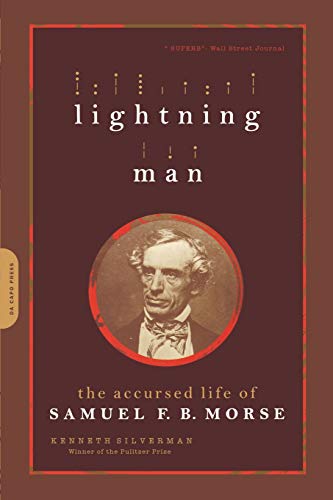
This brilliantly conceived biography is the very American tale of a quiet man, raised by religious zealots, who became a gifted and prolific painter (more than three hundred portraits and historical canvases), became the first Professor of Fine Arts at an American college, and founded the National Academy of Design. A classic overachiever, this was simply not enough for Samuel F. B. Morse; he subsequently ran for Congress and mayor of New York. Lastly, in his most famous life's work, he invented a machine that was to transform commerce, communication, transportation, military affairs, diplomacy, and the course of the modern world. What invention could be so revolutionary? The telegraph, of course-and the eponymous Morse code. Here is the story of an incredible invention, and an engrossing life, by a Bancroft- and Pulitzer Prize-winning author.
Die Inhaltsangabe kann sich auf eine andere Ausgabe dieses Titels beziehen.
Über die Autorin bzw. den Autor
Born and raised in Manhattan, Kenneth Silverman is Professor Emeritus of English at New York University. His other books include Timothy Dwight, A Cultural History of the American Revolution, Edgar A. Poe: Mournful and Never-Ending Remembrance, and Houdini!!! The Life of Ehrich Weiss. He is winner of the Bancroft Prize in American History and the Pulitzer Prize for Biography for The Life and Times of Cotton Mather.
Auszug. © Genehmigter Nachdruck. Alle Rechte vorbehalten.
Lightning Man
The Accursed Life of Samuel F. B. MorseBy Kenneth SilvermanDa Capo Press
Copyright © 2003 Kenneth SilvermanAll right reserved.
ISBN: 0-306-81394-7
Contents
FinleyONE: Geography......................................................3TWO: No One Uninspired by the Muses May Enter.......................21THREE: A Terrible Harum-Scarum Fellow...............................40FOUR: An Affection of the Heart.....................................67MorseFIVE: Il Diavolo....................................................97SIX: Anomalous, Nondescript, Hermaphrodite..........................124SEVEN: High Attribute of Ubiquity...................................147EIGHT: Traveling on a Snail's Back..................................174NINE: Beware of Tricks..............................................192TEN: Hurrah Boys Whip Up the Mules..................................220Samuel F. B. MorseELEVEN: Mere Men of Trade...........................................249TWELVE: Tantalus Still..............................................274THIRTEEN: The Great Telegraph Case..................................297FOURTEEN: A True Social Fraternity..................................325FIFTEEN: Can't! Sir, Can't!.........................................346SIXTEEN: Forward....................................................370CommandadorSEVENTEEN: Is This Treason? Is This Conspiracy?.....................391EIGHTEEN: Visions of Receding Glory.................................415Coda: 1872-2000.....................................................441Documentation.......................................................447Acknowledgments.....................................................483Index...............................................................485Illustration Credits................................................501
Chapter One
Geography (1789-1811)
On April 30, 1789, Jedediah Morse was installed as pastor of the First Congregational Church of Charlestown, Massachusetts. The occasion was triply significant to him. Twenty-seven years old, he had come to his vocation by study at Yale and graduate work in theology. He felt eager to promote the interests of religion but awed to contemplate the degenerate state of his fellow mortals, who every day crucified their Redeemer anew. The labor now to be undertaken by him was worthy but daunting, "a good work," he said, "but alas who is sufficient for these things."
The place mattered to Jedediah no less than the occasion. The First Church was one of the oldest in America, a fit pulpit for a man whose ancestors had emigrated to the New World in 1635, among the first settlers of Puritan New England. The church stood, too, in the shadow of Bunker's Hill. Just fourteen years earlier, armed provincials had defended the hill against three assaults by British infantry and marines.
And for Jedediah, the date was no less symbolic than the place. On the same day, on the balcony of New York City's Federal Hall, George Washington was inaugurated as the first President of the United States and called on the new nation to preserve "the sacred fire of liberty." Jedediah revered him as an epitome of republican virtue-self-sacrificing, pious, restrained, great because he was good, indeed, Jedediah said, "the greatest Man alive."
Two weeks after the momentous day of his settlement, Jedediah married twenty-three-year-old Elizabeth Finley, a granddaughter of the president of Princeton College. In appearance they were unlike, to judge from a later family portrait: Jedediah tall, slender, old-fashioned -looking in his knee breeches and black silk stockings; Elizabeth stoutish, buxom, jowly-"no dwarf," she said of herself. Their personalities differed, too. Jedediah's well-bred manner and sweet voice set him off from his wife's no-nonsense practicality and tart wit. Just the same they made a close, affectionate couple. In letters home he addressed her as "My dearest Life & Love." He borrowed the salutation, he explained, from a letter of George Washington to Martha Washington: "as he is an excellent pattern in almost everything, so in this I would imitate him, believing that my Love for you is as great as his for Mrs. W."
On April 27, 1791, two years after marrying, the couple had their first child, a son whom they named after Elizabeth's father and grandfather: Samuel Finley Breese Morse. Finley, as the family called him, spent his first seven years in the parsonage, a two-story wooden building near the First Church. The household included a pious Baptist servant-nurse, Nancy Shepherd. For a time, a black boy named Abraham also lived with the family, tending the horse and cow. Jedediah ministered to the black population of nearby Boston and publicly condemned the slave trade as inconsistent with republican principles.
Few details of Finley's early childhood remain. When about a year and a half old he contracted smallpox during an epidemic that struck a thousand people in Boston. At the age of four he began attending a dame school near the parsonage. Nancy Shepherd sometimes took him to Bunker's Hill and recounted its historic battle, which she had witnessed.
During the first ten years of their marriage Jedediah and Elizabeth had six more children. Only two survived, Finley's younger brothers Richard and Sidney. In the same period Jedediah became a national figure. While writing sermons and preaching about mankind's fallen state, he issued atlases, school texts, and travel guides with such titles as The American Universal Geography (1793) and The American Gazeteer (1797). He put the books to press, arranged for British editions, looked after sales and distribution, each year publishing a new geography or revision of some earlier one.
Jedediah's geographies became second in popularity only to Noah Webster's spelling books and the Bible. Producing them put him in touch with notable men at home and abroad. He dined in Philadelphia with Benjamin Franklin and at Mount Vernon with George and Martha Washington. His many, far-flung correspondents included John Adams; the Bishop of London; and the French foreign minister, Talleyrand, who also visited him in Charlestown. His publications brought him an honorary degree from the University of Edinburgh and fame as America's pre-eminent geographer. He did not hide his renown. On the title page of American Universal Geography he identified himself as a Doctor of Divinity, Fellow of the American Antiquarian Society, and Fellow of the Historical Society-as "Jedediah Morse, D.D.F.A.A.S.H.S."
Jedediah became prominent in political life as well. Like the rest of the Congregationalist clergy he allied himself with the Federalist party. Against the more liberal, capitalistic social order taking shape in the wake of the American Revolution, he upheld the Calvinistic faith of his New England forebears, whose piety and sense of human dependence on God he considered essential to republican life. He hoped that the new United States would be left to itself, "kept out of the Whirlpool of European Politicks." But there was no insulating the country from the long war for supremacy between Great Britain and Napoleon's France. As the eighteenth century closed, Jedediah like most other Federalists viewed with growing alarm French interference in American affairs: use of American seaports as bases for privateering, attempted bribes to American envoys, manipulation of the American press-especially the export to America of deism, skepticism, Voltairean...
„Über diesen Titel“ kann sich auf eine andere Ausgabe dieses Titels beziehen.
Suchergebnisse für Lightning Man: The Accursed Life Of Samuel F.B. Morse

Beispielbild für diese ISBN
Lightning Man: The Accursed Life Of Samuel F.B. Morse
Verlag:
Grand Central Publishing, 2004
ISBN 10: 0306813947
ISBN 13: 9780306813948
Gebraucht
Softcover
Anbieter: World of Books (was SecondSale), Montgomery, IL, USA
Verkäuferbewertung 5 von 5 Sternen

Zustand: Good. Item in good condition. Textbooks may not include supplemental items i.e. CDs, access codes etc. Artikel-Nr. 00104412214
Gebraucht kaufen
EUR 3,91
Versand gratis
Versand innerhalb von USA
Versand innerhalb von USA
Anzahl: 2 verfügbar
Beispielbild für diese ISBN
Lightning Man: The Accursed Life of Samuel F. B. Morse
Anbieter: ThriftBooks-Dallas, Dallas, TX, USA
Verkäuferbewertung 5 von 5 Sternen
Paperback. Zustand: Very Good. No Jacket. May have limited writing in cover pages. Pages are unmarked. ~ ThriftBooks: Read More, Spend Less. Artikel-Nr. G0306813947I4N00
Gebraucht kaufen
EUR 6,82
Versand gratis
Versand innerhalb von USA
Versand innerhalb von USA
Anzahl: 1 verfügbar
Beispielbild für diese ISBN
Lightning Man: The Accursed Life of Samuel F. B. Morse
Anbieter: ThriftBooks-Atlanta, AUSTELL, GA, USA
Verkäuferbewertung 5 von 5 Sternen
Paperback. Zustand: Very Good. No Jacket. May have limited writing in cover pages. Pages are unmarked. ~ ThriftBooks: Read More, Spend Less. Artikel-Nr. G0306813947I4N00
Gebraucht kaufen
EUR 6,82
Versand gratis
Versand innerhalb von USA
Versand innerhalb von USA
Anzahl: 1 verfügbar
Beispielbild für diese ISBN
Lightning Man: The Accursed Life of Samuel F. B. Morse
Anbieter: ThriftBooks-Atlanta, AUSTELL, GA, USA
Verkäuferbewertung 5 von 5 Sternen
Paperback. Zustand: Good. No Jacket. Pages can have notes/highlighting. Spine may show signs of wear. ~ ThriftBooks: Read More, Spend Less. Artikel-Nr. G0306813947I3N00
Gebraucht kaufen
EUR 6,82
Versand gratis
Versand innerhalb von USA
Versand innerhalb von USA
Anzahl: 1 verfügbar
Beispielbild für diese ISBN
Lightning Man: The Accursed Life of Samuel F. B. Morse
Anbieter: ThriftBooks-Dallas, Dallas, TX, USA
Verkäuferbewertung 5 von 5 Sternen
Paperback. Zustand: Good. No Jacket. Former library book; Pages can have notes/highlighting. Spine may show signs of wear. ~ ThriftBooks: Read More, Spend Less. Artikel-Nr. G0306813947I3N10
Gebraucht kaufen
EUR 6,82
Versand gratis
Versand innerhalb von USA
Versand innerhalb von USA
Anzahl: 1 verfügbar
Beispielbild für diese ISBN
Lightning Man: The Accursed Life of Samuel F. B. Morse
Anbieter: ThriftBooks-Dallas, Dallas, TX, USA
Verkäuferbewertung 5 von 5 Sternen
Paperback. Zustand: Very Good. No Jacket. Former library book; May have limited writing in cover pages. Pages are unmarked. ~ ThriftBooks: Read More, Spend Less. Artikel-Nr. G0306813947I4N10
Gebraucht kaufen
EUR 6,82
Versand gratis
Versand innerhalb von USA
Versand innerhalb von USA
Anzahl: 1 verfügbar
Beispielbild für diese ISBN
Lightning Man : The Accursed Life of Samuel F. B. Morse
Verlag:
Grand Central Publishing, 2004
ISBN 10: 0306813947
ISBN 13: 9780306813948
Gebraucht
Softcover
Anbieter: Better World Books, Mishawaka, IN, USA
Verkäuferbewertung 5 von 5 Sternen
Zustand: Very Good. Pages intact with possible writing/highlighting. Binding strong with minor wear. Dust jackets/supplements may not be included. Stock photo provided. Product includes identifying sticker. Better World Books: Buy Books. Do Good. Artikel-Nr. 12088258-6
Gebraucht kaufen
EUR 7,32
Versand gratis
Versand innerhalb von USA
Versand innerhalb von USA
Anzahl: 2 verfügbar
Beispielbild für diese ISBN
Lightning Man: The Accursed Life Of Samuel F.B. Morse
Verlag:
Grand Central Publishing, 2004
ISBN 10: 0306813947
ISBN 13: 9780306813948
Gebraucht
Paperback
Anbieter: WorldofBooks, Goring-By-Sea, WS, Vereinigtes Königreich
Verkäuferbewertung 5 von 5 Sternen
Paperback. Zustand: Very Good. The book has been read, but is in excellent condition. Pages are intact and not marred by notes or highlighting. The spine remains undamaged. Artikel-Nr. GOR005757613
Gebraucht kaufen
EUR 10,07
EUR 6,52 Versand
Versand von Vereinigtes Königreich nach USA
Versand von Vereinigtes Königreich nach USA
Anzahl: 1 verfügbar
Beispielbild für diese ISBN
Lightning Man: The Accursed Life of Samuel F. B. Morse
Anbieter: Revaluation Books, Exeter, Vereinigtes Königreich
Verkäuferbewertung 5 von 5 Sternen
Trade Paperback. Zustand: Brand New. illustrated edition. 512 pages. 9.00x6.00x1.00 inches. In Stock. Artikel-Nr. x-0306813947
Neu kaufen
EUR 32,68
EUR 14,55 Versand
Versand von Vereinigtes Königreich nach USA
Versand von Vereinigtes Königreich nach USA
Anzahl: 2 verfügbar