
Verwandte Artikel zu New World Coming: The 1920s And The Making Of Modern...
Inhaltsangabe
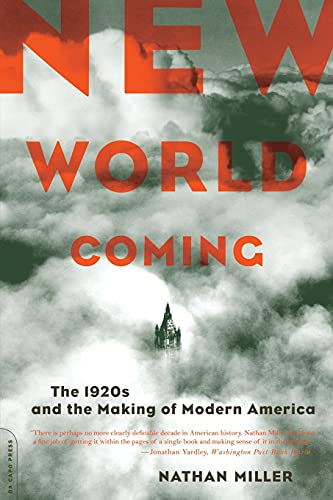
The images of the 1920s have been indelibly imprinted on the American imagination-from jazz, bootleggers, flappers, talkies, the Model T Ford, Babe Ruth, and Charles Lindbergh to the fight for women's right to vote, racial injustice, and the birth of organized crime. Nathan Miller has penned the ultimate introduction to the era. Publishers Weekly calls it "an excellent chronicle of that turbulent, troubled, and tempestuous decade," and Jonathan Yardley's Washington Post review proclaimed this the new classic history of the 1920s, replacing Frederick Lewis Allen's celebrated account.Using the life of F. Scott Fitzgerald as a backdrop, Miller describes the world of Calvin Coolidge, H. L. Mencken, Woodrow Wilson, and the Red Scare in extraordinarily accessible (and frequently witty) writing, New World Coming is destined to become the book we all turn to to recall one of the most beloved eras in American history.
Die Inhaltsangabe kann sich auf eine andere Ausgabe dieses Titels beziehen.
Über die Autorin bzw. den Autor
Nathan Miller is an award-winning journalist and the author of twelve works of history and biography, including Broadside: The Age of Fighting Sail, 1775-1815, FDR: An Intimate History, and War at Sea. He lives in Washington, D.C.
Auszug. © Genehmigter Nachdruck. Alle Rechte vorbehalten.
New World Coming
By Nathan MillerDa Capo Press
Copyright © 2004 Nathan MillerAll right reserved.
ISBN: 9780306813795
Prologue
Prologue
Throughout the pale summer nights of 1919, a light always seemed to be burning in a third-floor front room of a brownstone at 599 Summit Avenue in St. Paul. Sometimes a slim figure paced back and forth across the open windows. Up there, amid the treetops, twenty-two-year-old F. Scott Fitzgerald, subsisting mainly on cigarettes and nervous energy, was working on a novel he desperately hoped would bring him money and acclaim. Not long out of the U.S. Army following the Armistice, which ended World War I, he was being supported by his parents, his career as a writer was stymied, and his girl had broken up with him because she believed he had no prospects.
To get a breath of air, Fitzgerald unlatched a screen on one of the windows and, careful not to disturb the chapter outlines pinned to the curtains, stepped out onto a small landing where he had a sweeping view up and down the boulevard. Summit Avenue crowns a bluff overlooking the Lower Town, St. Paul's business section, and is the spine of the Summit, then the city's most fashionable neighborhood. Nearby, the Roman Catholic Cathedral of St. Paul - Fitzgerald was christened there - crouched at the intersection of Summit and Selby Avenues "like a plump white bulldog." Wooden Queen Annes, Romanesque sandstones, red-brick faux chateaus with fairy-tale towers, and Renaissance palazzos lined the avenue - "a museum of American architectural failures," in his words.
As a child, Fitzgerald mingled with children whose surnames were the same as the streets on which they played - Griggs and MacKubin and Hersey. It was a good time and a good place to grow up. Scott and his companions saw the coming of the automobile and the airplane, the spread of electric lights and the telephone, and for a nickel they could pass an enchanted hour watching the first movies. Nearby, there were still fields to race across and woods in which to gather chestnuts. These were America's "Confident Years" in which Theodore Roosevelt fought trusts and political bosses at home, made the dirt fly on the Panama Canal, and sent the U.S. Navy's white-hulled battleships around the world.
Fitzgerald went to tea dances at the University Club up Summit Avenue and was invited to parties given by the daughter of James J. Hill, the railroad magnate, at her family's nearby thirty-two-room mansion. In later years Fitzgerald was contemptuous of the Summit, but there was a touch of envy in his feelings, for his family had only a tenuous hold on St. Paul society. Throughout his life, he was always haunted by the terror of slipping from the comfortable assurance of this world into poverty.
Edward Fitzgerald, his father, had claim to a past that was brighter than his present. A small, dapper man with a Vandyke and courtly manners, he had come to Minnesota from Maryland, where his family had been prominent in colonial times. Francis Scott Key, the author of "The Star-Spangled Banner," for whom he named his son, was a remote cousin of his mother, but by the elder Fitzgerald's time, the bloodline had thinned. He ran a wicker furniture business and in 1890 married Mary McQuillan, the daughter of a prosperous Irish wholesale grocer. Not long after the couple married, their misfortunes began. The Fitzgeralds' first two children, both girls, died in epidemics, and shortly after Scott's birth, in 1896, the wicker business failed.
Fortunes diminished, the elder Fitzgerald became a salesman for Procter & Gamble and peddled soap powder and other products to stores in various upstate New York towns. He enjoyed only a modest success and the morning mail often contained bills that he crumpled and threw down with a grunted "Confound it." Scott was twelve when his father, then in his fifties, lost even that job. "Dear God," Fitzgerald remembered praying, "please don't let us go to the poorhouse; please don't let us go to the poorhouse." The Fitzgeralds returned to St. Paul, where the family resources lay, to become pensioners of the McQuillans.
A rich maiden aunt paid Scott's tuition at Newman, a Catholic prep school in New Jersey, and at Princeton. Only a few years before, Woodrow Wilson, the university's president, had vainly tried to democratize the school by closing the exclusive eating clubs, but Princeton was "the pleasantest country club in America" according to Fitzgerald. Although he was a Midwesterner, he wasn't a Jew or a "poler," as grinds were known, and made Cottage, one of the more socially select clubs. At the induction party, he passed out cold for the first time in his life. With his friend Edmund Wilson he wrote skits and lyrics for Triangle Club musicals, flounced on stage as a chorus girl, and contributed to The Tiger and Nassau Lit. He neglected his studies, but had larger horizons. "I want to be one of the greatest writers who have ever lived, don't you?" he remarked to Wilson.
Fitzgerald was infatuated with Ginevra King, a beautiful debutante from Lake Forest, outside Chicago. "Flirt smiled from her large black-brown eyes," he later wrote of Ginevra's fictional counterpart. But their relationship was troubled. At a house party in Lake Forest, Fitzgerald overheard someone say, "Poor boys shouldn't think of marrying rich girls." Before long, Ginevra's letters grew less frequent and then stopped altogether. Soon after, she married a man who owned a string of polo ponies. Fitzgerald never forgot Ginevra King - he saved all her letters - and Jay Gatsby's timeless love for Daisy Fay, who also married a man with a string of polo ponies, undoubtedly had its roots in his memory of her.
On academic probation and unlikely to graduate, Fitzgerald was rescued by America's entry into World War I. He obtained a commission as a second lieutenant in the army, and went to war in a trim uniform tailored by Brooks Brothers. He reported to Fort Leavenworth, Kansas, for training, where the captain in charge of his company was a West Pointer with a broad grin named Dwight D. Eisenhower. Fitzgerald envisioned himself as a war hero, but was an inept soldier. He bumbled through close-order drill, slept during lectures on "Trench Behavior" and "The Lewis Gun," and claimed with some justification to be "the world's worst second lieutenant."
Weekends were spent in a corner of the officers club, where amid smoke, conversation, and rattling newspapers, he labored over a novel, The Romantic Egoist, that he had started at Princeton. In a hospital in Italy, nineteen-year-old Ernest Hemingway struggled to recover the use of a leg shattered by an Austrian mortar shell and read and reread the words a British officer had written out for him on a slip of paper: "By my troth, I care not; a man can die but once, we owe God a death.... He that dies this year is quit for the next." In France, Private John Dos Passos, U.S. Army Medical Corps, carried away "buckets full of amputated arms and hands and legs from an operating room." And in Baltimore, Henry L. Mencken tapped out the opening chapter of The American Language on his battered Corona while trucks rumbled under the window of his row house on Union Square day and night, carrying the victims of an influenza pandemic to the cemeteries.
Fitzgerald, overcome by the conviction that he was going to be killed in the war like the British poet Rupert Brooke, saw his book as a chance to leave a record behind. "I lived in the smeary pencil pages" of the novel, he recalled. "The drills, marches and Small Problems for Infantry were a shadowy dream. My whole heart was...
„Über diesen Titel“ kann sich auf eine andere Ausgabe dieses Titels beziehen.
Suchergebnisse für New World Coming: The 1920s And The Making Of Modern...

Beispielbild für diese ISBN
New World Coming: The 1920s And The Making Of Modern America
Anbieter: World of Books (was SecondSale), Montgomery, IL, USA
Verkäuferbewertung 5 von 5 Sternen

Paperback. Zustand: Good. A meticulous, often funny history of an era that continues to obsess Americans of every generation-the Roaring Twenties. Artikel-Nr. 00105579347
Gebraucht kaufen
EUR 4,82
Versand gratis
Versand innerhalb von USA
Versand innerhalb von USA
Anzahl: 6 verfügbar
Beispielbild für diese ISBN
New World Coming: The 1920s And The Making Of Modern America
Anbieter: World of Books (was SecondSale), Montgomery, IL, USA
Verkäuferbewertung 5 von 5 Sternen
Paperback. Zustand: Very Good. A meticulous, often funny history of an era that continues to obsess Americans of every generation-the Roaring Twenties. Artikel-Nr. 00110070485
Gebraucht kaufen
EUR 4,82
Versand gratis
Versand innerhalb von USA
Versand innerhalb von USA
Anzahl: 1 verfügbar
Beispielbild für diese ISBN
New World Coming
Verlag:
Grand Central Publishing (edition Reprint), 2004
ISBN 10: 0306813793
ISBN 13: 9780306813795
Gebraucht
Paperback
Anbieter: BooksRun, Philadelphia, PA, USA
Verkäuferbewertung 5 von 5 Sternen
Paperback. Zustand: Very Good. Reprint. It's a well-cared-for item that has seen limited use. The item may show minor signs of wear. All the text is legible, with all pages included. It may have slight markings and/or highlighting. Artikel-Nr. 0306813793-11-1
Gebraucht kaufen
EUR 5,75
Versand gratis
Versand innerhalb von USA
Versand innerhalb von USA
Anzahl: 1 verfügbar
Beispielbild für diese ISBN
New World Coming : The 1920s and the Making of Modern America
Verlag:
Grand Central Publishing, 2004
ISBN 10: 0306813793
ISBN 13: 9780306813795
Gebraucht
Softcover
Anbieter: Better World Books, Mishawaka, IN, USA
Verkäuferbewertung 5 von 5 Sternen
Zustand: Good. Pages intact with minimal writing/highlighting. The binding may be loose and creased. Dust jackets/supplements are not included. Stock photo provided. Product includes identifying sticker. Better World Books: Buy Books. Do Good. Artikel-Nr. 5867918-6
Gebraucht kaufen
EUR 6,35
Versand gratis
Versand innerhalb von USA
Versand innerhalb von USA
Anzahl: 1 verfügbar
Beispielbild für diese ISBN
New World Coming : The 1920s and the Making of Modern America
Verlag:
Grand Central Publishing, 2004
ISBN 10: 0306813793
ISBN 13: 9780306813795
Gebraucht
Softcover
Anbieter: Better World Books, Mishawaka, IN, USA
Verkäuferbewertung 5 von 5 Sternen
Zustand: Very Good. Pages intact with possible writing/highlighting. Binding strong with minor wear. Dust jackets/supplements may not be included. Stock photo provided. Product includes identifying sticker. Better World Books: Buy Books. Do Good. Artikel-Nr. 4106369-6
Gebraucht kaufen
EUR 6,35
Versand gratis
Versand innerhalb von USA
Versand innerhalb von USA
Anzahl: 2 verfügbar
Beispielbild für diese ISBN
New World Coming: The 1920s And The Making Of Modern America
Anbieter: Wonder Book, Frederick, MD, USA
Verkäuferbewertung 5 von 5 Sternen
Zustand: Good. Good condition. With remainder mark. A copy that has been read but remains intact. May contain markings such as bookplates, stamps, limited notes and highlighting, or a few light stains. Artikel-Nr. L20O-00500
Gebraucht kaufen
EUR 6,42
Versand gratis
Versand innerhalb von USA
Versand innerhalb von USA
Anzahl: 1 verfügbar
Beispielbild für diese ISBN
New World Coming
Anbieter: BookOutlet, Jefferson City, TN, USA
Verkäuferbewertung 5 von 5 Sternen
Paperback. Zustand: New. Paperback. Publisher overstock, may contain remainder mark on edge. Artikel-Nr. 9780306813795B
Neu kaufen
EUR 3,67
EUR 2,90 Versand
Versand innerhalb von USA
Versand innerhalb von USA
Anzahl: Mehr als 20 verfügbar
Foto des Verkäufers
NEW WORLD COMING
Verlag:
Grand Central Publishing, 2004
ISBN 10: 0306813793
ISBN 13: 9780306813795
Gebraucht
Softcover
Anbieter: Goodwill Northern Illinois, Rockford, IL, USA
Verkäuferbewertung 5 von 5 Sternen
Zustand: good. The cover shows wear with possible indentations, creases, and small tears. The pages show wear that may include evidence of handling, smudges, and edge discoloration markings stains . The book may or may not have mild corner dings. The imagery is a stock photo of the item. Artikel-Nr. 4LFI2R000O6R_ns
Gebraucht kaufen
EUR 8,53
Versand gratis
Versand innerhalb von USA
Versand innerhalb von USA
Anzahl: 1 verfügbar
Beispielbild für diese ISBN
New World Coming: The 1920s And The Making Of Modern America
Verlag:
Hachette Books, United States, London, 2004
ISBN 10: 0306813793
ISBN 13: 9780306813795
Gebraucht
Paperback
Anbieter: WorldofBooks, Goring-By-Sea, WS, Vereinigtes Königreich
Verkäuferbewertung 5 von 5 Sternen
Paperback. Zustand: Very Good. The images of the 1920s have been indelibly imprinted on the American imagination-from jazz, bootleggers, flappers, talkies, the Model T Ford, Babe Ruth, and Charles Lindbergh to the fight for women's right to vote, racial injustice, and the birth of organized crime.Nathan Miller has penned the ultimate introduction to the era. Publishers Weekly calls it "an excellent chronicle of that turbulent, troubled, and tempestuous decade," and Jonathan Yardley's Washington Post review proclaimed this the new classic history of the 1920s, replacing Frederick Lewis Allen's celebrated account.Using the life of F. Scott Fitzgerald as a backdrop, Miller describes the world of Calvin Coolidge, H. L. Mencken, Woodrow Wilson, and the Red Scare in extraordinarily accessible (and frequently witty) writing, New World Coming is destined to become the book we all turn to to recall one of the most beloved eras in American history. The book has been read, but is in excellent condition. Pages are intact and not marred by notes or highlighting. The spine remains undamaged. Artikel-Nr. GOR007731945
Gebraucht kaufen
EUR 3,41
EUR 6,63 Versand
Versand von Vereinigtes Königreich nach USA
Versand von Vereinigtes Königreich nach USA
Anzahl: 3 verfügbar
Beispielbild für diese ISBN
New World Coming: The 1920s and the Making of Modern America
Anbieter: Eagle Eye Books, Decatur, GA, USA
Verkäuferbewertung 4 von 5 Sternen

Paper Back. Zustand: Used. Artikel-Nr. 864989
Gebraucht kaufen
EUR 7,34
EUR 3,56 Versand
Versand innerhalb von USA
Versand innerhalb von USA
Anzahl: 1 verfügbar