
Verwandte Artikel zu Project Puffin: The Improbable Quest to Bring a Beloved...
Inhaltsangabe
The inspiring story of a young ornithologist who reintroduced puffins where none had been seen for a century
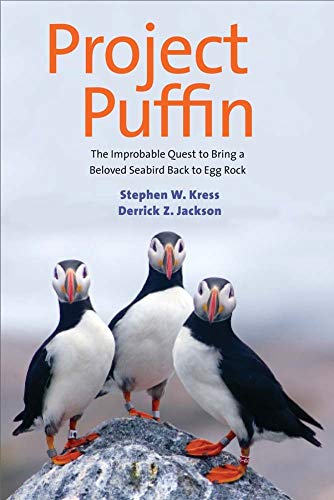
Project Puffin is the inspiring story of how a beloved seabird was restored to long-abandoned nesting colonies off the Maine coast. As a young ornithology instructor at the Hog Island Audubon Camp, Dr. Stephen W. Kress learned that puffins had nested on nearby islands until extirpated by hunters in the late 1800s. To right this environmental wrong, he resolved to bring puffins back to one such island—Eastern Egg Rock. Yet bringing the plan to reality meant convincing skeptics, finding resources, and inventing restoration methods at a time when many believed in “letting nature take its course.”
Today, Project Puffin has restored more than 1,000 puffin pairs to three Maine islands. But even more exciting, techniques developed during the project have helped to restore rare and endangered seabirds worldwide. Further, reestablished puffins now serve as a window into the effects of global warming. The success of Dr. Kress’s project offers hope that people can restore lost wildlife populations and the habitats that support them. The need for such inspiration has never been greater.
Project Puffin is the inspiring story of how a beloved seabird was restored to long-abandoned nesting colonies off the Maine coast. As a young ornithology instructor at the Hog Island Audubon Camp, Dr. Stephen W. Kress learned that puffins had nested on nearby islands until extirpated by hunters in the late 1800s. To right this environmental wrong, he resolved to bring puffins back to one such island—Eastern Egg Rock. Yet bringing the plan to reality meant convincing skeptics, finding resources, and inventing restoration methods at a time when many believed in “letting nature take its course.”
Today, Project Puffin has restored more than 1,000 puffin pairs to three Maine islands. But even more exciting, techniques developed during the project have helped to restore rare and endangered seabirds worldwide. Further, reestablished puffins now serve as a window into the effects of global warming. The success of Dr. Kress’s project offers hope that people can restore lost wildlife populations and the habitats that support them. The need for such inspiration has never been greater.
Die Inhaltsangabe kann sich auf eine andere Ausgabe dieses Titels beziehen.
Über die Autorinnen und Autoren
Stephen W. Kress is the National Audubon Society’s Vice President for Bird Conservation and director of the Audubon Seabird Restoration Program and Hog Island Audubon Camp. Derrick Z. Jackson, a Pulitzer Prize finalist for commentary and an accomplished photographer, is a contributing columnist at the Boston Globe. He lives in Cambridge, MA.
Stephen W. Kress is the National Audubon Society's Vice President for Bird Conservation and director of the Audubon Seabird Restoration Program and Hog Island Audubon Camp. Derrick Z. Jackson, a Pulitzer Prize finalist for commentary and an accomplished photographer, is a contributing columnist at the Boston Globe. He lives in Cambridge, MA.
Auszug. © Genehmigter Nachdruck. Alle Rechte vorbehalten.
Project Puffin
The Improbable Quest to Bring a Beloved Seabird Back to Egg Rock
By Stephen W. Kress, Derrick Z. JacksonYale UNIVERSITY PRESS
Copyright © 2015 Stephen W. Kress and Derrick Z. Jackson
All rights reserved.
ISBN: 978-0-300-20481-0All rights reserved.
Contents
Preface, ix,
Acknowledgments, xiii,
Introduction: My Passion for Puffins, 1,
1 Chasing Skinks, 8,
2 Ghosts of the Gallery, 27,
3 My Judge and Drury, 58,
4 A Suitcase of Puffins, 67,
5 Massacre to Miracle, 90,
6 Soaked Sod and Puffin Condos, 114,
7 Waiting, 138,
8 Triumph or Tragedy?, 170,
9 Puffin ... with Fish!, 188,
10 Roger's Rogue Wave, 200,
11 Filling the Ark, 210,
12 Project Puffin Goes Global, 228,
13 Reconsidering the Balance of Nature, 271,
14 My Skink, Christina's Ducks, and Juliet's Tern Concerto, 296,
Notes, 327,
Bibliography, 333,
Index, 341,
CHAPTER 1
Chasing Skinks
Long before the puffin, there was the skink.
This lizard was my prize of prizes when I was about ten years old, living in Bexley, Ohio, a cozy village embedded within the eastern reaches of Columbus. It was the mid-1950s, a time when families let fourth-graders romp from house to house and disappear for hours in forested parks. Much of my childhood universe occupied what lay under the shaded canopy of Blacklick Woods Metropolitan Park, a twenty-minute drive through farmland from our suburban home. The park was a paradise of some of the least disturbed beech-maple forest and vernal swamps in central Ohio.
My mom, Lina, would drop me off there with a friend, Mac Albin, with nary the concern displayed by today's parents. In fact, I don't know whether to laugh or shake my head in sadness when I read today of the struggle of families to let children explore these woods. In a 2002 article, the Columbus Dispatch wrote how parents and grandparents watch their children play at Blacklick, concerned "that the girls are never completely safe. Not in today's world, where a child can be abducted from a front yard or bedroom." The article quoted Kathy Double of Reynoldsburg, a thirty-six-year-old mother who runs a childcare center for her two children and four others. She said, "When she takes the playgroup to Blacklick the rules are 'If you can't see me, I can't see you. I pick a spot in the park where I can see the whole play area. I follow that old mafia rule: Keep your back to the wall and watch for your enemies.'"
There were no walls for Mac and me as these woods became my best friend. It started in fourth grade when Steve Albin, Mac's older brother, invited Mac and me to come with him to Blacklick for the Saturday morning "Junior Explorers" program. At Blacklick, I found trees, ponds, geology, and birds so interesting that Mac and I asked our parents not to pick us up until hours after Explorers ended so we could ramble on our own. We pleaded with them to take us to the park and drop us off even when Explorers was not in session. The moist swamp forest and vernal pools made Blacklick particularly rich with reptiles and amphibians like wood frogs, spring peepers, and salamanders. Mac and I were never disappointed. Even the tiny fairy shrimp that emerged in the vernal pools after the first spring thaw were cause for getting soaked. The park naturalists were so taken with how happy we were—wet and muddy—that they invited us to help them maintain a trailside collection of native animals.
Our bonus for helping them clean the cages was the gift of snakes, turtles, and even an occasional raccoon for our own backyards. My dad, Herman, who owned a business reconditioning burlap bags for potatoes and plant nurseries, was handy making furniture, and he helped me build terrariums and showed me how to build cages. All that Mom the homemaker asked was that I keep my "zoo" in the backyard or basement. When salamanders and garter snakes got loose in the house, she acted alarmed but ended up using the incident as jolly material at her next canasta game. I began to assume that she vicariously enjoyed my menagerie.
I became especially enchanted with the five-lined skink. They were like no other lizards we encountered, elusive and confined to just a few locations in the park. They were like tiny T rexes, terrorizing beetles, grasshoppers, crickets, and spiders. The young skinks, just three to four inches long, were especially appealing for their neon-blue tails. When we found one sunning on a dead stump, we would admire it for a moment, then pounce on it for capture. But skinks have evolved an amazing method of self-preservation in a world where their predators include a long list of sharp-eyed creatures, including herons, owls, hawks, jays, snakes, skunks, raccoons, and foxes. If it grabs the skink by the tail, the predator soon finds itself holding nothing more than that wiggly tail.
Meanwhile, the skink sprints off to the nearest patch of poison ivy or other ground cover to grow another tail and live another day. The greatest disappointment was to lose the prize and be left holding this wriggling, Day-Glo tail. Outdoor ethics were unknown to me at the time, and, oddly, I don't recall the otherwise sage naturalists talking to us about wildlife conservation.
Another favorite activity for Mac and me was seining up little fish from local creeks for aquariums. Curious to see if fish could distinguish colors, I rigged a fifteen-gallon aquarium with electromagnetic feeding cups on each side of the tank. My idea was to draw the fish to the four corners of the tank in response to a bank of differently colored lights. Each color was paired with a different side of the tank. At first I paired food with light and trained the fish to visit different stations in response to the colors. After the conditioning was complete, the lights alone would send the fish to the appropriate corner of the tank. I had great plans to use the system for developing an intelligence test for fish and to begin a ranking of different species based on the time it would take them to condition to the lights. I thought the experiment was working until someone asked me, "How do you know it isn't the brightness rather than the color they're seeing?" That taught me at an early age that colorful experiments often wind up shaded in gray.
Other people asked me questions that piqued my interest in nature. On a spring day in 1954, at Montrose Elementary School in Bexley, my fourth-grade teacher, Mrs. Reed, spotted a bird down below our second-floor classroom window. She drew the class to the window and asked us, "Who can identify that brown bird poking at the ground?"
I ran to get the dog-eared Golden Guide to birds she kept on her shelf. When the robin-sized bird rose into the air, displaying a white rump and a flash of yellow on its underwing, it was all I needed for a correct answer. That was enough for me to thumb to the drawing of a northern (then called yellow-shafted) flicker. Hence my first success in bird identification! I begged for Golden Guides as birthday and Hanukkah presents, and many nights, my mom would come into my bedroom to make sure I was asleep only to find the light on and a Golden Guide at my pillow or dropped down on the floor under my dangling arm.
Dad acknowledged my enthrallment by bringing home box turtles he found crossing the road while visiting farmers on his bag sales trips. Dad worked long hours, brought home a briefcase of work, and returned to the office on most Saturday mornings. When he did take Saturday off, our best opportunity for one-on-one time was fishing. He was not especially fond of fishing per se—few Jewish businessmen like him bothered with it. But perhaps because his hard-working father, a deli owner, died of pneumonia when Dad was just ten, he was happy to spend time with me, taking me fishing along Big Walnut Creek and other small rivers where we could soak a line.
Because he was not cut out of the L.L.Bean mold, Dad was often impatient even as he tried to please me. After a few casts, there would be the usual proclamation, "There's no fish here. Let's go." Although I was happy to pull in a sparkling sunfish or prickly backed catfish, Dad's time meant more than the actual fishing. One day, his hand was pulled into a printing press at the bag shop. He lost a finger, and a thumb was crushed. When I visited him at the hospital, I cried, but it was not because he was hurt. It was because our fishing date was canceled.
And further truth be told, I was always more interested in amphibians than fish. Many of our sessions started with trying to hook something on the line, but when fishing was slow, I happily turned to pouncing on frogs. The first day I experienced a sense of loss for an animal was on a fishing trip. I was thrilled to find a box turtle sitting by one of our favorite fishing holes. But when I picked it up, its head was gone. Somebody had recently cut it off with a clean slice, leaving just a stump where its head had been. Was it sacrificed for bait? Or was this just a cruel joke? I was devastated.
That day I began to think about my own impact on nature. I thought of all the salamanders I had kidnapped from moist trails and how they had dried up or overheated in my jars. Even as a child, I began to see that I too was a predator and I was having a negative effect on animals.
As these darker thoughts were dawning on me and I was outgrowing Junior Explorers, Mac and I heard there were some serious birdwatchers willing to take a couple of kids to look for hawks and owls. We immediately signed up. It was another late 1950s dream that would be unthinkable today—a stranger with wheels offering to take us to the woods!
Irving Kassoy was no casual community volunteer. He was a member of Columbus's elite Wheaton Club. Founded in 1921, the club was loaded with Ohio State University professors, state natural history museum officials, and writers. It was named after naturalist John Maynard Wheaton, a Columbus physician who was born in 1840 and died of tuberculosis at forty-six. Legend has it that Wheaton's love of nature came about as a child because he kept himself outdoors perpetually seeking fresh air for his diseased lungs.
Kassoy, born in Russia in 1904, was brought by his family to the United States as a toddler and grew up to become a jewelry salesman in Manhattan. Before moving to Columbus, he had established his own business in 1936, selling supplies to diamond dealers. The firm bearing his name still exists in New York City and Long Island; Kassoy, Inc., specializes in microscopes and magnifying loupes for jewelers that compete with the lenses of Zeiss and Bausch & Lomb.
But it was not glistening diamonds dangling from the necks of the rich and famous that stirred Kassoy's deepest passions. It was the darkest corners of woods and buildings. He became such an expert on barn owls that a writer for the New Yorker followed him around for a story in 1936 titled: "Owl Man." The article described him as "a slim little fellow of 32, very pale and somewhat bald. His chin is pointed and his skin is drawn taut from his cheeks up to his wide forehead. You couldn't help noticing his grave eyes because of the thick glasses he wears. Even to one not knowing the nature of his hobby, Mr. Kassoy's general appearance would be hauntingly suggestive of owls" Kassoy was so good at his craft that the publicity manager for the Audubon Society declared, "The National Association of Audubon Societies gets all its owl reports from Mr. Kassoy."
The barn owl was Kassoy's favorite because that species was a year-round city resident. In 1932, he heard about a barn owl nest in the ventilator of an old mansion in Pelham Bay Park in the Bronx. The owl family produced five chicks out of six eggs in the spring of 1933. The next year Kassoy convinced the city parks department to give him a set of keys to the mansion so that he could set up a one-man midnight-owl vigil. He placed a box at an opening of the ventilator, lit the space with a battery-powered light, and fixed into place a one-way glass plate that would let him see into the nest.
Kassoy once took Roger Tory Peterson to the mansion. As Peterson later recounted in Birds over America: "The caretaker believed the house was haunted and I am sure he thought Kassoy was quite mad, sitting up there night after night by himself.... Huddled there were five of the most grotesque owlets I have ever seen, like little monkeys in fuzzy bedclothes, with white caps pulled over their ears.... When I called the owlets grotesque, he was indignant. To him they were beautiful babies.... Night after night, 200 or more, he hunched over his box like some immobile Buddha, his face, reflecting the wan light, the only thing visible in the blackness."
Kassoy and Peterson belonged to the Bronx County Bird Club, arguably the most elite collection of amateur naturalists in the nation. The club started in 1918 with eleven-year-olds thumbing through a bird guide used by a Boy Scout for his birding merit badge. By 1924, when most of them were no older than seventeen, the club had blossomed into a formal organization. One of its purposes was to participate in the Audubon Christmas Bird Count. Kassoy and Allan Cruickshank were two of the nine original members. Another was Joe Hickey, who would take his interest in birds to the University of Wisconsin, where he studied under the father of wildlife management, Aldo Leopold. Hickey wrote an acclaimed bird-watching guide, and his pesticide research in the 1960s was crucial in the banning of DDT. Part of Hickey's concern about DDT came from club cofounder Richard Herbert, who charted the disappearance of peregrine falcons from cliffs along the Hudson River. Peterson joined in 1927. It was remarkable that so much brilliance could come from a bunch of boys, who, as Peterson later remarked, "were addicted to the Hunts Point Dump." Where the rest of New York City's populace saw foul refuse, they found four snowy owls feasting on rats.
By 1950, Kassoy had sold off his jewelry supply business and moved to Columbus so that his wife could be near her family. By weekday, he was an upholsterer. On Saturdays, armed with binoculars and spotting scope, he became my birding superhero, arriving at my front door at dawn in a beige Plymouth station wagon to pick up Mac and me as my parents slept.
We usually first headed off to a local diner for bacon, eggs, and toast. Often there would be another member or two of the Wheaton Club in the car, such as Milt Trautman, the undisputed authority on the fishes of Ohio, or cigar-smoking local artist David Henderson, a great admirer of Francis Lee Jaques, painter of wildlife habitat dioramas at the American Museum of Natural History in New York. Henderson encouraged my own interest in sketching and watercolors of birds and frogs and later gave me several of Jaques's books that were inscribed to him.
For four years, when I was thirteen until sixteen, these men would take me, fall through spring, on their search for rough-legged hawks, short-eared owls, and barn owls, collecting notes on horned larks, white-crowned sparrows, and golden plovers along the Ross-Pickaway County Line Road in southern Ohio.
While other kids played sports, I tromped through corn stubble and grassy fields counting short-eared owls. During the day, these owls roost on the ground, so wed line up side by side, then spread ourselves out in a long, straight line and walk across the field to flush the birds from their communal roost. We would usually see twenty or more of the graceful birds. In late afternoon, we would sometimes see the owls hunting over the fields. Occasionally, we saw them clap their wings under their bodies as part of a courtship display.
In time, I became something of a nephew to Kassoy. He had a cute, curly-haired daughter named Laura on whom I had a secret crush. But she wanted no part of her dad's bird-watching obsession and blamed birds for her parents' divorce. The fact that I was a birder pretty much killed any chance I had with her. Perhaps I was a substitute for the daughter Kassoy would have preferred riding shotgun.
During one of our many car rides, Kassoy shared what he knew about the roots of American birding. Ludlow Griscom, who died in 1959, right about the time these Saturday trips started, had been a friend and mentor to the boys of the Bronx County Bird Club. Griscom, born in 1890, is often credited as inspiring modern bird-watching, since he was among the first to demonstrate that it was possible to identify birds with field glasses instead of blasting them with a shotgun. Legend has it that an old-school shotgun bird collector dared Griscom to prove that he could identify a warbler—possibly in Central Park—on field markings alone. Griscom saw a warbler in a tree and declared it a Cape May. The old-school birder gunned the bird down to the ground, where they both saw that it was indeed a Cape May.
(Continues...)
Excerpted from Project Puffin by Stephen W. Kress, Derrick Z. Jackson. Copyright © 2015 Stephen W. Kress and Derrick Z. Jackson. Excerpted by permission of Yale UNIVERSITY PRESS.
All rights reserved. No part of this excerpt may be reproduced or reprinted without permission in writing from the publisher.
Excerpts are provided by Dial-A-Book Inc. solely for the personal use of visitors to this web site.
„Über diesen Titel“ kann sich auf eine andere Ausgabe dieses Titels beziehen.
Suchergebnisse für Project Puffin: The Improbable Quest to Bring a Beloved...

Beispielbild für diese ISBN
Project Puffin: The Improbable Quest to Bring a Beloved Seabird Back to Egg Rock
Anbieter: World of Books (was SecondSale), Montgomery, IL, USA
Verkäuferbewertung 5 von 5 Sternen

Hardback. Zustand: Very Good. The inspiring story of a young ornithologist who reintroduced puffins where none had been seen for a century. Artikel-Nr. 00110537601
Gebraucht kaufen
EUR 5,49
Versand gratis
Versand innerhalb von USA
Versand innerhalb von USA
Anzahl: 1 verfügbar
Beispielbild für diese ISBN
Project Puffin : The Improbable Quest to Bring a Beloved Seabird Back to Egg Rock
Verlag:
Yale University Press, 2015
ISBN 10: 0300204817
ISBN 13: 9780300204810
Gebraucht
Hardcover
Erstausgabe
Anbieter: Better World Books, Mishawaka, IN, USA
Verkäuferbewertung 5 von 5 Sternen
Zustand: Very Good. 1st Edition. Former library copy. Pages intact with possible writing/highlighting. Binding strong with minor wear. Dust jackets/supplements may not be included. Includes library markings. Stock photo provided. Product includes identifying sticker. Better World Books: Buy Books. Do Good. Artikel-Nr. GRP95983706
Gebraucht kaufen
EUR 8,54
Versand gratis
Versand innerhalb von USA
Versand innerhalb von USA
Anzahl: 1 verfügbar
Beispielbild für diese ISBN
Project Puffin : The Improbable Quest to Bring a Beloved Seabird Back to Egg Rock
Verlag:
Yale University Press, 2015
ISBN 10: 0300204817
ISBN 13: 9780300204810
Gebraucht
Hardcover
Erstausgabe
Anbieter: Better World Books, Mishawaka, IN, USA
Verkäuferbewertung 5 von 5 Sternen
Zustand: Good. 1st Edition. Pages intact with minimal writing/highlighting. The binding may be loose and creased. Dust jackets/supplements are not included. Stock photo provided. Product includes identifying sticker. Better World Books: Buy Books. Do Good. Artikel-Nr. 10730863-75
Gebraucht kaufen
EUR 8,54
Versand gratis
Versand innerhalb von USA
Versand innerhalb von USA
Anzahl: 1 verfügbar
Beispielbild für diese ISBN
Project Puffin : The Improbable Quest to Bring a Beloved Seabird Back to Egg Rock
Verlag:
Yale University Press, 2015
ISBN 10: 0300204817
ISBN 13: 9780300204810
Gebraucht
Hardcover
Erstausgabe
Anbieter: Better World Books, Mishawaka, IN, USA
Verkäuferbewertung 5 von 5 Sternen
Zustand: Good. 1st Edition. Former library copy. Pages intact with minimal writing/highlighting. The binding may be loose and creased. Dust jackets/supplements are not included. Includes library markings. Stock photo provided. Product includes identifying sticker. Better World Books: Buy Books. Do Good. Artikel-Nr. GRP95769715
Gebraucht kaufen
EUR 8,54
Versand gratis
Versand innerhalb von USA
Versand innerhalb von USA
Anzahl: 1 verfügbar
Beispielbild für diese ISBN
Project Puffin : The Improbable Quest to Bring a Beloved Seabird Back to Egg Rock
Verlag:
Yale University Press, 2015
ISBN 10: 0300204817
ISBN 13: 9780300204810
Gebraucht
Hardcover
Erstausgabe
Anbieter: Better World Books: West, Reno, NV, USA
Verkäuferbewertung 5 von 5 Sternen
Zustand: Very Good. 1st Edition. Pages intact with possible writing/highlighting. Binding strong with minor wear. Dust jackets/supplements may not be included. Stock photo provided. Product includes identifying sticker. Better World Books: Buy Books. Do Good. Artikel-Nr. 11243758-75
Gebraucht kaufen
EUR 8,54
Versand gratis
Versand innerhalb von USA
Versand innerhalb von USA
Anzahl: 1 verfügbar
Beispielbild für diese ISBN
Project Puffin: The Improbable Quest to Bring a Beloved Seabird Back to Egg Rock
Anbieter: WorldofBooks, Goring-By-Sea, WS, Vereinigtes Königreich
Verkäuferbewertung 5 von 5 Sternen
Paperback. Zustand: Very Good. The book has been read, but is in excellent condition. Pages are intact and not marred by notes or highlighting. The spine remains undamaged. Artikel-Nr. GOR008712316
Gebraucht kaufen
EUR 31,16
EUR 6,64 Versand
Versand von Vereinigtes Königreich nach USA
Versand von Vereinigtes Königreich nach USA
Anzahl: 1 verfügbar
Beispielbild für diese ISBN
Project Puffin The Improbable Quest to Bring a Beloved Seabird Back to Egg Rock
Anbieter: Revaluation Books, Exeter, Vereinigtes Königreich
Verkäuferbewertung 5 von 5 Sternen
Hardcover. Zustand: Brand New. 352 pages. 8.75x6.00x1.25 inches. In Stock. Artikel-Nr. 0300204817
Neu kaufen
EUR 54,52
EUR 14,82 Versand
Versand von Vereinigtes Königreich nach USA
Versand von Vereinigtes Königreich nach USA
Anzahl: 1 verfügbar