
Verwandte Artikel zu Jefferson's Shadow: The Story of His Science
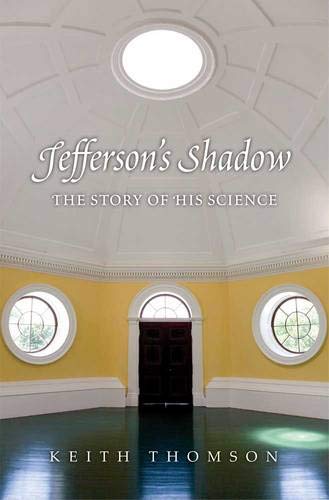
Inhaltsangabe
In the voluminous literature on Thomas Jefferson, little has been written about his passionate interest in science. This new and original study of Jefferson presents him as a consummate intellectual whose view of science was central to both his public and his private life. Keith Thomson reintroduces us in this remarkable book to Jefferson's eighteenth-century world and reveals the extent to which Jefferson used science, thought about it, and contributed to it, becoming in his time a leading American scientific intellectual.
With a storyteller's gift, Thomson shows us a new side of Jefferson. He answers an intriguing series of questions—How was Jefferson's view of the sciences reflected in his political philosophy and his vision of America's future? How did science intersect with his religion? Did he make any original contributions to scientific knowledge?—and illuminates the particulars of Jefferson's scientific endeavors. Thomson discusses Jefferson's theories that have withstood the test of time, his interest in the practical applications of science to societal problems, his leadership in the use of scientific methods in agriculture, and his contributions toward launching at least four sciences in America: geography, paleontology, climatology, and scientific archaeology. A set of delightful illustrations, including some of Jefferson's own sketches and inventions, completes this impressively researched book.
Die Inhaltsangabe kann sich auf eine andere Ausgabe dieses Titels beziehen.
Über die Autorin bzw. den Autor
Keith Thomson is executive officer at the American Philosophical Society and professor emeritus of natural history at the University of Oxford.
Auszug. © Genehmigter Nachdruck. Alle Rechte vorbehalten.
Jefferson's Shadow
The Story of His ScienceBy Keith ThomsonYale University Press
Copyright © 2012 Keith ThomsonAll right reserved.
ISBN: 978-0-300-18403-7
Contents
Preface and Acknowledgments.........................................................ixAuthor's Note.......................................................................xiiiIntroduction........................................................................1ONE Lost: One Large Moose...........................................................9TWO The Man Who Could Not Live Without Books........................................14THREE Schooling, Formal and Informal................................................25FOUR A Measured and Orderly World...................................................38FIVE Science and the Mastodon.......................................................51SIX The Natural History of Virginia and America.....................................62SEVEN Mountains and Shells..........................................................74EIGHT On Fossils and Extinction.....................................................86NINE Europe and the Peoples of America..............................................101TEN Natural History, Slavery, and Race..............................................118ELEVEN The Color of Their Skin......................................................134TWELVE The Paris Years..............................................................145THIRTEEN The Practical Scientist....................................................165FOURTEEN Climate and Geography......................................................179FIFTEEN Redeeming the Wilderness....................................................195SIXTEEN The Unknown West............................................................216SEVENTEEN "His Theories I Cannot Admire"............................................229EIGHTEEN Philosophers Unwelcome.....................................................239NINETEEN Transcendental Truths......................................................252Epilogue. Measuring the Shadow......................................................259Appendix: Jefferson's Letter on Climate to Jean Baptiste Le Roy.....................265Notes...............................................................................271Index...............................................................................305
Chapter One
Lost: One Large Moose
SOMEWHERE IN FRANCE, PERHAPS in Paris, it is possible—just barely possible—that there still exists a set of moose antlers that once belonged to Thomas Jefferson, third president of the United States. They would now be nearly 250 years old, but antlers are made of hard stuff; unless burned in a fire, they should have survived. Where are they? They spanned some four to five feet. The moose they came from had been a very large one, and that was the whole reason they were sent to Paris in the first place.
These antlers had once adorned the head of a moose living in the woods of Vermont. Jefferson, when American minister to France, went to great expense to have them imported to France. When last seen, they were part of the collections of the royal natural history museum, the Cabinet du Roi, in the Jardin des Plantes, having been sent there by Jefferson on October 1, 1787. But they are not there now. Perhaps they were lost, destroyed, or "borrowed" during the upheavals of the French Revolution. Were they ever formally added into the collections? Nobody knows.
The antlers arrived at Le Havre from Portsmouth, New Hampshire, via Southampton, England, in a large crate and were delivered to the Hôtel de Langeac, the rather grand house that Jefferson maintained on the Champs-Élysées. He kept them for only a few days. Although he had spent forty-five English pounds to obtain them, he gave them away almost immediately. Also in the crate were the bones and skin of another American moose, together with "the horns of the Caribou, the elk, the deer, the spiked horned buck, and the Roebuck of America." All were presented to the royal collections; all are now lost. In fact, the moose skin arrived with most of the fur missing and possibly was not worth keeping anyway.
Nothing about Jefferson's moose was quite what it seemed. The antlers did not belong to the same specimen as the skin and the skeleton, which had come from a gigantic moose standing seven feet high at the shoulder. Moose shed their antlers annually, and this one had been shot in the early spring, when the snows were still on the ground and moose were antler-less. So another set of antlers was put into the shipment—still big, but something of a disappointment to Jefferson.
Though sent to the royal collections, the gift was not meant for the king. It was intended for the Comte de Buon, superintendent of the royal collections and the greatest natural historian of the age. Nor was it simply a scientific gift. The whole assemblage, accompanied by a letter written in full courtly style, was a not-so-subtle scientific slap in the face, a challenge to Buon's formidable authority. To use a word with (appropriately) French associations, the gift was an act of American chauvinism. Science was being used, not for the first time and certainly not for the last, as a political weapon.
Jefferson had been trying for a year to get various American friends to find, kill, and send to him a notable specimen of a moose. Finally, his old friend General John Sullivan, a Revolutionary War hero and now president (that is, governor) of New Hampshire, took up the challenge. Sullivan arranged for a troop of soldiers to trek west into Vermont to cull the biggest moose they could find. It was slow work; a road had to be hacked through the snowy forest to get the specimen out. It was prepared according to Jefferson's precise, but inexpert, directions. As Sullivan reported, once the moose had been dressed in the field, "the remaining flesh began to be in a state of putrefaction. Every Engine was set at work to preserve the Bones and Cleanse them from the remaining flesh, and to preserve the skins with the hair on, with the hoofs on and Bones of Legs and thighs in the skin without putrefaction, and the Jobb was both Expensive and Dicult, and such as was never before attempted, in this Quarter. But it was at Last Accomplished exactly agreable to Your Directions, except that the bones of the head are not Left in the skin agreably to your Directions, as it was not possible to preserve them in that Connection, but the head of the skin being whole and well dresst it may be Drawn on at pleasure."
Jefferson was no taxidermist, and if he was a little surprised by the sorry state of the specimens when they arrived, he was even more surprised by the size of the bill. By most measures, forty-five English pounds was the equivalent in modern terms to several thousand dollars. At that time, one could buy (and we know Jefferson did) a pair of silver-mounted pistols for one pound, eighteen pence, and a microscope from Dolland's in London for five pounds, five shillings.
Matters were not improved when the shipment was badly delayed; actually, it was left behind on the dock at Portsmouth in March. This contributed to the decay of the specimens, but when the crate arrived at his house, Jefferson eagerly opened it and laid out the contents, showing them o to every visitor, many of whom may have been surprised to see that such a long-anticipated shipment contained a bunch of odoriferous bones. Then, on the cool, rainy last day of September 1787, everything...
„Über diesen Titel“ kann sich auf eine andere Ausgabe dieses Titels beziehen.
Suchergebnisse für Jefferson's Shadow: The Story of His Science

Beispielbild für diese ISBN
Jefferson's Shadow: The Story of His Science
Anbieter: ThriftBooks-Atlanta, AUSTELL, GA, USA
Verkäuferbewertung 5 von 5 Sternen

Hardcover. Zustand: Very Good. No Jacket. May have limited writing in cover pages. Pages are unmarked. ~ ThriftBooks: Read More, Spend Less. Artikel-Nr. G0300184034I4N00
Gebraucht kaufen
EUR 6,19
Versand gratis
Versand innerhalb von USA
Versand innerhalb von USA
Anzahl: 1 verfügbar
Beispielbild für diese ISBN
Jefferson's Shadow: The Story of His Science
Anbieter: ThriftBooks-Dallas, Dallas, TX, USA
Verkäuferbewertung 5 von 5 Sternen
Hardcover. Zustand: Good. No Jacket. Pages can have notes/highlighting. Spine may show signs of wear. ~ ThriftBooks: Read More, Spend Less. Artikel-Nr. G0300184034I3N00
Gebraucht kaufen
EUR 6,19
Versand gratis
Versand innerhalb von USA
Versand innerhalb von USA
Anzahl: 1 verfügbar
Beispielbild für diese ISBN
Jefferson's Shadow : The Story of His Science
Anbieter: Better World Books, Mishawaka, IN, USA
Verkäuferbewertung 5 von 5 Sternen
Zustand: Very Good. Former library copy. Pages intact with possible writing/highlighting. Binding strong with minor wear. Dust jackets/supplements may not be included. Includes library markings. Stock photo provided. Product includes identifying sticker. Better World Books: Buy Books. Do Good. Artikel-Nr. 3939916-6
Gebraucht kaufen
EUR 9,38
Versand gratis
Versand innerhalb von USA
Versand innerhalb von USA
Anzahl: 1 verfügbar
Beispielbild für diese ISBN
Jefferson's Shadow: The Story of His Science (First Edition)
Verlag:
Yale University Press, New Haven, 2012
ISBN 10: 0300184034
ISBN 13: 9780300184037
Gebraucht
Hardcover
Erstausgabe
Anbieter: Dan Pope Books, West Hartford, CT, USA
Verkäuferbewertung 5 von 5 Sternen
Hardcover. Zustand: Fine. Zustand des Schutzumschlags: Fine. 1st Edition. New Haven, Yale University Press, 2012. First edition. First printing (with full number line including 1). Hardbound. Fine in a fine jacket. A clean tight copy. Comes with archival-quality mylar jacket protector. xiii + 321 pp. Artikel-Nr. Yale-
Gebraucht kaufen
EUR 31,04
EUR 3,87 Versand
Versand innerhalb von USA
Versand innerhalb von USA
Anzahl: 1 verfügbar
Foto des Verkäufers
Jefferson's Shadow: The Story of His Science
Verlag:
Yale University Press, 2012
ISBN 10: 0300184034
ISBN 13: 9780300184037
Gebraucht
Hardcover
Erstausgabe
Anbieter: Southampton Books, Sag Harbor, NY, USA
Verkäuferbewertung 5 von 5 Sternen
Hardcover. Zustand: Like New. First Edition. First Edition, First Printing. Published by Yale University Press, 2012. Octavo. Hardcover. Book is like new. Dust jacket is like new. Great copy of this engaging history title.100% positive feedback. 30 day money back guarantee. NEXT DAY SHIPPING! Excellent customer service. Please email with any questions. All books packed carefully and ship with free delivery confirmation/tracking. All books come with free bookmarks. Ships from Sag Harbor, New York. Artikel-Nr. 401025
Gebraucht kaufen
EUR 44,35
EUR 4,30 Versand
Versand innerhalb von USA
Versand innerhalb von USA
Anzahl: 1 verfügbar