
Verwandte Artikel zu Johnson and Boswell: A Biography of Friendship
Inhaltsangabe
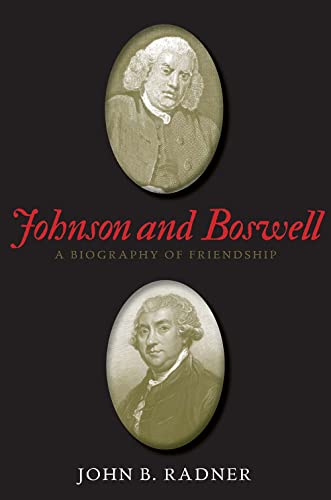
<p>In this book John Radner examines the fluctuating, close, and complex friendship enjoyed by Samuel Johnson and James Boswell, from the day they met in 1763 to the day when Boswell published his monumental <i>Life of Johnson</i>. </p><p>Drawing on everything Johnson and Boswell wrote to and about the other, this book charts the psychological currents that flowed between them as they scripted and directed their time together, questioned and advised, confided and held back. It explores the key longings and shifting tensions that distinguished this from each man's other long-term friendships, while it tracks in detail how Johnson and Boswell brought each other to life, challenged and confirmed each other, and used their deepening friendship to define and assess themselves. It tells a story that reaches through its specificity into the dynamics of most sustained friendships, with their breaks and reconnections, their silences and fresh intimacies, their continuities and transformations.</p>
Die Inhaltsangabe kann sich auf eine andere Ausgabe dieses Titels beziehen.
Über die Autorin bzw. den Autor
<p><b>John B. Radner</b> is associate professor of English emeritus at George Mason University.</p>
Auszug. © Genehmigter Nachdruck. Alle Rechte vorbehalten.
Johnson and Boswell
A BIOGRAPHY OF FRIENDSHIPBy JOHN B. RADNERYale UNIVERSITY PRESS
Copyright © 2012 Yale UniversityAll right reserved.
ISBN: 978-0-300-17875-3
Contents
Preface..............................................................................................................................................ixIntroduction.........................................................................................................................................11 Taking Charge of Boswell (1763)....................................................................................................................112 "Perpetual Friendship"? (1764–1767)...........................................................................................................363 Jostling for Control (1768–1771)..............................................................................................................584 New Collaborations (1772)..........................................................................................................................825 Embracing the Biographer (1772–1773)..........................................................................................................996 Cooperation and Rivalry in Scotland (14 August to 22 November 1773)................................................................................1137 Negotiating and Competing for Narrative Control (14 August to 22 November 1773)....................................................................1328 Collaboration Manqué (November 1773 to May 1775)..............................................................................................1499 Renegotiating the Friendship, Part 1 (1775–1777): Depression, Defiance, and Dependency........................................................16910 Renegotiating the Friendship, Part 2 (1777–1778): Confrontation, Collaboration, and Celebration..............................................19211 "Strangers to Each Other" (May 1778 to March 1781)................................................................................................21412 The Lives of the Poets and Johnson's (Auto)biography (1777–1781).............................................................................23213 Reconnecting (1781–1783).....................................................................................................................24614 "Some Time Together before We Are Parted" (March 1783 to May 1784)................................................................................26515 "Love Me as Well as You Can" (1784)...............................................................................................................28416 Rewriting the Hebrides Trip (1785)................................................................................................................30117 Boswell Claiming His Inheritance (1786–1791).................................................................................................31518 Winning Johnson's Blessing........................................................................................................................339Appendix: Key Events in Lives of Samuel Johnson (SJ) and James Boswell (JB), Days They Were Together, and Letters They Exchanged.....................355Cue Titles and Abbreviations.........................................................................................................................359Notes................................................................................................................................................363Index................................................................................................................................................403
Chapter One
Taking Charge of Boswell (1763)
What did Johnson and Boswell each make of the other when they met on 16 May 1763, and what did each get from their time together during the next twelve weeks? What did their new friendship mean to each when they parted on 6 August? How did this change in the four months before Johnson finally replied to Boswell's August and October letters?
Keeping in mind that much is elusive about why people become friends, I want to begin answering these questions by charting the twenty-two days in 1763 when Johnson and Boswell were with each other, in each case noting where they met, whether they were in company or alone (or both), and whether they were together for just a few minutes (short), for a more substantial conversation (long), for several hours (hours), or for the whole day (all day). I have also included 25 December 1762, the first day Boswell attempted to meet Johnson, and have noted their letters during the final months of 1763.
Even apart from Boswell's reports of what he and Johnson said and did while together, this chart clearly indicates a developing friendship. There was a steady progression in the frequency of contact: from six meetings (three by chance) on five days during the first six weeks — through 26 June — to eighteen meetings on seventeen days during the next six weeks. In the first six weeks, they were only twice together for hours; but in the next three weeks, they spent three evenings together; and they had considerable time together, mostly alone, on eight occasions during the final three weeks. Boswell wrote soon after reaching Holland and again about seven weeks later. But curiously, Johnson responded only in December, four months after the two friends had parted.
Later I argue that what Johnson and Boswell experienced before Boswell left, combined with what happened — and what did not happen — afterward, created the longings that eventually led Boswell to become Johnson's biographer and that inclined Johnson to accept this transforming adjustment. So I want to be as clear as possible about what each experienced in 1763.
Boswell (16 May to 6 August): "Will you really take a charge of me?"
During his first months in London, Boswell delighted in his diverse moods, his whims and openness to new experience, even as he worked at constructing a unified, dignified self. He relished his "sensibility," his "romantic imagination," his capacity to be moved by music and literature and landscape. But he hoped to acquire sufficient resolution and firmness of mind to bear up under disappointments. Early in 1763, he agreed with the flattering declaration by the actor and playwright David Garrick, whom Boswell had met in 1760, that Boswell would "be a very great man," for, as Boswell described himself, "There is a blossom about me of something more distinguished than the generality of Mankind." But he worried that this blossom "will never swell into fruit": "I sometimes indulge noble Reveries of having a Regiment, of getting into parliament, making a figure, and becoming a man of consequence in the state. But these are checked by dispiriting reflections on my melancholy temper and imbecility of mind." Seeing himself as a work in process, Boswell hoped to "become sounder & stronger as I grow up."
To facilitate his progress Boswell had repeatedly sought authority and guidance from older men such as West Digges, a Scottish actor; Lord Kames, a Scottish philosopher and judge; and Sir John Pringle, a Scottish physician and Lord Auchinleck's oldest friend, though he also tried to maintain some "independency." Thomas Sheridan, an Irish actor and teacher of elocution, had been Boswell's mentor — "My Socrates" — from the summer of 1761 up through January 1763, when he rejected Boswell's prologue for his wife's play, at which point Boswell approached Sir David Dalrymple, a lawyer and scholar respected by both Boswell and his father, who in 1762 had witnessed the agreement to let his father appoint trustees should Boswell inherit Auchinleck before he had proved capable of self-control. On 10 February 1763, Boswell asked Dalrymple to "take a charge" of him: to "let me know what books to read, & what company to keep, and how to conduct myself." His "precepts might do me good," Boswell added, and "I might follow them just as far as I thought them right," since Dalrymple in Scotland would not see any deviations. At Dalrymple's suggestion, they wrote every week for the next six months.
In May, realizing he had no chance for a commission in the Foot Guards, Boswell asked Dalrymple to help negotiate a peace with his father. Partly because of Dalrymple's intercession, but chiefly because of Boswell's conciliatory letter, which suggested he was "a little settled from [his] reelings," Lord Auchinleck agreed to allow his heir two years of study and travel abroad before returning home for further study and the practice of law. (Lord Auchinleck had studied law at Leyden, but Dalrymple suggested Utrecht, where he had studied.) At the end of this letter, Lord Auchinleck urged Boswell to "find out some person of worth who may be a friend, not one who will say as you say when with you, and when he is away will make a jest of you as much as any other." Two months before Boswell read these words, William Temple, a close friend from college in Edinburgh, had come to London, and was with Boswell on about half the days from 2 April through 7 July. Though more "liberal" than five years before, Temple still encouraged Boswell's "fixing on some plan of life." He advised Boswell to "force [himself] to be reserved & grave" and provided occasions to be "rational & composed, yet lively & entertaining." On 9 June, a day after his father's letter arrived, Temple endorsed Boswell's decision to study law and assured his friend he "might live like Sir David Dalrymple at Edinburgh; be at London three months in the year, and live more comfortably than if [he] pushed the scheme of the Guards."
Temple was a sobering, calming influence, just the sort of friend Lord Auchinleck had hoped Boswell would find. Before Temple left for Cambridge early in July, Samuel Johnson had also begun to assume this role.
At first, Boswell seems not to have been especially eager to reconnect with Johnson. He reported being "sorry" on 16 May at having to leave the lively conversation; but he delayed visiting Johnson for more than a week. On 24 May, Johnson received Boswell "very courteously" into his "very solemn and very slovenly" chambers, and spoke with such authority about the "very strong evidences" for Christianity that Boswell "listened to this great Oracle with much satisfaction," and resolved in the entry for 24 May to "cultivate this acquaintance." But they next met twenty days later, when Boswell once again stopped by Johnson's. When they then parted, Boswell reported that Johnson "shook me by the hand at parting, & asked me why I did not call oftener." But despite this explicit encouragement, and Boswell's awareness of the benefit of their connection — "I am never with this man without feeling myself bettered & rendered happier" — twelve days passed before their next sustained conversation.
About this time, however, Boswell began seeking extended time alone with Johnson. According to the Life, as they parted on 13 June, Johnson promised to spend an evening with Boswell at the Mitre tavern, without designating a date. When they met by chance at 1 a.m. on 16 June, Boswell suggested their going then, but Johnson knew they would not be admitted so late. He offered to go "another night with all my heart," but nothing was scheduled. Two days later, Boswell planned to call on Johnson: "Be fine & appoint him to sup with you next week. Think of telling him your imbecility — your disposition to ridicule &c. & take his advice." Having initially sought Johnson as a London celebrity, and then as a reassuring authority, an energizing intellect, Boswell now wished to recast him as a mentor, complementing Dalrymple in the role once played by Sheridan. Having agreed with his father to abandon the Guards scheme and to practice law in Scotland after study and travel abroad, Boswell hoped Johnson would provide a plan for the time he had been given.
If Boswell stopped by on 18 June, Johnson must have been out. But there is no record of Boswell's trying to connect until he saw Johnson a week later at Clifton's chophouse and arranged to meet him that evening. Then, as they talked from nine until after one, Boswell confessed much more than his "imbecility" and "disposition to ridicule," asked for more than a plan of study, and heard much more than advice. During these hours, their relationship significantly deepened, and Boswell "went home in high exultation."
Until 28 July, Boswell continued to initiate their contacts, stopping by for visits and arranging tavern suppers. Boswell invited others to join them at their next two suppers: Johnson's friend Goldsmith on 1 July, and Goldsmith again on 6 July, along with Davies and two others — though, curiously, not Temple, who would return the next day to Cambridge. On 11 July, however, Boswell's memorandum reads, "see Johnson soon & consult on Plan fully and be as oft wt. him as you can"; and on 14 July, Boswell and Johnson spent a second long evening alone at the Mitre. They solidified their friendship by returning to all the topics raised on 25 June, confirmed that they were "very good Companions," and self-consciously agreed that two bottles of port "would seem to be the quantity for us." On 20 July, their next evening together, Boswell invited his eccentric uncle, John Boswell, M.D., and his friend George Dempster, a Scottish lawyer and member of Parliament. But from that point on, the two new friends were mostly alone, spending six additional evenings together before they parted on the beach at Harwich.
When with others, they discussed a range of literary and political topics, on which Johnson spoke with authority and rebutted challenges. When alone, their talk regularly returned to the topics that Boswell had raised when they were first alone — his doubts about religion, his relationship with Lord Auchinleck, and his "plan of study" — on all of which Johnson offered advice and arguments grounded in his own experience. They also discussed their friendship, hoping it would survive the coming separation.
From the start, Boswell was impressed with Johnson's energy and power of mind, his "great Knowledge," and "that strength of Sentiment & perspicuity of expression for which he is remarkable." No one else had such range and forcefulness. Johnson established his authority by seeking fundamental explanations, general principles, springs of actions, as when he offered "strong reasons" to justify Boswell's "strong monarchical Inclinations." He also drew significant conclusions from "the most trivial matters," as when Boswell's report of a man (also named Johnson) riding at full gallop while standing first on one horse and then on two showed what could be achieved through "industry and application" and should inspire everyone to become "equally expert in whatever profession he chose to pursue." Even "lively enough" talk appeared "very trifling after being with Mr. Johnson," and the entries reporting their conversations — conversations also described in letters to Temple, Dalrymple, and Lieutenant Andrew Erskine — were generally much fuller than others.
Johnson was all that Sheridan and Kames and Dalrymple had been — and more. He was wiser — or at least deeper delving — than anyone Boswell had met, and more consistently alert and lively. Boswell described Johnson as a "great Oracle," a "great man." But he was facetious, too, and exuberant, as when he imagined all the outrageous things Boswell might do if his surly landlord tried to hold him to the lease on rooms he now wished to vacate. Also Johnson clearly identified with Boswell, which none of his other mentors seem to have done, and Johnson's autobiographical revelations made him a heartening example. Johnson, too, had not always been an assured Christian, but now was a firm believer; and Boswell echoed Johnson when he wrote Dalrymple that his own past "skepticism was not owing to thinking wrong, but to not thinking at all." Johnson also knew from experience that struggle between a son and a father was unavoidable, but he confidently anticipated harmony once Boswell — "at thirty" — had become what Lord Auchinleck wanted him to be now.
Johnson also reassuringly emphasized his indolence. Having initially promised to devise a plan of study for Boswell, he later reported having never followed a plan for more than two days. Instead, he advised Boswell simply "to read just as inclination prompted," to set aside "five hours a day for study, and in these hours gratify whatever literary desires may spring up." When Boswell worried he had been away from books so long that he had lost all interest in reading, Johnson reported that he, too, "allways felt an inclination to do nothing." ("He says he has led but an idle life," Boswell wrote Temple; "think ... of that.") When Boswell marveled that "the most indolent man in Britain had written the most laborious work, The English Dictionary," Johnson said that "if he had applied properly," he might have done it in three years rather than ten.
Johnson also encouraged Boswell to "keep a journal of [his] life, fair and undisguised," something he himself had often unsuccessfully resolved to do. According to Boswell, Johnson "said it would be a very good exercise, and would yield me infinite Satisfaction, when the ideas were faded from my Remembrance." Lord Auchinleck was baffled that "a lad of sense and come to age should be so childish as to keep a register of his follies and communicate it to others as if proud of them," and Temple initially feared that writing a journal would make Boswell "hunt about for adventures to adorn it with" instead of being "calm & studious and regular in [his] conduct." But Johnson endorsed the reflective, self-defining writing Boswell been doing for more than ten months. And when Boswell "gave him a specimen" to read — probably the entry for 6 July, which reports their morning discussion of Boswell's rude landlord, then some of the wide-ranging talk that night, when "Mr. Johnson was exceeding good company" and Boswell "gently assisted conversation by those little arts which serve to make people throw out their sentiments with ease and freedom" — Johnson "laughed placid, and said very well." Boswell reported this sharing only to Erskine, who earlier had approved the journal. But he wrote Dalrymple that Johnson encouraged keeping a journal, assuming he would tell his father.
Boswell also learned that Johnson had achieved so much despite suffering, like Boswell, from debilitating depression. On the same day he first told Johnson of his religious doubts and his troubles with Lord Auchinleck, Boswell wrote Dalrymple that he had "at bottom a melancholy cast, which dissipation relieves by making me thoughtless, and therefore an easier, tho' a more contemptible, animal." Four weeks later, when he finally told Johnson he was "much afflicted with Melancholy which was hereditary" — his grandfather, but not his father, had been prone to depression — Boswell was heartened to hear that Johnson, too, "had been greatly distressed with it, & for that reason had been obliged to fly from Study and Meditation to the dissipating variety of life." Unlike Lord Auchinleck and all his previous mentors, Johnson was a fellow depressive. Based on his experience, Johnson urged Boswell "to have constant Occupation of mind, to take a great deal of exercise, and to live moderately; especially to shun drinking at night." Boswell had recently given similar advice to his melancholy friend Johnston of Grange, and he had resolved to avoid taverns — except with Johnson, and the poet Charles Churchill. But it gave him "great relief" to discuss his melancholy with Johnson, "that strange satisfaction which human Nature feels at the idea of participating distress with others." Johnson's suffering from melancholy was especially reassuring because he had nevertheless written so much and so well, and had achieved such coherence of character.
(Continues...)
Excerpted from Johnson and Boswellby JOHN B. RADNER Copyright © 2012 by Yale University. Excerpted by permission of Yale UNIVERSITY PRESS. All rights reserved. No part of this excerpt may be reproduced or reprinted without permission in writing from the publisher.
Excerpts are provided by Dial-A-Book Inc. solely for the personal use of visitors to this web site.
„Über diesen Titel“ kann sich auf eine andere Ausgabe dieses Titels beziehen.
Suchergebnisse für Johnson and Boswell: A Biography of Friendship

Beispielbild für diese ISBN
Johnson and Boswell: A Biography of Friendship
Anbieter: ThriftBooks-Dallas, Dallas, TX, USA
Verkäuferbewertung 5 von 5 Sternen

Hardcover. Zustand: Very Good. No Jacket. May have limited writing in cover pages. Pages are unmarked. ~ ThriftBooks: Read More, Spend Less. Artikel-Nr. G0300178751I4N00
Gebraucht kaufen
EUR 6,42
Versand gratis
Versand innerhalb von USA
Versand innerhalb von USA
Anzahl: 1 verfügbar
Beispielbild für diese ISBN
Johnson and Boswell : A Biography of Friendship
Anbieter: Better World Books, Mishawaka, IN, USA
Verkäuferbewertung 5 von 5 Sternen
Zustand: Good. Former library copy. Pages intact with minimal writing/highlighting. The binding may be loose and creased. Dust jackets/supplements are not included. Includes library markings. Stock photo provided. Product includes identifying sticker. Better World Books: Buy Books. Do Good. Artikel-Nr. 7537561-6
Gebraucht kaufen
EUR 7,59
Versand gratis
Versand innerhalb von USA
Versand innerhalb von USA
Anzahl: 1 verfügbar
Beispielbild für diese ISBN
Johnson and Boswell : A Biography of Friendship
Anbieter: Better World Books, Mishawaka, IN, USA
Verkäuferbewertung 5 von 5 Sternen
Zustand: Good. Pages intact with minimal writing/highlighting. The binding may be loose and creased. Dust jackets/supplements are not included. Stock photo provided. Product includes identifying sticker. Better World Books: Buy Books. Do Good. Artikel-Nr. 13404394-75
Gebraucht kaufen
EUR 7,59
Versand gratis
Versand innerhalb von USA
Versand innerhalb von USA
Anzahl: 1 verfügbar
Beispielbild für diese ISBN
Johnson and Boswell: A Biography of Friendship
Anbieter: Books From California, Simi Valley, CA, USA
Verkäuferbewertung 4 von 5 Sternen

hardcover. Zustand: Very Good. Artikel-Nr. mon0004179366
Gebraucht kaufen
EUR 17,46
EUR 4,46 Versand
Versand innerhalb von USA
Versand innerhalb von USA
Anzahl: 1 verfügbar
Beispielbild für diese ISBN
Johnson and Boswell: A Biography of Friendship
Anbieter: Windows Booksellers, Eugene, OR, USA
Verkäuferbewertung 5 von 5 Sternen
Hardcover with dust jacket. VG/VG. Very good. 415 pages. 415 pp. Artikel-Nr. 595937
Gebraucht kaufen
EUR 15,65
EUR 6,70 Versand
Versand innerhalb von USA
Versand innerhalb von USA
Anzahl: 1 verfügbar
Beispielbild für diese ISBN
Johnson and Boswell: A Biography of Friendship (First Edition)
Verlag:
Yale University Press (New Haven), 2013
ISBN 10: 0300178751
ISBN 13: 9780300178753
Neu
Hardcover
Erstausgabe
Anbieter: Dan Pope Books, West Hartford, CT, USA
Verkäuferbewertung 5 von 5 Sternen
Hardcover. Zustand: New. Zustand des Schutzumschlags: New. 1st Edition. First edition, first printing (indicated by full number sequence, including the 1). Hardbound. BRAND NEW! Fine in a fine dust jacket. A tight, clean copy, new and unread. NOT price-clipped. Comes with archival-quality mylar dust jacket protector. Shipped in well padded box. Artikel-Nr. university-press-yale-01
Neu kaufen
EUR 23,01
EUR 4,02 Versand
Versand innerhalb von USA
Versand innerhalb von USA
Anzahl: 1 verfügbar
Foto des Verkäufers
Johnson and Boswell: A Biography of Friendship
Anbieter: Bookbot, Prague, Tschechien
Verkäuferbewertung 5 von 5 Sternen
Hardcover. Zustand: Fine. Leichte Gebrauchsspuren; Leichte Verschmutzung / Farbtonveränderung. In this book John Radner examines the fluctuating, close, and complex friendship enjoyed by Samuel Johnson and James Boswell, from the day they met in 1763 to the day when Boswell published his monumental Life of Johnson . Drawing on everything Johnson and Boswell wrote to and about the other, this book charts the psychological currents that flowed between them as they scripted and directed their time together, questioned and advised, confided and held back. It explores the key longings and shifting tensions that distinguished this from each man's other long-term friendships, while it tracks in detail how Johnson and Boswell brought each other to life, challenged and confirmed each other, and used their deepening friendship to define and assess themselves. It tells a story that reaches through its specificity into the dynamics of most sustained friendships, with their breaks and reconnections, their silences and fresh intimacies, their continuities and transformations. Artikel-Nr. a7748b9d-248c-4bc9-a327-063913cbc75b
Gebraucht kaufen
EUR 12,48
EUR 18,99 Versand
Versand von Tschechien nach USA
Versand von Tschechien nach USA
Anzahl: 1 verfügbar
Foto des Verkäufers
Johnson & Boswell ; A Biography of Friendship
Verlag:
Yale University Press, USA, 2012
ISBN 10: 0300178751
ISBN 13: 9780300178753
Gebraucht
Hardcover
Erstausgabe
Anbieter: powellbooks Somerset UK., Ilminster, SOM, Vereinigtes Königreich
Verkäuferbewertung 3 von 5 Sternen

Hardcover. Zustand: Very Good. Zustand des Schutzumschlags: Very Good. 1st Edition. In this book John Radner examines the fluctuating, close , and complex friendship enjoyed by Samuel Johnson and James Boswell, from the day they met in 1763 to the day Boswell published his monumental " Life of Johnson" The maroon boards and text block are good, clean and tight, the dust jacket is also very good. All book prices include 2nd class tracked and signed for postage UK Only. Artikel-Nr. 06671
Gebraucht kaufen
EUR 22,21
EUR 39,54 Versand
Versand von Vereinigtes Königreich nach USA
Versand von Vereinigtes Königreich nach USA
Anzahl: 1 verfügbar
Beispielbild für diese ISBN
Johnson and Boswell : A Biography of Friendship : ()
Anbieter: Asano Bookshop, Nagoya, AICHI, Japan
Verkäuferbewertung 4 von 5 Sternen
Hardcover. Zustand: New. Examines the fluctuating, close, and complex friendship enjoyed by Samuel Johnson and James Boswell, from the day they met in 1763 to the day when Boswell published his monumental "Life of Johnson". This book charts the psychological currents that flowed between them as they scripted and directed their time together. Artikel-Nr. a26470
Neu kaufen
EUR 41,41
EUR 33,06 Versand
Versand von Japan nach USA
Versand von Japan nach USA
Anzahl: 1 verfügbar
Beispielbild für diese ISBN
Johnson and Boswell : A Biography of Friendship : ()
Anbieter: Asano Bookshop, Nagoya, AICHI, Japan
Verkäuferbewertung 4 von 5 Sternen
Zustand: Brand New. Examines the fluctuating, close, and complex friendship enjoyed by Samuel Johnson and James Boswell, from the day they met in 1763 to the day when Boswell published his monumental "Life of Johnson". This book charts the psychological currents that flowed between them as they scripted and directed their time together. Artikel-Nr. a26852
Neu kaufen
EUR 73,63
EUR 33,06 Versand
Versand von Japan nach USA
Versand von Japan nach USA
Anzahl: 1 verfügbar