
Verwandte Artikel zu Wetware: A Computer in Every Living Cell
Inhaltsangabe
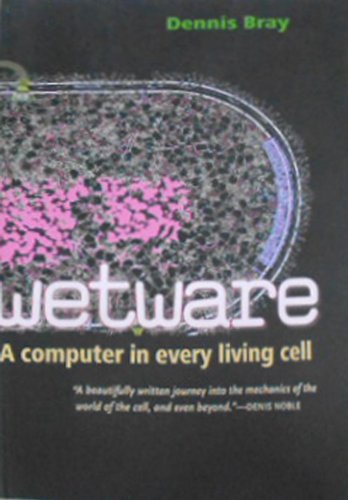
In the tradition of as Erwin Schrödinger’s What Is Life? and Richard Dawkins’s The Selfish Gene, a distinguished cell biologist explains how living cells perform computations
How does a single-cell creature, such as an amoeba, lead such a sophisticated life? How does it hunt living prey, respond to lights, sounds, and smells, and display complex sequences of movements without the benefit of a nervous system? This book offers a startling and original answer.
In clear, jargon-free language, Dennis Bray taps the findings of the new discipline of systems biology to show that the internal chemistry of living cells is a form of computation. Cells are built out of molecular circuits that perform logical operations, as electronic devices do, but with unique properties. Bray argues that the computational juice of cells provides the basis of all the distinctive properties of living systems: it allows organisms to embody in their internal structure an image of the world, and this accounts for their adaptability, responsiveness, and intelligence.
In Wetware, Bray offers imaginative, wide-ranging and perceptive critiques of robotics and complexity theory, as well as many entertaining and telling anecdotes. For the general reader, the practicing scientist, and all others with an interest in the nature of life, the book is an exciting portal to some of biology’s latest discoveries and ideas.
Die Inhaltsangabe kann sich auf eine andere Ausgabe dieses Titels beziehen.
Über die Autorin bzw. den Autor
Dennis Bray is professor emeritus, University of Cambridge, and coauthor of several influential texts on molecular and cell biology. In 2007, he was awarded the prestigious European Science Prize in Computational Biology.
„Über diesen Titel“ kann sich auf eine andere Ausgabe dieses Titels beziehen.
Suchergebnisse für Wetware: A Computer in Every Living Cell

Beispielbild für diese ISBN
Wetware: A Computer in Every Living Cell
Anbieter: Books From California, Simi Valley, CA, USA
Verkäuferbewertung 4 von 5 Sternen

paperback. Zustand: Good. Ex-library copy with usual markings. Artikel-Nr. mon0004239890
Gebraucht kaufen
EUR 16,07
EUR 4,47 Versand
Versand innerhalb von USA
Versand innerhalb von USA
Anzahl: 1 verfügbar
Beispielbild für diese ISBN
Wetware: A Computer in Every Living Cell
Anbieter: WorldofBooks, Goring-By-Sea, WS, Vereinigtes Königreich
Verkäuferbewertung 5 von 5 Sternen

Paperback. Zustand: Very Good. The book has been read, but is in excellent condition. Pages are intact and not marred by notes or highlighting. The spine remains undamaged. Artikel-Nr. GOR005560030
Gebraucht kaufen
EUR 16,34
EUR 6,72 Versand
Versand von Vereinigtes Königreich nach USA
Versand von Vereinigtes Königreich nach USA
Anzahl: 1 verfügbar
Beispielbild für diese ISBN
Wetware
Anbieter: PBShop.store US, Wood Dale, IL, USA
Verkäuferbewertung 5 von 5 Sternen
PAP. Zustand: New. New Book. Shipped from UK. Established seller since 2000. Artikel-Nr. GB-9780300167849
Beispielbild für diese ISBN
Wetware
Anbieter: PBShop.store UK, Fairford, GLOS, Vereinigtes Königreich
Verkäuferbewertung 5 von 5 Sternen
PAP. Zustand: New. New Book. Shipped from UK. Established seller since 2000. Artikel-Nr. GB-9780300167849
Neu kaufen
EUR 23,59
EUR 6,02 Versand
Versand von Vereinigtes Königreich nach USA
Versand von Vereinigtes Königreich nach USA
Anzahl: 3 verfügbar
Beispielbild für diese ISBN
Wetware: A Computer in Every Living Cell
Anbieter: Kennys Bookstore, Olney, MD, USA
Verkäuferbewertung 5 von 5 Sternen
Zustand: New. How does a single-cell creature, such as an amoeba, lead such a sophisticated life? How does it hunt living prey, respond to lights, sounds, and smells, and display complex sequences of movements without the benefit of a nervous system? This book offers a startling and original answer. Num Pages: 280 pages, 23 black-&-white illustrations. BIC Classification: PSA; PSF. Category: (G) General (US: Trade). Dimension: 231 x 156 x 19. Weight in Grams: 400. . 2011. Paperback. . . . . Books ship from the US and Ireland. Artikel-Nr. V9780300167849
Neu kaufen
EUR 24,08
EUR 9,41 Versand
Versand innerhalb von USA
Versand innerhalb von USA
Anzahl: 12 verfügbar
Beispielbild für diese ISBN
Wetware
Anbieter: Majestic Books, Hounslow, Vereinigtes Königreich
Verkäuferbewertung 4 von 5 Sternen
Zustand: New. pp. 280 23 Illus. Artikel-Nr. 3449129
Neu kaufen
EUR 26,02
EUR 7,80 Versand
Versand von Vereinigtes Königreich nach USA
Versand von Vereinigtes Königreich nach USA
Anzahl: 3 verfügbar
Beispielbild für diese ISBN
Wetware A Computer in Every Living Cell
Anbieter: Revaluation Books, Exeter, Vereinigtes Königreich
Verkäuferbewertung 5 von 5 Sternen
Paperback. Zustand: Brand New. 280 pages. 9.84x5.91x0.59 inches. In Stock. Artikel-Nr. __0300167849
Neu kaufen
EUR 22,58
EUR 12,00 Versand
Versand von Vereinigtes Königreich nach USA
Versand von Vereinigtes Königreich nach USA
Anzahl: 2 verfügbar
Foto des Verkäufers
Wetware : A Computer in Every Living Cell
Anbieter: GreatBookPricesUK, Woodford Green, Vereinigtes Königreich
Verkäuferbewertung 5 von 5 Sternen
Zustand: As New. Unread book in perfect condition. Artikel-Nr. 9164598
Gebraucht kaufen
EUR 23,34
EUR 18,00 Versand
Versand von Vereinigtes Königreich nach USA
Versand von Vereinigtes Königreich nach USA
Anzahl: 1 verfügbar
Beispielbild für diese ISBN
Wetware: A Computer in Every Living Cell
Anbieter: Ria Christie Collections, Uxbridge, Vereinigtes Königreich
Verkäuferbewertung 5 von 5 Sternen
Zustand: New. In English. Artikel-Nr. ria9780300167849_new
Neu kaufen
EUR 28,68
EUR 13,55 Versand
Versand von Vereinigtes Königreich nach USA
Versand von Vereinigtes Königreich nach USA
Anzahl: 15 verfügbar
Foto des Verkäufers
Wetware: a computer in every living cell.
Verlag:
New Haven: Yale University Press, 2009., 2011
ISBN 10: 0300167849
ISBN 13: 9780300167849
Gebraucht
Softcover
Anbieter: Andrew Isles Natural History Books, Prahran, VIC, Australien
Verkäuferbewertung 5 von 5 Sternen
Octavo, paperback,267 pp.,illustrations. How does a single-cell creature, such as an amoeba, lead such a sophisticated life? How does it hunt living prey, respond to lights, sounds, and smells, and display complex sequences of movements without the benefit of a nervous system? This book offers a startling and original answer. In clear, jargon-free language, Dennis Bray taps the findings of the new discipline of systems biology to show that the internal chemistry of living cells is a form of computation. Cells are built out of molecular circuits that perform logical operations, as electronic devices do, but with unique properties. Bray argues that the computational juice of cells provides the basis of all the distinctive properties of living systems: it allows organisms to embody in their internal structure an image of the world, and this accounts for their adaptability, responsiveness, and intelligence. Artikel-Nr. 32082
Gebraucht kaufen
EUR 19,47
EUR 27,78 Versand
Versand von Australien nach USA
Versand von Australien nach USA
Anzahl: 1 verfügbar