
Verwandte Artikel zu Julius Caesar: Fully annotated, with an Introduction...
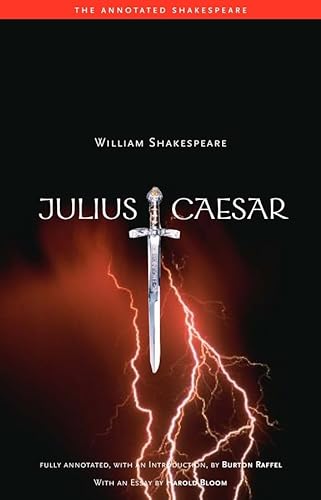
Julius Caesar: Fully annotated, with an Introduction by Burton Raffel (The Annotated Shakespeare) - Softcover
Inhaltsangabe
The Annotated Shakespeare Series allowsreaders to fully understand and enjoy the rich plays of the world&;s greatest dramatist
The first tragedy to be played in the new Globe Theatre, Julius Caesar is set at a crucial turning point in Roman history, as the Republican gives way to the imperial. Safely removed in time and place from Shakespeare&;s Elizabethan England, Rome makes the perfect laboratory for the playwright&;s free-ranging political analysis.
This fully annotated version of Julius Caesar makesthe play completely accessible to readers in the twenty-first century. It has been carefully assembled with students, teachers, and the general reader in mind. Eminent linguist and translator Burton Raffel offers generous help with vocabulary and usage of Elizabethan English, pronunciation, prosody, and alternative readings of phrases and lines. His on-page annotations provide readers with all the tools they need to comprehend the play and begin to explore its many possible interpretations. 
The first tragedy to be played in the new Globe Theatre, Julius Caesar is set at a crucial turning point in Roman history, as the Republican gives way to the imperial. Safely removed in time and place from Shakespeare&;s Elizabethan England, Rome makes the perfect laboratory for the playwright&;s free-ranging political analysis.
This fully annotated version of Julius Caesar makesthe play completely accessible to readers in the twenty-first century. It has been carefully assembled with students, teachers, and the general reader in mind. Eminent linguist and translator Burton Raffel offers generous help with vocabulary and usage of Elizabethan English, pronunciation, prosody, and alternative readings of phrases and lines. His on-page annotations provide readers with all the tools they need to comprehend the play and begin to explore its many possible interpretations. 
Die Inhaltsangabe kann sich auf eine andere Ausgabe dieses Titels beziehen.
Über die Autorin bzw. den Autor
Burton Raffel is Distinguished Professor of Arts and Humanities Emeritus and professor of English emeritus, University of Louisiana at Lafayette. His most recent of many edited and translated publications is Das Nibelungenlied, published by Yale University Press. He lives in Lafayette. Harold Bloom, Sterling Professor of the Humanities at Yale University and Berg Professor of English at New York University, is the author of many books, including The Western Canon, Shakespeare: The Invention of the Human, and Jesus and Yahweh: The Names Divine.
Auszug. © Genehmigter Nachdruck. Alle Rechte vorbehalten.
Julius Caesar
By William ShakespeareYale University Press
Copyright © 2006 Burton RaffelAll right reserved.
ISBN: 978-0-300-10809-5
Contents
About This Book................................................ixIntroduction...................................................xviiSome Essentials of the Shakespearean Stage.....................xxixJulius Caesar..................................................1An Essay by Harold Bloom.......................................145Further Reading................................................151Finding List...................................................157
Chapter One
CHARACTERS (DRAMATIS PERSONAE)
Julius Caesar Marcus Brutus Caius Cassius (Brutus'brother-in-law) Casca Octavius Caesar (great-nephew of Julius Caesar) Mark Antony Lepidus Cicero, Publius, Popilius Lena (senators) Marullus, Flavius (tribunes) Cinna, Caius Ligarius, Metellus Cimber, Decius Brutus, Trebonius (conspirators) Calphurnia (Caesar's wife) Portia (Brutus'wife) Lucius (Brutus'personal servant) Titinius (Caesar's personal servant) Lucilius, Pindarus, Messala, Young Cato, Strato (officers in army of Brutus and Cassius) Varro,Claudio,Clitus,Dardanius,Volumnius (soldiers in army of Brutus and Cassius), Artemidorus, Carpenter, Cobbler, Soothsayer, Cinna (a poet - neither a conspirator nor a lucky man),and another Poet (Marcus Favonius,though not named in the text)
Servants, Messengers, Plebeians Caesar's Ghost
Act 1
SCENE 1 Rome, a street
Enter Flavius, Marullus, and Commoners
Flavius Hence! Home, you idle creatures, get you home. Is this a holiday? What, know you not (Being mechanical) you ought not walk Upon a laboring day without the sign Of your profession? Speak, what trade art thou? 5
Commoner 1 Why sir, a carpenter.
Marullus Where is thy leather apron and thy rule? What dost thou with thy best apparel on? You sir, what trade are you?
Commoner 2 Truly, sir, in respect of a fine workman, I am but 10 - as you would say - a cobbler.
Marullus But what trade art thou? Answer me directly.
Commoner 2 A trade sir, that I hope I may use with a safe conscience, which is indeed, sir, a mender of bad soles.
Flavius What trade, thou knave? Thou naughty knave, 15 what trade?
Commoner 2 Nay, I beseech you, sir, be not out with me. Yet, if you be out, sir, I can mend you.
Marullus What meanest thou by that? Mend me, thou saucy 20 fellow?
Commoner 2 Why sir, cobble you.
Flavius Thou art a cobbler, art thou?
Commoner 2 Truly, sir, all that I live by is with the awl. I meddle with no tradesman's matters, nor women's matters, but with awl I am indeed, sir, a surgeon to old shoes. 25 When they are in great danger, I recover them. As proper men as ever trod upon neat's leather have gone upon my handiwork.
Flavius But wherefore art not in thy shop today? Why dost thou lead these men about the streets? 30
Commoner 2 Truly, sir, to wear out their shoes, to get myself into more work. But indeed, sir, we make holiday, to see Caesar and to rejoice in his triumph.
Marullus Wherefore rejoice? What conquest brings he home?
What tributaries follow him to Rome, 35 To grace in captive bonds his chariot wheels? You blocks, you stones, you worse than senseless things! O you hard hearts, you cruel men of Rome, Knew you not Pompey? Many a time and oft Have you climbed up to walls and battlements, 40 To towers and windows, yea, to chimney tops, Your infants in your arms, and there have sat The livelong day, with patient expectation, To see great Pompey pass the streets of Rome.
And when you saw his chariot but appear, 45 Have you not made an universal shout, That Tiber trembled underneath her banks To hear the replication of your sounds Made in her concave shores? And do you now put on your best attire? 50 And do you now cull out a holiday? And do you now strew flowers in his way, That comes in triumph over Pompey's blood? Be gone! Run to your houses, fall upon your knees, 55 Pray to the gods to intermit the plague That needs must light on this ingratitude.
Flavius Go, go, good countrymen, and for this fault Assemble all the poor men of your sort. Draw them to Tiber banks, and weep your tears 60 Into the channel, till the lowest stream Do kiss the most exalted shores of all. See whe'r their basest mettle be not moved. They vanish tongue-tied in their guiltiness. Go you down that way towards the Capitol, 65 This way will I. Disrobe the images, If you do find them decked with ceremonies.
Marullus May we do so? You know it is the feast of Lupercal.
Flavius It is no matter, let no images 70 Be hung with Caesar's trophies. I'll about, And drive away the vulgar from the streets. So do you too, where you perceive them thick. These growing feathers plucked from Caesar's wing Will make him fly an ordinary pitch, 75 Who else would soar above the view of men And keep us all in servile fearfulness. EXEUNT
SCENE 2 A public place
FLOURISH
ENTER Caesar, Antony (STRIPPED DOWN FOR MAKING THE RELIGIOUS RUN), Calphurnia, Portia, Decius Brutus, Cicero, Brutus, Cassius, and Casca, a crowd and a Soothsayer following
Caesar Calphurnia!
Casca Peace, ho! Caesar speaks.
Caesar Calphurnia!
Calphurnia Here my lord.
Caesar Stand you directly in Antonio's way,
When he doth run his course. Antonio!
Antony Caesar, my lord? 5
Caesar Forget not in your speed, Antonio, To touch Calphurnia. For our elders say The barren, touchd in this holy chase, Shake off their sterile curse.
Antony I shall remember:
When Caesar says "Do this," it is performed. 10
Caesar Set on, and leave no ceremony out.
Soothsayer Caesar!
Caesar Ha? Who calls?
Casca Bid every noise be still! Peace yet again!
Caesar Who is it in the press that calls on me? 15 I hear a tongue shriller than all the music Cry "Caesar!" Speak. Caesar is turned to hear.
Soothsayer Beware the Ides of March.
Caesar What man is that?
Brutus A soothsayer bids you beware the Ides of March.
Caesar Set him before me, let me see his face. 20
Cassius Fellow, come from the throng, look upon...
„Über diesen Titel“ kann sich auf eine andere Ausgabe dieses Titels beziehen.
Suchergebnisse für Julius Caesar: Fully annotated, with an Introduction...

Beispielbild für diese ISBN
Julius Caesar (The Annotated Shakespeare)
Anbieter: World of Books (was SecondSale), Montgomery, IL, USA
Verkäuferbewertung 5 von 5 Sternen

Zustand: Very Good. Item in very good condition! Textbooks may not include supplemental items i.e. CDs, access codes etc. Artikel-Nr. 00109615882
Gebraucht kaufen
EUR 3,79
Versand gratis
Versand innerhalb von USA
Versand innerhalb von USA
Anzahl: 1 verfügbar
Beispielbild für diese ISBN
Julius Caesar (The Annotated Shakespeare)
Anbieter: World of Books (was SecondSale), Montgomery, IL, USA
Verkäuferbewertung 5 von 5 Sternen
Zustand: Good. Item in good condition. Textbooks may not include supplemental items i.e. CDs, access codes etc. Artikel-Nr. 00099053863
Gebraucht kaufen
EUR 3,79
Versand gratis
Versand innerhalb von USA
Versand innerhalb von USA
Anzahl: 1 verfügbar
Beispielbild für diese ISBN
Julius Caesar (The Annotated Shakespeare)
Verlag:
Yale University Press (edition Annotated), 2006
ISBN 10: 0300108095
ISBN 13: 9780300108095
Gebraucht
Paperback
Anbieter: BooksRun, Philadelphia, PA, USA
Verkäuferbewertung 5 von 5 Sternen
Paperback. Zustand: Fair. Annotated. The item might be beaten up but readable. May contain markings or highlighting, as well as stains, bent corners, or any other major defect, but the text is not obscured in any way. Artikel-Nr. 0300108095-7-1
Gebraucht kaufen
EUR 4,74
Versand gratis
Versand innerhalb von USA
Versand innerhalb von USA
Anzahl: 1 verfügbar
Beispielbild für diese ISBN
Julius Caesar (The Annotated Shakespeare)
Anbieter: Wonder Book, Frederick, MD, USA
Verkäuferbewertung 5 von 5 Sternen
Zustand: Good. Good condition. A copy that has been read but remains intact. May contain markings such as bookplates, stamps, limited notes and highlighting, or a few light stains. Artikel-Nr. H19K-00985
Gebraucht kaufen
EUR 6,20
Versand gratis
Versand innerhalb von USA
Versand innerhalb von USA
Anzahl: 1 verfügbar
Beispielbild für diese ISBN
Julius Caesar
Anbieter: Better World Books, Mishawaka, IN, USA
Verkäuferbewertung 5 von 5 Sternen
Zustand: Good. Pages intact with minimal writing/highlighting. The binding may be loose and creased. Dust jackets/supplements are not included. Stock photo provided. Product includes identifying sticker. Better World Books: Buy Books. Do Good. Artikel-Nr. 4295064-6
Gebraucht kaufen
EUR 6,34
Versand gratis
Versand innerhalb von USA
Versand innerhalb von USA
Anzahl: 1 verfügbar
Beispielbild für diese ISBN
Julius Caesar
Anbieter: Better World Books: West, Reno, NV, USA
Verkäuferbewertung 5 von 5 Sternen
Zustand: Good. Pages intact with minimal writing/highlighting. The binding may be loose and creased. Dust jackets/supplements are not included. Stock photo provided. Product includes identifying sticker. Better World Books: Buy Books. Do Good. Artikel-Nr. 4295064-6
Gebraucht kaufen
EUR 6,34
Versand gratis
Versand innerhalb von USA
Versand innerhalb von USA
Anzahl: 1 verfügbar
Beispielbild für diese ISBN
Julius Caesar
Anbieter: Better World Books, Mishawaka, IN, USA
Verkäuferbewertung 5 von 5 Sternen
Zustand: Very Good. Pages intact with possible writing/highlighting. Binding strong with minor wear. Dust jackets/supplements may not be included. Stock photo provided. Product includes identifying sticker. Better World Books: Buy Books. Do Good. Artikel-Nr. 3169463-6
Gebraucht kaufen
EUR 6,34
Versand gratis
Versand innerhalb von USA
Versand innerhalb von USA
Anzahl: 1 verfügbar
Beispielbild für diese ISBN
Julius Caesar
Anbieter: ThriftBooks-Dallas, Dallas, TX, USA
Verkäuferbewertung 5 von 5 Sternen
Paperback. Zustand: Good. No Jacket. Pages can have notes/highlighting. Spine may show signs of wear. ~ ThriftBooks: Read More, Spend Less. Artikel-Nr. G0300108095I3N00
Gebraucht kaufen
EUR 6,62
Versand gratis
Versand innerhalb von USA
Versand innerhalb von USA
Anzahl: 1 verfügbar
Beispielbild für diese ISBN
Julius Caesar
Anbieter: ThriftBooks-Atlanta, AUSTELL, GA, USA
Verkäuferbewertung 5 von 5 Sternen
Paperback. Zustand: Very Good. No Jacket. May have limited writing in cover pages. Pages are unmarked. ~ ThriftBooks: Read More, Spend Less. Artikel-Nr. G0300108095I4N00
Gebraucht kaufen
EUR 6,62
Versand gratis
Versand innerhalb von USA
Versand innerhalb von USA
Anzahl: 1 verfügbar
Beispielbild für diese ISBN
Julius Caesar
Anbieter: Majestic Books, Hounslow, Vereinigtes Königreich
Verkäuferbewertung 4 von 5 Sternen

Zustand: New. pp. xxxi + 159. Artikel-Nr. 8197993
Neu kaufen
EUR 11,35
EUR 7,56 Versand
Versand von Vereinigtes Königreich nach USA
Versand von Vereinigtes Königreich nach USA
Anzahl: 1 verfügbar