
Verwandte Artikel zu Johnson On the English Language (Yale Edition of the...
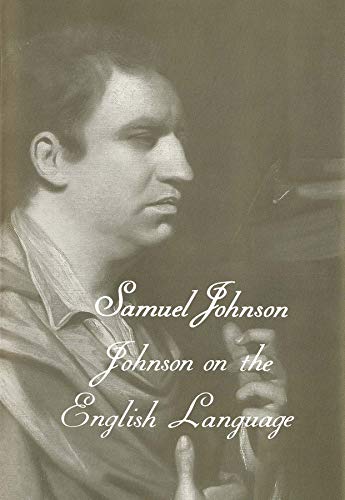
Johnson On the English Language (Yale Edition of the Works of Samuel Johnson, 18, Band 18) - Hardcover
Inhaltsangabe
This volume collects the most important statements on the English language by Samuel Johnson, one of its greatest expositors and speakers. The book includes scholarly, fully annotated editions of Johnson’s main writings on the history, structure, and cultural importance of the English language as well as his reflections on lexicography. These texts represent Johnson’s thinking as he undertook and completed the major work of his life, the colossal Dictionary of the English Language.
The editors set Johnson’s writings on the English language in historical context and provide the fullest possible account of their composition. Among the works presented in the volume are Johnson’s Plan of a Dictionary of the English Language and the Preface to the Dictionary, both of which are counted among his finest works of prose.
Die Inhaltsangabe kann sich auf eine andere Ausgabe dieses Titels beziehen.
Über die Autorin bzw. den Autor
Gwin J. Kolb is Chester D. Tripp Professor Emeritus in Humanities, University of Chicago. Robert DeMaria, Jr., is Henry Noble MacCracken Professor of English at Vassar College.
Auszug. © Genehmigter Nachdruck. Alle Rechte vorbehalten.
THE WORKS OF SAMUEL JOHNSON VOL XVIII
Johnson on the English LanguageBy SAMUEL JOHNSONYALE UNIVERSITY PRESS
Copyright © 2005 Yale UniversityAll right reserved.
ISBN: 978-0-300-10672-5
Contents
Preface....................................................................................................................ixContents...................................................................................................................xvIntroduction...............................................................................................................xviiShort Titles and Abbreviations.............................................................................................xlvSigla Used in the Textual Notes............................................................................................xlviiThe Plan of a Dictionary of the English Language (1747) Editor's Introduction..............................................3The Plan of a Dictionary of the English Language (1747)....................................................................25From A Dictionary of the English Language (1755)Editor's Introduction to the Preface.......................................................................................63Preface....................................................................................................................73Editor's Introduction to "The History of the English Language".............................................................115"The History of the English Language"......................................................................................125Editor's Introduction to "A Grammar of the English Tongue".................................................................265"A Grammar of the English Tongue"..........................................................................................275From A Dictionary of the English Language, First Abridged Edition..........................................................(1756)Editor's Introduction......................................................................................................363The Preface................................................................................................................367From A Dictionary of the English Language, Fourth Folio Edition (1773)Editor's Introduction......................................................................................................373"Advertisement to this Edition"............................................................................................375AppendicesFacsimile and Transcription of "A Short Scheme for compiling a new Dictionary of the English Language".....................379Facsimile of the Fair Copy of the Plan.....................................................................................428Index......................................................................................................................491
Chapter One
THE PLAN OF A DICTIONARY OF THE ENGLISH LANGUAGE (1747) EDITOR'S INTRODUCTIONComposition, Publication, and Reception of the Plan
The composition of The Plan of a Dictionary of the English Language ranks among the most complicated processes of writing and revising that Johnson ever undertook. The successive stages in the composition can be described at length because two annotated manuscript drafts of the pamphlet are extant, a quantity seemingly unequalled by the preliminary stages of any other of Johnson's works. Our account is a shorter, simpler, altered version of a much more extensive treatment, readily accessible to the curious.
The story begins soon after Johnson had presumably decided to accept the tentative proposal of seven important London booksellers (John and Paul Knapton, Thomas Longman and Thomas Shewell, Charles Hitch, Andrew Millar, and Robert Dodsley, who apparently initiated the proposal) that he prepare a new dictionary of the English language, or at least that he draw up a prospectus of such a work which, meeting with their approval, would lead to a formal contract (which, in the event, he and the booksellers signed on 18 June 1746). Accordingly, Johnson wrote "A Short Scheme for compiling a new Dictionary of the English Language," a holograph manuscript now part of the Hyde Collection at the Houghton Library, which is reproduced (and accompanied by a printed text) in the Appendix below (pp. 378-427). Both his known habit of rapid composition and the manuscript itself suggest that the "Scheme" was drawn up only a short time before 30 April 1746, the date noted by Johnson on the last leaf, supposedly just after completing the piece. For a man who had "long thought" of making a dictionary and who testified repeatedly to his speed in writing, the composition of the nineteen-leaf "Scheme" was, at most, probably a matter of a few days' labor. Indeed, like "forty-eight of the printed octavo pages of the Life of Savage" (Life, I.166), the whole document may have been created at a single sitting.
Whatever the exact period of composition, a study of the manuscript indicates, first, that Johnson was primarily intent on setting down, quickly and systematically, his notions about the problems and practices involved in compiling a dictionary of the English language and, second, that he was not making a conscious effort to write in his most polished style. The "Scheme" originally consisted of nineteen leaves, but part of the third and all of the eighth are now missing. The remaining seventeen and one-third leaves3 contain approximately 3,500 words arranged in some 41 paragraphs. In these paragraphs, which correspond to the "body" (pars. 7-74) of the first printed text, Johnson treated, sequentially, such topics as the choice of words for inclusion in his dictionary, spelling, pronunciation, etymology, syntax, definition, "the Distribution of words into their proper classes," and illustrative quotations. That he recorded his thoughts speedily and painlessly and without very much attention to the niceties of writing is evidenced, in varying degrees, by the clean appearance of most of the leaves, the probable omission of several words, the heavy reliance on the comma for pointing and the absence of all punctuation marks in a good many spots where one would normally expect them, the few lapses from "correct" or typically Johnsonian syntax, and the small number of revisions relative to the number made during subsequent stages in the composition of the Plan.
The changes that Johnson made before submitting the manuscript to readers consist almost wholly of (1) the substitution of words or phrases for the originals, (2) the correction of mistakes resulting from haste or carelessness, and (3) the deletion of words (largely) or phrases. These changes are distributed fairly evenly throughout the document, with fourteen of the seventeen and one-third leaves each containing, roughly, from two to five.
After he had written the "Scheme" and had made changes of the sort just described, Johnson presumably passed the manuscript to at least one reader and possibly more: two different persons wrote comments on it. We can offer no conjecture about the identity of the more taciturn of the two, who seems, from the location of his remarks, to have been the second reader. But we think that the first, and much more vocal, reader was probably the bull-breeding king of Ashbourne, Johnson's close friend Dr. John Taylor. Taylor's handwriting is markedly similar to...
„Über diesen Titel“ kann sich auf eine andere Ausgabe dieses Titels beziehen.
Suchergebnisse für Johnson On the English Language (Yale Edition of the...

Beispielbild für diese ISBN
The Works of Samuel Johnson, Vol 18: Johnson on the English Language
Anbieter: World of Books (was SecondSale), Montgomery, IL, USA
Verkäuferbewertung 5 von 5 Sternen

Hardback. Zustand: Good. Essential writings on the English language-its history, structure, and cultural importance-by one of its most adroit practitioners. Artikel-Nr. CIN0300106726G
Gebraucht kaufen
EUR 21,45
Versand gratis
Versand innerhalb von USA
Versand innerhalb von USA
Anzahl: 1 verfügbar
Beispielbild für diese ISBN
The Works of Samuel Johnson, Vol 18: Johnson on the English Language
Anbieter: Books From California, Simi Valley, CA, USA
Verkäuferbewertung 4 von 5 Sternen

hardcover. Zustand: Very Good. Artikel-Nr. mon0004061763
Gebraucht kaufen
EUR 23,49
EUR 4,44 Versand
Versand innerhalb von USA
Versand innerhalb von USA
Anzahl: 2 verfügbar
Beispielbild für diese ISBN
Samuel Johnson: Johnson on the English Language (Volume 18)
Anbieter: Anybook.com, Lincoln, Vereinigtes Königreich
Verkäuferbewertung 5 von 5 Sternen
Zustand: Good. Volume 18. This is an ex-library book and may have the usual library/used-book markings inside.This book has hardback covers. Clean from markings. In good all round condition. No dust jacket. Please note the Image in this listing is a stock photo and may not match the covers of the actual item,900grams, ISBN:0300106726. Artikel-Nr. 8969239
Gebraucht kaufen
EUR 23,99
EUR 15,55 Versand
Versand von Vereinigtes Königreich nach USA
Versand von Vereinigtes Königreich nach USA
Anzahl: 1 verfügbar
Beispielbild für diese ISBN
Johnson on the English Language (Volume 18)
Anbieter: Anybook.com, Lincoln, Vereinigtes Königreich
Verkäuferbewertung 5 von 5 Sternen
Zustand: Good. Volume 18. This is an ex-library book and may have the usual library/used-book markings inside.This book has hardback covers. Clean from markings. In good all round condition. No dust jacket. Please note the Image in this listing is a stock photo and may not match the covers of the actual item,900grams, ISBN:0300106726. Artikel-Nr. 8969242
Gebraucht kaufen
EUR 31,39
EUR 15,55 Versand
Versand von Vereinigtes Königreich nach USA
Versand von Vereinigtes Königreich nach USA
Anzahl: 1 verfügbar
Beispielbild für diese ISBN
Johnson on the English Language: Johnson on the English Language v. 18 (Yale Edition of the Works of Samuel Johnson)
Anbieter: Revaluation Books, Exeter, Vereinigtes Königreich
Verkäuferbewertung 5 von 5 Sternen
Hardcover. Zustand: Brand New. annotated edition. 560 pages. 9.00x6.00x1.75 inches. In Stock. Artikel-Nr. 0300106726
Neu kaufen
EUR 54,33
EUR 14,90 Versand
Versand von Vereinigtes Königreich nach USA
Versand von Vereinigtes Königreich nach USA
Anzahl: 1 verfügbar