
Verwandte Artikel zu The Jewish Political Tradition: Volume I: Authority
Inhaltsangabe
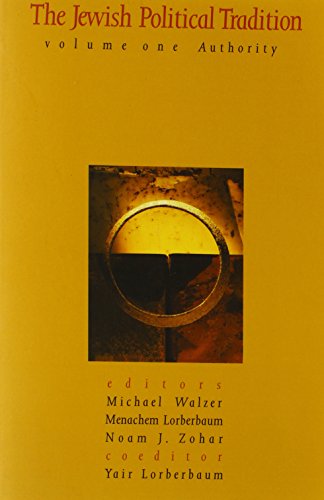
This book launches a landmark four-volume collaborative work exploring the political thought of the Jewish people from biblical times to the present. Each volume includes a selection of texts—from the Bible and Talmud, midrashic literature, legal responsa, treatises, and pamphlets—annotated for modern readers and accompanied by new commentaries written by eminent philosophers, lawyers, political theorists, and other scholars working in different fields of Jewish studies. These contributors join the arguments of the texts, agreeing or disagreeing, elaborating, refining, qualifying, and sometimes repudiating the political views of the original authors. The series brings the little-known and unexplored Jewish tradition of political thinking and writing into the light, showing where and how it resonates in the state of Israel, the chief diaspora settlements, and, more broadly, modern political experience.
This first volume, Authority, addresses the basic question of who ought to rule the community: What claims to rule have been put forward from the time of the exodus from Egypt to the establishment of the state of Israel? How are such claims disputed and defended? What constitutes legitimate authority? The authors discuss the authority of God, then the claims of kings, priests, prophets, rabbis, lay leaders, gentile rulers (during the years of the exile), and the Israeli state. The volume concludes with several perspectives on the issue of whether a modern state can be both Jewish and democratic. Forthcoming volumes will address the themes of membership, community, and political vision.
Among the contributors to this volume:
Amy Gutmann
Moshe Halbertal
David Hartman
Moshe Idel
Sanford Levinson
Susan Neiman
Hilary Putnam
Joseph Raz
Michael Sandel
Allan Silver
Yael Tamir
This first volume, Authority, addresses the basic question of who ought to rule the community: What claims to rule have been put forward from the time of the exodus from Egypt to the establishment of the state of Israel? How are such claims disputed and defended? What constitutes legitimate authority? The authors discuss the authority of God, then the claims of kings, priests, prophets, rabbis, lay leaders, gentile rulers (during the years of the exile), and the Israeli state. The volume concludes with several perspectives on the issue of whether a modern state can be both Jewish and democratic. Forthcoming volumes will address the themes of membership, community, and political vision.
Among the contributors to this volume:
Amy Gutmann
Moshe Halbertal
David Hartman
Moshe Idel
Sanford Levinson
Susan Neiman
Hilary Putnam
Joseph Raz
Michael Sandel
Allan Silver
Yael Tamir
Die Inhaltsangabe kann sich auf eine andere Ausgabe dieses Titels beziehen.
Über die Autorin bzw. den Autor
Michael Walzer is UPS Foundation Professor of Social Science at the Institute for Advanced Study in Princeton. Menachem Lorberbaum is senior lecturer in the department of Jewish philosophy at Tel Aviv University. Noam Zohar is senior lecturer in the department of philosophy at Bar Ilan University. Yair Lorberbaum is lecturer in the faculty of law at Bar Ilan University. All four editors are research fellows at the Shalom Hartman Institute in Jerusalem.
Auszug. © Genehmigter Nachdruck. Alle Rechte vorbehalten.
The Jewish Political Tradition
VOLUME I AuthorityYale University Press
Copyright © 2000 Yale UniversityAll right reserved.
ISBN: 978-0-300-10201-7
Contents
Table of Contents for Volumes I-IV...................................................................................xiForeword DAVID HARTMAN..............................................................................................xiiiPreface and Acknowledgments..........................................................................................xviIntroduction: The Jewish Political Tradition MICHAEL WALZER.........................................................xxiThe Selection, Translation, and Presentation of the Texts MENACHEM LORBERBAUM AND NOAM J. ZOHAR.....................xxxiiLaw, Story, and Interpretation: Reading Rabbinic Texts MICHAEL FISHBANE.............................................xxxixList of Abbreviations................................................................................................lviVolume I. AuthorityIntroduction.........................................................................................................3Chapter 1. Covenant: God's Law and the People's Consent..............................................................5IntroductionBiblical CovenantsCovenant and ConsentThe Scope of Covenantal CommitmentChapter 2. Revelation: Torah and Reason..............................................................................47IntroductionNatural Law, Reason, and Revelation: Classical DiscussionsRevelation, Morality, and Ritual: Modern StrugglesChapter 3. Kings.....................................................................................................108IntroductionBiblical Views of MonarchyThe Constitution of MonarchyCritiques of MonarchyThe Realm of Torah and the Realm of PoliticsChapter 4. Priests...................................................................................................166IntroductionIn the Bible: Holy PriestsThe Second Temple: Ruling PriestsFrom Priests to SagesChapter 5. Prophets..................................................................................................199IntroductionThe Prophetic CallingProphecy as Political ChallengeGod's Word: Truth, Falsehood, and InterpretationA Medieval Prophet: The Abulafia ControversyChapter 6. Rabbis and Sages..........................................................................................244IntroductionCustodians of the LawBeyond ProphecyAuthority of the Oral LawMedieval Arguments: Karaites and RabbanitesModern Concerns: Halakhic Innovation and Rabbinic AuthorityChapter 7. Controversy and Dissent...................................................................................307IntroductionMajority and MinorityThe Individual: Knowledge and ResponsibilityThe Rebellious Elder: Institutional AuthorityLiving with DisagreementMedieval Arguments: The Value of UniformityModern Disputes: The Problem of AuthorityChapter 8. The Good Men of the Town..................................................................................379IntroductionTalmudic FoundationsJustifying the Kahal's Authority: Early AshkenazRestricting the Kahal's Authority: Early SpainDeveloped Doctrines of the KahalThe Kahal and the RabbiChapter 9. The Gentile State.........................................................................................430IntroductionLegitimacy of Non-Jewish AuthorityModern Disputes: Civil and Religious LawChapter 10. The State of Israel......................................................................................463IntroductionLegal and Political ContinuityReligious Significance of the StateA Jewish and Democratic StateGlossary of Names....................................................................................................525Glossary of Terms....................................................................................................545List of Commentators.................................................................................................555Index of Biblical and Rabbinic Sources...............................................................................557Index of Names.......................................................................................................5565General Index........................................................................................................571
Chapter One
Covenant God's Law and the People's Consent
Introduction
Biblical Covenants
Acceptance of the Torah
1. Exodus 19:7-20:18
The Covenant at Sinai
2. Exodus 24:1-8, 12-18
The Covenant at Moab
3. Deuteronomy 29:1, 9-28; 30:11-20
The Covenant at Shechem
4. Joshua 24:1-28
The Forced Covenant
5. Ezekiel 20:1-6, 10-22, 30-38
Pledging a Renewed Covenant
6. Nehemiah 9:1-8, 24-26, 30-37; 10:1-40
Commentary. Bernard M. Levinson, "The Sinai Covenant: The Argument of Revelation"
Covenant and Consent
Grounds of Obligation
7. Mekhilta Derabbi Yishmael, Bahodesh 5, 6
"A Forceful Disclaimer Regarding the Torah"
8. BT Shabbat 88a
God's Bound Subjects
9. Sifre Numbers 115
Commentary. Michael J. Sandel, "Covenant and Consent"
Offering the Torah to the Nations
10. Sifre Deuteronomy 343
The Scope of Covenantal Commitment
Individual Responsibility
11. BT Sotah 37a-b
The Covenant: Meaning and Intention 12. BT Shevu'ot 29a-b
Future Generations
13. Isaac Abravanel, Commentary on the Pentateuch, Deuteronomy 29
Freedom and Necessity
14. Judah Loew (Maharal of Prague), Tiferet Yisrael, Chapter 32
Covenant as Social Contract
15. Baruch Spinoza, Theological-Political Treatise, Chapters 5 and 17
Introduction
Many of the central issues of modern consent theory are already posed in biblical and Rabbinic literature. Reading these texts, one has to keep reminding oneself that their authors were not consent theorists and that a covenant with God is not the same thing as a social contract. Contract and convenant indeed have similar effects-creating political unity and moral obligation-and at least some of the writers represented in this chapter seem to believe that the obligation to obey God's law derives, and can only derive, from the people's consent. But God is no equal or near equal, like all the other parties to the social contract; nor do the people, when they consent, "give the law to themselves" (as in Rousseau's version of contract theory)-they accept the law as God gives it. And how free can their acceptance be, when the divine lawgiver is absolute and omnipotent?
In the different midrashic elaborations of the Sinai story, only sampled here, God is sometimes seen persuading the people to accept his law (the prophet Hosea describes him wooing Israel like a lover) and sometimes threatening and coercing them. The first is the more attractive account; the second is theoretically more interesting, for the Rabbis, or some of them, recognize that coerced consent is not morally or legally binding. So they are driven to look for some later occasion when consent is given voluntarily-and they find this only in the next to last chapter of the book of Esther, where the acceptance of the laws of Purim by the exilic community of Persian Jews is taken as a general...
„Über diesen Titel“ kann sich auf eine andere Ausgabe dieses Titels beziehen.
Suchergebnisse für The Jewish Political Tradition: Volume I: Authority

Beispielbild für diese ISBN
The Jewish Political Tradition Volume I: Authority
Anbieter: World of Books (was SecondSale), Montgomery, IL, USA
Verkäuferbewertung 5 von 5 Sternen

Zustand: Good. Item in good condition. Textbooks may not include supplemental items i.e. CDs, access codes etc. Artikel-Nr. 00099877976
Gebraucht kaufen
EUR 7,75
Versand gratis
Versand innerhalb von USA
Versand innerhalb von USA
Anzahl: 1 verfügbar