Colonial Situations: Essays on the Contextualization of Ethnographic Knowledge (History of Anthropology) - Softcover
Inhaltsangabe
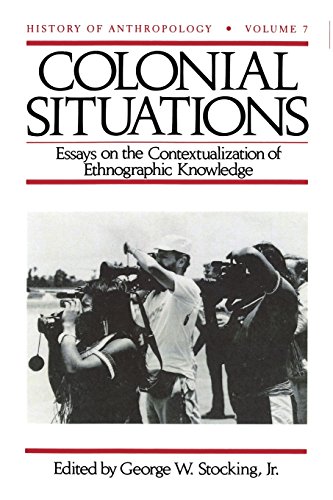
As European colonies in Asia and Africa became independent nations, as the United States engaged in war in Southeast Asia and in covert operations in South America, anthropologists questioned their interactions with their subjects and worried about the political consequences of government-supported research. By 1970, some spoke of anthropology as the child of Western imperialism and as scientific colonialism. Ironically, as the link between anthropology and colonialism became more widely accepted within the discipline, serious interest in examining the history of anthropology in colonial contexts diminished.
This volume is an effort to initiate a critical historical consideration of the varying colonial situations in which (and out of which) ethnographic knowledge essential to anthropology has been produced. The essays comment on ethnographic work from the middle of the nineteenth century to nearly the end of the twentieth, in regions from Oceania through southeast Asia, the Andaman Islands, and southern Africa to North and South America.
The colonial situations also cover a broad range, from first contact through the establishment of colonial power, from District Officer administrations through white settler regimes, from internal colonialism to international mandates, from early pacification to wars of colonial liberation, from the expropriation of land to the defense of ecology. The motivations and responses of the anthropologists discussed are equally varied: the romantic resistance of Maclay and the complicity of Kubary in early colonialism; Malinowskis salesmanship of academic anthropology; Specks advocacy of Indian land rights; Schneiders grappling with the ambiguities of rapport; and Turners facilitation of Kaiapo cinematic activism.
Provides fresh insights for those who care about the history of science in general and that of anthropology in particular, and a valuable reference for professionals and graduate students.Choice
Among the most distinguished publications in anthropology, as well as in the history of social sciences.George Marcus,Anthropologica
Die Inhaltsangabe kann sich auf eine andere Ausgabe dieses Titels beziehen.
Über die Autorin bzw. den Autor
George W. Stocking, Jr., is the Stein-Freiler Distinguished Service Professor of Anthropology and the Committee on the Conceptual Foundations of Science at the University of Chicago. His books includeThe Ethnographers Magic, also published by the University of Wisconsin Press,Race, Culture, and Evolution: Essays in the History of Anthropology, and Victorian Anthropology.
„Über diesen Titel“ kann sich auf eine andere Ausgabe dieses Titels beziehen.
Suchergebnisse für Colonial Situations: Essays on the Contextualization...

Beispielbild für diese ISBN
Colonial Situations : Essays on the Contextualization of Ethnographic Knowledge
Verlag:
University of Wisconsin Press, 1993
ISBN 10: 0299131246
ISBN 13: 9780299131241
Gebraucht
Softcover
Anbieter: Better World Books, Mishawaka, IN, USA
Verkäuferbewertung 5 von 5 Sternen

Zustand: Good. Used book that is in clean, average condition without any missing pages. Artikel-Nr. 9396344-6
Beispielbild für diese ISBN
Colonial Situations
Anbieter: PBShop.store UK, Fairford, GLOS, Vereinigtes Königreich
Verkäuferbewertung 5 von 5 Sternen
PAP. Zustand: New. New Book. Shipped from UK. Established seller since 2000. Artikel-Nr. FW-9780299131241
Neu kaufen
EUR 22,32
Versand:
EUR 4,73
Von Vereinigtes Königreich nach USA
Anzahl: 1 verfügbar
Beispielbild für diese ISBN
Colonial Situations: Essays on the Contextualization of Ethnographic Knowledge
Verlag:
University of Wisconsin Press, 1993
ISBN 10: 0299131246
ISBN 13: 9780299131241
Gebraucht
Softcover
Anbieter: Hamelyn, Madrid, M, Spanien
Verkäuferbewertung 4 von 5 Sternen

Zustand: Bueno. : Este volumen presenta una consideración histórica crítica de las diversas situaciones coloniales en las que se ha producido el conocimiento etnográfico esencial para la antropología. Los ensayos abarcan regiones desde Oceanía, el sudeste asiático y el sur de África hasta América del Norte y del Sur. Se examina el trabajo etnográfico desde mediados del siglo XIX hasta casi finales del siglo XX, abarcando desde el primer contacto hasta el establecimiento del poder colonial, las administraciones de los funcionarios de distrito, los regímenes de colonos blancos, el colonialismo interno y los mandatos internacionales. EAN: 9780299131241 Tipo: Libros Categoría: Historia|Filosofía|Arte y Cultura Título: Colonial Situations: Essays on the Contextualization of Ethnographic Knowledge Autor: George W. Stocking Editorial: University of Wisconsin Press Idioma: en Páginas: 340 Formato: tapa blanda. Artikel-Nr. Happ-2025-12-02-796bb6a7
Gebraucht kaufen
EUR 24,73
Versand:
EUR 12,99
Von Spanien nach USA
Anzahl: 1 verfügbar
Beispielbild für diese ISBN
Colonial Situations Essays on the Contextualization of Ethnographic Knowledge
Anbieter: Revaluation Books, Exeter, Vereinigtes Königreich
Verkäuferbewertung 5 von 5 Sternen
Paperback. Zustand: Brand New. 340 pages. 9.00x5.75x0.75 inches. In Stock. Artikel-Nr. x-0299131246
Neu kaufen
EUR 29,34
Versand:
EUR 11,37
Von Vereinigtes Königreich nach USA
Anzahl: 2 verfügbar
Beispielbild für diese ISBN
Colonial Situations: Essays on the Contextualization of Ethnographic Knowledge (History of Anthropology)
Verlag:
University of Wisconsin Press, 1993
ISBN 10: 0299131246
ISBN 13: 9780299131241
Neu
Softcover
Anbieter: Kennys Bookstore, Olney, MD, USA
Verkäuferbewertung 5 von 5 Sternen
Zustand: New. This volume attempts a critical historical consideration of the varying colonial situations in which (and from which) ethnographic knowledge essential to anthropology has been produced. The essays cover regions from Oceania, Southeast Asia and southern Africa to North and South America. Editor(s): Stocking, George W. Series: History of Anthropology S. Num Pages: 348 pages, 23 illustrations, 2 maps. BIC Classification: 3JH; 3JJ; HBTQ; HBTR; JHMP. Category: (UP) Postgraduate, Research & Scholarly; (UU) Undergraduate. Dimension: 229 x 152 x 21. Weight in Grams: 481. . 1993. 1st Edition. Paperback. . . . . Books ship from the US and Ireland. Artikel-Nr. V9780299131241
Beispielbild für diese ISBN
Colonial Situations: Essays on the Contextualization of Ethnographic Knowledge (History of Anthropology)
Verlag:
University of Wisconsin Press, 1993
ISBN 10: 0299131246
ISBN 13: 9780299131241
Neu
Softcover
Anbieter: Majestic Books, Hounslow, Vereinigtes Königreich
Verkäuferbewertung 4 von 5 Sternen
Zustand: New. pp. 348. Artikel-Nr. 8196386
Neu kaufen
EUR 37,62
Versand:
EUR 7,39
Von Vereinigtes Königreich nach USA
Anzahl: 1 verfügbar
Foto des Verkäufers
Colonial Situations: Essays on the Contextualization of Ethnographic Knowledge
Anbieter: moluna, Greven, Deutschland
Verkäuferbewertung 4 von 5 Sternen
Zustand: New. This volume attempts a critical historical consideration of the varying colonial situations in which (and from which) ethnographic knowledge essential to anthropology has been produced. The essays cover regions from Oceania, Southeast Asia and southern Afri. Artikel-Nr. 594501247
Neu kaufen
EUR 28,13
Versand:
EUR 48,99
Von Deutschland nach USA
Anzahl: 1 verfügbar
Foto des Verkäufers
Colonial Situations : Essays on the Contextualization of Ethnographic Knowledge
Verlag:
University Of Wisconsin Press Jan 2005, 2005
ISBN 10: 0299131246
ISBN 13: 9780299131241
Neu
Taschenbuch
Anbieter: AHA-BUCH GmbH, Einbeck, Deutschland
Verkäuferbewertung 5 von 5 Sternen
Taschenbuch. Zustand: Neu. Neuware - The relation of anthropology to colonialism and imperialism became a burning issue for anthropologists in the mid-1960s. As European colonies in Asia and Africa became independent nations, as the United States engaged in war in South-east Asia and in covert operations in South America, anthropologists questioned their interactions with their subjects and worried about the political consequences of government-supported research. By 1970, some spoke of anthropology as ''the child of Western imperialism'' and as ''scientific colonialism''. Ironically, as the link between anthropology and colonialism became more widely accepted within the discipline, serious interest diminished in examining the history of anthropology in colonial contexts. This volume attempts a critical historical consideration of the varying colonial situations in which (and from which) ethnographic knowledge essential to anthropology has been produced. The essays comment on ethnographic work from the middle of the 19th century to almost the end of the 20th; they cover regions from Oceania through Southeast Asia, the Andaman Islands and Southern Africa, to North and South America. The ''colonial situations'' also range from first contact through to the establishment of colonial power; from District Officer administrations through to white settler regimes; from internal colonialism to international mandates; from early pacification to wars of colonial liberation; from the expropriation of land to the defence of ecology. The motivations and responses of the anthropologists discussed are equally varied: the romantic resistance of Maclay and the complicity of Kubary in early colonialism; Malinowski's salesmanship of academic anthropology; Speck's advocacy of Indian land rights; Schneider's grappling with the ambiguities of rapport; and Turner's facilitation of Kayapo cinematic activism. Artikel-Nr. 9780299131241
Neu kaufen
EUR 31,87
Versand:
EUR 62,41
Von Deutschland nach USA
Anzahl: 1 verfügbar