
Verwandte Artikel zu From Manor to Market: Structural Change in England,...
Inhaltsangabe
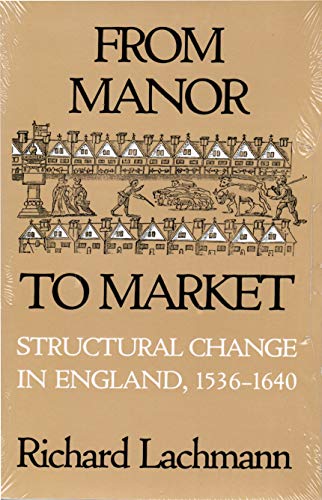
Richard Lachmann offers new answers to the old question of how England became the first nation to undergo the transition from feudalism to capitalism. Lachmann identifies conflicts among elites within the feudal ruling class- rather than conflicts between classes - as the primary dynamic within the feudal system that accounted for the timing and direction of structural change. His original research and analysis should be of interest to sociologists, political scientists, historians, and others concerned with English history, peasant studies, and economic history. The interaction of elite and class conflict, says Lachmann, explains the particular development of land and labor markets and of agrarian capitalism in 17th century England. The author builds upon the concern in Marxist works on the transition with changes in the organization and relations of agrarian production. He analyzes feudal manors to gain an understanding of their stability in the face of the heightened class struggles that accompanied the demographic crisis of the 14th century Black Death. Lachmann, by diagramming English social structure over the subsequent centuries, finds that relations among clerical, landlord, and state elites were transformed prior to class relations at the point of production. The 1536 Dissolution of the Monasteries is shown to be critical in allowing the monarchy to consolidate power at the national level. Lachmann analyzes the effects that removal of clerical and crown regulation within manors had upon the dynamic of landlord-peasant conflict. The study of class conflict on manors demonstrates that the significant 16th century development was the consolidation of the several elites' powers in the hands of the gentry, giving that new class, organized on the county level, the upper hand against both a court-based monarchy and peasants on manors. In the theoretical conclusion, Lachmann argues that this historical analysis suggests that a focus upon the economics and politics of porduction is mistaken. The totality of social structure must be examined to find the sites of efficacious political action. Feudalism is distinguished by a duality of such sites - national and local - and a duality of struggles - elites and class. As a result, early capitalist social formations can only be understood as structural artifacts of those dual struggles.
Die Inhaltsangabe kann sich auf eine andere Ausgabe dieses Titels beziehen.
Suchergebnisse für From Manor to Market: Structural Change in England,...

Beispielbild für diese ISBN
From Manor to Market : Structural Change in England, 1536-1640
Verlag:
University of Wisconsin Press, 1987
ISBN 10: 0299114244
ISBN 13: 9780299114244
Gebraucht
Softcover
Anbieter: Better World Books: West, Reno, NV, USA
Verkäuferbewertung 5 von 5 Sternen

Zustand: Very Good. 1st Printing. Former library copy. Pages intact with possible writing/highlighting. Binding strong with minor wear. Dust jackets/supplements may not be included. Includes library markings. Stock photo provided. Product includes identifying sticker. Better World Books: Buy Books. Do Good. Artikel-Nr. 51860480-6
Gebraucht kaufen
EUR 11,94
Versand gratis
Versand innerhalb von USA
Versand innerhalb von USA
Anzahl: 1 verfügbar
Beispielbild für diese ISBN
From Manor to Market: Structural Change in England, 1536-1640
Anbieter: ThriftBooks-Atlanta, AUSTELL, GA, USA
Verkäuferbewertung 5 von 5 Sternen
Paperback. Zustand: Good. No Jacket. Pages can have notes/highlighting. Spine may show signs of wear. ~ ThriftBooks: Read More, Spend Less. Artikel-Nr. G0299114244I3N00
Gebraucht kaufen
EUR 20,96
Versand gratis
Versand innerhalb von USA
Versand innerhalb von USA
Anzahl: 1 verfügbar
Foto des Verkäufers
From Manor to Market: Structural Change in England, 1536-1640
Verlag:
Univ of Wisconsin Pr, U.S.A., 1987
ISBN 10: 0299114244
ISBN 13: 9780299114244
Gebraucht
Paperback
Anbieter: Book Express (NZ), Shannon, Neuseeland
Verkäuferbewertung 3 von 5 Sternen

Paperback. Zustand: Good. 166 pages. Artikel-Nr. 2962r
Gebraucht kaufen
EUR 4,62
EUR 39,18 Versand
Versand von Neuseeland nach USA
Versand von Neuseeland nach USA
Anzahl: 1 verfügbar
Beispielbild für diese ISBN
From Manor to Market: Structural Change in England, 1536-1640
Verlag:
University of Wisconsin Press, 1999
ISBN 10: 0299114244
ISBN 13: 9780299114244
Gebraucht
paperback
Anbieter: Sell Books, Elland, YORKS, Vereinigtes Königreich
Verkäuferbewertung 5 von 5 Sternen
paperback. Zustand: Acceptable. Please see the condition note after this for details, if this is missing please consider Acceptable to mean poor quality that could include major staining, water damage, writing, missing dustjacket, etc etc. Our books are dispatched from a Yorkshire former cotton mill. We list via barcode/ISBN so please note that the images are stock images and may not be the exact copy you receive, furthermore the details about edition and year might not be accurate as many publishers reuse the same ISBN for multiple editions and as we simply scan a barcode or enter an ISBN we do not check the validity of the edition data when listing. If you're looking for an exact edition please don't order (at least not without checking with us first, although we don't always have time to check). We aim to dispatch prompty, the service used will depend on order value and book size. We can ship to most countries, see our shipping policies. Payment is via Abe only. Artikel-Nr. L-BJ200148-N16-20250923-A
Gebraucht kaufen
EUR 44,23
EUR 14,17 Versand
Versand von Vereinigtes Königreich nach USA
Versand von Vereinigtes Königreich nach USA
Anzahl: 1 verfügbar