
Verwandte Artikel zu An Inconvenient Apocalypse: Environmental Collapse,...
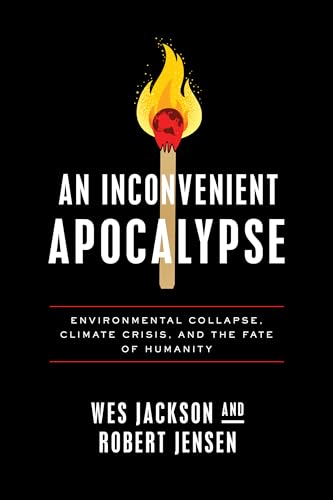
An Inconvenient Apocalypse: Environmental Collapse, Climate Crisis, and the Fate of Humanity - Softcover
Inhaltsangabe
"If we are to see a better future realized, not only do we need to rethink our individual patterns of behavior, but we must also resist cultural formations that reduce our humanity to marketplace identities. . . . If we decide this is who we are, our future may still be bright, even if it is not convenient." -The Christian Century
Die Inhaltsangabe kann sich auf eine andere Ausgabe dieses Titels beziehen.
Über die Autorin bzw. den Autor
Wes Jackson is cofounder and president emeritus of The Land Institute in Salina, Kansas. A 1992 MacArthur Fellow, he is the author and co-author of numerous books, including Hogs Are Up: Stories of the Land, with Digressions and New Roots for Agriculture.
Robert Jensen is professor emeritus in the School of Journalism at the University of Texas at Austin. He is the author of many books including The Restless and Relentless Mind of Wes Jackson: Searching for Sustainability and Plain Radical: Living, Loving, and Learning to Leave the Planet Gracefully.
Auszug. © Genehmigter Nachdruck. Alle Rechte vorbehalten.
Time for a summary of our assessment: The human species faces multiple cascading social and ecological crises that will not be solved by virtuous individuals making moral judgments of others’ failures or by frugal people exhorting the profligate to lower their consumption. Things are bad, getting worse, and getting worse faster than we expected. This is happening not just because of a few bad people or bad systems, though there are plenty of people doing bad things in bad systems that reward people for doing those bad things. At the core of the problem is our human-carbon nature, the scramble for energy-rich carbon that defines life. Technological innovations can help us cope, but that will not indefinitely forestall the dramatic changes that will test our ability to hold onto our humanity in the face of dislocation and deprivation. Although the worst effects of the crises are being experienced today in developing societies, more affluent societies aren’t exempt indefinitely. Ironically, in those more developed societies with greater dependency on high-energy/high-technology, the eventual crash might be the most unpredictable and disruptive. Affluent people tend to know the least about how to get by on less.
When presenting an analysis like this, we get two common responses from friends and allies who share our progressive politics and ecological concerns. The first is the claim that “fear appeals don’t work.” The second is to agree with the assessment but advise against saying such things in public because “people can’t handle it.”
On fear appeals: The reference is to public education campaigns that seek, for example, to reduce drunk driving by scaring people about the potentially fatal consequences. Well, sometimes fear appeals work and sometimes they don’t, but that isn’t relevant to our point. We are not focused on a single behavior, such as using tobacco, nor are we trying to develop a campaign to scare people into a specific behavior, such as quitting smoking. We are not trying to scare people at all. We are not proposing a strategy using the tricks of advertising and marketing (the polite terms in our society for propaganda). We are simply reporting the conclusions we have reached through our reading of the research and personal experience. We do not expect that a majority of people will agree with us today, but we see no alternative to speaking honestly. It is because others have spoken honestly to us over the years that we have been able to continue on this path. Friends and allies have treated us as rational adults capable of evaluating evidence and reaching conclusions, however tentative, and we believe we all owe each other that kind of respect.
We are not creating fear but simply acknowledging a fear that a growing number of people already feel, a fear that is based on an honest assessment of material realities and people’s behavior within existing social systems. Why would it be a good strategy to help people bury legitimate fears that are based on rational evaluation of evidence? As Barbara Ehrenreich points out, an obsession with so-called positive thinking not only undermines critical thinking but also produces anxiety of its own. Fear is counterproductive if it leads to paralysis but productive if it leads to inquiry and appropriate action to deal with a threat. Productive action is much more likely if we can imagine the possibility of a collective effort, and collective effort is impossible if we are left alone in our fear. The problem isn’t fear but the failure to face our fear together.
On handling it: It’s easy for people—ourselves included—to project our own fears onto others, to cover up our own inability to face difficult realities by suggesting the deficiency is in others. Both of us have given lectures or presented this perspective to friends and been told, “I agree with your assessment, but you shouldn’t say it publicly because people can’t handle it.” It’s never entirely clear who is in the category of “people.” Who are these people who are either cognitively or emotionally incapable of engaging these issues? These allegedly deficient folks are sometimes called “the masses,” implying a category of people not as smart as the people who are labeling them as such. We assume that whenever someone asserts that “people can’t handle it,” the person speaking really is confessing “I can’t handle it.” Rather than confront their own limitations, many find it easier to displace their fears onto others.
We may not be able to handle the social and ecological problems that humans have created, if by “handle” we mean considering only those so-called solutions that allow us to imagine that we can continue the high-energy/high-technology living to which affluent people have become accustomed and to which others aspire. But we have no choice but to handle reality, since we can’t wish it away. We increase our chances of handling it sensibly if we face reality together.
Where does that leave us? Let’s sum up the state of affairs at his moment in history:
We humans have made a mess of things, which is readily evident if we face the avalanche of studies and statistics describing the contemporary ecological crises we face. But even with the mounting evidence of the consequences for people and the ecosphere, we have not committed to a serious project to slow the damage that we do. Those who have little or no access to wealth and power would be within their rights to object, on the grounds that the “we” diffuses responsibility. Who has made a mess of things and who has failed to act? Who’s to blame for the problems and who’s responsible for the costs? Put more bluntly, borrowing from the imagined exchange between the Lone Ranger and Tonto when they were in a tough fight with Indians, “What do you mean, we, white man?”
Our thesis: While not every individual or culture is equally culpable, the human failure over the past 10,000 years is the result of the imperative of all life to seek out energy-rich carbon. Humans play that energy-seeking game armed with an expansive cognitive capacity and a species propensity to cooperate and develop a complex division of labor. That’s a way of saying that humans are smart, and we know how to coordinate our activities to leverage our smarts. Specific individuals and societies are morally accountable for their failures, and certain political and economic systems are central to those failures. But the failures are also the result of the kind of organisms we are. Both things are true, and both things are relevant.
The global North—which is to say, fossil-fuel powered capitalism as it developed in Europe—bears primary responsibility for the shape of the contemporary crises, and those societies have failed to meet their obligations, or in some cases to even acknowledge an obligation, to change course. In our lifetimes, the primary force behind that failure has been the United States of America. Within these affluent societies, the wealthy and powerful bear the greatest responsibility for destructive policies. But if there is to be a decent human future, we have to realize that human-carbon nature is at the core of the problem, a reality that exempts no one. We cannot ignore the relevance of “we.”
This may sound harsh in a world with so much human suffering, so unequally distributed. So, let us be clear: This analysis does not minimize or trivialize that suffering. Nor does this analysis ignore or minimize the moral and political failures that exacerbate it. We will say this over and over, so there can be no misunderstanding: Strategies for a sustainable...
„Über diesen Titel“ kann sich auf eine andere Ausgabe dieses Titels beziehen.
Suchergebnisse für An Inconvenient Apocalypse: Environmental Collapse,...

Beispielbild für diese ISBN
An Inconvenient Apocalypse: Environmental Collapse, Climate Crisis, and the Fate of Humanity
Verlag:
University of Notre Dame Press, 2022
ISBN 10: 0268203660
ISBN 13: 9780268203665
Gebraucht
Paperback
Anbieter: World of Books (was SecondSale), Montgomery, IL, USA
Verkäuferbewertung 5 von 5 Sternen

Paperback. Zustand: Very Good. Confronting harsh ecological realities and the multiple cascading crises facing our world today, An Inconvenient Apocalypse argues that humanity's future will be defined not by expansion but by contraction. For decades, our world has understood that we are on the brink of an apocalypse--and yet the only implemented solutions have been small and convenient, feel-good initiatives that avoid unpleasant truths about the root causes of our impending disaster. Wes Jackson and Robert Jensen argue that we must reconsider the origins of the consumption crisis and the challenges we face in creating a survivable future. Longstanding assumptions about economic growth and technological progress--the dream of a future of endless bounty--are no longer tenable. The climate crisis has already progressed beyond simple or nondisruptive solutions. The end result will be apocalyptic; the only question now is how bad it will be. Jackson and Jensen examine how geographic determinism shaped our past and led to today's social injustice, consumerist culture, and high-energy/high-technology dystopias. The solution requires addressing today's systemic failures and confronting human nature by recognizing the limits of our ability to predict how those failures will play out over time. Though these massive challenges can feel overwhelming, Jackson and Jensen weave a secular reading of theological concepts--the prophetic, the apocalyptic, a saving remnant, and grace--to chart a collective, realistic path for humanity not only to survive our apocalypse but also to emerge on the other side with a renewed appreciation of the larger living world. Artikel-Nr. 00109040940
Gebraucht kaufen
EUR 4,11
Versand gratis
Versand innerhalb von USA
Versand innerhalb von USA
Anzahl: 1 verfügbar
Beispielbild für diese ISBN
An Inconvenient Apocalypse: Environmental Collapse, Climate Crisis, and the Fate of Humanity
Verlag:
University of Notre Dame Press, 2022
ISBN 10: 0268203660
ISBN 13: 9780268203665
Gebraucht
Paperback
Anbieter: ThriftBooks-Dallas, Dallas, TX, USA
Verkäuferbewertung 5 von 5 Sternen
Paperback. Zustand: Good. No Jacket. Pages can have notes/highlighting. Spine may show signs of wear. ~ ThriftBooks: Read More, Spend Less. Artikel-Nr. G0268203660I3N00
Gebraucht kaufen
EUR 6,80
Versand gratis
Versand innerhalb von USA
Versand innerhalb von USA
Anzahl: 1 verfügbar
Beispielbild für diese ISBN
An Inconvenient Apocalypse: Environmental Collapse, Climate Crisis, and the Fate of Humanity
Verlag:
University of Notre Dame Press, 2022
ISBN 10: 0268203660
ISBN 13: 9780268203665
Gebraucht
Paperback
Anbieter: ThriftBooks-Dallas, Dallas, TX, USA
Verkäuferbewertung 5 von 5 Sternen
Paperback. Zustand: Good. No Jacket. Former library book; Pages can have notes/highlighting. Spine may show signs of wear. ~ ThriftBooks: Read More, Spend Less. Artikel-Nr. G0268203660I3N10
Gebraucht kaufen
EUR 6,80
Versand gratis
Versand innerhalb von USA
Versand innerhalb von USA
Anzahl: 1 verfügbar
Beispielbild für diese ISBN
An Inconvenient Apocalypse: Environmental Collapse, Climate Crisis, and the Fate of Humanity
Verlag:
University of Notre Dame Press, 2022
ISBN 10: 0268203660
ISBN 13: 9780268203665
Gebraucht
Paperback
Anbieter: ThriftBooks-Dallas, Dallas, TX, USA
Verkäuferbewertung 5 von 5 Sternen
Paperback. Zustand: Very Good. No Jacket. May have limited writing in cover pages. Pages are unmarked. ~ ThriftBooks: Read More, Spend Less. Artikel-Nr. G0268203660I4N00
Gebraucht kaufen
EUR 6,80
Versand gratis
Versand innerhalb von USA
Versand innerhalb von USA
Anzahl: 1 verfügbar
Beispielbild für diese ISBN
An Inconvenient Apocalypse : Environmental Collapse, Climate Crisis, and the Fate of Humanity
Verlag:
University of Notre Dame Press, 2022
ISBN 10: 0268203660
ISBN 13: 9780268203665
Gebraucht
Softcover
Anbieter: Better World Books: West, Reno, NV, USA
Verkäuferbewertung 5 von 5 Sternen
Zustand: Very Good. Former library copy. Pages intact with possible writing/highlighting. Binding strong with minor wear. Dust jackets/supplements may not be included. Includes library markings. Stock photo provided. Product includes identifying sticker. Better World Books: Buy Books. Do Good. Artikel-Nr. 48969142-6
Gebraucht kaufen
EUR 8,32
Versand gratis
Versand innerhalb von USA
Versand innerhalb von USA
Anzahl: 4 verfügbar
Beispielbild für diese ISBN
An Inconvenient Apocalypse : Environmental Collapse, Climate Crisis, and the Fate of Humanity
Verlag:
University of Notre Dame Press, 2022
ISBN 10: 0268203660
ISBN 13: 9780268203665
Gebraucht
Softcover
Anbieter: Better World Books, Mishawaka, IN, USA
Verkäuferbewertung 5 von 5 Sternen
Zustand: Good. Former library copy. Pages intact with minimal writing/highlighting. The binding may be loose and creased. Dust jackets/supplements are not included. Includes library markings. Stock photo provided. Product includes identifying sticker. Better World Books: Buy Books. Do Good. Artikel-Nr. 41633707-6
Gebraucht kaufen
EUR 8,32
Versand gratis
Versand innerhalb von USA
Versand innerhalb von USA
Anzahl: 1 verfügbar
Beispielbild für diese ISBN
An Inconvenient Apocalypse: Environmental Collapse, Climate Crisis, and the Fate of Humanity
Verlag:
University of Notre Dame Press, 2022
ISBN 10: 0268203660
ISBN 13: 9780268203665
Gebraucht
paperback
Anbieter: Books From California, Simi Valley, CA, USA
Verkäuferbewertung 4 von 5 Sternen

paperback. Zustand: Very Good. Artikel-Nr. mon0003839705
Gebraucht kaufen
EUR 12,46
EUR 4,44 Versand
Versand innerhalb von USA
Versand innerhalb von USA
Anzahl: 1 verfügbar
Beispielbild für diese ISBN
An Inconvenient Apocalypse: Environmental Collapse, Climate Crisis, and the Fate of Humanity
Verlag:
University of Notre Dame Press, 2022
ISBN 10: 0268203660
ISBN 13: 9780268203665
Gebraucht
Soft cover
Anbieter: AproposBooks&Comics, London, Vereinigtes Königreich
Verkäuferbewertung 4 von 5 Sternen
Soft cover. Zustand: Fine. Artikel-Nr. 151125/lewele/1YUIYUY
Gebraucht kaufen
EUR 7,27
EUR 17,73 Versand
Versand von Vereinigtes Königreich nach USA
Versand von Vereinigtes Königreich nach USA
Anzahl: 1 verfügbar
Beispielbild für diese ISBN
An Inconvenient Apocalypse
Anbieter: PBShop.store UK, Fairford, GLOS, Vereinigtes Königreich
Verkäuferbewertung 5 von 5 Sternen
PAP. Zustand: New. New Book. Shipped from UK. Established seller since 2000. Artikel-Nr. FW-9780268203665
Neu kaufen
EUR 21,74
EUR 4,93 Versand
Versand von Vereinigtes Königreich nach USA
Versand von Vereinigtes Königreich nach USA
Anzahl: 15 verfügbar
Beispielbild für diese ISBN
An Inconvenient Apocalypse: Environmental Collapse, Climate Crisis, and the Fate of Humanity
Verlag:
University of Notre Dame Press, 2022
ISBN 10: 0268203660
ISBN 13: 9780268203665
Gebraucht
paperback
Anbieter: Orbiting Books, Hereford, Vereinigtes Königreich
Verkäuferbewertung 5 von 5 Sternen
paperback. Zustand: Fine. Bumped edges. Appears unread, may have minor superficial marking. Next day dispatch from the UK (Mon-Fri). Please contact us with any queries. Artikel-Nr. mon0000723651
Gebraucht kaufen
EUR 14,87
EUR 14,23 Versand
Versand von Vereinigtes Königreich nach USA
Versand von Vereinigtes Königreich nach USA
Anzahl: 1 verfügbar