
Verwandte Artikel zu The Computational Beauty of Nature: Computer Explorations...
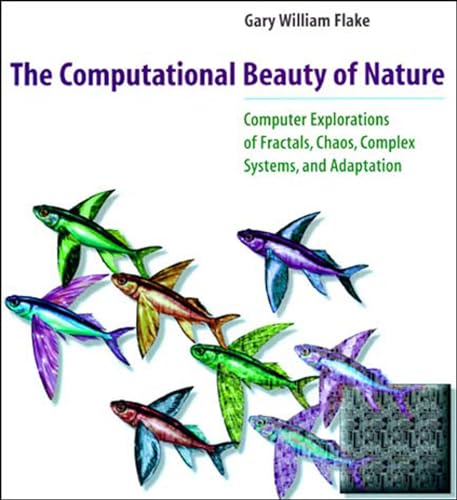
The Computational Beauty of Nature: Computer Explorations of Fractals, Chaos, Complex Systems, and Adaptation (Bradford Books) - Softcover
Inhaltsangabe
Gary William Flake develops in depth the simple idea that recurrent rules can produce rich and complicated behaviors.
In this book Gary William Flake develops in depth the simple idea that recurrent rules can produce rich and complicated behaviors. Distinguishing "agents" (e.g., molecules, cells, animals, and species) from their interactions (e.g., chemical reactions, immune system responses, sexual reproduction, and evolution), Flake argues that it is the computational properties of interactions that account for much of what we think of as "beautiful" and "interesting." From this basic thesis, Flake explores what he considers to be today's four most interesting computational topics: fractals, chaos, complex systems, and adaptation.
Each of the book's parts can be read independently, enabling even the casual reader to understand and work with the basic equations and programs. Yet the parts are bound together by the theme of the computer as a laboratory and a metaphor for understanding the universe. The inspired reader will experiment further with the ideas presented to create fractal landscapes, chaotic systems, artificial life forms, genetic algorithms, and artificial neural networks.
Die Inhaltsangabe kann sich auf eine andere Ausgabe dieses Titels beziehen.
Über die Autorin bzw. den Autor
Gary William Flake is a research scientist in the Adaptive Information and Signal Processing Department of Siemens Corporate Research, Princeton, New Jersey.
„Über diesen Titel“ kann sich auf eine andere Ausgabe dieses Titels beziehen.
Suchergebnisse für The Computational Beauty of Nature: Computer Explorations...

Beispielbild für diese ISBN
The Computational Beauty of Nature: Computer Explorations of Fractals, Chaos, Complex Systems, and Adaptation
Anbieter: World of Books (was SecondSale), Montgomery, IL, USA
Verkäuferbewertung 5 von 5 Sternen

Paperback. Zustand: Very Good. Gary William Flake develops in depth the simple idea that recurrent rules can produce rich and complicated behaviors. In this book Gary William Flake develops in depth the simple idea that recurrent rules can produce rich and complicated behaviors. Distinguishing "agents" (e.g., molecules, cells, animals, and species) from their interactions (e.g., chemical reactions, immune system responses, sexual reproduction, and evolution), Flake argues that it is the computational properties of interactions that account for much of what we think of as "beautiful" and "interesting." From this basic thesis, Flake explores what he considers to be today's four most interesting computational topics: fractals, chaos, complex systems, and adaptation. Each of the book's parts can be read independently, enabling even the casual reader to understand and work with the basic equations and programs. Yet the parts are bound together by the theme of the computer as a laboratory and a metaphor for understanding the universe. The inspired reader will experiment further with the ideas presented to create fractal landscapes, chaotic systems, artificial life forms, genetic algorithms, and artificial neural networks. Artikel-Nr. CIN0262561271VG
Gebraucht kaufen
EUR 30,95
Versand gratis
Versand innerhalb von USA
Versand innerhalb von USA
Anzahl: 1 verfügbar
Beispielbild für diese ISBN
The Computational Beauty of Nature : Computer Explorations of Fractals, Chaos, Complex Systems, and Adaptation
Anbieter: Better World Books, Mishawaka, IN, USA
Verkäuferbewertung 5 von 5 Sternen
Zustand: Very Good. Pages intact with possible writing/highlighting. Binding strong with minor wear. Dust jackets/supplements may not be included. Stock photo provided. Product includes identifying sticker. Better World Books: Buy Books. Do Good. Artikel-Nr. 14049594-6
Gebraucht kaufen
EUR 32,80
Versand gratis
Versand innerhalb von USA
Versand innerhalb von USA
Anzahl: 1 verfügbar
Beispielbild für diese ISBN
The Computational Beauty of Nature - Computer Explorations of Fractals, Chaos, Complex Systems & Adaption: Computer Explorations of Fractals, Chaos, Complex Systems, and Adaptation (A Bradford Book)
Anbieter: AwesomeBooks, Wallingford, Vereinigtes Königreich
Verkäuferbewertung 5 von 5 Sternen
Paperback. Zustand: Very Good. The Computational Beauty of Nature - Computer Explorations of Fractals, Chaos, Complex Systems & Adaption: Computer Explorations of Fractals, Chaos, Complex Systems, and Adaptation (A Bradford Book) This book is in very good condition and will be shipped within 24 hours of ordering. The cover may have some limited signs of wear but the pages are clean, intact and the spine remains undamaged. This book has clearly been well maintained and looked after thus far. Money back guarantee if you are not satisfied. See all our books here, order more than 1 book and get discounted shipping. Artikel-Nr. 7719-9780262561273
Gebraucht kaufen
EUR 39,14
EUR 4,92 Versand
Versand von Vereinigtes Königreich nach USA
Versand von Vereinigtes Königreich nach USA
Anzahl: 2 verfügbar
Beispielbild für diese ISBN
The Computational Beauty of Nature - Computer Explorations of Fractals, Chaos, Complex Systems & Adaption: Computer Explorations of Fractals, Chaos, Complex Systems, and Adaptation (A Bradford Book)
Anbieter: Bahamut Media, Reading, Vereinigtes Königreich
Verkäuferbewertung 4 von 5 Sternen

Paperback. Zustand: Very Good. This book is in very good condition and will be shipped within 24 hours of ordering. The cover may have some limited signs of wear but the pages are clean, intact and the spine remains undamaged. This book has clearly been well maintained and looked after thus far. Money back guarantee if you are not satisfied. See all our books here, order more than 1 book and get discounted shipping. Artikel-Nr. 6545-9780262561273
Gebraucht kaufen
EUR 38,46
EUR 8,34 Versand
Versand von Vereinigtes Königreich nach USA
Versand von Vereinigtes Königreich nach USA
Anzahl: 2 verfügbar
Beispielbild für diese ISBN
Computational Beauty of Nature: Computer Explorations of Fractals, Chaos, Complex Systems, and Adaptation
Anbieter: Majestic Books, Hounslow, Vereinigtes Königreich
Verkäuferbewertung 4 von 5 Sternen
Zustand: New. pp. 520. Artikel-Nr. 8204178
Neu kaufen
EUR 72,27
EUR 7,76 Versand
Versand von Vereinigtes Königreich nach USA
Versand von Vereinigtes Königreich nach USA
Anzahl: 1 verfügbar
Beispielbild für diese ISBN
The Computational Beauty of Nature: Computer Explorations of Fractals, Chaos, Complex Systems, and Adaptation
Anbieter: Ria Christie Collections, Uxbridge, Vereinigtes Königreich
Verkäuferbewertung 5 von 5 Sternen
Zustand: New. In English. Artikel-Nr. ria9780262561273_new
Neu kaufen
EUR 85,47
EUR 17,85 Versand
Versand von Vereinigtes Königreich nach USA
Versand von Vereinigtes Königreich nach USA
Anzahl: Mehr als 20 verfügbar
Beispielbild für diese ISBN
The Computational Beauty of Nature Computer Explorations of Fractals, Chaos, Complex Systems & Adaption (Paper)
Anbieter: Revaluation Books, Exeter, Vereinigtes Königreich
Verkäuferbewertung 5 von 5 Sternen
Paperback. Zustand: Brand New. reprint edition. 420 pages. 9.00x7.75x1.25 inches. In Stock. Artikel-Nr. x-0262561271
Neu kaufen
EUR 111,48
EUR 14,93 Versand
Versand von Vereinigtes Königreich nach USA
Versand von Vereinigtes Königreich nach USA
Anzahl: 2 verfügbar
Beispielbild für diese ISBN
The Computational Beauty of Nature: Computer Explorations of Fractals, Chaos, Complex Systems, and Adaptation
Anbieter: Kennys Bookstore, Olney, MD, USA
Verkäuferbewertung 5 von 5 Sternen
Zustand: New. 2000. Reprint. Paperback. Gary William Flake develops in depth the simple idea that recurrent rules can produce rich and complicated behaviors. Num Pages: 520 pages, 173. BIC Classification: GPFC; PBMX; PBWS; UYA. Category: (P) Professional & Vocational; (UP) Postgraduate, Research & Scholarly; (UU) Undergraduate. Dimension: 227 x 202 x 24. Weight in Grams: 930. . . . . . Books ship from the US and Ireland. Artikel-Nr. V9780262561273
Neu kaufen
EUR 153,47
EUR 9,36 Versand
Versand innerhalb von USA
Versand innerhalb von USA
Anzahl: Mehr als 20 verfügbar
Beispielbild für diese ISBN
The Computational Beauty of Nature : Computer Explorations of Fractals, Chaos, Complex Systems, and Adaptation
Anbieter: Buchpark, Trebbin, Deutschland
Verkäuferbewertung 5 von 5 Sternen
Zustand: Sehr gut. Zustand: Sehr gut | Seiten: 516 | Sprache: Englisch | Produktart: Bücher | Gary William Flake develops in depth the simple idea that recurrent rules can produce rich and complicated behaviors.In this book Gary William Flake develops in depth the simple idea that recurrent rules can produce rich and complicated behaviors. Distinguishing "agents" (e.g., molecules, cells, animals, and species) from their interactions (e.g., chemical reactions, immune system responses, sexual reproduction, and evolution), Flake argues that it is the computational properties of interactions that account for much of what we think of as "beautiful" and "interesting." From this basic thesis, Flake explores what he considers to be today's four most interesting computational topics: fractals, chaos, complex systems, and adaptation.Each of the book's parts can be read independently, enabling even the casual reader to understand and work with the basic equations and programs. Yet the parts are bound together by the theme of the computer as a laboratory and a metaphor for understanding the universe. The inspired reader will experiment further with the ideas presented to create fractal landscapes, chaotic systems, artificial life forms, genetic algorithms, and artificial neural networks. Artikel-Nr. 1498179/2
Gebraucht kaufen
EUR 59,99
EUR 105,00 Versand
Versand von Deutschland nach USA
Versand von Deutschland nach USA
Anzahl: 1 verfügbar