
Verwandte Artikel zu Experiments in the Machine Interpretation of Visual...
Inhaltsangabe
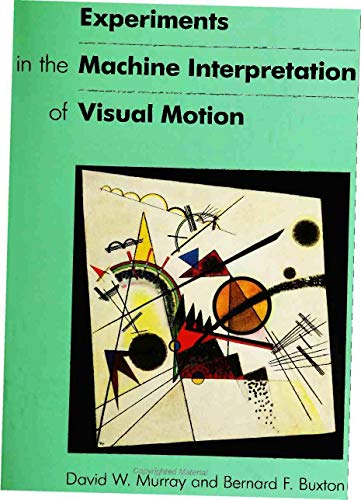
If robots are to act intelligently in everyday environments, they must have a perception of motion and its consequences. This book describes experimental advances made in the interpretation of visual motion over the last few years that have moved researchers closer to emulating the way in which we recover information about the surrounding world. It describes algorithms that form a complete, implemented, and tested system developed by the authors to measure two-dimensional motion in an image sequence, then to compute three-dimensional structure and motion, and finally to recognize the moving objects.
The authors develop algorithms to interpret visual motion around four principal constraints. The first and simplest allows the scene structure to be recovered on a pointwise basis. The second constrains the scene to a set of connected straight edges. The third makes the transition between edge and surface representations by demanding that the wireframe recovered is strictly polyhedral. And the final constraint assumes that the scene is comprised of planar surfaces, and recovers them directly.
ContentsImage, Scene, and Motion • Computing Image Motion • Structure from Motion of Points • The Structure and Motion of Edges • From Edges to Surfaces • Structure and Motion of Planes • Visual Motion Segmentation • Matching to Edge Models • Matching to Planar Surfaces
Die Inhaltsangabe kann sich auf eine andere Ausgabe dieses Titels beziehen.
Über die Autorin bzw. den Autor
David W. Murray is University Lecturer in Engineering Science at the University of Oxford and Draper's Fellow in Robotics at St Anne's College, Oxford.
„Über diesen Titel“ kann sich auf eine andere Ausgabe dieses Titels beziehen.
Suchergebnisse für Experiments in the Machine Interpretation of Visual...

Beispielbild für diese ISBN
Experiments in the Machine Interpretation of Visual Motion
Anbieter: Better World Books, Mishawaka, IN, USA
Verkäuferbewertung 5 von 5 Sternen

Zustand: Good. Former library copy. Pages intact with minimal writing/highlighting. The binding may be loose and creased. Dust jackets/supplements are not included. Includes library markings. Stock photo provided. Product includes identifying sticker. Better World Books: Buy Books. Do Good. Artikel-Nr. 10076496-75
Gebraucht kaufen
EUR 41,50
Versand gratis
Versand innerhalb von USA
Versand innerhalb von USA
Anzahl: 1 verfügbar
Foto des Verkäufers
Experiments in the Machine Interpretation of Visual Motion.
Anbieter: Kloof Booksellers & Scientia Verlag, Amsterdam, Niederlande
Verkäuferbewertung 4 von 5 Sternen

Zustand: as new. Cambridge, MA: The MIT Press, 1990. Hardcover. Dustjacket. 236 pp.(Artificial intelligence). - If robots are to act intelligently in everyday environments, they must have a perception of motion and its consequences. This book describes experimental advances made in the interpretation of visual motion over the last few years that have moved researchers closer to emulating the way in which we recover information about the surrounding world. It describes algorithms that form a complete, implemented, and tested system developed by the authors to measure two-dimensional motion in an image sequence, then to compute three-dimensional structure and motion, and finally to recognize the moving objects. The authors develop algorithms to interpret visual motion around four principal constraints. The first and simplest allows the scene structure to be recovered on a pointwise basis. The second constrains the scene to a set of connected straight edges. The third makes the transition between edge and surface representations by demanding that the wireframe recovered is strictly polyhedral. And the final constraint assumes that the scene is comprised of planar surfaces, and recovers them directly. English text. Condition : as new. Condition : as new copy. ISBN 9780262132633. Keywords : , Artikel-Nr. 263290
Gebraucht kaufen
EUR 16,95
EUR 30,00 Versand
Versand von Niederlande nach USA
Versand von Niederlande nach USA
Anzahl: 1 verfügbar
Foto des Verkäufers
Experiments in the Machine Interpretation of Visual Motion (Artificial Intelligence)
Anbieter: buch & töne GmbH, München, BY, Deutschland
Verkäuferbewertung 5 von 5 Sternen
Zustand: Wie neu. 262 Seiten Ungelesen. Einband geringfügig berieben bzw. angestoßen. Am Schnitt als Mängelexemplar gekennzeichnet. Rechnung mit ausgew. MwSt. R_archi_22_4_15 9780262132633 . Bei Mehrfachbestellungen bei uns, reduziert sich für Sie der Versandkostenanteil pro Titel. Sprache: Deutsch Gewicht in Gramm: 527 15,9 x 2,5 x 24,1 cm, Gebundene Ausgabe. Artikel-Nr. 35081
Gebraucht kaufen
EUR 19,00
EUR 57,91 Versand
Versand von Deutschland nach USA
Versand von Deutschland nach USA
Anzahl: 1 verfügbar