Verwandte Artikel zu Decisions, Uncertainty and the Brain: The Science of...
Inhaltsangabe
Book by Glimcher Paul W
Die Inhaltsangabe kann sich auf eine andere Ausgabe dieses Titels beziehen.
Críticas
"Glimcher does extraordinary neuroscience and relates it to the most fundamental of all questions: how the brain makes decisions. His use of game theory to characterize decision making in both humans and monkeys under conditions of strategic conflict is unique. What could be more important than studying the neurobiological basis of volitional choice in earnest? The implications and applications of his work are singular."--Michael S. Gazzaniga, Center for Cognitive Neuroscience, Dartmouth College
Reseña del editor
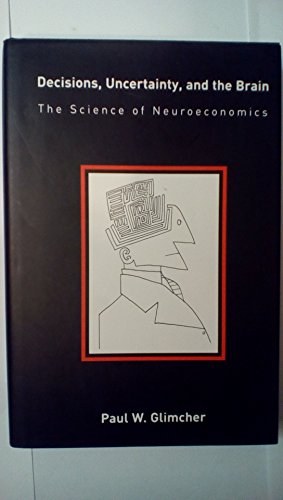
In this work, Paul Glimcher argues that economic theory may provide an alternative to the classical Cartesian model of the brain and behavior. Ren Descartes (1596-1650) believed that all behaviors could be divided into two categories, the simple and the complex. Simple behaviors were those in which a given sensory event gave rise deterministically to an appropriate motor response. Complex behaviors were those in which the relationship between stimulus and response was unpredictable. These behaviors were the product of a process that Descartes called the soul, but that a modern scientist might call cognition or volition. Glimcher argues that Cartesian dualism operates from the false premise that the reflex is able to describe behavior in the real world that animals inhabit. A mathematically rich cognitive theory, he claims, could solve the most difficult problems that any environment could present, eliminating the need for dualism by eliminating the need for a reflex theory. Such a mathematically rigorous description of the neural processes that connect sensation and action, he explains, will have its roots in microeconomic theory. Economic theory allows physiologists to define both the optimal course of action that an animal might select and a mathematical route by which that optimal solution can be derived. Glimcher outlines what an economics-based cognitive model might look like and how one would begin to test it empirically. Along the way, he presents a fascinating history of neuroscience. He also discusses related questions about determinism, free will, and the stochastic nature of complex behavior.
„Über diesen Titel“ kann sich auf eine andere Ausgabe dieses Titels beziehen.
- VerlagBradford Books
- Erscheinungsdatum2004
- ISBN 10 0262072440
- ISBN 13 9780262072441
- EinbandTapa dura
- Anzahl der Seiten395
Gebraucht kaufen
Zustand: BefriedigendFormer library book; may include... Mehr zu diesem Angebot erfahren

EUR 21,25
Versand:
Gratis
Innerhalb der USA

Beste Suchergebnisse beim ZVAB
Beispielbild für diese ISBN
Decisions, Uncertainty, and the Brain : The Science of Neuroeconomics
Anbieter: Better World Books, Mishawaka, IN, USA
Verkäuferbewertung 5 von 5 Sternen

Zustand: Good. Former library book; may include library markings. Used book that is in clean, average condition without any missing pages. Artikel-Nr. 12934612-6
Anzahl: 1 verfügbar
Foto des Verkäufers
Decisions, Uncertainty, and the Brain: The Science of Neuroeconomics
Anbieter: books4less (Versandantiquariat Petra Gros GmbH & Co. KG), Welling, Deutschland
Verkäuferbewertung 5 von 5 Sternen
gebundene Ausgabe. Zustand: Gut. 375 Seiten Das hier angebotene Buch stammt aus einer teilaufgelösten Bibliothek und kann die entsprechenden Kennzeichnungen aufweisen (Rückenschild, Instituts-Stempel.); der Buchzustand ist ansonsten ordentlich und dem Alter entsprechend gut. In ENGLISCHER Sprache. Sprache: Englisch Gewicht in Gramm: 805. Artikel-Nr. 2159302
Anzahl: 1 verfügbar
Beispielbild für diese ISBN
Decisions, Uncertainty, and the Brain: the Science of Neuroeconomics - 1st Edition/1st Printing
ISBN 10: 0262072440
ISBN 13: 9780262072441
Gebraucht
Hardcover
Erstausgabe
Anbieter: Books Tell You Why - ABAA/ILAB, Summerville, SC, USA
Verkäuferbewertung 5 von 5 Sternen
Cloth. Zustand: Fine. Zustand des Schutzumschlags: Near Fine. First Edition; First Printing. A Fine first Printing of the First Edition in a Nearly Fine dust-jacket that is scuffed and has mild edgewear; This book is about the science of neuroeconomics and how it affects decision-making. It explains how the brain processes information and how this affects our decisions.; 8vo; 375 pages. Artikel-Nr. 57465
Anzahl: 1 verfügbar