Inhaltsangabe
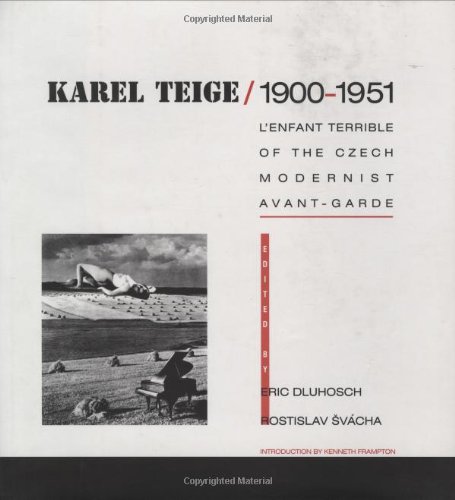
"Tiege was at one and the same time both an agent provocateur and seismograph, at once provoking action and debate and yet simultaneously reacting with the utmost sensitivity to the shifting political spectrum of his time."--from the introduction by Kenneth FramptonKarel Teige (1900-1951), a leading figure of the avant-garde of the 1920s and 1930s, participated in every important argument and controversy of those turbulent years. He edited the most influential avant-garde journals on Czech and international cultural affairs and wrote profoundly original essays and books on the theory and criticism of art and architecture. He also produced paintings, collages, photomontages, film scripts, book covers, and typefaces and participated in theatrical performances.When the Communists took over Czechoslovakia in 1948, Teige was first hailed as a progressive, then denounced for not toeing the party line--even though he was never a card-carrying member of the Communist Party. He died a broken man, forbidden to speak out or to publish. Since the recovery of his work after the "velvet revolution" of 1989, his legacy has been revived not only in Prague, but also in Western Europe and the United States.Teige firmly believed in an ars una, free of the artificial separation of one branch of the arts from the other. The concept of ars una is reflected in the essays of this book, which provide intellectual riches without overly compartmentalized attempts at "academic" criticism. Because the only significant writing by Teige to appear so far in English is his well-known argument with Le Corbusier, the "Mundaneum Affair," four essays by Teige have been included.Contributors : Polana Bregantová, Lenka Bydzovská, Rumjana Daceva, Eric Dluhosch, Vojtech Lahoda, Miroslav Petrícek, Jr., Klaus Spechtenhauser, Karel Srp, Rostislav Svácha, Daniel Weiss.Published with the assistance of the Getty Grant Program.
Die Inhaltsangabe kann sich auf eine andere Ausgabe dieses Titels beziehen.
Über die Autorin bzw. den Autor
Eric Dluhosch is Professor Emeritus of Architecture at the Massachusetts Institute of Technology.
„Über diesen Titel“ kann sich auf eine andere Ausgabe dieses Titels beziehen.
Suchergebnisse für Karel Teige / 1900--1951: L'Enfant Terrible of...

Beispielbild für diese ISBN
Karel Tiege, 1900-1951: L'Enfant Terrible of the Czech Modernist Avant-Garde
Anbieter: Powell's Bookstores Chicago, ABAA, Chicago, IL, USA
Verkäuferbewertung 5 von 5 Sternen

Zustand: Used - Very Good. 1999. Hardcover. Cloth, d.j., in an acetate cover. Some shelf-wear. Else bright, clean copy. Very Good. Artikel-Nr. SON000008313
Beispielbild für diese ISBN
Karel Tiege, 1900-1951: L'Enfant Terrible of the Czech Modernist Avant-Garde
Anbieter: Powell's Bookstores Chicago, ABAA, Chicago, IL, USA
Verkäuferbewertung 5 von 5 Sternen
Zustand: Used - Like New. Cloth, dj. Fine. Artikel-Nr. Sact02665
Foto des Verkäufers
Karel Teige 1900-1951 L'Enfant Terrible of the Czech Modernist Avant-Garde
Verlag:
The MIT Press, Cambridge, MA, 1999
ISBN 10: 0262041707
ISBN 13: 9780262041706
Gebraucht
Hardcover
Erstausgabe
Anbieter: Jeff Hirsch Books, ABAA, Wadsworth, IL, USA
Verkäuferbewertung 5 von 5 Sternen
First edition and first printing. Hardcover. 418 pages. A collection of essays about Czech artist Karel Teige. Edited by Eric Dluhosch and Rostislav Svacha. Includes numerous black and white illustrations. A fine copy in a fine dust jacket. A very fresh copy. Artikel-Nr. 183379
Beispielbild für diese ISBN
Karel Teige / 19001951 L`Enfant Terrible of the Czech Modernist AvantGarde
Anbieter: Anybook.com, Lincoln, Vereinigtes Königreich
Verkäuferbewertung 5 von 5 Sternen
Zustand: Good. This is an ex-library book and may have the usual library/used-book markings inside.This book has hardback covers. In good all round condition. Dust jacket in good condition. Please note the Image in this listing is a stock photo and may not match the covers of the actual item,1900grams, ISBN:9780262041706. Artikel-Nr. 8243153
Gebraucht kaufen
EUR 34,33
Versand:
EUR 17,07
Von Vereinigtes Königreich nach USA
Anzahl: 1 verfügbar
Foto des Verkäufers
Karel Teige - Enfant terrible of the Czech Modernist Avant-Garde - Eric Dluhosch - Mit press - 1999
Anbieter: ARTBOOKS, Schoorl, Niederlande
Verkäuferbewertung 5 von 5 Sternen
Hardcover. Zustand: Near Fine. 1st Edition. Title - Karel Teige - Enfant terrible of the Czech Modernist Avant-Garde / Author - Eric Dluhosch - Rostislav Svacha / Publisher - Mit press / Year - 1999 / Language - English / Binding - Hardcover + dust jacket / Size - 25 x 26,5 cm / Pages - 418 / ISBN - 0262041707. Artikel-Nr. ABE-1744118671035
Gebraucht kaufen
EUR 49,50
Versand:
EUR 35,00
Von Niederlande nach USA
Anzahl: 1 verfügbar
Foto des Verkäufers
Karel Teige / 1900-1951: L'Enfant Terrible of the Czech Modernist Avant-Garde
Verlag:
The MIT Press,, Cambridge,, 1999
ISBN 10: 0262041707
ISBN 13: 9780262041706
Gebraucht
Hardcover
Erstausgabe
Anbieter: Design Books, New York, NY, USA
Verkäuferbewertung 5 von 5 Sternen
Hard Cover. Zustand: Fine. Zustand des Schutzumschlags: Fine. First Edition. This is a fine hardcover copy with a fine dust jacket with no wear at all. Completely clean. This is a Review Copy with MIT Press Review Copy card and press release laid in. Illustrated in black & white. 10" high X 9" wide, 420 pages. Large heavy book, foreign shipping will be extra. This book will be securely wrapped and packed in a sturdy box and shipped with tracking. Artikel-Nr. 018643
Gebraucht kaufen
EUR 133,11
Versand:
EUR 3,88
Innerhalb der USA
Anzahl: 1 verfügbar
Beispielbild für diese ISBN
Karel Teige/1900-1951; L'Enfant Terrible of the Czech Modernist Avant-Garde
Verlag:
The MIT Press, Cambridge, MA, 1999
ISBN 10: 0262041707
ISBN 13: 9780262041706
Gebraucht
Hardcover
Erstausgabe
Anbieter: Ground Zero Books, Ltd., Silver Spring, MD, USA
Verkäuferbewertung 4 von 5 Sternen

Hardcover. Zustand: Very good. Zustand des Schutzumschlags: Very good. Presumed First Edition, First printing. The format is approximately 9.75 inches by 10.25 inches. xxvi, 420 pages. The dust jacket is in a plastic sleeve. Illustrations (some in color). Notes. Introduction by Kenneth Frampton. Appendix: Chronological Overview--Dates, Events, Manifestos, and Books Rumjana Daceva (Trans. by Eric Dluhosch). Postscript: My Uncle, Karel Teige by Milos Aulicky (Trans. by Eric Dluhosch). Selected Bibliography. Sources. Index. Czech Pronunciation. Karel Teige (13 December 1900 1 October 1951) was a Czech modernist avant-garde artist, writer, critic and one of the most important figures of the 1920s and 1930s movement. He was a member of the Dev tsil movement in the 1920s and worked as an editor and graphic designer for Dev tsil's monthly magazine ReD (Revue Dev tsilu). One of his major works on architecture theory is The Minimum Dwelling. Although not an architect, Teige was an articulate and knowledgeable architecture critic, an active participant in CIAM, and friends with Hannes Meyer, the second director of the Bauhaus. He gave guest lectures at the Bauhaus in Dessau. Teige and Meyer both believed in a scientific, functionalist approach to architecture. In 1929 he famously criticized Le Corbusier's Mundaneum project (planned for Geneva but never built) on the grounds that Corbusier had departed from rational functionalism, and was on his way to becoming a mere stylist. Teige believed that 'the only aim and scope of modern architecture is the scientific solution of exact tasks of rational construction. "Tiege was at one and the same time both an agent provocateur and seismograph, at once provoking action and debate and yet simultaneously reacting with the utmost sensitivity to the shifting political spectrum of his time." -- from the introduction by Kenneth Frampton. Karel Teige (1900--1951), a leading figure of the avant-garde of the 1920s and 1930s, participated in every important argument and controversy of those turbulent years. He edited the most influential avant-garde journals on Czech and international cultural affairs and wrote profoundly original essays and books on the theory and criticism of art and architecture. He also produced paintings, collages, photomontages, film scripts, book covers, and typefaces and participated in theatrical performances. When the Communists took over Czechoslovakia in 1948, Teige was first hailed as a progressive, then denounced for not toeing the party line -- even though he was never a card-carrying member of the Communist Party. He died a broken man, forbidden to speak out or to publish. Since the recovery of his work after the "velvet revolution" of 1989, his legacy has been revived not only in Prague, but also in Western Europe and the United States. Teige firmly believed in an ars una, free of the artificial separation of one branch of the arts from the other. The concept of ars una is reflected in the essays of this book, which provide intellectual riches without overly compartmentalized attempts at "academic" criticism. Because the only significant writing by Teige to appear so far in English is his well-known argument with Le Corbusier, the "Mundaneum Affair," four essays by Teige have been included. Contributors:Polana Bregantová, Lenka Bydzovská, Rumjana Daceva, Eric Dluhosch, Vojtech Lahoda, Miroslav Petrícek, Jr., Klaus Spechtenhauser, Karel Srp, Rostislav Svácha, Daniel Weiss. Published with the assistance of the Getty Grant Program. The Congrès Internationaux d'Architecture Moderne (CIAM), or International Congresses of Modern Architecture, was an organization founded in 1928 and disbanded in 1959, responsible for a series of events and congresses arranged across Europe by the most prominent architects of the time, with the objective of spreading the principles of the Modern Movement focusing in all the main domains of architecture (such as landscape, urbanism, industrial design, and many others). The organization was hugely influential. It was not only engaged in formalizing the ar. Artikel-Nr. 90227
Gebraucht kaufen
EUR 155,29
Versand:
EUR 4,31
Innerhalb der USA
Anzahl: 1 verfügbar