
Verwandte Artikel zu The Things We Do: Using the Lessons of Bernard and...
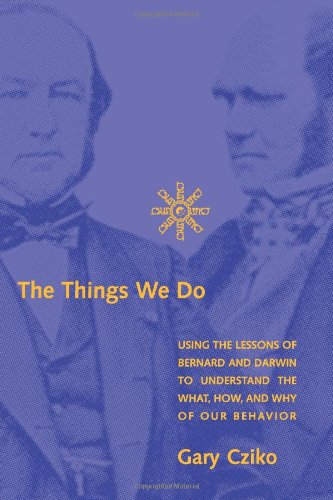
The Things We Do: Using the Lessons of Bernard and Darwin to Understand the What, How, and Why of Our Behavior (A Bradford Book) - Hardcover
Inhaltsangabe
Cziko shows how the lessons of Bernard and Darwin, updated with the best of current scientific knowledge, can provide solutions to certain long-standing theoretical and practical problems in behavioral science and enable us to develop new methods and topics for research.
The remarkable achievements that modern science has made in physics, chemistry, biology, medicine, and engineering contrast sharply with our limited knowledge of the human mind and behavior. A major reason for this slow progress, claims Gary Cziko, is that with few exceptions, behavioral and cognitive scientists continue to apply a Newtonian-inspired view of animate behavior as an organism's output determined by environmental input. This one-way cause-effect approach ignores the important findings of two major nineteenth-century biologists, French physiologist Claude Bernard and English naturalist Charles Darwin.
Approaching living organisms as purposeful systems that behave in order to control their perceptions of the external environment provides a new perspective for understanding what, why, and how living things, including humans, do what they do. Cziko examines in particular perceptual control theory, which has its roots in Bernard's work on the self-regulating nature of living organisms and in the work of engineers who developed the field of cybernetics during and after World War II. He also shows how our evolutionary past together with Darwinian processes currently occurring within our bodies, such as the evolution of new brain connections, provide insights into the immediate and ultimate causes of behavior.
Writing in an accessible style, Cziko shows how the lessons of Bernard and Darwin, updated with the best of current scientific knowledge, can provide solutions to certain long-standing theoretical and practical problems in behavioral science and enable us to develop new methods and topics for research.
Die Inhaltsangabe kann sich auf eine andere Ausgabe dieses Titels beziehen.
Suchergebnisse für The Things We Do: Using the Lessons of Bernard and...

Beispielbild für diese ISBN
The Things We Do: Using the Lessons of Bernard and Darwin to Understand the What, How, and Why of Our Behavior
Anbieter: World of Books (was SecondSale), Montgomery, IL, USA
Verkäuferbewertung 5 von 5 Sternen

Zustand: Good. Item in good condition. Textbooks may not include supplemental items i.e. CDs, access codes etc. Artikel-Nr. 00104749695
Gebraucht kaufen
EUR 8,49
Versand gratis
Versand innerhalb von USA
Versand innerhalb von USA
Anzahl: 1 verfügbar
Beispielbild für diese ISBN
The Things We Do : Using the Lessons of Bernard and Darwin to Understand the What, How, and Why of Our Behavior
Anbieter: Better World Books, Mishawaka, IN, USA
Verkäuferbewertung 5 von 5 Sternen
Zustand: Good. Former library copy. Pages intact with minimal writing/highlighting. The binding may be loose and creased. Dust jackets/supplements are not included. Includes library markings. Stock photo provided. Product includes identifying sticker. Better World Books: Buy Books. Do Good. Artikel-Nr. 4514943-75
Gebraucht kaufen
EUR 8,58
Versand gratis
Versand innerhalb von USA
Versand innerhalb von USA
Anzahl: 1 verfügbar
Beispielbild für diese ISBN
The Things We Do : Using the Lessons of Bernard and Darwin to Understand the What, How, and Why of Our Behavior
Anbieter: Better World Books, Mishawaka, IN, USA
Verkäuferbewertung 5 von 5 Sternen
Zustand: Very Good. Former library copy. Pages intact with possible writing/highlighting. Binding strong with minor wear. Dust jackets/supplements may not be included. Includes library markings. Stock photo provided. Product includes identifying sticker. Better World Books: Buy Books. Do Good. Artikel-Nr. 15832869-20
Gebraucht kaufen
EUR 8,58
Versand gratis
Versand innerhalb von USA
Versand innerhalb von USA
Anzahl: 1 verfügbar
Beispielbild für diese ISBN
The Things We Do: Using the Lessons of Bernard and Darwin to Understand the What, How, and Why of Our Behavior (A Bradford Book)
Anbieter: AwesomeBooks, Wallingford, Vereinigtes Königreich
Verkäuferbewertung 5 von 5 Sternen
Hardcover. Zustand: Very Good. The Things We Do: Using the Lessons of Bernard and Darwin to Understand the What, How, and Why of Our Behavior (A Bradford Book) This book is in very good condition and will be shipped within 24 hours of ordering. The cover may have some limited signs of wear but the pages are clean, intact and the spine remains undamaged. This book has clearly been well maintained and looked after thus far. Money back guarantee if you are not satisfied. See all our books here, order more than 1 book and get discounted shipping. Artikel-Nr. 7719-9780262032773
Gebraucht kaufen
EUR 25,59
EUR 4,80 Versand
Versand von Vereinigtes Königreich nach USA
Versand von Vereinigtes Königreich nach USA
Anzahl: 2 verfügbar
Beispielbild für diese ISBN
The Things We Do: Using the Lessons of Bernard and Darwin to Understand the What, How, and Why of Our Behavior (A Bradford Book)
Anbieter: Bahamut Media, Reading, Vereinigtes Königreich
Verkäuferbewertung 5 von 5 Sternen
Hardcover. Zustand: Very Good. This book is in very good condition and will be shipped within 24 hours of ordering. The cover may have some limited signs of wear but the pages are clean, intact and the spine remains undamaged. This book has clearly been well maintained and looked after thus far. Money back guarantee if you are not satisfied. See all our books here, order more than 1 book and get discounted shipping. Artikel-Nr. 6545-9780262032773
Gebraucht kaufen
EUR 25,15
EUR 8,12 Versand
Versand von Vereinigtes Königreich nach USA
Versand von Vereinigtes Königreich nach USA
Anzahl: 2 verfügbar
Beispielbild für diese ISBN
The things we do : using the lessons of Bernard and Darwin to understand the what, how, and why of our behavior.
Verlag:
Cambridge, Mass. : MIT Press, 2000
ISBN 10: 0262032775
ISBN 13: 9780262032773
Gebraucht
Hardcover
Anbieter: Emile Kerssemakers ILAB, Heerlen, Niederlande
Verkäuferbewertung 5 von 5 Sternen
Orig. cloth. With dustjacket. xii,290 pp.; 24 cm. Text in English - (previous owner's name at top of title page) Otherwise as new. 'A Bradford book.'. 740g. Artikel-Nr. 22436
Gebraucht kaufen
EUR 18,00
EUR 25,45 Versand
Versand von Niederlande nach USA
Versand von Niederlande nach USA
Anzahl: 1 verfügbar
Beispielbild für diese ISBN
The Things We Do Using the Lessons of Bernard and Darwin to Understand the What, How, and Why of Our Behavior
Anbieter: Revaluation Books, Exeter, Vereinigtes Königreich
Verkäuferbewertung 5 von 5 Sternen
Hardcover. Zustand: Brand New. illustrated edition. 302 pages. 9.00x6.25x1.00 inches. In Stock. Artikel-Nr. zk0262032775
Neu kaufen
EUR 60,91
EUR 14,55 Versand
Versand von Vereinigtes Königreich nach USA
Versand von Vereinigtes Königreich nach USA
Anzahl: 1 verfügbar