
Verwandte Artikel zu California Design, 1930-1965: Living in a Modern Way
Inhaltsangabe
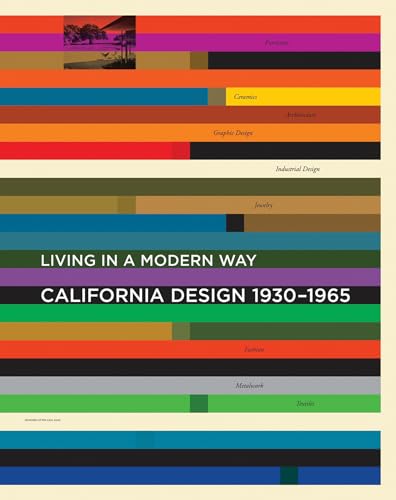
The first comprehensive examination of California's mid-century modern design, generously illustrated.
In 1951, designer Greta Magnusson Grossman observed that California design was “not a superimposed style, but an answer to present conditions.... It has developed out of our own preferences for living in a modern way.” California design influenced the material culture of the entire country, in everything from architecture to fashion. This generously illustrated book, which accompanies a major exhibition at the Los Angeles County Museum of Art, is the first comprehensive examination of California's mid-century modern design. It begins by tracing the origins of a distinctively California modernism in the 1930s by such European émigrés as Richard Neutra, Rudolph Schindler, and Kem Weber; it finds other specific design influences and innovations in solid-color commercial ceramics, inspirations from Mexico and Asia, new schools for design training, new concepts about leisure, and the conversion of wartime technologies to peacetime use (exemplified by Charles and Ray Eames's plywood and fiberglass furniture).
The heart of California Design is the modern California home, famously characterized by open plans conducive to outdoor living. The layouts of modernist homes by Pierre Koenig, Craig Ellwood, and Raphael Soriano, for example, were intended to blur the distinction between indoors and out. Homes were furnished with products from Heath Ceramics, Van Keppel-Green, and Architectural Pottery as well as other, previously unheralded companies and designers. Many objects were designed to be multifunctional: pool and patio furniture that was equally suitable indoors, lighting that was both task and ambient, bookshelves that served as room dividers, and bathing suits that would turn into ensembles appropriate for indoor entertainment.
California Design includes 350 images, most in color, of furniture, ceramics, metalwork, architecture, graphic and industrial design, film, textiles, and fashion, and ten incisive essays that trace the rise of the California design aesthetic.
Die Inhaltsangabe kann sich auf eine andere Ausgabe dieses Titels beziehen.
Über die Autorin bzw. den Autor
Wendy Kaplan is Department Head and Curator of Decorative Arts and Design at the Los Angeles County Museum of Art.
Auszug. © Genehmigter Nachdruck. Alle Rechte vorbehalten.
CALIFORNIA DESIGN 1930–1965
LIVING IN A MODERN WAYThe MIT Press
Copyright © 2011 Museum Associates, Los Angeles County Museum of ArtAll right reserved.
ISBN: 978-0-262-01607-0
Contents
Foreword...............................................................................................................................21Corporate Sponsor's Statement..........................................................................................................251. Introduction: "Living in a Modern Way" WENDY KAPLAN................................................................................272. The Rise of California Modern Design, 1930–41 CHRISTOPHER LONG...............................................................613. Fusing Old and New: Émigré Designers in California BOBBYE TIGERMAN.......................................................914. Open World: California Architects and the Modern Home NICHOLAS OLSBERG.............................................................1175. At Home with California Modern, 1945–65 PAT KIRKHAM..........................................................................1476. War and Peace: Unexpected Dividends BILL STERN.....................................................................................1797. Serious Business: The "Designer-Craftsman" in Postwar California GLENN ADAMSON.....................................................2038. Distinctly Californian: Modernism in Textiles and Fashion MELISSA LEVENTON.........................................................2339. Developing a Language of Vision: Graphic Design in California JEREMY AYNSLEY.......................................................26310. "It Has To Be Sold": The Dissemination of California Design, 1945–65 WENDY KAPLAN AND STACI STEINBERGER.....................289Map of California, 1930–65.......................................................................................................320Checklist of the Exhibition............................................................................................................321Acknowledgments........................................................................................................................347Lenders to the Exhibition..............................................................................................................353Illustration Credits...................................................................................................................354Index..................................................................................................................................356
Chapter One
Introduction: "Living in a Modern Way" WENDY KAPLAN
"What Makes the California Look"? asked the Los Angeles Times, a question so pressing it was posed on the cover of the newspaper's "Home" magazine for October 21, 1951 (1.1). The answer was so obvious that it was immediately supplied with this image and its caption: "In this abstract arrangement are the glowing color, originality of treatment and simplicity of design that typify the California look."
The cover depicted the most recognized characteristic of California culture—indoor/outdoor living—and many of the objects assembled have become icons of California design. Since the state's benign climate permitted the great outdoors to be incorporated as an extended living room, the photograph highlights objects intended to be used either on a patio or in the living room: a planter by Architectural Pottery and a cord-and-metal lounge chair by Van Keppel-Green. The blurring of boundaries is emphasized with the prominently featured grill and the garden lamp, both by Hawk House, placed among the interior furnishings. New industrial materials—a fiberglass chair by Charles and Ray Eames and a plastic screen by Spencer Smilie—are displayed with traditional handicrafts, evidence of other ways that boundaries were fluid. The bright yellows, burnt oranges, and vivid greens of sunny climes prevail, as does a stripped-down, casual aesthetic that was the essence of California modern style.
The essays in this book explore how "The California Look" was established, idealized, and disseminated at mid-century. It became synonymous with a modern way of life and, as the "Home" magazine article observed, a symbol of "the willingness to experiment and be different, to solve problems in California's way." Such paeans to California exceptionalism were ubiquitous until the late 1960s—one of the most oft-repeated quotations about the Golden State is writer Wallace Stegner's 1959 observation that California is "America, only more so." If the United States symbolized the land of opportunity for immigrants, California was the repository of the most intense longings for reinvention. Odes to California's endless capacity for growth, inventiveness, and individuality, coupled with its rejection of conventions, permeated the popular press of the era. As industrial designer Henry Dreyfuss, who moved from New york to Pasadena in 1944, wrote three years later: "On the Pacific Coast there are fewer shackles on tradition. There is an unslackening development of new thought. There is a decided willingness to take a chance on new ideas." More recently, the California dream has been exhaustively and eloquently studied by historians such as Kevin Starr; many books and innumerable articles have been devoted to the image of California and the state's history of incessant boosterism.
These associations are persistent because so many of them ring true. This volume explores the California modern aesthetic, analyzing how the general qualities associated with the state (optimism and democracy, fearless experimentation, and a love of new technology) and those specific to design (an affinity for light and brilliant color, an openness to Asian and Latin influences, and an embrace of fluid spaces and cross-disciplines) made the state's best products distinctive. None of these qualities, however, was unique to California, and all had important precedents before the 1930s, when this account begins.
The characteristics now associated with the mid-century home had first developed with the Arts and Crafts movement at the turn of the last century, particularly in the work of Frank Lloyd Wright. In the Prairie houses, he created interior spaces that were not enclosed in the traditional sense. Barriers between the dining room, living room, and porch were abolished, establishing interpenetrating spaces and freeing the walls to define distinct areas rather than enclose them. This startling innovation became widespread with its application to the inexpensive bungalow, which, though built throughout the country, has always been associated with California. The bungalow's open interior, one-story plan, prominent porch, and overhanging roof offered the ventilation and protection from the sun appropriate to the state's climate, and its rapid assembly, affordability, and informality made it particularly well suited to a mobile society.
In the 1920s, revolutionary experiments in modern living were taking place throughout Europe and elsewhere in the United States, most famously in Germany at the Bauhaus and in Holland with the De Stijl group of architects. Gerrit Rietveld's Schröder House in Utrecht (1924–25)—with its open plan, sliding walls for flexible room configurations, built-in furniture, and large, uncurtained windows—is widely considered to be the first truly modern house (1.2). Truus Schröder's convictions about what a house...
„Über diesen Titel“ kann sich auf eine andere Ausgabe dieses Titels beziehen.
Suchergebnisse für California Design, 1930-1965: Living in a Modern Way

Beispielbild für diese ISBN
California Design, 1930-1965: living in a Modern Way
Anbieter: World of Books (was SecondSale), Montgomery, IL, USA
Verkäuferbewertung 5 von 5 Sternen

Hardback. Zustand: Good. The first comprehensive examination of California's mid-century modern design, generously illustrated.In 1951, designer Greta Magnusson Grossman observed that California design was not a superimposed style, but an answer to present conditions. It has developed out of our own preferences for living in a modern way. California design influenced the material culture of the entire country, in everything from architecture to fashion. This generously illustrated book, which accompanies a major exhibition at the Los Angeles County Museum of Art, is the first comprehensive examination of California's mid-century modern design. It begins by tracing the origins of a distinctively California modernism in the 1930s by such European migr s as Richard Neutra, Rudolph Schindler, and Kem Weber; it finds other specific design influences and innovations in solid-color commercial ceramics, inspirations from Mexico and Asia, new schools for design training, new concepts about leisure, and the conversion of wartime technologies to peacetime use (exemplified by Charles and Ray Eames's plywood and fiberglass furniture).The heart of California Design is the modern California home, famously characterized by open plans conducive to outdoor living. The layouts of modernist homes by Pierre Koenig, Craig Ellwood, and Raphael Soriano, for example, were intended to blur the distinction between indoors and out. Homes were furnished with products from Heath Ceramics, Van Keppel-Green, and Architectural Pottery as well as other, previously unheralded companies and designers. Many objects were designed to be multifunctional: pool and patio furniture that was equally suitable indoors, lighting that was both task and ambient, bookshelves that served as room dividers, and bathing suits that would turn into ensembles appropriate for indoor entertainment.California Design includes 350 images, most in color, of furniture, ceramics, metalwork, architecture, graphic and industrial design, film, textiles, and fashion, and ten incisive essays that trace the rise of the California design aesthetic. Artikel-Nr. 00108287187
Gebraucht kaufen
EUR 58,39
Versand gratis
Versand innerhalb von USA
Versand innerhalb von USA
Anzahl: 1 verfügbar
Foto des Verkäufers
LIVING IN A MODERN WAY: CALIFORNIA DESIGN 1930-1965
Verlag:
Los Angeles County Museum of Art; The MIT Press, Cambridge, Massachusetts; London, England, 2011
ISBN 10: 0262016079
ISBN 13: 9780262016070
Gebraucht
Hardcover
Erstausgabe
Anbieter: Second Story Books, ABAA, Rockville, MD, USA
Verkäuferbewertung 4 von 5 Sternen

Hardcover. Zustand des Schutzumschlags: dj. First Edition, Fourth Printing. Quarto, 400 pages. In Very Good condition with a Very Good dust jacket. Spine is multicolored with white lettering. Dust jacket is protected with a mylar covering. Bumping to edges of dust jacket. Text block clean. Shelved in Design. 1415652. Shelved Dupont Bookstore. Artikel-Nr. 1415652
Gebraucht kaufen
EUR 64,08
EUR 6,22 Versand
Versand innerhalb von USA
Versand innerhalb von USA
Anzahl: 1 verfügbar
Beispielbild für diese ISBN
California Design, 1930-1965 : Living in a Modern Way
Anbieter: Better World Books: West, Reno, NV, USA
Verkäuferbewertung 5 von 5 Sternen
Zustand: Good. Former library copy. Pages intact with minimal writing/highlighting. The binding may be loose and creased. Dust jackets/supplements are not included. Includes library markings. Stock photo provided. Product includes identifying sticker. Better World Books: Buy Books. Do Good. Artikel-Nr. 11947026-6
Gebraucht kaufen
EUR 92,34
Versand gratis
Versand innerhalb von USA
Versand innerhalb von USA
Anzahl: 1 verfügbar
Beispielbild für diese ISBN
California Design, 19301965 "Living in a Modern Way"
Anbieter: Revaluation Books, Exeter, Vereinigtes Königreich
Verkäuferbewertung 5 von 5 Sternen
Hardcover. Zustand: Brand New. 360 pages. 12.25x9.75x1.50 inches. In Stock. Artikel-Nr. 0262016079
Neu kaufen
EUR 188,05
EUR 23,53 Versand
Versand von Vereinigtes Königreich nach USA
Versand von Vereinigtes Königreich nach USA
Anzahl: 1 verfügbar
Beispielbild für diese ISBN
Living in a modern way. California Design 1930-1965 Wendy Kaplan
Anbieter: BUCHSERVICE / ANTIQUARIAT Lars Lutzer, Wahlstedt, Deutschland
Verkäuferbewertung 5 von 5 Sternen
Softcover. Zustand: gut. 2011. Living in a modern way. California Design 1930-1965 In englischer Sprache. pages. Artikel-Nr. BN153176
Gebraucht kaufen
EUR 199,99
EUR 39,95 Versand
Versand von Deutschland nach USA
Versand von Deutschland nach USA
Anzahl: 1 verfügbar