
Verwandte Artikel zu Everyday Life in Southeast Asia
Inhaltsangabe
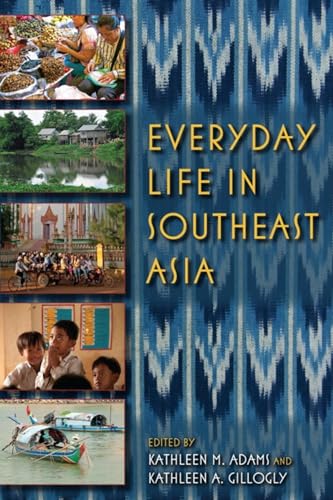
The peoples and cultures of Southeast Asia
Die Inhaltsangabe kann sich auf eine andere Ausgabe dieses Titels beziehen.
Über die Autorin bzw. den Autor
Kathleen M. Adams is Professor of Anthropology at Loyola University Chicago. She is author of Art as Power: Recrafting Identities, Tourism and Power in Tana Toraja, Indonesia and editor (with Sara Dickey) of Home and Hegemony: Domestic Work and Identity Politics in South and Southeast Asia.
Kathleen A. Gillogly is Assistant Professor of Anthropology at the University of Wisconsin-Parkside.
Auszug. © Genehmigter Nachdruck. Alle Rechte vorbehalten.
Everyday Life in Southeast Asia
By Kathleen M. Adams, Kathleen A. GilloglyIndiana University Press
Copyright © 2011 Indiana University Press
All rights reserved.
ISBN: 978-0-253-22321-0All rights reserved.
Contents
ACKNOWLEDGMENTS,
NOTE ON TRANSLITERATION,
MAPS,
Introduction: Southeast Asia and Everyday Life Kathleen A. Gillogy and Kathleen M. Adams,
Part One Fluid Personhood: Conceptualizing Identities,
1 Living in Indonesia without a Please or Thanks: Cultural Translations of Reciprocity and Respect Lorraine V. Aragon,
2 Toba Batak Selves: Personal, Spiritual, Collective Andrew Causey,
3 Poverty and Merit: Mobile Persons in Laos Holly High,
4 A Question of Identity: Different Ways of Being Malay and Muslim in Malaysia Judith Nagata,
Part Two Family, Households, and Livelihoods,
5 Maling, a Hanunóo Girl from the Philippines Harold C. Conklin,
6 Marriage and Opium in a Lisu Village in Northern Thailand Kathleen Gillogly,
7 Merit and Power in the Thai Social Order Lucien M. Hanks, Jr.,
Part Three Crafting the Nation-State,
8 Recording Tradition and Measuring Progress in the Ethnic Minority Highlands of Thailand Hjorleifur Jonsson,
9 Everyday Life and the Management of Cultural Complexity in Contemporary Singapore John Clammer,
10 Youth Culture and Fading Memories of War in Hanoi, Vietnam Christina Schwenkel,
Part Four World Religions in Everyday Life: Buddhism, Islam, Hinduism, and Christianity,
11 The Ordination of a Tree: The Buddhist Ecology Movement in Thailand Susan M. Darlington,
12 Javanese Women and the Veil Nancy Smith-Hefner,
13 Everyday Catholicism: Expanding the Sacred Sphere in the Philippines Katharine L. Wiegele,
Part Five Communicating Ideas: Popular Culture, Arts, and Entertainment,
14 Cultivating "Community" in an Indonesian Era of Conflict: Toraja Artistic Strategies for Promoting Peace Kathleen M. Adams,
15 The Fall of Thai Rocky Pattana Kitiarsa,
16 Everyday Life as Art: Thai Artists and the Aesthetics of Shopping, Eating, Protesting, and Having Fun Sandra Cate,
17 Eating Lunch and Recreating the Universe: Food and Cosmology in Hoi An, Vietnam Nir Avieli,
Part Six War and Recovery,
18 Living with the War Dead in Contemporary Vietnam Shaun Kingsley Malarney,
19 Producing the People: Exchange Obligations and Popular Nationalism Elizabeth G. Traube,
20 The Question of Collaborators: Moral Order and Community in the Aftermath of the Khmer Rouge Eve Monique Zucker,
Part Seven Global Processes and Shifting Ecological Relations,
21 When the Mountains No Longer Mean Home Chris Lyttleton,
22 "They Do Not Like to Be Confined and Told What to Do": Schooling Malaysian Indigenes Robert Knox Dentan, Anthony (Bah Tony) Williams-Hunt, and Juli Edo,
23 Narratives of Agency: Sex Work in Indonesia's Borderlands Michele Ford and Lenore Lyons,
24 Just Below the Surface: Environmental Destruction and Loss of Livelihood on an Indonesian Atoll Gene Ammarell,
REFERENCES,
SELECTED FILM RESOURCES,
CONTRIBUTORS,
INDEX,
CHAPTER 1
Living in Indonesia without a Please or Thanks: Cultural Translations of Reciprocity and Respect
Lorraine V. Aragon
"Can I take a sip of your drink, Dad?" I recently heard a seven year-old American girl ask in a public waiting room.
"Yes, but you didn't say 'Please'," her father chided gently.
"Please.... Thanks!" The little girl chanted these two magic words in quick succession as she eagerly reached for her father's can of soda pop.
It is easy to watch these remarkably powerful words being taught to young children in any home or public arena in the United States. Those of us who speak English or other European languages generally take these words for granted. But we know that their deployment brings politeness, persuasion, and permission to what might otherwise be unacceptable requests.
The power of these words also can be made visible by their absence. Try living a day in the company of others without ever saying "please" or "thank you," and see what happens. Social psychology experiments devised in the 1970s tested the boundaries of U.S. social norms through their intentional violation. Those studies, briefly in vogue, were termed ethnomethodology. The experiments were easy to design once the formula of nonchalant rule violation was conceived, but their popularity among psychologists and sociologists was short-lived because of the ill will they produced. Similar discomfort often arises when we travel innocently to distant places where customary rules of politeness differ. Even with our best efforts, our attempts to translate our own polite forms often seem to fall awkwardly flat.
That said, it may seem unimaginable that societies in Indonesia, a region known for its intricate forms of politeness, would lack such basic terms as please and thank you to oil the wheels of harmonious social interaction. As the anthropologists Clifford Geertz (1976) and James Peacock (1987) describe, the language, cosmology, politics, and aesthetics of Indonesia's most populous ethnic group, the Javanese, revolve around a dualism that contrasts the refined (alus, Javanese; halus, Indonesian) with the coarse or crude (kasar, Javanese and Indonesian).
We therefore would expect verbal expressions of gratitude to be prominent among peoples who are anxious about proper speech and social refinement. But, in fact, most of the more than three hundred indigenous languages spoken in the Indonesian archipelago do not include synonyms for terms such as please and thank you. Most languages in Indonesia borrow some "thank you" phrase from European languages or the national language, termed bahasa Indonesia, to cope with contemporary cosmopolitan expectations. When local people speak to one another in their native tongues, by contrast, they can make do without these phrases.
So, the cross-cultural puzzle arises. How does one live smoothly and politely in a society without a generic word like please to make your demanding requests upon others tolerable, and no phrases like thank you to express gratitude for help and kindness? Is gratitude simply assumed in small Southeast Asian communities of equals? Are the messages our European words contain perhaps encoded alternatively in nonverbal gestures?
The answers are more complicated. We must think in unfamiliar ways about what these kinds of words actually do—or, sometimes, cannot do—for us and others. Ward Keeler (1984:xvii) notes that "a critical part of learning a language is to learn not to want or need to say what one says in English, but rather to learn to say what people say in the culture of the language one is learning." In essence, then, studying a region's language in situ is much more about learning to intuit the logic of meaningful local categories and patterns of social expectations than it is about memorizing one-to-one linguistic translations. We are informed not only about technical language usage and conversational routines, but also about widespread Southeast Asian cultural practices of economic exchange and hierarchy. Keeler writes that Java is
full of small talk, and polite conversation draws on a large store of stereotypical remarks. To use them is not thought stultifying, as some Westerners find, but rather gracious, comfortable, indicative of the desire to make every encounter smooth and effortless for all concerned....
„Über diesen Titel“ kann sich auf eine andere Ausgabe dieses Titels beziehen.
Suchergebnisse für Everyday Life in Southeast Asia

Beispielbild für diese ISBN
Everyday Life in Southeast Asia
Verlag:
Indiana University Press, 2011
ISBN 10: 0253223210
ISBN 13: 9780253223210
Gebraucht
Paperback
Anbieter: World of Books (was SecondSale), Montgomery, IL, USA
Verkäuferbewertung 5 von 5 Sternen

Paperback. Zustand: Very Good. The peoples and cultures of Southeast Asia. Artikel-Nr. 00099228737
Gebraucht kaufen
EUR 5,89
Versand gratis
Versand innerhalb von USA
Versand innerhalb von USA
Anzahl: 2 verfügbar
Beispielbild für diese ISBN
Everyday Life in Southeast Asia
Verlag:
Indiana University Press, 2011
ISBN 10: 0253223210
ISBN 13: 9780253223210
Gebraucht
Paperback
Anbieter: World of Books (was SecondSale), Montgomery, IL, USA
Verkäuferbewertung 5 von 5 Sternen
Paperback. Zustand: Good. The peoples and cultures of Southeast Asia. Artikel-Nr. 00110909721
Gebraucht kaufen
EUR 5,89
Versand gratis
Versand innerhalb von USA
Versand innerhalb von USA
Anzahl: 2 verfügbar
Beispielbild für diese ISBN
Everyday Life in Southeast Asia
Verlag:
Indiana University Press, 2011
ISBN 10: 0253223210
ISBN 13: 9780253223210
Gebraucht
Paperback
Anbieter: ThriftBooks-Dallas, Dallas, TX, USA
Verkäuferbewertung 5 von 5 Sternen
Paperback. Zustand: As New. No Jacket. Pages are clean and are not marred by notes or folds of any kind. ~ ThriftBooks: Read More, Spend Less. Artikel-Nr. G0253223210I2N00
Gebraucht kaufen
EUR 6,05
Versand gratis
Versand innerhalb von USA
Versand innerhalb von USA
Anzahl: 1 verfügbar
Beispielbild für diese ISBN
Everyday Life in Southeast Asia
Verlag:
Indiana University Press, 2011
ISBN 10: 0253223210
ISBN 13: 9780253223210
Gebraucht
Softcover
Anbieter: Better World Books, Mishawaka, IN, USA
Verkäuferbewertung 5 von 5 Sternen
Zustand: Good. Pages intact with minimal writing/highlighting. The binding may be loose and creased. Dust jackets/supplements are not included. Stock photo provided. Product includes identifying sticker. Better World Books: Buy Books. Do Good. Artikel-Nr. 14815347-6
Gebraucht kaufen
EUR 6,37
Versand gratis
Versand innerhalb von USA
Versand innerhalb von USA
Anzahl: 1 verfügbar
Beispielbild für diese ISBN
Everyday Life in Southeast Asia
Verlag:
Indiana University Press, 2011
ISBN 10: 0253223210
ISBN 13: 9780253223210
Gebraucht
Softcover
Anbieter: Better World Books: West, Reno, NV, USA
Verkäuferbewertung 5 von 5 Sternen
Zustand: Good. Former library copy. Pages intact with minimal writing/highlighting. The binding may be loose and creased. Dust jackets/supplements are not included. Includes library markings. Stock photo provided. Product includes identifying sticker. Better World Books: Buy Books. Do Good. Artikel-Nr. 9600199-6
Gebraucht kaufen
EUR 6,37
Versand gratis
Versand innerhalb von USA
Versand innerhalb von USA
Anzahl: 1 verfügbar
Beispielbild für diese ISBN
Everyday Life in Southeast Asia
Verlag:
Indiana University Press, Bloomington, 2011
ISBN 10: 0253223210
ISBN 13: 9780253223210
Gebraucht
PAPERBACK
Signiert
Anbieter: COLLINS BOOKS, Seattle, WA, USA
Verkäuferbewertung 5 von 5 Sternen
PAPERBACK. Paper edition. 364pp b/w illustrations octavo paper. long inscription signed "Kathleen" slight cover wear otherwise very good. Artikel-Nr. 81806
Gebraucht kaufen
EUR 13,82
EUR 6,25 Versand
Versand innerhalb von USA
Versand innerhalb von USA
Anzahl: 1 verfügbar
Beispielbild für diese ISBN
Everyday Life in Southeast Asia
Verlag:
Indiana University Press, 2011
ISBN 10: 0253223210
ISBN 13: 9780253223210
Gebraucht
Softcover
Anbieter: medimops, Berlin, Deutschland
Verkäuferbewertung 5 von 5 Sternen
Zustand: good. Befriedigend/Good: Durchschnittlich erhaltenes Buch bzw. Schutzumschlag mit Gebrauchsspuren, aber vollständigen Seiten. / Describes the average WORN book or dust jacket that has all the pages present. Artikel-Nr. M00253223210-G
Gebraucht kaufen
EUR 20,64
EUR 10,00 Versand
Versand von Deutschland nach USA
Versand von Deutschland nach USA
Anzahl: 1 verfügbar
Beispielbild für diese ISBN
Everyday Life in Southeast Asia
Verlag:
Indiana University Press, 2011
ISBN 10: 0253223210
ISBN 13: 9780253223210
Gebraucht
Softcover
Anbieter: medimops, Berlin, Deutschland
Verkäuferbewertung 5 von 5 Sternen
Zustand: very good. Gut/Very good: Buch bzw. Schutzumschlag mit wenigen Gebrauchsspuren an Einband, Schutzumschlag oder Seiten. / Describes a book or dust jacket that does show some signs of wear on either the binding, dust jacket or pages. Artikel-Nr. M00253223210-V
Gebraucht kaufen
EUR 21,06
EUR 10,00 Versand
Versand von Deutschland nach USA
Versand von Deutschland nach USA
Anzahl: 1 verfügbar
Beispielbild für diese ISBN
Everyday Life in Southeast Asia
Anbieter: PBShop.store UK, Fairford, GLOS, Vereinigtes Königreich
Verkäuferbewertung 5 von 5 Sternen
PAP. Zustand: New. New Book. Shipped from UK. Established seller since 2000. Artikel-Nr. FW-9780253223210
Neu kaufen
EUR 27,12
EUR 6,01 Versand
Versand von Vereinigtes Königreich nach USA
Versand von Vereinigtes Königreich nach USA
Anzahl: 15 verfügbar
Beispielbild für diese ISBN
Everyday Life in Southeast Asia
Verlag:
Indiana University Press (USA), 2011
ISBN 10: 0253223210
ISBN 13: 9780253223210
Neu
Softcover
Anbieter: Majestic Books, Hounslow, Vereinigtes Königreich
Verkäuferbewertung 4 von 5 Sternen

Zustand: New. pp. 384. Artikel-Nr. 6869612
Neu kaufen
EUR 31,49
EUR 7,78 Versand
Versand von Vereinigtes Königreich nach USA
Versand von Vereinigtes Königreich nach USA
Anzahl: 3 verfügbar