
Verwandte Artikel zu Labor Disorders in Neoliberal Italy: Mobbing, Well-Being,...
Labor Disorders in Neoliberal Italy: Mobbing, Well-Being, and the Workplace (New Anthropologies of Europe) - Softcover
Buch 12 von 35: New Anthropologies of Europe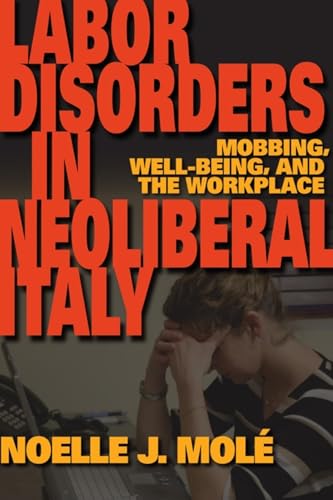
Inhaltsangabe
Winner, Society for the Anthropology of Work Book Prize
Die Inhaltsangabe kann sich auf eine andere Ausgabe dieses Titels beziehen.
Über die Autorin bzw. den Autor
Noelle J. Molé is a political and medical anthropologist. She teaches in the Expository Writing Program at New York University.
Auszug. © Genehmigter Nachdruck. Alle Rechte vorbehalten.
Labor Disorders in Neoliberal Italy
Mobbing, Well-Being, and the Workplace
By Noelle J. MoléIndiana University Press
Copyright © 2012 Noelle J. Molé
All rights reserved.
ISBN: 978-0-253-22319-7All rights reserved.
Contents
Preface,
Acknowledgments,
Introduction,
1. Toward Neoliberalism,
2. The Politics of Precariousness,
3. Existential Damages,
4. Feminizing the Inflexible,
5. Living It on the Skin,
6. The Sex of Mobbing,
7. Project Well-Being,
Notes,
Bibliography,
Index,
CHAPTER 1
Toward Neoliberalism
While mobbing is a term recognized throughout the European Union, it has come to have a particular urgency and salience in Italy. Mapping the field of Italy's dynamic political, social, and economic orders uncovers the historical conditions and tensions from which mobbing emerges. The discourse about mobbing reflects cultural apprehensions about the worst of global capitalism, reiterating its risks, effects, and human costs. The rapid replacement of Italy's protectionist labor regime, once one of the world's strongest, with neoliberal economic and social policies has played a significant role in shaping how workers might experience a sense of persecution and harassment at work. The social and economic history of stable work, as well as the speed with which neoliberalism has been implemented, has played a critical role in generating a set of moral orders in which the hasty removal of secure labor breeds fear, anxiety, and dread. Only in the context of Italy's moral economy, in which protected labor has been seen as a right of citizenship, could precarious work be recognized as unethical and even health endangering.
We must first recover Italy's specific cultural and political genealogies in order to understand why high-risk neoliberal labor regimes would seem, to many Italians, to be something economically, politically, and ethically deviant. The devaluation of labor can only be pathologized in a context in which labor is, or once was, valued. Policies that would fashion the Italian labor force into a pliable population of interchangeable human work units are unethical to many Italians, whose ethics animated the creation of state laws and policies in the past. Mobbing has emerged at a historical moment dominated by a sharp decline in labor safeguards, while there coexists a deep cultural value for safeguards in the increasingly market-oriented labor force. The pro-labor and pro-market political movements and ideologies create the moral orders in terms of which Italians may understand what is at stake during neoliberal reform and, in turn, what mobbing disrupts.
Emerging against neoliberal labor reform, the discourse of precariousness in Italy is a publicly debated set of ideas and the centerpiece of a new leftist political platform and social movement. And it has become a site of negotiation about the meaning of work, the rights of workers, and the role of the welfare state in protecting worker-citizens. The idea of precariousness underscores the perspective of the worker and valorizes long-term secure labor: it turns the neoliberal value of flexibility on its head.
Economic Miracles to Stagflation
What makes Italy's economic history unusual has been its rapid industrialization. After the demise of Mussolini's fascist government, Italy's 1948 Constitution shifted from its long-term centralized governance, particularly evident during the fascist regime, to allow for more robust regional governmental control (OECD 2001: 141). In the geopolitical context of post-fascism governance, plans were made to strengthen Italy's economy and to prevent the spread of communism in Europe (Barca et al. 2001: 32). The ruling Christian Democratic Party did not destabilize family-run firms, and it sustained economic growth into the 1950s, particularly in central and northern Italy (ibid.: 35). These factors facilitated the remarkable economic growth between 1950 and 1970 which became known as the "economic miracle," a manufacturing and industrial boom coinciding with the first reductions of the protectionist regime, which swiftly lowered labor costs (Ginsborg 1990: 214). Part of what sustained this extraordinary economic growth was the rapid movement of workers from Italy's South to its industrial North. Some studies suggest that in the early 1960s up to 5 million people (14 percent of Italy's total population) from the South moved to the central and northern regions of Italy (Di Matteo and Yoshikawa 2001: 52). The North, in essence, became an industrial frontier for unemployed and economically disadvantaged southerners.
The southern migration to the North also produced particular kinds of labor relations between employers and employees that led to industrial decentralization and flexibility (Piore and Sabel 1984). The southern workers, largely trained in agricultural sectors and not accustomed to factory labor, contributed to a great deal of strife between laborers and employers as many workers resisted the use of mass-production equipment, and this fact, unifying craftspeople and unskilled workers against employers, resulted in multiple strikes in the early 1960s (ibid.: 155). Thus, workers effectively limited not only their work pace and productivity but also the quality of their contracts and their promotions. In turn, new flexible strategies of management emerged to better control the labor force, and employers began to decentralize production. Workers were spread among smaller firms as a disciplinary measure, and this meant the creation of new jobs, especially for the artisans and craftspeople who left the large industrial sites (ibid.: 156). The existence of large firms encouraged workers to set up collaborations between smaller firms to become more competitive (Pagano and Trento 2003: 199). What is significant and unusual is that these small firms allowed workers to quickly develop the skills to become self-sufficient owners and managers themselves (ibid.). This particular type of rapid development of skilled artisans in small firms, together with the structure of decentralized production, became one of the unique strengths of the Italian economy. This mode of production, dubbed "flexible specialization," thrived in the Veneto region (Piore and Sabel 1984). The concept of flexible specialization stems from Piore and Sabel's description of Italian economic conditions but is also a generalized term for production driven by "networks of technologically sophisticated, highly flexible manufacturing firms; a strategy of permanent innovation: accommodation to ceaseless change" (ibid.: 17). Thus, and ironically, Italy's Veneto region is one of the birthplaces of the neoliberal labor regime—a precursor to what David Harvey would later describe as "flexible accumulation," which "rests on flexibility with respect to labour processes, labour markets, products, and patterns of consumption" (Harvey 1989: 147).
Despite the economic miracle, a significant portion of Italy's population, 19 percent of the workforce, was still employed in the agricultural sector in 1970 (Di Matteo and Yoshikawa 2001: 43). Wages increased in the 1960s and the need for capital remained high, contributing to the relatively stable growth of the Italian economy into the 1980s (Barca et al. 2001: 33). State labor policy in the 1970s stunted the growth of large-scale firms and limited their potential growth by requiring excessive bureaucratic work for the opening of new firms and by very high taxation (Carnazza et al. 2001: 161), leading to what became known as a period of...
„Über diesen Titel“ kann sich auf eine andere Ausgabe dieses Titels beziehen.
Suchergebnisse für Labor Disorders in Neoliberal Italy: Mobbing, Well-Being,...

Beispielbild für diese ISBN
Labor Disorders in Neoliberal Italy: Mobbing, Well-Being, and the Workplace (New Anthropologies of Europe)
Verlag:
Indiana University Press (edition ), 2011
ISBN 10: 0253223199
ISBN 13: 9780253223197
Gebraucht
Paperback
Anbieter: BooksRun, Philadelphia, PA, USA
Verkäuferbewertung 5 von 5 Sternen

Paperback. Zustand: Very Good. It's a well-cared-for item that has seen limited use. The item may show minor signs of wear. All the text is legible, with all pages included. It may have slight markings and/or highlighting. Artikel-Nr. 0253223199-8-1
Gebraucht kaufen
EUR 10,10
Versand gratis
Versand innerhalb von USA
Versand innerhalb von USA
Anzahl: 1 verfügbar
Beispielbild für diese ISBN
Labor Disorders in Neoliberal Italy
Anbieter: PBShop.store UK, Fairford, GLOS, Vereinigtes Königreich
Verkäuferbewertung 5 von 5 Sternen
PAP. Zustand: New. New Book. Shipped from UK. Established seller since 2000. Artikel-Nr. FW-9780253223197
Neu kaufen
EUR 22,87
EUR 4,85 Versand
Versand von Vereinigtes Königreich nach USA
Versand von Vereinigtes Königreich nach USA
Anzahl: 15 verfügbar
Beispielbild für diese ISBN
Labor Disorders in Neoliberal Italy
Verlag:
Indiana University Press (USA), 2011
ISBN 10: 0253223199
ISBN 13: 9780253223197
Neu
Softcover
Anbieter: Majestic Books, Hounslow, Vereinigtes Königreich
Verkäuferbewertung 4 von 5 Sternen

Zustand: New. pp. 248. Artikel-Nr. 6869631
Neu kaufen
EUR 29,18
EUR 7,58 Versand
Versand von Vereinigtes Königreich nach USA
Versand von Vereinigtes Königreich nach USA
Anzahl: 3 verfügbar
Beispielbild für diese ISBN
Labor Disorders in Neoliberal Italy: Mobbing, Well-Being, and the Workplace (New Anthropologies of Europe)
Anbieter: Ria Christie Collections, Uxbridge, Vereinigtes Königreich
Verkäuferbewertung 5 von 5 Sternen
Zustand: New. In English. Artikel-Nr. ria9780253223197_new
Neu kaufen
EUR 28,74
EUR 13,16 Versand
Versand von Vereinigtes Königreich nach USA
Versand von Vereinigtes Königreich nach USA
Anzahl: Mehr als 20 verfügbar
Beispielbild für diese ISBN
Labor Disorders in Neoliberal Italy
Anbieter: Kennys Bookstore, Olney, MD, USA
Verkäuferbewertung 5 von 5 Sternen
Zustand: New. Harassment at work as a public health and labour issue Series: New Anthropologies of Europe. Num Pages: 228 pages, black & white illustrations. BIC Classification: 1DST; GTB; JHBL. Category: (P) Professional & Vocational. Dimension: 171 x 228 x 17. Weight in Grams: 344. . 2011. Paperback. . . . . Books ship from the US and Ireland. Artikel-Nr. V9780253223197
Neu kaufen
EUR 35,67
EUR 9,23 Versand
Versand innerhalb von USA
Versand innerhalb von USA
Anzahl: Mehr als 20 verfügbar
Beispielbild für diese ISBN
Labor Disorders in Neoliberal Italy Mobbing, WellBeing, and the Workplace
Anbieter: Revaluation Books, Exeter, Vereinigtes Königreich
Verkäuferbewertung 5 von 5 Sternen
Paperback. Zustand: Brand New. 248 pages. 9.00x6.10x0.60 inches. In Stock. Artikel-Nr. x-0253223199
Neu kaufen
EUR 34,41
EUR 11,66 Versand
Versand von Vereinigtes Königreich nach USA
Versand von Vereinigtes Königreich nach USA
Anzahl: 2 verfügbar
Foto des Verkäufers
Labor Disorders in Neoliberal Italy: Mobbing, Well-Being, and the Workplace
Verlag:
INDIANA UNIV PR, 2011
ISBN 10: 0253223199
ISBN 13: 9780253223197
Neu
Kartoniert / Broschiert
Anbieter: moluna, Greven, Deutschland
Verkäuferbewertung 5 von 5 Sternen
Kartoniert / Broschiert. Zustand: New. Artikel-Nr. 594484225
Neu kaufen
EUR 31,78
EUR 48,99 Versand
Versand von Deutschland nach USA
Versand von Deutschland nach USA
Anzahl: Mehr als 20 verfügbar
Foto des Verkäufers
Labor Disorders in Neoliberal Italy | Mobbing, Well-Being, and the Workplace
Anbieter: preigu, Osnabrück, Deutschland
Verkäuferbewertung 5 von 5 Sternen
Taschenbuch. Zustand: Neu. Labor Disorders in Neoliberal Italy | Mobbing, Well-Being, and the Workplace | Noelle J. Molé | Taschenbuch | Indiana University Press | Einband - flex.(Paperback) | Englisch | 2011 | Indiana University Press | EAN 9780253223197 | Verantwortliche Person für die EU: Mare Nostrum Group B.V., Doelen 72, 4831 GR BREDA, NIEDERLANDE, gpsr[at]mare-nostrum[dot]co[dot]uk | Anbieter: preigu. Artikel-Nr. 131037080
Neu kaufen
EUR 24,10
EUR 70,00 Versand
Versand von Deutschland nach USA
Versand von Deutschland nach USA
Anzahl: 5 verfügbar