
Verwandte Artikel zu War of Words, War of Stones: Racial Thought and Violence...
Inhaltsangabe
Winner, 2011 Martin A. Klein Award, American Historical AssociationFinalist, 2012 Herskovits Award
Die Inhaltsangabe kann sich auf eine andere Ausgabe dieses Titels beziehen.
Über die Autorin bzw. den Autor
Jonathon Glassman is Associate Professor of History at Northwestern University. He is author of Feasts and Riot: Revelry, Rebellion, and Popular Consciousness on the Swahili Coast, 1856-1888, which was awarded the Herskovits Prize in African Studies.
Auszug. © Genehmigter Nachdruck. Alle Rechte vorbehalten.
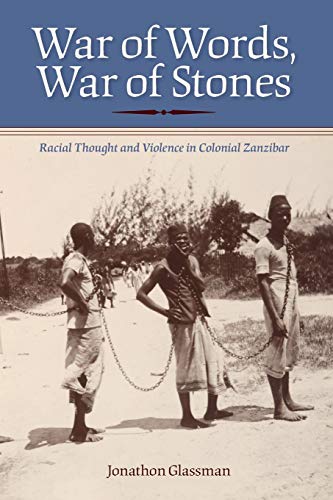
War of Words, War of Stones
Racial thought and Violence in Colonial Zanzibar
By Jonathon GlassmanIndiana University Press
Copyright © 2011 Jonathon Glassman
All rights reserved.
ISBN: 978-0-253-22280-0All rights reserved.
Contents
Preface and Acknowledgments, ix,
Note on Usage, xiii,
PART 1. INTRODUCTION,
1 Rethinking Race in the Colonial World, 3,
2 The Creation of a Racial State, 23,
PART 2. WAR OF WORDS,
3 A Secular Intelligentsia and the Origins of Exclusionary Ethnic Nationalism, 75,
4 Subaltern Intellectuals and the Rise of Racial Nationalism, 105,
5 Politics and Civil Society during the Newspaper Wars, 147,
PART 3. WAR OF STONES,
6 Rumor, Race, and Crime, 179,
7 Violence as Racial Discourse, 230,
8 "June" as Chosen Trauma, 264,
Conclusion and Epilogue: Remaking Race, 282,
Glossary, 303,
Notes, 305,
List of References, 381,
Index, 391,
CHAPTER 1
Rethinking Race in the Colonial World
I
The Sultanate of Zanzibar, a pair of islands twenty miles off the coast of East Africa, has captured the attention of the Western world at two moments in the modern era, both times as an emblem of the battle between civilization and barbarism. The first was in the third quarter of the nineteenth century, when David Livingstone and other ideologues of missionary Christianity made it famous as the seat of what they called the "Arab slave trade" that was then disrupting many parts of the continental mainland. Their crusade to end the slave trade and replace it with civilization and "legitimate commerce" culminated in colonial conquest at the century's end, undertaken in the name of advancing moral and social progress. The second moment, far briefer, seemed at the time a coda to the story of abolition. On the night of 11-12 January 1964, one month after Zanzibar had gained its independence from British rule, the Arab sultan and his elected constitutional government were overthrown by forces claiming to represent the islands' African racial majority and to be fighting to redress the centuries-old injustice of Arab rule. The coup was accompanied by pogroms that took the lives of thousands of the islands' Arab minority.
Contemporary observers regarded the latter events as a grave setback to the orderly processes of the preceding decade, in which British administrators and Zanzibari politicians had sought to nurture a civic nationalism that would take the place of colonial rule. Similar setbacks would occur elsewhere in the former colonial world, including in Nigeria, Rwanda, Sudan, and South Asia. In the language of social scientists, nationalists had aimed to build a "civil order" in which "the gross actualities of blood, race, language, locality, religion, or tradition" would be subordinated. But those "primordial sentiments" proved difficult to avoid, rooted as they were in the region's deepest histories. In the case of Zanzibar, observers across the political and ideological spectrum agreed that the violence was the product of over two millennia of tension created by Arab racial domination. The African-American Chicago Defender, a venerable champion of African nationalism, explained that the revolution was an "Arab-African explosion which had its beginning in more than 25 centuries [of] Arab influence and unresolved racial conflicts," including the never-forgotten experience of the "Arab slave trade." Mainstream pundits and policy makers, including those less sympathetic to African nationalism, issued similar pronouncements. The widespread and apparently spontaneous pogroms in Zanzibar seemed powerful evidence of such primordialist interpretations.
These were not simply the views of foreigners. Only three years earlier, spokesmen for the party that would take power after the 1964 revolution, the Afro-Shirazi Party (ASP), had apologized for a similar outbreak of racial violence in much the same way: as a "spontaneous" outburst of popular anger that had sprung from centuries of racial oppression. The ASP was a party of explicit racial nationalism, and the elite Arabs who led its main rival, the multiracial Zanzibar National Party (ZNP), did not accept its narrative of Arab oppression. Nevertheless, until quite late the ZNP leaders had shared a similar historical vision of the deep-seated nature of Zanzibar's racial divisions. Indeed, the far-fetched idea that Arabs had been living in East Africa as a distinct racial elite for over two millennia had long been propagated by the Arab nationalists themselves. In short, primordialist explanations of Zanzibar's racial divisions had been ubiquitous among the islands' political thinkers.
Yet this model of deeply rooted divisions between Arab and African — boundaries that were clear cut, fixed, and slow to change — sat poorly with the most common representations of this part of East Africa. Zanzibar is part of the Swahili coast, a name given to the language and culture practiced along almost 2,000 miles of the Indian Ocean littoral. Although the language belongs to the Bantu linguistic family, it contains many Arabic loanwords and the culture is often represented as a synthesis of African and Middle Eastern elements. More pertinently, Swahili society has often been portrayed — by Western scholars, colonial administrators, and Swahili intellectuals themselves — as the epitome of ethnic fluidity and racial indeterminacy. Swahili-speakers simultaneously perceive themselves as Arab, Persian, and/or Indian as well as African; the specific emphasis an individual gives to his or her racial identity can shift according to situation and generation. In the 1950s, the anthropologist A. H. J. Prins wrote that Swahili-peakers rarely thought of themselves as belonging exclusively to any one racial category (a person was "never Swahili and nothing else") and observed that individuals constantly crossed and straddled boundaries. More recently, the literary scholars Alamin Mazrui and Ibrahim Noor Shariff have described Swahili "identity paradigms" as "assimilative and flexible," based on "a concept of belonging that is truly liberal." Such identity paradigms were quintessentially African, they write, and stand in contrast to the fixed, rigid identity paradigms characteristic of Western thought. Throughout the colonial era, in fact, indigenous and British elites represented Zanzibar as islands of racial harmony. To a large extent this representation was a myth, informed by overlapping sets of paternalist ideals and belied by many instances of tension that punctuated the sultanate's public life. Yet it contained a kernel of truth, for Zanzibaris had not, as a rule, organized themselves into ethnically discrete communities, and, despite occasional tension, few thought of ethnic divisions with the kind of exclusionary rigidity that informed the pogroms of the early 1960s.
So primordialist explanations of Zanzibar's racial divisions are easily discounted — and, indeed, although simple primordialism is still commonplace among journalists, few serious scholars accept it anymore. But that leaves the puzzle of explaining how ethnic identities had become so polarized by mid-century. Within weeks of the 1964 revolution, the leaders of the ASP, in a sudden change of their primordialist views, began offering an answer that would soon become standard among scholars and political thinkers in many parts of the continent. In a speech in March, Abeid Amani Karume, the founding president of the Revolutionary Government, announced the prohibition of ethnic associations (klabu za...
„Über diesen Titel“ kann sich auf eine andere Ausgabe dieses Titels beziehen.
Suchergebnisse für War of Words, War of Stones: Racial Thought and Violence...

Beispielbild für diese ISBN
War of Words, War of Stones
Anbieter: PBShop.store UK, Fairford, GLOS, Vereinigtes Königreich
Verkäuferbewertung 5 von 5 Sternen

PAP. Zustand: New. New Book. Shipped from UK. Established seller since 2000. Artikel-Nr. FW-9780253222800
Neu kaufen
EUR 26,53
EUR 5,86 Versand
Versand von Vereinigtes Königreich nach USA
Versand von Vereinigtes Königreich nach USA
Anzahl: 15 verfügbar
Beispielbild für diese ISBN
War of Words, War of Stones
Verlag:
Indiana University Press (USA), 2011
ISBN 10: 025322280X
ISBN 13: 9780253222800
Neu
Softcover
Anbieter: Majestic Books, Hounslow, Vereinigtes Königreich
Verkäuferbewertung 4 von 5 Sternen

Zustand: New. pp. 414. Artikel-Nr. 5413749
Neu kaufen
EUR 34,42
EUR 7,58 Versand
Versand von Vereinigtes Königreich nach USA
Versand von Vereinigtes Königreich nach USA
Anzahl: 3 verfügbar
Beispielbild für diese ISBN
War of Words, War of Stones: Racial Thought and Violence in Colonial Zanzibar
Anbieter: Ria Christie Collections, Uxbridge, Vereinigtes Königreich
Verkäuferbewertung 5 von 5 Sternen
Zustand: New. In English. Artikel-Nr. ria9780253222800_new
Neu kaufen
EUR 30,44
EUR 13,17 Versand
Versand von Vereinigtes Königreich nach USA
Versand von Vereinigtes Königreich nach USA
Anzahl: Mehr als 20 verfügbar
Foto des Verkäufers
War of words, war of stones Racial thought and violence in colonial Zanzibar
Anbieter: Antiquariaat van Starkenburg, Apeldoorn, Niederlande
Verkäuferbewertung 5 von 5 Sternen
sewed, 398 pp, ills. Artikel-Nr. gwaf0157
Gebraucht kaufen
EUR 18,00
EUR 30,00 Versand
Versand von Niederlande nach USA
Versand von Niederlande nach USA
Anzahl: 1 verfügbar
Beispielbild für diese ISBN
War of Words, War of Stones
Anbieter: Kennys Bookstore, Olney, MD, USA
Verkäuferbewertung 5 von 5 Sternen
Zustand: New. Race and racial thinking on the Swahili coast Num Pages: 414 pages, 15 b&w illus., 5 maps. BIC Classification: 1H; 1HFG; GTB; HBG; HBLW3; JPA. Category: (P) Professional & Vocational. Dimension: 157 x 218 x 28. Weight in Grams: 566. . 2011. Paperback. . . . . Books ship from the US and Ireland. Artikel-Nr. V9780253222800
Neu kaufen
EUR 41,43
EUR 9,16 Versand
Versand innerhalb von USA
Versand innerhalb von USA
Anzahl: Mehr als 20 verfügbar
Beispielbild für diese ISBN
War of Words, War of Stones Racial Thought and Violence in Colonial Zanzibar
Anbieter: Revaluation Books, Exeter, Vereinigtes Königreich
Verkäuferbewertung 5 von 5 Sternen
Paperback. Zustand: Brand New. 398 pages. 9.00x6.00x1.00 inches. In Stock. Artikel-Nr. x-025322280X
Neu kaufen
EUR 42,50
EUR 14,59 Versand
Versand von Vereinigtes Königreich nach USA
Versand von Vereinigtes Königreich nach USA
Anzahl: 2 verfügbar
Foto des Verkäufers
War of Words, War of Stones : Racial Thought and Violence in Colonial Zanzibar
Verlag:
Indiana University Press Feb 2011, 2011
ISBN 10: 025322280X
ISBN 13: 9780253222800
Neu
Taschenbuch
Anbieter: AHA-BUCH GmbH, Einbeck, Deutschland
Verkäuferbewertung 5 von 5 Sternen
Taschenbuch. Zustand: Neu. Neuware - The Swahili coast of Africa is often described as a paragon of transnational culture and racial fluidity. Yet, during a brief period in the 1960s, Zanzibar became deeply divided along racial lines as intellectuals and activists, engaged in bitter debates about their nation's future, ignited a deadly conflict that spread across the island. War of Words, War of Stones explores how violently enforced racial boundaries arose from Zanzibar's entangled history. Jonathon Glassman challenges explanations that assume racial thinking in the colonial world reflected only Western ideas. He shows how Africans crafted competing ways of categorizing race from local tradition and engagement with the Atlantic and Indian Ocean worlds. Artikel-Nr. 9780253222800
Neu kaufen
EUR 47,10
EUR 30,50 Versand
Versand von Deutschland nach USA
Versand von Deutschland nach USA
Anzahl: 1 verfügbar
Beispielbild für diese ISBN
War of Words War of Stones: Racial Thought and Violence in Colonial Zanzibar
Verlag:
Indiana University Press, 2011
ISBN 10: 025322280X
ISBN 13: 9780253222800
Gebraucht
Softcover
Anbieter: LiLi - La Liberté des Livres, CANEJAN, Frankreich
Verkäuferbewertung 4 von 5 Sternen
Zustand: fine. vendeur professionnel. envoi soigne en 24/48h. le livre peut presenter de tres legers signes d'usure, petites rayures ou imperfections esthetiques. Artikel-Nr. 2605110006010
Gebraucht kaufen
EUR 17,70
EUR 65,00 Versand
Versand von Frankreich nach USA
Versand von Frankreich nach USA
Anzahl: 1 verfügbar
Foto des Verkäufers
War of Words, War of Stones
Verlag:
INDIANA UNIV PR, 2011
ISBN 10: 025322280X
ISBN 13: 9780253222800
Neu
Kartoniert / Broschiert
Anbieter: moluna, Greven, Deutschland
Verkäuferbewertung 5 von 5 Sternen
Kartoniert / Broschiert. Zustand: New. Race and racial thinking on the Swahili coastÜber den AutorJonathon GlassmanInhaltsverzeichnisPreface and AcknowledgmentsNote on UsagePart 1. Introduction1. Rethinking Race in the Co. Artikel-Nr. 897572055
Neu kaufen
EUR 36,69
EUR 48,99 Versand
Versand von Deutschland nach USA
Versand von Deutschland nach USA
Anzahl: Mehr als 20 verfügbar
Foto des Verkäufers
War of Words, War of Stones | Racial Thought and Violence in Colonial Zanzibar
Anbieter: preigu, Osnabrück, Deutschland
Verkäuferbewertung 5 von 5 Sternen
Taschenbuch. Zustand: Neu. War of Words, War of Stones | Racial Thought and Violence in Colonial Zanzibar | Jonathon Glassman | Taschenbuch | Indiana University Press | Einband - flex.(Paperback) | Englisch | 2011 | Indiana University Press | EAN 9780253222800 | Verantwortliche Person für die EU: Mare Nostrum Group B.V., Doelen 72, 4831 GR BREDA, NIEDERLANDE, gpsr[at]mare-nostrum[dot]co[dot]uk | Anbieter: preigu. Artikel-Nr. 107161146
Neu kaufen
EUR 28,65
EUR 70,00 Versand
Versand von Deutschland nach USA
Versand von Deutschland nach USA
Anzahl: 5 verfügbar