
Verwandte Artikel zu Flaherty: Decades in the Cause of Independent Cinema
Inhaltsangabe
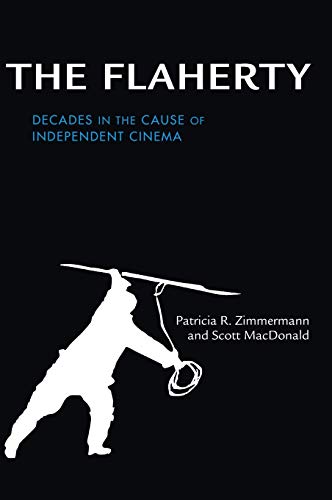
This is the inspiring story of The Flaherty, one of the oldest continuously running nonprofit media arts institutions in the world, which has shaped the development of independent film, video, and emerging forms in the United States over the past 60 years. Combining the words of legendary independent filmmakers with a detailed history of The Flaherty, Patricia R. Zimmermann and Scott MacDonald showcase its history and legacy, amply demonstrating how the relationships created at the annual Flaherty seminar have been instrumental in transforming American media history. Moving through the decades, each chapter opens with a detailed history of the organization by Zimmermann, who traces the evolution of The Flaherty from a private gathering of filmmakers to a small annual convening, to today's ever-growing nexus of filmmakers, scholars, librarians, producers, funders, distributors, and others associated with international independent cinema. MacDonald expands each chapter by giving voice to the major figures in the evolution of independent media through transcriptions of key discussions galvanized by films shown at The Flaherty. The discussions feature Frances Flaherty, Robert Gardner, Fred Wiseman, Willard Van Dyke, Jim McBride, Michael Snow, Hollis Frampton, Erik Barnouw, Barbara Kopple, Ed Pincus, Trinh T. Minh-ha, Bruce Conner, Peter Watkins, Su Friedrich, Marlon Riggs, William Greaves, Ken Jacobs, Kazuo Hara, Mani Kaul, Craig Baldwin, Bahman Ghobadi, Eyal Sivan, and many others.
Die Inhaltsangabe kann sich auf eine andere Ausgabe dieses Titels beziehen.
Über die Autorin bzw. den Autor
Patricia R. Zimmermann is Professor of Screen Studies at Ithaca College. She is the author of Reel Families: A Social History of Amateur Film (IUP, 1995) and Open Spaces: Openings, Closings, and Thresholds of International Public Media, among many other titles.
Scott MacDonald is Professor of Art History at Hamilton College. He is author of many books including, most recently, Avant-Doc: Intersections of Documentary and Avant-Garde Cinema and Binghamton Babylon: Voices from the Cinema Department (a nonfiction novel).
Auszug. © Genehmigter Nachdruck. Alle Rechte vorbehalten.
The Flaherty
Decades in the Cause of Independent Cinema
By Patricia R. Zimmermann, Scott MacDonaldIndiana University Press
Copyright © 2017 Patricia R. Zimmermann and Scott MacDonald
All rights reserved.
ISBN: 978-0-253-02624-8All rights reserved.
Contents
Acknowledgments, ix,
Introduction, 1,
Patricia R. Zimmermann: Imagining a History of the Flaherty Seminar, 1,
Scott MacDonald: The Logistics of Transcribing and Editing Flaherty Discussions, 4,
1. The Flaherty Way, 9,
2. A Seminar, 1955–1959, 35,
3. An Organization, 1960–1969, 55,
4. Politics, Cultural and Formal, 1970–1980, 95,
5. Shock of the New, 1981–1989, 137,
6. Crises, 1990–1999, 189,
7. The Brand, 2000–2015, 261,
Index, 327,
CHAPTER 1
THE FLAHERTY WAY
The Flaherty Seminar is one of the oldest, continuously running gatherings for independent film in the world. Launched by Frances Flaherty in 1955, the seminar explored the "Flaherty Way" of making films, rejecting planning and scripts required by commercial production practices. Frances was the widow of renowned documentary filmmaker Robert Flaherty. Although Robert directed the films and occupies a central, if controversial, place in documentary film history books, it was Frances who developed the Robert Flaherty Film Seminar for community, debate, dialogue, and screenings. The seminar has provided a retreat-like, closed setting for distributors, film librarians, filmmakers, funders, programmers, and scholars for more than sixty years.
Robert Flaherty, who shot films in exotic locations such as the Canadian north and Samoa and then shared production stories to eager acolytes rather than theorizing his practice, did not conceptualize the "Flaherty Way." Instead, his widow developed the "Flaherty Way" after his death. She advocated for a poetic cinema that surrendered to the materials and the environment. In Frances's vision, the "Flaherty Way" offered a more artisanal, personal cinema than the formulaic, predictable industrial model based on imposition of commercial norms, planning, and scripts. Resolutely anti-Hollywood, the "Flaherty Way" combined the explorer's journeys into the unknown, the ethnographer's observation of cultural patterns, and the Zen mystics' openness to surroundings.
The Robert Flaherty Foundation and the Robert Flaherty Seminar emerged from Frances's contention that learning to see in deeper, more complex ways could be acquired through intensive viewing and vigorous discussion. In a 1961 letter to the Guggenheim Foundation in support of a grant application by Frances, George Amberg wrote: "It may be useful to point out that Mrs. Flaherty is not, as would be natural, so much concerned with building a monument in honor of a great filmmaker and a great man, than with promoting and supporting a vital succession, establishing a tradition, making discoveries, and encouraging new talent. Toward this end, she organized the Flaherty Foundation and initiated the Flaherty Seminars, an annual venture devoted to the scholarly and critical study of the motion picture."
The Flaherty Foundation and the Flaherty Seminar are significant in film history. They show the challenges of the early foundational period in the development of the nascent nonprofit public media sector in the United States in the post–World War II period. They suggest the importance of institutional histories to delineate the infrastructure bolstering cinematic cultures beyond the commercial systems. The foundation and the seminars occupy a vital interstitial zone between emergent alternative film cultures in the 1950s: 16mm exhibition, art cinemas, educational and industrial films, film festivals, film societies, independent cinema beyond commercial studios, and university film education.
The Flaherty Foundation, formed by Frances and David Flaherty, Robert's brother, in 1951, and its outgrowth, the Flaherty Seminar, inaugurated in 1955, were initially dedicated to preserving and circulating Flaherty's films. They advocated for an artisanal, independent, poetic cinema immunized from the commercial Hollywood system. Convening a small, intimate group of distributors, editors, filmmakers, scholars, and writers on the family farm in Dummerston, Vermont, for ten days in the summer, the early years of the seminar were characterized by camaraderie, intellectual and artistic intensity, and a hope that cinema go beyond commercial filmmaking with its rules and conventions.
The early seminars focused on the works and practices of Robert Flaherty. Seminarians dived into close analysis of Flaherty films, such as Nanook of the North (1922) and Louisiana Story (1948), listened to lectures by those who worked on Flaherty films, such as Ricky Leacock and Helen van Dongen, and watched experimental and documentary films produced outside the Hollywood system.
Combining the ciné-club and film society models of postscreening discussion and more intellectual models of lectures elaborating cinematic techniques, the seminar did not operate as a film festival, with public screenings of narrative films in theaters. Instead, the Flaherty Seminar was a small gathering on the family farm, seminarians applied to attend, and many films were historical rather than current releases. The seminar advanced cinematic practice and conceptual thinking in the loosely defined nontheatrical sector. The early seminars' emphasis on critical viewing, philosophical inquiry, and probing discussion distinguished it from film festivals. Its purpose was educational. It advocated for cinema as an art. Attendees were not an audience but were called participants, implying active engagement rather than passive viewing. As David Flaherty noted in 1960 after mounting five seminars on the Flaherty farm, "Yes, we think 'participants' is a better word to use than 'students.'"
The Flaherty Seminar emerged in the postwar context of the Cold War (1947–91), where the United States and the Soviet Union engaged in a tense global military and strategic conflict between competing ideologies of democracy and communism. David Flaherty's use of the word participant rather than student aligns with a Cold War ideology promulgating that the United States offered individual freedoms, in contrast to the Union of Soviet Socialist Republics (USSR), which was figured as limiting freedom of expression and participation. The Cold War spurred US military buildup, a strategy of containment against the advances of communism around the globe, and the development and expansion of the United States Information Agency, a government organization to promote American culture through public diplomacy. The connection between US Cold War international strategies and practices and the Flaherty Seminar is not one of direct causation as much as it is one of a discursive historical surround that illuminates interpretation of how to position its politics and practices. The seminar occupied a complicated, somewhat foggy middle ground between the individualism promoted by US Cold War ideology and the communist collectivity of the USSR: it advanced auteurs and their individual artistic vision while it fostered an intense, yet isolated, group experience.
The Flaherty Seminar never openly aligned with entertainment and news industry unions, which had been under scrutiny and attack during the various post-World War II Red Scares. In 1947, the House Un-American Activities Committee (HUAC) attacked Hollywood — almost 100 percent unionized by the postwar period —...
„Über diesen Titel“ kann sich auf eine andere Ausgabe dieses Titels beziehen.
Suchergebnisse für Flaherty: Decades in the Cause of Independent Cinema

Beispielbild für diese ISBN
The Flaherty: Decades in the Cause of Independent Cinema
Verlag:
Indiana University Press, 2017
ISBN 10: 0253026245
ISBN 13: 9780253026248
Gebraucht
Hardcover
Anbieter: ThriftBooks-Atlanta, AUSTELL, GA, USA
Verkäuferbewertung 5 von 5 Sternen

Hardcover. Zustand: Very Good. No Jacket. May have limited writing in cover pages. Pages are unmarked. ~ ThriftBooks: Read More, Spend Less. Artikel-Nr. G0253026245I4N00
Gebraucht kaufen
EUR 10,15
Versand gratis
Versand innerhalb von USA
Versand innerhalb von USA
Anzahl: 1 verfügbar
Beispielbild für diese ISBN
The Flaherty: Decades in the Cause of Independent Cinema
Verlag:
Indiana University Press, 2017
ISBN 10: 0253026245
ISBN 13: 9780253026248
Gebraucht
Hardcover
Erstausgabe
Anbieter: Jackson Street Booksellers, Omaha, NE, USA
Verkäuferbewertung 5 von 5 Sternen
Hardcover. Zustand: Fine. Zustand des Schutzumschlags: Fine. 1st Edition. Fine copy in hardcover with fine jacket. Artikel-Nr. 025709
Gebraucht kaufen
EUR 18,08
EUR 5,71 Versand
Versand innerhalb von USA
Versand innerhalb von USA
Anzahl: 1 verfügbar
Beispielbild für diese ISBN
The Flaherty: Decades in the Cause of Independent Cinema
Anbieter: Majestic Books, Hounslow, Vereinigtes Königreich
Verkäuferbewertung 4 von 5 Sternen

Zustand: New. pp. 356. Artikel-Nr. 379149316
Neu kaufen
EUR 41,79
EUR 7,56 Versand
Versand von Vereinigtes Königreich nach USA
Versand von Vereinigtes Königreich nach USA
Anzahl: 1 verfügbar
Beispielbild für diese ISBN
THE FLAHERTY
Anbieter: Romtrade Corp., STERLING HEIGHTS, MI, USA
Verkäuferbewertung 5 von 5 Sternen
Zustand: New. This is a Brand-new US Edition. This Item may be shipped from US or any other country as we have multiple locations worldwide. Artikel-Nr. ABBB-194772
Beispielbild für diese ISBN
The Flaherty: Decades in the Cause of Independent Cinema
Anbieter: Ria Christie Collections, Uxbridge, Vereinigtes Königreich
Verkäuferbewertung 5 von 5 Sternen
Zustand: New. In English. Artikel-Nr. ria9780253026248_new
Neu kaufen
EUR 49,46
EUR 13,13 Versand
Versand von Vereinigtes Königreich nach USA
Versand von Vereinigtes Königreich nach USA
Anzahl: 1 verfügbar
Beispielbild für diese ISBN
The Flaherty: Decades in the Cause of Independent Cinema
Anbieter: Kennys Bookstore, Olney, MD, USA
Verkäuferbewertung 5 von 5 Sternen
Zustand: New. 2017. Hardcover. . . . . . Books ship from the US and Ireland. Artikel-Nr. V9780253026248
Neu kaufen
EUR 59,93
EUR 9,22 Versand
Versand innerhalb von USA
Versand innerhalb von USA
Anzahl: 1 verfügbar
Beispielbild für diese ISBN
The Flaherty Decades in the Cause of Independent Cinema
Anbieter: Revaluation Books, Exeter, Vereinigtes Königreich
Verkäuferbewertung 5 von 5 Sternen
Hardcover. Zustand: Brand New. 341 pages. 10.25x7.50x1.00 inches. In Stock. Artikel-Nr. x-0253026245
Neu kaufen
EUR 70,50
EUR 14,53 Versand
Versand von Vereinigtes Königreich nach USA
Versand von Vereinigtes Königreich nach USA
Anzahl: 2 verfügbar
Foto des Verkäufers
Flaherty : Decades in the Cause of Independent Cinema
Verlag:
Indiana University Press Mai 2017, 2017
ISBN 10: 0253026245
ISBN 13: 9780253026248
Neu
Hardcover
Anbieter: AHA-BUCH GmbH, Einbeck, Deutschland
Verkäuferbewertung 5 von 5 Sternen
Buch. Zustand: Neu. Neuware - This is the inspiring story of The Flaherty, one of the oldest continuously running nonprofit media arts institutions in the world, which has shaped the development of independent film, video, and emerging forms in the United States over the past 60 years. Combining the words of legendary independent filmmakers with a detailed history of The Flaherty, Patricia R. Zimmermann and Scott MacDonald showcase its history and legacy, amply demonstrating how the relationships created at the annual Flaherty seminar have been instrumental in transforming American media history. Moving through the decades, each chapter opens with a detailed history of the organization by Zimmermann, who traces the evolution of The Flaherty from a private gathering of filmmakers to a small annual convening, to today's ever-growing nexus of filmmakers, scholars, librarians, producers, funders, distributors, and others associated with international independent cinema. MacDonald expands each chapter by giving voice to the major figures in the evolution of independent media through transcriptions of key discussions galvanized by films shown at The Flaherty. The discussions feature Frances Flaherty, Robert Gardner, Fred Wiseman, Willard Van Dyke, Jim McBride, Michael Snow, Hollis Frampton, Erik Barnouw, Barbara Kopple, Ed Pincus, Trinh T. Minh-ha, Bruce Conner, Peter Watkins, Su Friedrich, Marlon Riggs, William Greaves, Ken Jacobs, Kazuo Hara, Mani Kaul, Craig Baldwin, Bahman Ghobadi, Eyal Sivan, and many others. Artikel-Nr. 9780253026248
Neu kaufen
EUR 59,80
EUR 35,00 Versand
Versand von Deutschland nach USA
Versand von Deutschland nach USA
Anzahl: 1 verfügbar
Foto des Verkäufers
Flaherty
Anbieter: moluna, Greven, Deutschland
Verkäuferbewertung 5 von 5 Sternen
Zustand: New. Über den AutorPatricia R. Zimmermann, Scott MacDonaldInhaltsverzeichnisAcknowledgmentsIntroduction Patricia Zimmermann: Imagining a History of the Flaherty Seminar Scott MacDonald: Th. Artikel-Nr. 446863160
Neu kaufen
EUR 46,66
EUR 48,99 Versand
Versand von Deutschland nach USA
Versand von Deutschland nach USA
Anzahl: Mehr als 20 verfügbar