
Verwandte Artikel zu Rite of Spring at 100 (Musical Meaning and Interpretation)
Rite of Spring at 100 (Musical Meaning and Interpretation) - Hardcover
Buch 13 von 21: Musical Meaning and Interpretation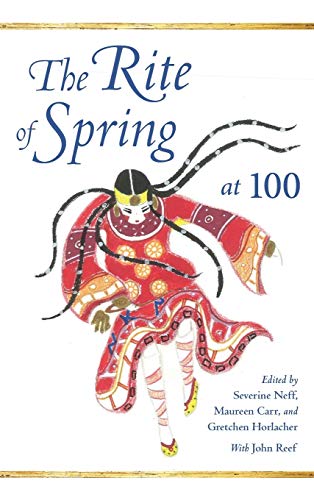
Inhaltsangabe
Winner, Ruth A. Solie Award, American Musicological Society
Die Inhaltsangabe kann sich auf eine andere Ausgabe dieses Titels beziehen.
Über die Autorin bzw. den Autor
Severine Neff is the Eugene Falk Distinguished Professor of Music Emeritus at the University of North Carolina at Chapel Hill. She is author of The Musical Idea and the Logic, Technique, and Art of Its Presentation (with Patricia Carpenter); Coherence, Counterpoint, Instrumentation, Instruction in Form; and The Second String Quartet in F-Sharp Minor, Op. 10: A Norton Critical Score. She served as Editor-in-Chief of Music Theory Spectrum.
Gretchen Horlacher is Professor of Music at the Jacobs School of Music, Indiana University at Bloomington. She is author of Building Blocks: Repetition and Continuity in Stravinsky's Music.
Maureen A. Carr is Distinguished Professor of Music Theory at The Pennsylvania State University. She is author of After the Rite: Stravinsky's Path to Neoclassicism (1914-1925); Multiple Masks: Neoclassicism in Stravinsky's Works on Greek Subjects; and two facsimile editions for A-R Editions: Stravinsky's "Pulcinella": A Facsimile of the Sources and Sketches, and Stravinsky's "Histoire du soldat": A Facsimile of the Sketches.
John Reef is Assistant Professor of Music Theory at Nazareth College.
Auszug. © Genehmigter Nachdruck. Alle Rechte vorbehalten.
The Rite of Spring at 100
By Severine Neff, Maureen Carr, Gretchen Horlacher, John ReefIndiana University Press
Copyright © 2017 Indiana University Press
All rights reserved.
ISBN: 978-0-253-02420-6All rights reserved.
Contents
List of Audiovisual Materials, xiii,
Foreword: A Total Artwork: Memorable Resonances and Reverberations in The Rite / Stephen Walsh, xix,
Acknowledgments, xxiii,
Editorial Notes, xxvii,
Introductory Essay: Stravinsky's Russia and the Politics of Cultural Ferment / Donald J. Raleigh, 1,
Part I: Dancing Le sacre across the Century,
1. A Century of Rites: The Making of an Avant-Garde Tradition / Lynn Garafola, 17,
2. The Rite of Spring as a Dance: Recent Re-visions / Stephanie Jordan, 29,
3. Re-sourcing Nijinsky: The Rite of Spring and Yvonne Rainer's RoS Indexical / Gabriele Brandstetter, 39,
4. Death by Dancing in Nijinsky's Rite / Millicent Hodson, 47,
Part II: Le sacre and Stravinsky in France,
5. Le sacre du printemps: A Ballet for Paris / Annegret Fauser, 83,
6. Styling Le sacre: The Rite's Role in French Fashion / Mary E. Davis, 98,
7. The Rite of Spring, National Narratives, and Estrangement / Brigid Cohen, 129,
8. Formalizing a "Purely Acoustic" Musical Objectivity: Another Look at a 1915 Interview with Stravinsky / William Robin, 138,
9. Racism at The Rite / Tamara Levitz, 146,
Part III: Observations on Le sacre in Russia,
10. Commentary and Observations on Le sacre in Russia: An Overview / Kevin Bartig, 181,
11. Stravinsky, Roerich, and Old Slavic Rituals in The Rite of Spring / Tatiana Baranova Monighetti, 189,
12. Orchestral Sketches of Le sacre du printemps in the National Library of Russia / Natalia Braginskaya, 199,
13. Yuri Nikolaevich Kholopov: His Analytical Comments on The Rite of Spring / Grigory Lyzhov, 211,
14. Leonard Bernstein's 1959 Triumph in the Soviet Union / Olga Manulkina, 219,
15. The Rite of Spring in Russia / Svetlana Savenko, 237,
16. "I Penetrated the Mystery of the Spring Lapidary Rhythms": Baroque Topoi in The Rite of Spring / Elena Vereshchagina, 246,
17. "The Great Sacrifice": Contextualizing the Dream / Tatiana Vereshchagina, 272,
18. An Interview with Composer Vladimir Tarnopolski / Edited and with an Introductory Note by Christy Keele and John Reef, 279,
Part IV: The Sounds of Le sacre,
19. The Physicality of The Rite: Remarks on the Forces of Meter and Their Disruption / Pieter C. van den Toorn, 285,
20. How Not to Hear Le sacre du printemps? Schoenberg's Theories, Leibowitz's Recording / Severine Neff, 304,
21. Rethinking Blocks and Superimposition: Form in the "Ritual of the Two Rival Tribes" / Gretchen Horlacher, 331,
22. Stravinsky at the Crossroads after The Rite: "Jeu de rossignol mécanique" (Performance of the Mechanical Nightingale) (1 August 1913) / Maureen Carr, 339,
23. Dissonant Bells: The Rite's "Sacrificial Dance" 1913/2013 / Marianne Kielian-Gilbert, 354,
24. Revisiting The Rite in Stravinsky's Later Serial Music / Lynne Rogers, 380,
25. Dionysos Monometrikos / Stephen Walsh, 402,
Plenary Essay: Resisting The Rite / Richard Taruskin, 417,
Bibliography / Compiled by Sara Hoffee, Letitia Glozer, and John Reef, 447,
List of Contributors, 489,
General Index, 497,
Index of Composers and Their Works, 515,
Index of Choreographers, 519,
CHAPTER 1
A Century of Rites: The Making of an Avant-Garde Tradition
Lynn Garafola
Since the premiere of The Rite of Spring in 1913, scores of choreographic works to the celebrated Stravinsky music have seen the light of day. In 1987, when Joan Acocella and I compiled a list of as many productions as we could document for the Dance Critics Association symposium "The Rite of Spring at Seventy-Five," the number was forty-four. (Of course, that was in the Dark Ages before Google and the Internet!) By the time we republished the list in Ballet Review in 1992, it had climbed to seventy-five, including more than twenty earlier versions we had missed. Since then the numbers have grown exponentially. In 1999 the Italian critic Ada d'Adamo counted ninety-three versions. Three years later, "Stravinsky the Global Dancer," the database developed by Stephanie Jordan and her colleague Larraine Nicholas at Roehampton University in 2002, recorded 181 settings of the score, with roughly half since 1990 and with several choreographers staging multiple versions. After a brief slackening, the numbers spiked again in 2013, with countless new productions and revivals of old ones marking The Rite's centenary. Seemingly the idea of the now-legendary work coupled with its memorable score posed an irresistible challenge.
Even as the productions keep coming, like Vaslav Nijinsky's original they keep disappearing, with perhaps two dozen or so in active repertory. To be sure, few dance works outlive the first decade of their creation. They may leave traces, documentary and otherwise, but as living works they enter the limbo of non-performance, where they languish long after any hope of retrievability has gone. Yet The Rite of Spring, despite the absence of a definitive theatrical text, continues to occupy cultural space. In the introduction to her book The Archive and the Repertoire, performance scholar Diana Taylor muses: "Is performance that which disappears, or that which persists, transmitted through a nonarchival system of transfer that I ... call the repertoire?" In other words, is the cultural relevance of The Rite of Spring linked to what Taylor calls "the paradoxical omnipresence of the disappeared"? Or, to put it a little differently, does the cycle of loss and renewal built into the very identity of the ballet inspire its continuous reinvention? Is the very absence of a fixed, stable, or permanent choreographic text what accounts for the ballet's staying power? If so, what ideologies and impulses do these Rites seem to espouse, what conventions do they reject, and why have they retained their imaginative force?
In this essay I argue that The Rite of Spring, precisely because it is a lost ballet, comprises a body of ideas rather than a detailed choreographic script and that this conceptual freedom allows both for the ballet's continual reinvention and for the persistence of ideas associated with the original. One group of ideas centers on the ballet's transgressiveness — its primitivism, violence, modernity, and repudiation of traditional ballet aesthetics — all underscored by the "riot" that took place at the premiere. From this perspective The Rite is a model of formal radicalism, a dance that says "no" to the status quo and hints at freedoms beyond the stage. At the same time, The Rite belongs to ballet's canon. It was produced by Diaghilev's Ballets Russes, an heir to the nineteenth-century Franco-Russian tradition and the progenitor of its twentieth-century descendants. It was produced on a grand scale, and its central conceit — the death of the maiden — has a long ballet history. Finally, it was choreographed by Vaslav Nijinsky, the company's celebrity danseur and Diaghilev's lover, whose career was cut short by mental illness, a tragedy that memorialized him as a mad genius. From the first, The Rite proclaimed its centrality to ballet history, even as it rejected the conventions of the past and exuded a whiff of scandal.
Since 1913, choreographers have approached The Rite from numerous vantage...
„Über diesen Titel“ kann sich auf eine andere Ausgabe dieses Titels beziehen.
Suchergebnisse für Rite of Spring at 100 (Musical Meaning and Interpretation)

Beispielbild für diese ISBN
The Rite of Spring at 100 (Musical Meaning and Interpretation)
Verlag:
Indiana University Press, 2017
ISBN 10: 025302420X
ISBN 13: 9780253024206
Gebraucht
Hardcover
Anbieter: Anybook.com, Lincoln, Vereinigtes Königreich
Verkäuferbewertung 5 von 5 Sternen

Zustand: Good. This is an ex-library book and may have the usual library/used-book markings inside.This book has hardback covers. In good all round condition. No dust jacket. Please note the Image in this listing is a stock photo and may not match the covers of the actual item,1050grams, ISBN:9780253024206. Artikel-Nr. 9793757
Gebraucht kaufen
EUR 39,81
EUR 15,91 Versand
Versand von Vereinigtes Königreich nach USA
Versand von Vereinigtes Königreich nach USA
Anzahl: 1 verfügbar
Beispielbild für diese ISBN
The Rite of Spring at 100 (Musical Meaning and Interpretation)
Anbieter: Majestic Books, Hounslow, Vereinigtes Königreich
Verkäuferbewertung 4 von 5 Sternen

Zustand: New. Artikel-Nr. 371245710
Neu kaufen
EUR 77,60
EUR 7,60 Versand
Versand von Vereinigtes Königreich nach USA
Versand von Vereinigtes Königreich nach USA
Anzahl: 1 verfügbar
Beispielbild für diese ISBN
The Rite of Spring at 100
Anbieter: Revaluation Books, Exeter, Vereinigtes Königreich
Verkäuferbewertung 5 von 5 Sternen
Hardcover. Zustand: Brand New. 520 pages. 9.50x6.50x1.50 inches. In Stock. Artikel-Nr. x-025302420X
Neu kaufen
EUR 84,93
EUR 14,62 Versand
Versand von Vereinigtes Königreich nach USA
Versand von Vereinigtes Königreich nach USA
Anzahl: 2 verfügbar