
Verwandte Artikel zu Quick Hits for Teaching with Technology: Successful...
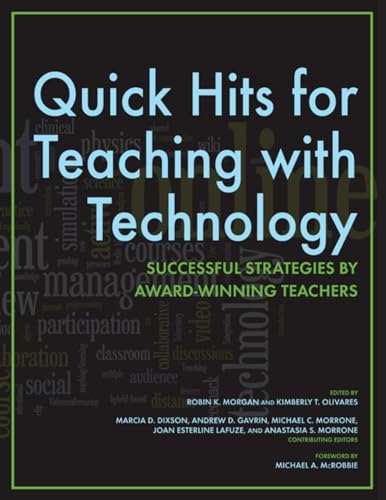
Quick Hits for Teaching with Technology: Successful Strategies by Award-Winning Teachers - Softcover
Inhaltsangabe
Tips on innovative uses of technology for effective learning
Die Inhaltsangabe kann sich auf eine andere Ausgabe dieses Titels beziehen.
Über die Autorin bzw. den Autor
Robin K. Morgan is Professor of Psychology, Indiana University Southeast. She is editor (with Rosanne M. Cordell, Betsy Lucal, Sharon Hamilton, and Robert Orr) of Quick Hits for New Faculty (IUP, 2004).
Kimberly T. Olivares is Administrative Manager of the Faculty Colloquium on Excellence in Teaching, Indiana University-Purdue University Indianapolis and editor (with M. A. Cooksey) of Quick Hits for Service-Learning (IUP, 2010).
Auszug. © Genehmigter Nachdruck. Alle Rechte vorbehalten.
Quick Hits for Teaching with Technology
Successful Strategies by Award-Winning Teachers
By Robin K. Morgan, Kimberly T. OlivaresIndiana University Press
Copyright © 2012 Indiana University Faculty Colloquium on Excellence in Teaching
All rights reserved.
ISBN: 978-0-253-00612-7All rights reserved.
Contents
Foreword by Michael A. McRobbie, ix,
Welcome to Quick Hits: Teaching with Technology, xi,
Introduction Student Success Is Our Mission by David J. Malik, xiii,
1 Promoting Engagement, 1,
2 Providing Access, 35,
3 Enhancing Evaluation, 63,
4 Becoming More Efficient, 87,
Annotated Bibliography, 111,
Contributors, 115,
Index, 127,
CHAPTER 1
Promoting Engagement
Technology transforming learning
Grecor Novak
Professor Emeritus, Department of Physics Indiana University Purdue University Indianapolis
Learning technologies should be designed to increase, and not to reduce, the amount of personal contact between students and faculty on intellectual issues. (Study Group on the Conditions of Excellence in American Higher Education, 1984)
In the May 13, 2011 issue of Science, Louis Deslauriers and colleagues report the results of an interesting experiment conducted at University of British Columbia (Deslauriers, Schelew, & Wieman, 2011). In the words of the authors:
"We compared the amounts of learning achieved using two different instructional approaches under controlled conditions. We measured the learning of a specific set of topics and objectives when taught by 3 hours of traditional lecture given by an experienced highly rated instructor and 3 hours of instruction given by a trained but inexperienced instructor using instruction based on research in cognitive psychology and physics education. The comparison was made between two large sections (N = 267 and N = 271) of an introductory undergraduate physics course. We found increased student attendance, higher engagement, and more than twice the learning in the section taught using research-based instruction."
"The instructional approach used in the experimental section included elements promoted by CWSEI and its partner initiative at the University of Colorado: pre-class reading assignments, pre-class reading quizzes, in-class clicker questions with student-student discussion (CQ), small-group active learning tasks (GT), and targeted in-class instructor feedback (IF). Before each of the three 50-min classes, students were assigned a three- or four-page reading, and they completed a short true false online quiz on the reading."
The rather striking results of this experiment highlight two important trends that research into teaching and learning has spawned during the past three decades (Bransford, Brown, & Cocking, 2000). The first is the realization that replacing passive environments, even if presided over by charismatic, knowledgeable and engaging presenters, with active student-centered pedagogies leads to superior learning outcomes.
The second trend, without which the first would be much less effective, is the growing use of technology, inside and outside of the classroom.
The key features of the Deslauriers experiment are: pre-class reading assignments, pre-class reading quizzes, in-class clicker questions with student-student discussion, small-group active learning tasks, and targeted in-class instructor feedback. All of these parts carefully aligned with one another and all of it informed by education research. The students were actively involved in carefully planned activities at all times. Technology, supporting the experience in and out-of-class, was brought in as needed by the pedagogy involved. An experiment similar to the one above, but more narrowly focused, was recently conducted at North Georgia College & State University (Formica, Easley, & Spraker, 2010).
Student centered activity-based lessons and the use of information technologies in teaching and learning are work in progress, but the evidence from the classroom indicates that we are on the right track.
The two critical theoretical underpinning of these efforts are constructivism and cognitivism. To learn means to construct meaning rather than memorize facts. Student-instructor, student-student and student-content interactions, facilitated by the use of technology, drive the effort. These interactions encourage students to assume some ownership of and control over their learning, provide realistic and relevant contexts and encourage the exploration of multiple perspectives and metacognition. Cognitive science research into how the human brain processes and stores information provides the theoretical basis for lesson designs. Learning tasks are constructed to engage the learner in the learning process, to scaffold the learning as needed to foster the development of understanding, and to provide timely and meaningful feedback.
Technical tools have been assisting learning since the cave paintings. Arguably, serious large-scale use of the technology in teaching and learning can be traced to the educational films developed for the large number of servicemen returning from WWII. Media-based presentations of educational materials are still with us with Power Point and streaming video and audio. The fifties saw the emergence of two major designs, programmed instruction and mastery approach. In programmed instruction the material to be learned is broken up into small units, incorporating frequent feedback and correction. Mastery approach is based on Bloom's taxonomy of intellectual development.
These forms of instruction have evolved into CAI, computer-based and computer-assisted instruction, still with us today. During the 1980s and 1990s computer environments were developed where learners can build, explore, and immerse themselves in micro-worlds and simulations. Another major step was taken when the world-wide-web was made public in the mid-nineties, paving the way for computer-mediated-communication, CMC, which creates an always-open communication path for student-instructor, student-student and student-content interaction. CMC also provides tools for the maintenance of learning communities and for course and curriculum management. The internet has made possible the creation of distance learning, courses fully online, as well as hybrid designs, such as Just-in-Time Teaching, blending on-line work and in-class activities with live teachers. The next advance is likely to come when the mobile technologies of today are harnessed in the service of teaching and learning (Sharples, Milrad, Arnedillo Sánchez, & Vavoula, 2009). The audience for this is the next generation of students, growing up with these tools (Schachter, 2009). An astounding number of very young children are users of mobile technologies (Gutnick, Robb, Takeuchi, & Kotler, 2010). Seventy-five percent of 5 - 9 yr-olds use cell phones.
There is not much doubt that student-centered instruction, facilitated by available technology, is here to stay in one form or another. The question debated in the educational research community is: how does one optimize the many benefits of the new paradigm: easy access to course materials, improved student motivation and participation (Kulik & Kulik, 1991), differential instruction serving different learning styles, etc. Resource availability and cost issues aside, and there are many, the intellectual challenge is to find the proper balance between technology tools and live human interactions. The pedagogical strategies must follow from evidence-based science of learning...
„Über diesen Titel“ kann sich auf eine andere Ausgabe dieses Titels beziehen.
Suchergebnisse für Quick Hits for Teaching with Technology: Successful...

Beispielbild für diese ISBN
Quick Hits for Teaching with Technology: Successful Strategies by Award-Winning Teachers
Verlag:
Indiana University Press, 2012
ISBN 10: 0253006120
ISBN 13: 9780253006127
Gebraucht
Softcover
Anbieter: World of Books (was SecondSale), Montgomery, IL, USA
Verkäuferbewertung 5 von 5 Sternen

Zustand: Very Good. Item in good condition. Textbooks may not include supplemental items i.e. CDs, access codes etc. Artikel-Nr. 00059242561
Gebraucht kaufen
EUR 4,72
Versand gratis
Versand innerhalb von USA
Versand innerhalb von USA
Anzahl: 1 verfügbar
Beispielbild für diese ISBN
Quick Hits for Teaching with Technology: Successful Strategies by Award-Winning Teachers
Verlag:
Indiana University Press, 2012
ISBN 10: 0253006120
ISBN 13: 9780253006127
Gebraucht
Paperback
Anbieter: ThriftBooks-Dallas, Dallas, TX, USA
Verkäuferbewertung 5 von 5 Sternen
Paperback. Zustand: Good. No Jacket. Former library book; Pages can have notes/highlighting. Spine may show signs of wear. ~ ThriftBooks: Read More, Spend Less. Artikel-Nr. G0253006120I3N10
Gebraucht kaufen
EUR 5,93
Versand gratis
Versand innerhalb von USA
Versand innerhalb von USA
Anzahl: 1 verfügbar
Beispielbild für diese ISBN
Quick Hits for Teaching with Technology - Successful Strategies by Award-Winning Teachers
Anbieter: PBShop.store UK, Fairford, GLOS, Vereinigtes Königreich
Verkäuferbewertung 5 von 5 Sternen
PAP. Zustand: New. New Book. Shipped from UK. Established seller since 2000. Artikel-Nr. FW-9780253006127
Neu kaufen
EUR 21,62
EUR 6,85 Versand
Versand von Vereinigtes Königreich nach USA
Versand von Vereinigtes Königreich nach USA
Anzahl: 1 verfügbar
Beispielbild für diese ISBN
Quick Hits for Teaching with Technology: Successful Strategies by Award-Winning Teachers
Anbieter: Ria Christie Collections, Uxbridge, Vereinigtes Königreich
Verkäuferbewertung 5 von 5 Sternen
Zustand: New. In English. Artikel-Nr. ria9780253006127_new
Neu kaufen
EUR 23,98
EUR 13,17 Versand
Versand von Vereinigtes Königreich nach USA
Versand von Vereinigtes Königreich nach USA
Anzahl: 1 verfügbar
Beispielbild für diese ISBN
Quick Hits for Teaching with Technology: Successful Strategies by Award-Winning Teachers
Anbieter: Kennys Bookstore, Olney, MD, USA
Verkäuferbewertung 5 von 5 Sternen
Zustand: New. Provides tips on innovative uses of technology for effective learning Editor(s): Morgan, Robin K.; Olivares, Kimberly T. Num Pages: 148 pages, 22 b&w illus. BIC Classification: JNT; JNV. Category: (G) General (US: Trade). Dimension: 7112 x 5487 x 10. Weight in Grams: 363. . 2012. Paperback. . . . . Books ship from the US and Ireland. Artikel-Nr. V9780253006127
Neu kaufen
EUR 30,83
EUR 9,16 Versand
Versand innerhalb von USA
Versand innerhalb von USA
Anzahl: 1 verfügbar
Beispielbild für diese ISBN
Quick Hits for Teaching with Technology Successful Strategies by AwardWinning Teachers
Anbieter: Revaluation Books, Exeter, Vereinigtes Königreich
Verkäuferbewertung 5 von 5 Sternen
Paperback. Zustand: Brand New. 129 pages. 10.75x8.25x0.25 inches. In Stock. Artikel-Nr. x-0253006120
Neu kaufen
EUR 30,54
EUR 11,67 Versand
Versand von Vereinigtes Königreich nach USA
Versand von Vereinigtes Königreich nach USA
Anzahl: 2 verfügbar
Foto des Verkäufers
Quick Hits for Teaching with Technology : Successful Strategies by Award-Winning Teachers
Verlag:
Indiana University Press Feb 2012, 2012
ISBN 10: 0253006120
ISBN 13: 9780253006127
Neu
Taschenbuch
Anbieter: AHA-BUCH GmbH, Einbeck, Deutschland
Verkäuferbewertung 5 von 5 Sternen
Taschenbuch. Zustand: Neu. Neuware - An accompanying interactive website enhances the value of this innovative tool. Artikel-Nr. 9780253006127
Neu kaufen
EUR 36,73
EUR 30,50 Versand
Versand von Deutschland nach USA
Versand von Deutschland nach USA
Anzahl: 1 verfügbar
Foto des Verkäufers
Quick Hits for Teaching with Technology
Verlag:
Indiana University Press, 2012
ISBN 10: 0253006120
ISBN 13: 9780253006127
Neu
Kartoniert / Broschiert
Anbieter: moluna, Greven, Deutschland
Verkäuferbewertung 5 von 5 Sternen
Kartoniert / Broschiert. Zustand: New. Provides tips on innovative uses of technology for effective learningÜber den AutorRobin K. Morgan is Professor of Psychology, Indiana University Southeast. She is editor (with Rosanne M. Cordell, Betsy Lucal, Sharon H. Artikel-Nr. 857719296
Neu kaufen
EUR 29,83
EUR 48,99 Versand
Versand von Deutschland nach USA
Versand von Deutschland nach USA
Anzahl: Mehr als 20 verfügbar
Beispielbild für diese ISBN
Quick Hits for Teaching with Technology : Successful Strategies by Award-Winning Teachers
Verlag:
Indiana University Press, 2012
ISBN 10: 0253006120
ISBN 13: 9780253006127
Gebraucht
Softcover
Anbieter: Buchpark, Trebbin, Deutschland
Verkäuferbewertung 5 von 5 Sternen
Zustand: Sehr gut. Zustand: Sehr gut | Sprache: Englisch | Produktart: Bücher | An accompanying interactive website enhances the value of this innovative tool. Artikel-Nr. 11913192/2
Gebraucht kaufen
EUR 19,73
EUR 105,00 Versand
Versand von Deutschland nach USA
Versand von Deutschland nach USA
Anzahl: 1 verfügbar