
Verwandte Artikel zu New Routes for Diaspora Studies (21st Century Studies,...
Inhaltsangabe
Rethinking diasporas and geographies of difference
Die Inhaltsangabe kann sich auf eine andere Ausgabe dieses Titels beziehen.
Über die Autorin bzw. den Autor
Sukanya Banerjee is Associate Professor of English at the University of Wisconsin-Milwaukee and author of Becoming Imperial Citizens: Indians in the Late-Victorian Empire.
Aims McGuinness is Associate Professor of History at the University of Wisconsin-Milwaukee and author of Path of Empire: Panama and the California Gold Rush, 1848-1856.
Steven C. McKay is Associate Professor of Sociology at the University of California at Santa Cruz and author of Satanic Mills or Silicon Islands? The Politics of High-Tech Production in the Philippines.
Auszug. © Genehmigter Nachdruck. Alle Rechte vorbehalten.
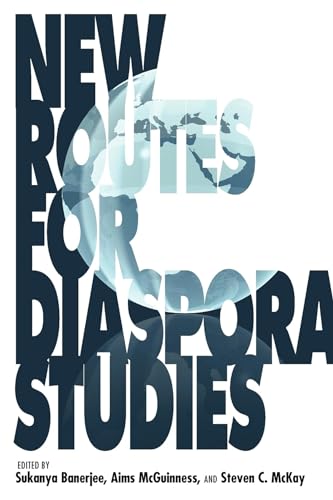
New Routes for Diaspora Studies
By Sukanya Banerjee, Aims McGuinness, Steven C. McKayIndiana University Press
Copyright © 2012 Board of Regents of the University of Wisconsin System
All rights reserved.
ISBN: 978-0-253-00210-5All rights reserved.
Contents
ACKNOWLEDGMENTS,
Introduction: Routing Diasporas Sukanya Banerjee,
PART 1 INTERROGATING TERMS,
1 The Middle Passages of Black Migration | Jenny Sharpe,
2 Making the Exodus from Algeria "Eu ro pe an": Family and Race in 1962 France | Todd Shepard,
3 Enslaved Lives, Enslaving Labels: A New Approach to the Colonial Indian Labor Diaspora | Crispin Bates and Marina Carter,
PART 2 MAPS OF INTIMACY,
4 Empire, Anglo- India, and the Alimentary Canal | Parama Roy,
5 Domestic Internationalisms, Imperial Nationalisms: Civil Rights, Immigration, and Conjugal Military Policy | Rachel Ida Buff,
PART 3 NATION, NARRATIVE, DIASPORA,
6 Serial Migration: Stories of Home and Belonging in Diaspora | Lok Siu,
7 Building Associations: Nineteenth- Century Monumental Architecture and the Jew in the American Imagination | Martin A. Berger,
8 Cultural Forms and World Systems: The Ethnic Epic in the New Diaspora | Betty Joseph,
Afterword: Diaspora and the Language of Neoliberalism Aims McGuinness and Steven C. McKay,
LIST OF CONTRIBUTORS,
INDEX,
CHAPTER 1
The Middle Passages of Black Migration
JENNY SHARPE
The middle passage is a particularly charged signifier within a black literary imagination. Carl Pedersen calls it "arguably the defining moment of the African-American experience." He identifies a literary geography that extends the signification of the middle passage beyond the historical moment of the African slave trade, when the term narrowly referred to the second or "middle" portion of the triangular trade route between Europe, Africa, and the Americas. In response to a Eurocentric perspective that considered the middle passage as a rupture with African culture, there developed an Afro-centric one that sought to establish continuity with Africa. Pedersen, however, is interested in those writers who charted a third path. For Afro-Caribbean intellectuals such as C. L. R. James, Edward Kamau Brathwaite, George Lamming, Wilson Harris, Edouard Glissant, and Derek Walcott, the transatlantic passage of enslaved Africans did not signify the absence of black creativity, as it did for European colonizers. Rather, it signaled the beginning of a new creolized and hybridized culture. To the Afro-Caribbean writers that Pedersen identifies, one can add black British writers such as Caryl Phillips and Fred D'Aguiar, who have fictionalized the lives of slaves who journey back and forth along the transatlantic trade route, and artists such as Keith Piper and Lubaina Himid, whose seascapes memorialize the death and suffering of slaves who experienced the middle passage. These black British writers and artists not only resurrect middle passage images in order to let the dead bear witness to the past, they also transform those images so that they can speak to the more recent migration of people from Africa and the Caribbean. If, during an era of black power and nation building, the middle passage signified a fundamental connection with Africa, the term has more recently been deployed to describe multiple crossings that transform the meaning of diaspora into a vital and ongoing process. The routes traveled by black migrants do not necessarily retrace the same paths of the slave ships: they cross continental Europe, the English Channel, and the Caribbean Sea. The theoretical "routing" of a transatlantic black diaspora thus involves not making the multiple crossings cohere into a single narrative but rather maintaining their temporal and spatial disjunctures and discontinuities.
This new imaginative geography is present in Paul Gilroy's The Black Atlantic: Modernity and Double Consciousness (1993), which invokes the ship as a chronotope for charting the temporal and spatial axes of a transatlantic culture. The ship, for Gilroy, represents the crisscrossing of travelers and cultures along the triangular slave trade route, which is a movement that complicates a simple, linear narrative of a black diaspora originating in Africa. Instead of denoting a foundational connection with Africa, the middle passage in Gilroy's black Atlantic model represents a "catastrophic rupture" that hurtled diasporic space into a linear temporal order. Alluding to Gilroy's explanation, James Clifford suggests that the middle passage does not simply exist as a past moment in time because its trauma continues to be repeated. "For black Atlantic diaspora consciousness," he observes, "the recurring break where time stops and restarts is the Middle Passage. Enslavement and its aftermaths—displaced, repeated structures of racialization and exploitation—constitute a pattern of black experiences inextricably woven in the fabric of hegemonic modernity." Time, for a transatlantic black diaspora, is broken; the past can, and does, coexist with the present.
The simultaneity of past and present is incorporated into the narrative structure of two literary works that metaphorically extend the middle passage to contemporary conditions of black migration. Caryl Phillips' novel A Distant Shore (2003) tells the story of an African refugee who is smuggled into post9/11 Europe as a traumatic journey that mirrors the middle passage and ends in death. Edwidge Danticat's short story "Children of the Sea" (1993) allegorizes the middle passage for conveying the present hardships and future uncertainties experienced by Haitian boat people fleeing the political instability of their nation. Both works suggest that although the waters modern migrants cross may not be as vast as the Atlantic Ocean, their voyages are no less perilous than the ones made by slaves. They transform received images from the past in order to critique the present treatment of black refugees. They also, however, harness the symbolic value of the middle passage as the beginning of a transatlantic black diaspora for rethinking its meaning. Both works expose the limitations of a diaspora model that suggests a unified history and destiny of all peoples of African descent. A Distant Shore revives a middle passage memory to show the isolation of the black man living in the diaspora, while "Children of the Sea" frames that memory with a Haitian worldview that offers a counternarrative to the middle passage's broken temporality.
Phillips often deploys the middle passage as a metaphor for the psychological state of homelessness associated with migrancy. In A Distant Shore, two intersecting narratives about an African refugee and a divorced English woman show how the term "stranger" does not apply to immigrants alone. "England has changed," observes Dorothy, a retired schoolteacher, about the former mining town where she grew up and to which she has now returned. "These days it's difficult to tell who's from around here and who's not. Who belongs and who's a stranger. It's disturbing. It doesn't feel right" (3). Here the sense of homelessness applies to a middle-aged English woman who is estranged from a hometown that offers her no asylum, equal to its treatment of the lone black inhabitant, Solomon Bartholomew. Their shared state of mind makes them shipmates in the turbulent national waters. The white woman is also connected to the black man as the potential recipient of his story. "This is a woman to whom I might tell my story," he thinks. "If I do not share my story, then I have only this one...
„Über diesen Titel“ kann sich auf eine andere Ausgabe dieses Titels beziehen.
Suchergebnisse für New Routes for Diaspora Studies (21st Century Studies,...

Beispielbild für diese ISBN
New Routes for Diaspora Studies (21st Century Studies)
Verlag:
Indiana University Press, 2012
ISBN 10: 0253002109
ISBN 13: 9780253002105
Gebraucht
Softcover
Anbieter: Phatpocket Limited, Waltham Abbey, HERTS, Vereinigtes Königreich
Verkäuferbewertung 5 von 5 Sternen

Zustand: Good. Your purchase helps support Sri Lankan Children's Charity 'The Rainbow Centre'. Ex-library, so some wear and internal barcode may have been clipped, but in good overall condition. Our donations to The Rainbow Centre have helped provide an education and a safe haven to hundreds of children who live in appalling conditions. Artikel-Nr. Z1-C-009-02271
Gebraucht kaufen
EUR 21,10
EUR 12,41 Versand
Versand von Vereinigtes Königreich nach USA
Versand von Vereinigtes Königreich nach USA
Anzahl: 1 verfügbar
Beispielbild für diese ISBN
New Routes for Diaspora Studies
Anbieter: PBShop.store UK, Fairford, GLOS, Vereinigtes Königreich
Verkäuferbewertung 5 von 5 Sternen
PAP. Zustand: New. New Book. Shipped from UK. Established seller since 2000. Artikel-Nr. FW-9780253002105
Neu kaufen
EUR 31,02
EUR 4,85 Versand
Versand von Vereinigtes Königreich nach USA
Versand von Vereinigtes Königreich nach USA
Anzahl: 15 verfügbar
Beispielbild für diese ISBN
New Routes for Diaspora Studies
Verlag:
Indiana University Press (USA), 2012
ISBN 10: 0253002109
ISBN 13: 9780253002105
Neu
Softcover
Anbieter: Majestic Books, Hounslow, Vereinigtes Königreich
Verkäuferbewertung 4 von 5 Sternen

Zustand: New. pp. 252 5 Illus. Artikel-Nr. 3517604
Neu kaufen
EUR 34,04
EUR 7,58 Versand
Versand von Vereinigtes Königreich nach USA
Versand von Vereinigtes Königreich nach USA
Anzahl: 3 verfügbar
Beispielbild für diese ISBN
New Routes for Diaspora Studies (21st Century Studies)
Anbieter: Ria Christie Collections, Uxbridge, Vereinigtes Königreich
Verkäuferbewertung 5 von 5 Sternen
Zustand: New. In English. Artikel-Nr. ria9780253002105_new
Neu kaufen
EUR 30,42
EUR 13,17 Versand
Versand von Vereinigtes Königreich nach USA
Versand von Vereinigtes Königreich nach USA
Anzahl: Mehr als 20 verfügbar
Beispielbild für diese ISBN
New Routes for Diaspora Studies
Anbieter: Kennys Bookstore, Olney, MD, USA
Verkäuferbewertung 5 von 5 Sternen
Zustand: New. 2012. Paperback. . . . . . Books ship from the US and Ireland. Artikel-Nr. V9780253002105
Neu kaufen
EUR 40,96
EUR 9,05 Versand
Versand innerhalb von USA
Versand innerhalb von USA
Anzahl: Mehr als 20 verfügbar
Beispielbild für diese ISBN
New Routes for Diaspora Studies
Anbieter: Revaluation Books, Exeter, Vereinigtes Königreich
Verkäuferbewertung 5 von 5 Sternen
Paperback. Zustand: Brand New. 241 pages. 8.75x6.00x0.75 inches. In Stock. Artikel-Nr. x-0253002109
Neu kaufen
EUR 40,51
EUR 11,66 Versand
Versand von Vereinigtes Königreich nach USA
Versand von Vereinigtes Königreich nach USA
Anzahl: 2 verfügbar
Foto des Verkäufers
New Routes for Diaspora Studies
Anbieter: moluna, Greven, Deutschland
Verkäuferbewertung 5 von 5 Sternen
Zustand: New. Considers how to rethink diasporas and the geographies of differenceÜber den Autoredited by Sukanya Banerjee, Aims McGuinness, Steven C. McKay, OtherJohn Blum, with contributions by Todd Shepard, Crispin Bates, Marina Carter, Pa. Artikel-Nr. 446862767
Neu kaufen
EUR 35,70
EUR 48,99 Versand
Versand von Deutschland nach USA
Versand von Deutschland nach USA
Anzahl: Mehr als 20 verfügbar