
Verwandte Artikel zu Coming on Strong: Gender and Sexuality in Women's...
Inhaltsangabe
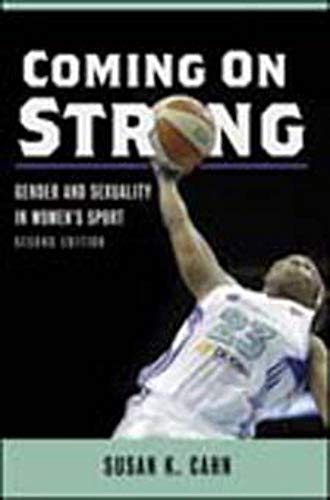
Acclaimed since its original publication, Coming on Strong has become a much-cited touchstone in scholarship on women and sports. In this new edition, Susan K. Cahn updates her detailed history of women's sport and the struggles over gender, sexuality, race, class, and policy that have often defined it. A new chapter explores the impact of Title IX and how the opportunities and interest in sports it helped create reshaped women's lives even as the legislation itself came under sustained attack.
Die Inhaltsangabe kann sich auf eine andere Ausgabe dieses Titels beziehen.
Über die Autorin bzw. den Autor
Susan K. Cahn is a professor of history at the University of Buffalo. She is author of Sexual Reckonings: Southern Girls in a Troubling Age and co-editor of Women and Sports in the United States: A Documentary Reader.
Auszug. © Genehmigter Nachdruck. Alle Rechte vorbehalten.
Coming On Strong
Gender and Sexuality in Women's Sport
By Susan K. CahnUNIVERSITY OF ILLINOIS PRESS
Copyright © 2015 Susan K. Cahn
All rights reserved.
ISBN: 978-0-252-08064-7All rights reserved.
Contents
Preface, ix,
Introduction, 1,
1. The New Type of Athletic Girl, 7,
2. Grass-roots Growth and Sexual Sensation in the Flapper Era, 31,
3. Games of Strife The Battle over Women's Competitive Sport, 55,
4. Order on the Court The Campaign to Suppress Women's Basketball, 83,
5. "Cinderellas" of Sport Black Women in Track and Field, 110,
6. No Freaks, No Amazons, No Boyish Bobs The All-American Girls Baseball League, 140,
7. Beauty and the Butch The "Mannish" Athlete and the Lesbian Threat, 164,
8. "Play It, Don't Say It" Lesbian Identity and Community in Women's Sport, 185,
9. Women Competing/Gender Contested, 207,
10. You've Come a Long Way, Maybe A "Revolution" in Women's Sport?, 246,
Epilogue. "Are We There Yet?" The Paradox of Progress, 281,
Notes, 315,
Index, 389,
CHAPTER 1
THE NEW TYPE OF ATHLETIC GIRL
In the fall of 1911 Lippincott's Monthly described the modern athletic woman: "She loves to walk, to row, to ride, to motor, to jump and run ... as Man walks, jumps, rows, rides, motors, and runs." To many early-twentieth-century observers, the female athlete represented the bold and energetic modern woman, breaking free from Victorian constraints, and tossing aside old-fashioned ideas about separate spheres for men and women. Popular magazines celebrated this transformation, issuing favorable notice that the "hardy sun-tanned girl" who spent the summer in outdoor games was fast replacing her predecessors, the prototypical "Lydia Languish" and the "soggy matron" of old.
With the dawning of the new century, interest in sport had burgeoned. More and more Americans were participating as spectators or competitors in football, baseball, track and field, and a variety of other events. At the same time women were streaming into education, the paid labor force, and political reform movements in unprecedented numbers. Women's social and political activism sparked a reconsideration of their nature and place in society, voiced through vigorous debates on a wide range of issues, from the vote to skirt lengths. Popular interest in sport and concern over women's changing status converged in the growing attention paid to the "athletic girl," a striking symbol of modern womanhood.
The female athlete's entrance into a male-defined sphere made her not only a popular figure but an ambiguous, potentially disruptive character as well. Sport had developed as a male preserve, a domain in which men expressed and cultivated masculinity through athletic competition. Yet, along with other "New Women" who demanded access to such traditional male realms as business and politics, women athletes of the early twentieth century claimed the right to share in sport. They stood on the borderline between new feminine ideals and customary notions of manly sport, symbolizing both the possibilities and the dangers of the New Woman's daring disregard for traditional gender arrangements.
The female athlete's ambiguity created a dilemma for her advocates. Given women's evident enjoyment of such "masculine" pursuits, could the "athletic girl" (and thus, the modern woman) reap the benefits of sport (and modernity) without becoming less womanly? The Lippincott's Monthly article was titled "The Masculinization of Girls." And while it concluded positively that "with muscles tense and blood aflame, she plays the manly role," women's assumption of "the manly role" generated deep hostility and anxiety among those who feared that women's athletic activity would damage female reproductive capacity, promote sexual licentiousness, and blur "natural" gender differences.
The perceived "mannishness" of the female athlete complicated her reception, making the "athletic girl" a cause for concern as well as celebration. Controversy did not dampen women's enthusiasm, but it did lead some advocates of women's sport to take a cautious approach, one designed specifically to avert charges of masculinization. Women physical educators took an especially prudent stance, articulating a unique philosophy of women's athletics that differed substantially from popular ideals of "manly sport."
The tension between sport and femininity led, paradoxically, to educators' insistence on women's equal right to sport and on inherent differences between female and male athletes. Balancing claims of equality and difference, physical educators articulated a woman-centered philosophy of sport that proposed "moderation" as the watchword of women's physical activity. Moderation provided the critical point of difference between women's and men's sport, a preventive against the masculine effects of sport. It was this philosophy, with its calculated effort to resolve the issue of "mannishness," which guided the early years of twentieth-century women's athletics.
* * *
Interest in women's athletics reflected the growing popularity of sport in industrial America. In a society in which the division between leisure and labor was increasingly distinct, many Americans filled their free time with modern exercise regimens and organized sport. It was in the middle and latter decades of the nineteenth century that two pivotal traditions developed—that of "manly sport" and that of female exercise. Each would influence the turn-of-the-century boom in women's sport and shape the views of female physical educators.
Traditions of "manly sport" developed over the course of the nineteenth century as large-scale transformations in the American economy, class relations, and leisure habits helped spawn new forms of athletic culture. In an antebellum society destabilized by rapid commercialization and the first stages of industrial revolution, the emerging middle class took an inordinate interest in cultivating self-discipline and a strictly regulated body. Not only did they perceive the growing numbers of poor, immigrant, urban workers as an unruly mass in need of disciplined activity, they also worried about their own capacity to subdue momentary passions for the controlled, regulated habits of body deemed necessary for climbing the ladder of success. Exercise—as well as diet, health, and sexual reforms—offered a means to these ends.
Guided by a Victorian philosophy of "rational recreation" and a religious ideal of "muscular Christianity," male sport and exercise began to flourish in the years before the Civil War. Physical culture specialists prescribed rigorous routines designed to improve both body and mind. A strict regimen of physical exercise was expected to contain sexual energy, breed self-control, and strengthen a man's moral and religious fiber through muscular development. The physically fit Victorian man could then channel his mental and physical energies into a life of productive labor and moral rectitude.
By contrast, a much-less-respectable sporting life developed outside the middle class. Bachelor clerks, artisans, and shopkeepers joined other adventurous men in an informal sporting fraternity. They created a rich social and athletic life by organizing baseball clubs and frequenting prizefights, boat races, footraces, and gambling dens. Their ranks included men from the "lower orders" as well as men of higher social standing, who—chafing at the restrictions of polite society—enjoyed a rough-and-tumble life-style in which gambling,...
„Über diesen Titel“ kann sich auf eine andere Ausgabe dieses Titels beziehen.
Suchergebnisse für Coming on Strong: Gender and Sexuality in Women's...

Beispielbild für diese ISBN
Coming on Strong : Gender and Sexuality in Women's Sport
Verlag:
University of Illinois Press, 2015
ISBN 10: 0252080645
ISBN 13: 9780252080647
Gebraucht
Softcover
Anbieter: Better World Books Ltd, Dunfermline, Vereinigtes Königreich
Verkäuferbewertung 5 von 5 Sternen

Zustand: Very Good. Former library copy. Pages intact with possible writing/highlighting. Binding strong with minor wear. Dust jackets/supplements may not be included. Includes library markings. Stock photo provided. Product includes identifying sticker. Better World Books: Buy Books. Do Good. Artikel-Nr. 17237771-6
Gebraucht kaufen
EUR 8,39
EUR 5,83 Versand
Versand von Vereinigtes Königreich nach USA
Versand von Vereinigtes Königreich nach USA
Anzahl: 1 verfügbar
Beispielbild für diese ISBN
Coming On Strong
Anbieter: Majestic Books, Hounslow, Vereinigtes Königreich
Verkäuferbewertung 4 von 5 Sternen

Zustand: New. pp. 416. Artikel-Nr. 311950686
Neu kaufen
EUR 27,54
EUR 7,58 Versand
Versand von Vereinigtes Königreich nach USA
Versand von Vereinigtes Königreich nach USA
Anzahl: 3 verfügbar
Beispielbild für diese ISBN
Coming On Strong: Gender and Sexuality in Women's Sport
Anbieter: Ria Christie Collections, Uxbridge, Vereinigtes Königreich
Verkäuferbewertung 5 von 5 Sternen
Zustand: New. In English. Artikel-Nr. ria9780252080647_new
Neu kaufen
EUR 26,10
EUR 13,97 Versand
Versand von Vereinigtes Königreich nach USA
Versand von Vereinigtes Königreich nach USA
Anzahl: Mehr als 20 verfügbar
Beispielbild für diese ISBN
Coming On Strong Gender and Sexuality in Women`s Sport
Anbieter: Revaluation Books, Exeter, Vereinigtes Königreich
Verkäuferbewertung 5 von 5 Sternen
Paperback. Zustand: Brand New. 2nd edition. 395 pages. 9.25x6.25x1.25 inches. In Stock. Artikel-Nr. __0252080645
Neu kaufen
EUR 25,64
EUR 14,57 Versand
Versand von Vereinigtes Königreich nach USA
Versand von Vereinigtes Königreich nach USA
Anzahl: 2 verfügbar
Beispielbild für diese ISBN
Coming On Strong: Gender and Sexuality in Women s Sport
Anbieter: Kennys Bookstore, Olney, MD, USA
Verkäuferbewertung 5 von 5 Sternen
Zustand: New. 2015. 2nd ed. Paperback. . . . . . Books ship from the US and Ireland. Artikel-Nr. V9780252080647
Neu kaufen
EUR 35,15
EUR 9,06 Versand
Versand innerhalb von USA
Versand innerhalb von USA
Anzahl: 3 verfügbar
Foto des Verkäufers
Coming on Strong : Gender and Sexuality in Women's Sport
Verlag:
University Of Illinois Press Mär 2015, 2015
ISBN 10: 0252080645
ISBN 13: 9780252080647
Neu
Taschenbuch
Anbieter: AHA-BUCH GmbH, Einbeck, Deutschland
Verkäuferbewertung 5 von 5 Sternen
Taschenbuch. Zustand: Neu. Neuware - Acclaimed since its original publication, Coming on Strong has become a much-cited touchstone in scholarship on women and sports. In this new edition, Susan K. Cahn updates her detailed history of women's sport and the struggles over gender, sexuality, race, class, and policy that have often defined it. A new chapter explores the impact of Title IX and how the opportunities and interest in sports it helped create reshaped women's lives even as the legislation itself came under sustained attack. Artikel-Nr. 9780252080647
Neu kaufen
EUR 23,74
EUR 30,50 Versand
Versand von Deutschland nach USA
Versand von Deutschland nach USA
Anzahl: 1 verfügbar
Beispielbild für diese ISBN
COMING ON STRONG
Anbieter: Speedyhen, Hertfordshire, Vereinigtes Königreich
Verkäuferbewertung 5 von 5 Sternen
Zustand: NEW. Artikel-Nr. NW9780252080647
Neu kaufen
EUR 20,88
EUR 47,80 Versand
Versand von Vereinigtes Königreich nach USA
Versand von Vereinigtes Königreich nach USA
Anzahl: 3 verfügbar
Foto des Verkäufers
COMING ON STRONG
Anbieter: moluna, Greven, Deutschland
Verkäuferbewertung 5 von 5 Sternen
Zustand: New. Über den AutorSusan K. CahnKlappentext First Illinois paperback, 2015 --Title page verso. Artikel-Nr. 594481283
Neu kaufen
EUR 27,66
EUR 48,99 Versand
Versand von Deutschland nach USA
Versand von Deutschland nach USA
Anzahl: 3 verfügbar
Foto des Verkäufers
Coming on Strong | Gender and Sexuality in Women's Sport
Verlag:
University of Illinois Press, 2015
ISBN 10: 0252080645
ISBN 13: 9780252080647
Neu
Taschenbuch
Anbieter: preigu, Osnabrück, Deutschland
Verkäuferbewertung 5 von 5 Sternen
Taschenbuch. Zustand: Neu. Coming on Strong | Gender and Sexuality in Women's Sport | Susan K Cahn | Taschenbuch | Einband - flex.(Paperback) | Englisch | 2015 | University of Illinois Press | EAN 9780252080647 | Verantwortliche Person für die EU: Mare Nostrum Group B.V., Doelen 72, 4831 GR BREDA, NIEDERLANDE, gpsr[at]mare-nostrum[dot]co[dot]uk | Anbieter: preigu. Artikel-Nr. 121929127
Neu kaufen
EUR 31,80
EUR 70,00 Versand
Versand von Deutschland nach USA
Versand von Deutschland nach USA
Anzahl: 1 verfügbar