
Verwandte Artikel zu Rebels and Runaways: Slave Resistance in Nineteenth-Century...
Rebels and Runaways: Slave Resistance in Nineteenth-Century Florida (New Black Studies) - Hardcover
Buch 10 von 42: New Black Studies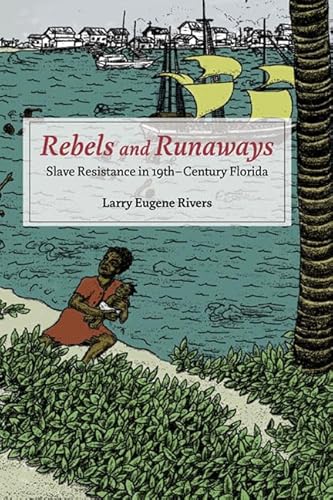
Inhaltsangabe
This gripping study examines slave resistance and protest in antebellum Florida and its local and national impact from 1821 to 1865. Using a variety of sources such as slaveholders' wills and probate records, ledgers, account books, court records, oral histories, and numerous newspaper accounts, Larry Eugene Rivers discusses the historical significance of Florida as a runaway slave haven dating back to the seventeenth century and explains Florida's unique history of slave resistance and protest. In moving detail, Rivers illustrates what life was like for enslaved blacks whose families were pulled asunder as they relocated from the Upper South to the Lower South to an untamed place such as Florida, and how they fought back any way they could to control small parts of their own lives.
Against a smoldering backdrop of violence, this study analyzes the various degrees of slave resistance--from the perspectives of both slave and master--and how they differed in various regions of antebellum Florida. In particular, Rivers demonstrates how the Atlantic world view of some enslaved blacks successfully aided their escape to freedom, a path that did not always lead North but sometimes farther South to the Bahama Islands and Caribbean. Identifying more commonly known slave rebellions such as the Stono, Louisiana, Denmark (Telemaque) Vesey, Gabriel, and the Nat Turner insurrections, Rivers argues persuasively that the size, scope, and intensity of black resistance in the Second Seminole War makes it the largest sustained slave insurrection ever to occur in American history.
Meticulously researched, Rebels and Runaways offers a detailed account of resistance, protest, and violence as enslaved blacks fought for freedom.
Die Inhaltsangabe kann sich auf eine andere Ausgabe dieses Titels beziehen.
Über die Autorin bzw. den Autor
Larry Eugene Rivers is president of Fort Valley State University in central Georgia and the author of Slavery in Florida: Territorial Days to Emancipation.
Auszug. © Genehmigter Nachdruck. Alle Rechte vorbehalten.
Rebels and Runaways
Slave Resistance in Nineteenth-Century FloridaBy LARRY EUGENE RIVERSUniversity of Illinois Press
Copyright © 2012 Board of Trustees of the University of IllinoisAll right reserved.
ISBN: 978-0-252-03691-0
Contents
Florida: A Runaway Haven.............................................xiIntroduction.........................................................1Chapter 1: Day-to-Day Resistance.....................................11Chapter 2: Stepping Up the Degrees of Resistance.....................25Chapter 3: Away without Leave........................................39Chapter 4: A Yearning for Freedom....................................51Chapter 5: Destinations of Runaways..................................64Chapter 6: Flight Away from Florida..................................77Chapter 7: In Search of Kinfolk and Loved Ones.......................90Chapter 8: Catch the Runaway.........................................106Chapter 9: Slave Violence............................................121Chapter 10: The Second Seminole War..................................131Chapter 11: The Civil War............................................146Afterword............................................................161Notes................................................................169Index................................................................211
Introduction
No close examination of American slavery can better expose the institution's cruel realities than a careful look at the many and varied ways in which its victims resisted their bondage and oppression. This argument, of course, is not a new one. Over a decade past, John Hope Franklin and Loren Schweninger's seminal work Runaway Slaves: Rebels on the Plantation took on the subject in a comprehensive manner by focusing directly on slave flight and rebellion throughout the South during the period 1790 to 1860. Their study showed, as the authors remarked, "how a significant number of slaves challenged the system and how the great majority of them struggled to attain their freedom even if they failed." Franklin and Schweninger drew attention, as well, to "how slave owners marshaled considerable effort to prevent the practice of running away, meted out punishments to slaves who disregarded the rules, and established laws and patrols to control the movement of slaves." They added of their research: "It exposed the violence and cruelty that were inherent in the slave system. It illustrates, perhaps better than any other approach, how enslaved blacks resisted with various forms of violence and how slave owners responded, at times brutally, to demonstrate their authority over their human chattel."Given the extended time frame they considered and a focus that covered most states in the South, Franklin and Schweninger admirably captured the overall essence of regional slave resistance and of the experiences of bond-people as they resisted. As would be true of any large study of the kind, however, their need for generalization due to constraints of time, resources, and space limited Franklin and Schweninger's ability to reveal in great depth the multilayered and richly textured experiences of bondservants who resisted, rebelled, or ran away from their owners in each state of the South. The loss of such rich experience unfortunately can prove highly detrimental to achieving understanding and helpful insight.
Now that over a decade has passed since the release of Runaway Slaves, the time has arrived for another look at the subject, one that not only tests the conclusions offered by its distinguished authors but also affords the kind of in-depth look that a more general survey cannot hope to offer. A state study would fill the bill, and, to this author's mind, Florida provides an excellent laboratory. Its experience may not be typical of the South as a whole, but this very fact may be telling on the more general experience. As a locale not often considered in studies of American slavery, its story comes as a fresh one. In some respects, it may even come as a startling eye-opener.
Accordingly, this study aims to examine slave resistance in Florida while incorporating perspectives that reach beyond its borders to embrace a regional and even larger context. In doing so, it builds upon the foundation laid by Franklin and Schweninger and also upon the works of scholars such as Jane Landers, Michael Gomez, John Blassingame, Lawrence Levine, Margaret Washington Creel, Walter Johnson, Sterling Stuckey, Freddie Parker, and Gwendolyn Hall. Taken together, these historians of slavery, among other things, offered highly useful tools for conceptualizing and analyzing the slave's experience in the Old South and beyond. These authors noted, for example, that a supportive African, Caribbean, and African American culture helped slaves to maintain a sense of agency and humanity. They noted also that the political organization and collective actions of bondservants as they addressed the hegemony of masters and owners remained rooted firmly within the slave community.
The time frame utilized for this look at slave resistance in Florida, it should be pointed out from the start, is considerably shorter than the 1790 to 1860 period adopted by Franklin and Schweninger. For one thing, Florida historiography already benefits from Jane Landers's excellent Black Society in Spanish Florida. This award-winning volume brilliantly analyzes the lives of Africans, persons of African descent, and enslaved blacks in Spanish Florida up to 1821. Landers's work covers many aspects of the African and African American experience under Spanish rule, especially the complex and international world that linked the Caribbean and Africa—and Indians, blacks, and Europeans and their governments and leaderships—to North America. Landers drew also upon African, European, and indigenous models to re-create the black Spanish experience in the "circum-Atlantic periphery of Florida." Some blacks, she emphasized helpfully, were at home on international waters and used the port of St. Augustine and other outlets to connect blacks in Florida to other ports on both sides of the Atlantic as well as to the Caribbean.
As Landers further detailed, some blacks developed maroon societies, not to mention stable communities. In the latter case, Fort Mose, founded in 1738, probably stood out as the first "southern" free black community. It lay a mere two miles north of St. Augustine, Florida's gateway to the Atlantic. Black communities such as Fort Mose helped their inhabitants to establish cultural ties to other Africans, Spanish, Native Americans, and Anglo Americans. The interactions among these groups certainly played complex and varied roles that would contribute to setting the stage for the evolution of slavery in Florida following its cession to the United States in 1821.
Other Florida scholars, too, have joined Landers in setting firm foundations for this study. Their work is noted more closely in the chapters that follow, and all deserve recognition for their contributions. I would underscore here, though, the fact that Kathleen Deagan, Daniel L. Schafer, and Canter Brown Jr. have added significantly to scholars' understanding of the interactions between blacks, whites, and Indians in Florida, particularly in northeast Florida and the peninsula. In a general sense, they have explored the power and culture of these groups from the Spanish period to and through the Civil War. Their studies did not purport to focus specifically on slave resistance or on how it changed over time...
„Über diesen Titel“ kann sich auf eine andere Ausgabe dieses Titels beziehen.
Weitere beliebte Ausgaben desselben Titels

Suchergebnisse für Rebels and Runaways: Slave Resistance in Nineteenth-Century...

Beispielbild für diese ISBN
Rebels and Runaways - Slave Resistance in Nineteenth-Century Florida
Verlag:
MO - University of Illinois Press, 2012
ISBN 10: 0252036913
ISBN 13: 9780252036910
Neu
Hardcover
Anbieter: PBShop.store UK, Fairford, GLOS, Vereinigtes Königreich
Verkäuferbewertung 5 von 5 Sternen

HRD. Zustand: New. New Book. Shipped from UK. Established seller since 2000. Artikel-Nr. FW-9780252036910
Neu kaufen
EUR 118,50
EUR 5,86 Versand
Versand von Vereinigtes Königreich nach USA
Versand von Vereinigtes Königreich nach USA
Anzahl: 15 verfügbar
Beispielbild für diese ISBN
Rebels And Runaways
Anbieter: Majestic Books, Hounslow, Vereinigtes Königreich
Verkäuferbewertung 4 von 5 Sternen

Zustand: New. pp. 264. Artikel-Nr. 57974540
Neu kaufen
EUR 122,99
EUR 7,58 Versand
Versand von Vereinigtes Königreich nach USA
Versand von Vereinigtes Königreich nach USA
Anzahl: 3 verfügbar
Beispielbild für diese ISBN
Rebels and Runaways Slave Resistance in NineteenthCentury Florida
Anbieter: Revaluation Books, Exeter, Vereinigtes Königreich
Verkäuferbewertung 5 von 5 Sternen
Hardcover. Zustand: Brand New. 264 pages. 9.10x6.40x0.90 inches. In Stock. Artikel-Nr. __0252036913
Neu kaufen
EUR 132,79
EUR 14,58 Versand
Versand von Vereinigtes Königreich nach USA
Versand von Vereinigtes Königreich nach USA
Anzahl: 2 verfügbar
Beispielbild für diese ISBN
Rebels and Runaways: Slave Resistance in Nineteenth-Century Florida
Anbieter: Kennys Bookstore, Olney, MD, USA
Verkäuferbewertung 5 von 5 Sternen
Zustand: New. Argues persuasively that the size, scope, and intensity of black resistance in the Second Seminole War makes it the largest sustained slave insurrection in American history. Series: The New Black Studies Series. Num Pages: 264 pages, 32 black and white photographs, 7 tables. BIC Classification: 1KBBFL; 3JH; HBJK; HBLL; HBTS. Category: (P) Professional & Vocational. Dimension: 5817 x 3887 x 30. Weight in Grams: 590. . 2012. 1st Edition. Hardcover. . . . . Books ship from the US and Ireland. Artikel-Nr. V9780252036910
Neu kaufen
EUR 161,65
EUR 9,10 Versand
Versand innerhalb von USA
Versand innerhalb von USA
Anzahl: Mehr als 20 verfügbar