
Verwandte Artikel zu The Rural Face of White Supremacy: Beyond Jim Crow
Inhaltsangabe
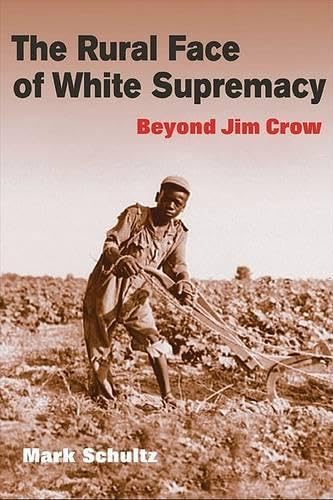
Now in paperback, The Rural Face of White Supremacy presents a detailed study of the daily experiences of ordinary people in rural Hancock County, Georgia. Drawing on his own interviews with over two hundred black and white residents, Mark Schultz argues that the residents acted on the basis of personal rather than institutional relationships. As a result, Hancock County residents experienced more intimate face-to-face interactions, which made possible more black agency than their urban counterparts were allowed. While they were still firmly entrenched within an exploitive white supremacist culture, this relative freedom did create a space for a range of interracial relationships that included mixed housing, midwifery, church services, meals, and even common-law marriages.
Die Inhaltsangabe kann sich auf eine andere Ausgabe dieses Titels beziehen.
Über die Autorin bzw. den Autor
Mark Schultz is an associate professor of history at Lewis University in Romeoville, Illinois.
Auszug. © Genehmigter Nachdruck. Alle Rechte vorbehalten.
The Rural Face of White Supremacy
Beyond Jim CrowBy MARK SCHULTZUNIVERSITY OF ILLINOIS PRESS
Copyright © 2005 Board of Trustees of the University of IllinoisAll right reserved.
ISBN: 978-0-252-02960-8
Contents
List of Figures..........................................................................................ixPreface..................................................................................................xiAcknowledgments..........................................................................................xiiiIntroduction: A Place in Time............................................................................11. "Friendship Was Better Than Money"....................................................................132. The Other Rural Workers: Landowning and Working for Cash..............................................443. Beyond Segregation: The Outlines of Interracial Social Relations in Rural Hancock.....................664. The Solid South and the Permissive South..............................................................975. Race, Violence, and Power in a Personal Culture.......................................................1316. Paternalism and Patronage: Public Power in a Personal Culture.........................................175Epilogue: The Rise of "Public Work"......................................................................205Appendix A: Methods......................................................................................225Appendix B: Interviews...................................................................................235Notes....................................................................................................239General Index............................................................................................295Interviewee Index........................................................................................303
Chapter One
"Friendship Was Better than Money"
ONE DAY IN 1936 thirteen-year-old Carlton Morse was at school with his brothers and sisters. His family—black—worked on shares for a white Hancock planter. Midway through the schoolday a brother who had stayed home sick arrived with a note for Carleton to give his teacher. Before he delivered it, curiosity nudged him to open the note. It said simply that the Morse children needed to be excused from class. At home he learned why: the landlord had told his father that "the children didn't have time to go to school. The bushes needed cutting. Take them out." That day he had believed that his education had come to an end. Sixty years later he still became angry recalling the incident.
Fourteen years earlier and a few miles north of the Bennett family, a white farmer, Dick Sykes, rode a horse to the farm of Katie Hunt, a black woman in her early thirties. Hunt and her husband, Wilkins, were relatively independent, renting land from a nearby white planter. Wilkins had gone to work in New York for the summer and was sending money to help his family through the first boll weevil year, while Katie and her children were taking care of their cotton acreage and substantial garden. Hunt was sitting on her porch when Sykes approached. The white man made small talk for a while and then hinted that the planter from whom she rented would like her to take her children out of summer school and set them to work poisoning the boll weevils. She answered: "He can't tell me to tell my children what to do, 'cause he isn't the daddy of nary a one of them. Every one of them is mine and Wilkins Hunt's—their daddy." The planter, she continued, "hain't got but one child that I know of—is Sarah—and that's the onliest person he can tell to go on out there and go—is his own daughter." Sykes laughed and said that he was going on to the next farm. "I just told them plain out, " remembered Katie Hunt; "I didn't never bite my tongue." She laughs every time she relates the story.
These stories illustrate that far from being "solid," the South provided for diverse experiences and widely differing self-direction among rural African Americans. The highly personal nature of the postbellum southern economy created many different economic platforms on which black and white southerners worked out their relationships. This rural southern diversity persisted until the region's distinctive agricultural system was subsumed into the national economy by forces unleashed in World War II. Yet our historical literature has not fully come to reflect this diversity. Where, for example, are the Katie Hunts in our histories of the rural South? Where, indeed, are any rural African Americans who achieved more than marginal economic or personal independence? Until recently much of the historical literature describing race relations in the postbellum rural South has taken for granted that the structure of the agricultural economy homogenized the region's African Americans into general poverty, dependence, and relative defenselessness. A number of writers have commented that their position was little removed from slavery. This is ironic, for dozens of recent studies have commented on the diversity of experiences collected under the title of "the" slave experience.
Beyond question, the experience of "freedom" offered much less than the freedmen had hoped for, beset as they were by white violence and largely denied the franchise, education, and land. Their freedom was further circumscribed by the limitations of the pre–World War II cotton culture—a culture that stifled urban growth, inhibited the development of a diversified economy, and held down southern wages generally.
The experience of African American southerners in the century after the Civil War has to be understood in the economic context of the region as a whole. While the rest of the country moved increasingly toward either industrialization or agricultural mechanization, southerners held fast to traditional farming technologies and labor-intensive farming strategies. As the rest of the country became accustomed to the cash-driven consumer economy and adapted to the bureaucratic, impersonal, modern culture it produced, many rural southerners remained in a distinctive semisubsistence cultural backwater: cash poor, local, personal, and in many regards, premodern. In the twentieth century as in the antebellum period, the cotton culture of Georgia's piedmont meshed "rationally" with the national economy while preserving a distinctive, "less rationalized" set of relationships within the South. In the decades after the Civil War, however, King Cotton became a petty, decrepit baron as worldwide cotton production rose and the price of cotton sank. A series of forces—some intentional and personal, others diffuse and impersonal—trapped African American farmers within this decaying industry and somewhat isolated world. Sometimes for better but more often for worse, they remained thralls to a diminished, increasingly miserly lord, until forces set into motion by the world wars opened a means of escape and integrated the South, economically, socially, and culturally, into the main currents of the nation.
From the end of Reconstruction until World War II, Hancock's planters and merchants exerted local control over the internal structure of this impoverished, insular culture. Although they lacked either the funds or the inclination to mechanize, the planters did control a large labor force, which they consciously kept unskilled through their manipulation of the education system. Whenever dependent...
„Über diesen Titel“ kann sich auf eine andere Ausgabe dieses Titels beziehen.
Suchergebnisse für The Rural Face of White Supremacy: Beyond Jim Crow

Beispielbild für diese ISBN
The Rural Face of White Supremacy: Beyond Jim Crow
Verlag:
University of Illinois Press, 2005
ISBN 10: 0252029607
ISBN 13: 9780252029608
Gebraucht
Hardcover
Anbieter: World of Books (was SecondSale), Montgomery, IL, USA
Verkäuferbewertung 5 von 5 Sternen

Hardback. Zustand: Good. Now in paperback, The Rural Face of White Supremacy presents a detailed study of the daily experiences of ordinary people in rural Hancock County, Georgia. Drawing on his own interviews with over two hundred black and white residents, Mark Schultz argues that the residents acted on the basis of personal rather than institutional relationships. As a result, Hancock County residents experienced more intimate face-to-face interactions, which made possible more black agency than their urban counterparts were allowed. While they were still firmly entrenched within an exploitive white supremacist culture, this relative freedom did create a space for a range of interracial relationships that included mixed housing, midwifery, church services, meals, and even common-law marriages. Artikel-Nr. 00087076499
Gebraucht kaufen
EUR 21,47
Versand gratis
Versand innerhalb von USA
Versand innerhalb von USA
Anzahl: 1 verfügbar
Beispielbild für diese ISBN
The Rural Face of White Supremacy : Beyond Jim Crow
Verlag:
University of Illinois Press, 2005
ISBN 10: 0252029607
ISBN 13: 9780252029608
Gebraucht
Hardcover
Anbieter: Better World Books, Mishawaka, IN, USA
Verkäuferbewertung 5 von 5 Sternen
Zustand: Good. Former library copy. Pages intact with minimal writing/highlighting. The binding may be loose and creased. Dust jackets/supplements are not included. Includes library markings. Stock photo provided. Product includes identifying sticker. Better World Books: Buy Books. Do Good. Artikel-Nr. 14420578-6
Gebraucht kaufen
EUR 21,48
Versand gratis
Versand innerhalb von USA
Versand innerhalb von USA
Anzahl: 1 verfügbar