
Verwandte Artikel zu No Better Place to Die: The Battle of Stones River
Inhaltsangabe
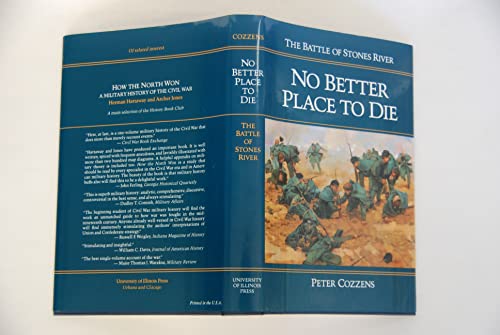
Uses excerpts from the letters, diaries, and memoirs of the combatants to recreate the Tennessee battle, and assesses its influence on the outcome of the Civil War
Die Inhaltsangabe kann sich auf eine andere Ausgabe dieses Titels beziehen.
Auszug. © Genehmigter Nachdruck. Alle Rechte vorbehalten.
No Better Place to Die
The Battle of Stones River
By Peter CozzensUNIVERSITY OF ILLINOIS PRESS
Copyright © 1990 Board of Trustees of the University of Illinois
All rights reserved.
ISBN: 978-0-252-01652-3All rights reserved.
Contents
List of Maps, vii,
Preface, ix,
Acknowledgments, xii,
One / Summer of Hope, Autumn of Despair, 1,
Two / The Rosecrans Touch, 12,
Three / A Hasty Advance, 29,
Four / We Lived Like Lords, 40,
Five / To Murfreesboro, 48,
Six / The Lines Were Forming, 64,
Seven / Boys, This Is Fun, 81,
Eight / Matters Looked Pretty Blue Now, 101,
Nine / The Rebels Were Falling Like Leaves of Autumn, 109,
Ten / Rosecrans Rallies The Right, 128,
Eleven / Our Boys Were Forced Back in Confusion, 144,
Twelve / Whirlwind in the Round Forest, 151,
Thirteen / We Laid To Rest Poor Boys Gone, 167,
Fourteen / Thunder on the Left, 177,
Fifteen / This Army Should Be Promptly Put in Retreat, 199,
Sixteen / Bragg's Army? He's Got None, 208,
Appendix / The Opposing Forces in the Stones River Campaign, 219,
Notes, 233,
Bibliography, 252,
Subject Index, 265,
Index of Personal Names, 276,
CHAPTER 1
Summer of Hope, Autumn of Despair
General Braxton Bragg needed a scapegoat. Defeat in Kentucky had cast a pall over his army and the nation; retreat into Tennessee transformed the loss into a clamor for the general's dismissal. For much of this, Bragg had only himself to blame. His buoyant predictions of victory and subsequent rapid advance into Kentucky had excited the imagination and hopes of the Confederate people who, reading the exuberant dispatches emanating from the Army of the Mississippi as it pushed northward, came to expect nothing less than the total restoration of Confederate authority over the border region. The sudden collapse of the autumn campaign, coming in the wake of Lee's withdrawal from Maryland, left them profoundly shaken, and their shattered expectations erupted into a wave of censure that none were more anxious to ride than Bragg's own most-senior lieutenants. As the army filed through the Cumberland Gap and out of Kentucky, lieutenant generals William J. Hardee and Leonidas Polk urged President Davis to recognize that only a change of commanders could save the army and salvage Confederate fortunes in the West. Their allegations echoed throughout the South. In Richmond, "earnest and angry" debate shook the floor of the Confederate Congress as members endorsed a resolution reflecting the demands of Hardee and Polk. The Southern press, never known for its self-restraint, quickly added its voice to the clamor.
As much as he might wish to protect his longtime friend, Davis could not ignore the demands of the general's defamers, who were legion and powerful. On the other hand, the president had no intention of relieving Bragg without a hearing, and so he summoned the general to Richmond to present his version of the campaign. Bragg lost no time. Perhaps sensing an opportunity to shift blame for the Kentucky debacle to his subordinates, he boarded an east-bound train out of Knoxville the morning after Davis's message was delivered to him.
Although many were only too anxious to heap responsibility for the sorry state of affairs in the West on the North Carolinian's shoulders, his abandonment of Kentucky was merely the culmination of a chain of events predating Bragg that had left the Confederate heartland vulnerable, its people fearful and discouraged. In fact, many thoughtful Southerners believed that the nadir actually had been reached four months earlier, in June 1862, when Pierre G. T. Beauregard's Army of the Mississippi, principal defender of the heartland, relinquished Corinth to three converging Union armies without firing a shot, thereby conceding the northern tip of Mississippi, and with it the vital Memphis and Charleston Railroad. Not only did Beauregard's withdrawal result in the cutting of a rail artery that had pumped supplies critical to the survival of the Confederacy eastward to the Atlantic, but it opened the way to a Federal advance on Chattanooga, gateway to the Deep South.
It was at this moment, under the shadow of impending doom, that Braxton Bragg replaced Beauregard as commander of the Army of the Mississippi, then lying idle at Tupelo. Several weeks later, he was elevated to command of all Confederate forces between Mississippi and Virginia.
Bragg faced three immediate challenges: he must protect Chattanooga, reopen the Memphis and Charleston Railroad, and recover at least a portion of Tennessee.
As the defense of Chattanooga was most urgent, Bragg rushed the division of Major General John P. McCown to the threatened city. After several weeks of correspondence with the commander of the Department of East Tennessee, Major General Edmund Kirby Smith, Bragg elected to transfer his entire army to Chattanooga. In doing so, he countered an advance against the city by Major General Don Carlos Buell's Army of the Ohio, which, despite a head start of over a month, had moved at a snail's pace.
With Chattanooga secure, Bragg met Kirby Smith on 31 July, ostensibly to discuss future operations. But if Kirby Smith had expected to have a voice in what was about to transpire, he was disappointed — the North Carolinian had already decided on his next move. Since assuming command of the Army of the Mississippi, Bragg had entertained a number of Kentucky's leading citizens, all of whom offered assurance of their state's fidelity and of the willingness of her men to join the Confederate service, should Bragg's army but appear on bluegrass soil. Bragg was convinced. A successful thrust into the state, he believed, not only would relieve pressure on the Deep South, but would return much of Tennessee to the Confederacy. And, if his Kentucky guests were correct, his army would be augmented by thousands of desperately needed volunteers. For the moment Bragg's enthusiasm was contagious, and Kirby Smith returned to his Knoxville headquarters committed to a joint advance. Before leaving, he told Bragg: "I will not only co-operate with you, but will cheerfully place my command under you subject to your orders."
Despite the apparent agreement between Bragg and Kirby Smith, their subordinates doubted the prospects of a campaign in which neither general commanded the other, and in which neither was willing to relinquish his autonomy, Kirby Smith's pledge to the contrary notwithstanding. As Bragg's chief of cavalry, Brigadier General Joseph Wheeler, later wrote, mere agreement as to intent was a poor substitute for unified command, particularly in an operation calling for the synchronized movement of two armies.
But could Bragg have exercised such authority effectively had it been his? Contemporaries were skeptical. The dyspeptic martinet was having trouble enough with his own subordinates. Witness the experience of Major General Richard Taylor, son of former president Zachary Taylor and a shrewd observer, who visited army headquarters in Chattanooga just prior to the invasion of Kentucky. At dinner one evening, Taylor inquired casually about a widely esteemed division commander. In the presence of his staff, Bragg retorted that the officer in question was "an old woman, utterly worthless." Taylor was shocked. "Such a declaration privately made would have been serious," he noted, "but publicly, and certain to be repeated, it was astonishing." Retiring with Bragg to a private room, Taylor asked with whom he intended to replace the general. With no one,...
„Über diesen Titel“ kann sich auf eine andere Ausgabe dieses Titels beziehen.
Suchergebnisse für No Better Place to Die: The Battle of Stones River

Beispielbild für diese ISBN
No Better Place to Die: The Battle of Stones River
Verlag:
University of Illinois Press, 1989
ISBN 10: 0252016521
ISBN 13: 9780252016523
Gebraucht
Hardcover
Anbieter: World of Books (was SecondSale), Montgomery, IL, USA
Verkäuferbewertung 5 von 5 Sternen

Hardback. Zustand: Good. Artikel-Nr. 00108249315
Gebraucht kaufen
EUR 8,75
Versand gratis
Versand innerhalb von USA
Versand innerhalb von USA
Anzahl: 1 verfügbar
Beispielbild für diese ISBN
No Better Place to Die : The Battle of Stones River
Verlag:
University of Illinois Press, 1989
ISBN 10: 0252016521
ISBN 13: 9780252016523
Gebraucht
Hardcover
Anbieter: Better World Books, Mishawaka, IN, USA
Verkäuferbewertung 5 von 5 Sternen
Zustand: Good. Former library copy. Pages intact with minimal writing/highlighting. The binding may be loose and creased. Dust jackets/supplements are not included. Includes library markings. Stock photo provided. Product includes identifying sticker. Better World Books: Buy Books. Do Good. Artikel-Nr. 8371793-6
Gebraucht kaufen
EUR 8,75
Versand gratis
Versand innerhalb von USA
Versand innerhalb von USA
Anzahl: 1 verfügbar
Beispielbild für diese ISBN
No Better Place to Die : The Battle of Stones River
Verlag:
University of Illinois Press, 1989
ISBN 10: 0252016521
ISBN 13: 9780252016523
Gebraucht
Hardcover
Anbieter: Better World Books: West, Reno, NV, USA
Verkäuferbewertung 5 von 5 Sternen
Zustand: Good. Pages intact with minimal writing/highlighting. The binding may be loose and creased. Dust jackets/supplements are not included. Stock photo provided. Product includes identifying sticker. Better World Books: Buy Books. Do Good. Artikel-Nr. 7484886-75
Gebraucht kaufen
EUR 9,41
Versand gratis
Versand innerhalb von USA
Versand innerhalb von USA
Anzahl: 1 verfügbar
Beispielbild für diese ISBN
No Better Place to Die : The Battle of Stones River
Verlag:
University of Illinois Press, 1989
ISBN 10: 0252016521
ISBN 13: 9780252016523
Gebraucht
Hardcover
Anbieter: Better World Books, Mishawaka, IN, USA
Verkäuferbewertung 5 von 5 Sternen
Zustand: Good. Pages intact with minimal writing/highlighting. The binding may be loose and creased. Dust jackets/supplements are not included. Stock photo provided. Product includes identifying sticker. Better World Books: Buy Books. Do Good. Artikel-Nr. 7484886-75
Gebraucht kaufen
EUR 9,41
Versand gratis
Versand innerhalb von USA
Versand innerhalb von USA
Anzahl: 1 verfügbar
Beispielbild für diese ISBN
No Better Place to Die: The Battle of Stones River
Verlag:
University of Illinois Press, 1989
ISBN 10: 0252016521
ISBN 13: 9780252016523
Gebraucht
Hardcover
Anbieter: ThriftBooks-Dallas, Dallas, TX, USA
Verkäuferbewertung 5 von 5 Sternen
Hardcover. Zustand: Fair. No Jacket. Missing dust jacket; Readable copy. Pages may have considerable notes/highlighting. ~ ThriftBooks: Read More, Spend Less. Artikel-Nr. G0252016521I5N01
Gebraucht kaufen
EUR 11,23
Versand gratis
Versand innerhalb von USA
Versand innerhalb von USA
Anzahl: 1 verfügbar
Beispielbild für diese ISBN
No Better Place to Die: The Battle of Stones River
Verlag:
University of Illinois Press, 1989
ISBN 10: 0252016521
ISBN 13: 9780252016523
Gebraucht
Hardcover
Anbieter: ThriftBooks-Atlanta, AUSTELL, GA, USA
Verkäuferbewertung 5 von 5 Sternen
Hardcover. Zustand: Fair. No Jacket. Missing dust jacket; Readable copy. Pages may have considerable notes/highlighting. ~ ThriftBooks: Read More, Spend Less. Artikel-Nr. G0252016521I5N01
Gebraucht kaufen
EUR 11,23
Versand gratis
Versand innerhalb von USA
Versand innerhalb von USA
Anzahl: 1 verfügbar
Beispielbild für diese ISBN
No Better Place to Die: The Battle of Stones River
Anbieter: Revaluation Books, Exeter, Vereinigtes Königreich
Verkäuferbewertung 5 von 5 Sternen
Hardcover. Zustand: Brand New. 281 pages. 9.50x6.50x1.00 inches. In Stock. Artikel-Nr. 0252016521
Neu kaufen
EUR 56,55
EUR 14,98 Versand
Versand von Vereinigtes Königreich nach USA
Versand von Vereinigtes Königreich nach USA
Anzahl: 1 verfügbar
Beispielbild für diese ISBN
No Better Place to Die: The Battle of Stones River
Anbieter: BennettBooksLtd, Los Angeles, CA, USA
Verkäuferbewertung 5 von 5 Sternen
hardcover. Zustand: New. In shrink wrap. Looks like an interesting title! Artikel-Nr. Q-0252016521
Neu kaufen
EUR 69,10
EUR 6,19 Versand
Versand innerhalb von USA
Versand innerhalb von USA
Anzahl: 1 verfügbar
Beispielbild für diese ISBN
No Better Place to Die: The Battle of Stones River
Verlag:
University of Illinois Press, Urbana, 1990
ISBN 10: 0252016521
ISBN 13: 9780252016523
Gebraucht
Hardcover
Erstausgabe
Signiert
Anbieter: Browse Awhile Books, Tipp City, OH, USA
Verkäuferbewertung 5 von 5 Sternen
Hardcover. Zustand: Near Fine. 1st Edition. Flatsigned on half-title page, along with owner's blindstamp. Signed by Author(s). Artikel-Nr. 1157272
Gebraucht kaufen
EUR 87,15
EUR 6,23 Versand
Versand innerhalb von USA
Versand innerhalb von USA
Anzahl: 1 verfügbar