
Verwandte Artikel zu The Headless State: Aristocratic Orders, Kinship Society,...
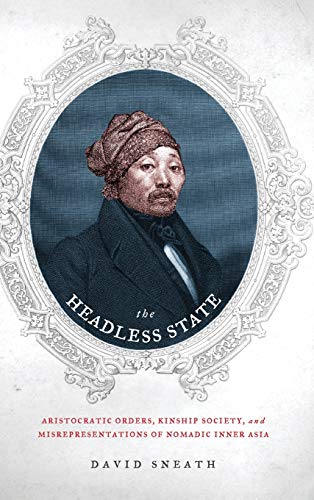
The Headless State: Aristocratic Orders, Kinship Society, and Misrepresentations of Nomadic Inner Asia: Aristocratic Orders, Kinship Society, & Misrepresentations of Nomadic Inner Asia - Hardcover
Inhaltsangabe
In this groundbreaking work, social anthropologist David Sneath aggressively dispels the myths surrounding the history of steppe societies and proposes a new understanding of the nature and formation of the state. Since the colonial era, representations of Inner Asia have been dominated by images of fierce nomads organized into clans and tribes—but as Sneath reveals, these representations have no sound basis in historical fact. Rather, they are the product of nineteenth-century evolutionist social theory, which saw kinship as the organizing principle in a nonstate society.
Sneath argues that aristocratic power and statelike processes of administration were the true organizers of life on the steppe. Rethinking the traditional dichotomy between state and nonstate societies, Sneath conceives of a "headless state" in which a configuration of statelike power was formed by the horizontal relations among power holders and was reproduced with or without an overarching ruler or central "head." In other words, almost all of the operations of state power existed at the local level, virtually independent of central bureaucratic authority.
Sneath's research gives rise to an alternative picture of steppe life in which aristocrats determined the size, scale, and degree of centralization of political power. His history of the region shows no clear distinction between a highly centralized, stratified "state" society and an egalitarian, kin-based "tribal" society. Drawing on his extensive anthropological fieldwork in the region, Sneath persuasively challenges the legitimacy of the tribal model, which continues to distort scholarship on the history of Inner Asia.
Die Inhaltsangabe kann sich auf eine andere Ausgabe dieses Titels beziehen.
Über die Autorin bzw. den Autor
David Sneath is director of the Mongolia and Inner Asia Studies Unit at Cambridge University and a lecturer in social anthropology. He conducted doctoral research in Inner Mongolia in the 1980s and since then has carried out research in Mongolia and other parts of Inner Asia.
„Über diesen Titel“ kann sich auf eine andere Ausgabe dieses Titels beziehen.
Suchergebnisse für The Headless State: Aristocratic Orders, Kinship Society,...

Beispielbild für diese ISBN
Headless State Aristocratic Or
Verlag:
Columbia University Press, 2007
ISBN 10: 0231140541
ISBN 13: 9780231140546
Gebraucht
Hardcover
Anbieter: World of Books (was SecondSale), Montgomery, IL, USA
Verkäuferbewertung 5 von 5 Sternen

Zustand: Good. Item in good condition. Textbooks may not include supplemental items i.e. CDs, access codes etc. Artikel-Nr. 00109067640
Gebraucht kaufen
EUR 58,37
Versand gratis
Versand innerhalb von USA
Versand innerhalb von USA
Anzahl: 1 verfügbar
Beispielbild für diese ISBN
Headless State: Aristocratic Orders, Kinship Society, and Misrepresentations of Nomadic Inner Asia
Verlag:
Columbia University Press, 2007
ISBN 10: 0231140541
ISBN 13: 9780231140546
Gebraucht
Hardcover
Anbieter: WorldofBooks, Goring-By-Sea, WS, Vereinigtes Königreich
Verkäuferbewertung 5 von 5 Sternen
Hardback. Zustand: Very Good. The book has been read, but is in excellent condition. Pages are intact and not marred by notes or highlighting. The spine remains undamaged. Artikel-Nr. GOR015055790
Gebraucht kaufen
EUR 69,24
EUR 6,51 Versand
Versand von Vereinigtes Königreich nach USA
Versand von Vereinigtes Königreich nach USA
Anzahl: 1 verfügbar
Foto des Verkäufers
The Headless State : Aristocratic Orders, Kinship Society, and Misrepresentations of Nomadic Inner Asia / David Sneath
Verlag:
New York, NY : Columbia University Press, 2007
ISBN 10: 0231140541
ISBN 13: 9780231140546
Gebraucht
Hardcover
Erstausgabe
Anbieter: MW Books, New York, NY, USA
Verkäuferbewertung 5 von 5 Sternen
1st edition. Fine cloth copy in an equally fine dust-wrapper. Particularly well-preserved overall; tight, bright, clean and especially sharp-cornered. Physical description; 3 maps. Notes; Includes bibliographical references (p. [239]-259) and index. Contents; Frontmatter -- Contents -- 1. Introduction -- 2. The Myth of the Kinship. Society Evolutionism and the Anthropological Imagination -- 3. The Imaginary Tribe. Colonial and Imperial Orders and the Peripheral Polity -- 4. The State Construction of the Clan. The Unilineal Descent Group and the Ordering of State Subjects -- 5. The Essentialized Nomad. Neocolonial and Soviet Models -- 6. Creating Peoples. Nation-state History and the Notion of Identity -- 7. The Headless State. Aristocratic Orders and the Substrata of Power -- Notes -- References -- Acknowledgments -- Index. Subjects; Since 1991. Aristocracy (Political science) Asia, Central. Clans Asia, Central. Power (Social sciences) Asia, Central. Tribal government Asia, Central. Tribal government. History. Aristocracy (Political science). Clans. Politics and government. Power (Social sciences). 1 Kg. Artikel-Nr. 424051
Gebraucht kaufen
EUR 129,22
Versand gratis
Versand innerhalb von USA
Versand innerhalb von USA
Anzahl: 1 verfügbar
Beispielbild für diese ISBN
The Headless State: Aristocratic Orders, Kinship Society, and Misrepresentations of Nomadic Inner Asia
Anbieter: Revaluation Books, Exeter, Vereinigtes Königreich
Verkäuferbewertung 5 von 5 Sternen
Hardcover. Zustand: Brand New. 273 pages. 9.50x6.25x1.25 inches. In Stock. Artikel-Nr. x-0231140541
Neu kaufen
EUR 126,69
EUR 14,54 Versand
Versand von Vereinigtes Königreich nach USA
Versand von Vereinigtes Königreich nach USA
Anzahl: 2 verfügbar
Foto des Verkäufers
Sneath, D: The Headless State
Anbieter: moluna, Greven, Deutschland
Verkäuferbewertung 5 von 5 Sternen
Zustand: New. Dispels the myths surrounding the history of steppe societies and proposes a fresh understanding of the nature and formation of the state. Drawing on his extensive anthropological fieldwork in the region, the author persuasively challenges the legitimacy of. Artikel-Nr. 594458170
Neu kaufen
EUR 97,71
EUR 48,99 Versand
Versand von Deutschland nach USA
Versand von Deutschland nach USA
Anzahl: Mehr als 20 verfügbar
Foto des Verkäufers
The Headless State : Aristocratic Orders, Kinship Society, and Misrepresentations of Nomadic Inner Asia
Verlag:
Columbia University Press Dez 2007, 2007
ISBN 10: 0231140541
ISBN 13: 9780231140546
Neu
Hardcover
Anbieter: AHA-BUCH GmbH, Einbeck, Deutschland
Verkäuferbewertung 5 von 5 Sternen
Buch. Zustand: Neu. Neuware - In this groundbreaking work, social anthropologist David Sneath aggressively dispels the myths surrounding the history of steppe societies and proposes a new understanding of the nature and formation of the state. Since the colonial era, representations of Inner Asia have been dominated by images of fierce nomads organized into clans and tribes-but as Sneath reveals, these representations have no sound basis in historical fact. Rather, they are the product of nineteenth-century evolutionist social theory, which saw kinship as the organizing principle in a nonstate society. Artikel-Nr. 9780231140546
Neu kaufen
EUR 185,84
EUR 35,00 Versand
Versand von Deutschland nach USA
Versand von Deutschland nach USA
Anzahl: 1 verfügbar