
Verwandte Artikel zu Memory and Emotion: The Making of Lasting Memories...
Inhaltsangabe
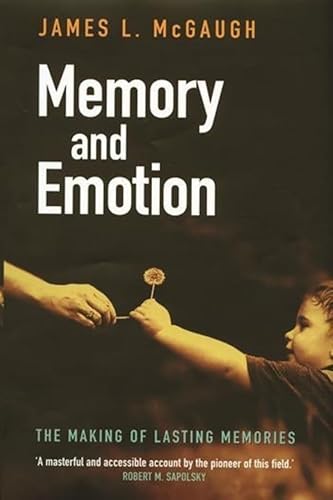
Most of us remember where we were and what we were doing on September 11, 2001. Why do most experiences leave little trace while some—even terrible ordeals that people wish they could forget—leave memories that last a lifetime? That is the mystery at the heart of this book.
Drawing on fascinating research and case studies, James McGaugh, a distinguished neuroscientist, reveals that the key to understanding how memories are created may well be understanding how they are lost. He shows that lasting memories are not stored instantly. Why the delay? The author explains how the slow consolidation of memory has important adaptive consequences. It allows physiological processes activated by experiences to regulate the strength of the memory of the experiences. Emotionally arousing experiences induce the release of stress hormones, which act on the brain to influence the consolidation of our memories of recent experience. These findings have important implications for the controversial issues of post–traumatic stress disorder and repressed memory syndrome.
From the prescientific writings of William James to the animal studies of the memory-research pioneers Pavlov, Thorndike, and Tolman, to the latest research of psychologists and neurologists drawing on PET imaging studies of the brain and laboratory experiments involving a variety of drugs, this succinct book provides a wealth of information.
Die Inhaltsangabe kann sich auf eine andere Ausgabe dieses Titels beziehen.
Über die Autorin bzw. den Autor
James L. McGaugh is founding director of the Center for the Neurobiology of Learning and Memory and research professor of neurobiology and behavior at the University of California, Irvine. He is a member of the National Academy of Sciences and the American Academy of Arts and Sciences.
„Über diesen Titel“ kann sich auf eine andere Ausgabe dieses Titels beziehen.
Suchergebnisse für Memory and Emotion: The Making of Lasting Memories...

Beispielbild für diese ISBN
Memory and Emotion: The Making of Lasting Memories
Verlag:
Columbia University Press, 2006
ISBN 10: 0231120230
ISBN 13: 9780231120234
Gebraucht
Paperback
Anbieter: World of Books (was SecondSale), Montgomery, IL, USA
Verkäuferbewertung 5 von 5 Sternen

Paperback. Zustand: Good. Provides a look at how we remember and why we forget. Beginning with the first scientific studies of learning and research, this book explores how memories are made and preserved; why some experiences fade and disappear with time; how stress hormones effect the consolidation of memory; whether drugs would improve our ability to learn; and more. Artikel-Nr. 00102594996
Gebraucht kaufen
EUR 8,62
Versand gratis
Versand innerhalb von USA
Versand innerhalb von USA
Anzahl: 1 verfügbar
Beispielbild für diese ISBN
Memory and Emotion: The Making of Lasting Memories
Verlag:
Columbia University Press, 2006
ISBN 10: 0231120230
ISBN 13: 9780231120234
Gebraucht
Paperback
Anbieter: World of Books (was SecondSale), Montgomery, IL, USA
Verkäuferbewertung 5 von 5 Sternen
Paperback. Zustand: Very Good. Provides a look at how we remember and why we forget. Beginning with the first scientific studies of learning and research, this book explores how memories are made and preserved; why some experiences fade and disappear with time; how stress hormones effect the consolidation of memory; whether drugs would improve our ability to learn; and more. Artikel-Nr. 00104034250
Gebraucht kaufen
EUR 8,62
Versand gratis
Versand innerhalb von USA
Versand innerhalb von USA
Anzahl: 1 verfügbar
Beispielbild für diese ISBN
Memory and Emotion: The Making of Lasting Memories (Maps of the Mind)
Verlag:
Columbia University Press, 2006
ISBN 10: 0231120230
ISBN 13: 9780231120234
Gebraucht
Softcover
Anbieter: Wonder Book, Frederick, MD, USA
Verkäuferbewertung 5 von 5 Sternen
Zustand: Good. Good condition. A copy that has been read but remains intact. May contain markings such as bookplates, stamps, limited notes and highlighting, or a few light stains. Artikel-Nr. P11J-01239
Gebraucht kaufen
EUR 8,62
Versand gratis
Versand innerhalb von USA
Versand innerhalb von USA
Anzahl: 1 verfügbar
Beispielbild für diese ISBN
Memory and Emotion: The Making of Lasting Memories
Verlag:
Columbia University Press, 2006
ISBN 10: 0231120230
ISBN 13: 9780231120234
Gebraucht
Paperback
Anbieter: ThriftBooks-Atlanta, AUSTELL, GA, USA
Verkäuferbewertung 5 von 5 Sternen
Paperback. Zustand: Fair. No Jacket. Readable copy. Pages may have considerable notes/highlighting. ~ ThriftBooks: Read More, Spend Less. Artikel-Nr. G0231120230I5N00
Gebraucht kaufen
EUR 9,13
Versand gratis
Versand innerhalb von USA
Versand innerhalb von USA
Anzahl: 1 verfügbar
Beispielbild für diese ISBN
Memory and Emotion: Preserving the Presence of the Past
Anbieter: Revaluation Books, Exeter, Vereinigtes Königreich
Verkäuferbewertung 5 von 5 Sternen
Paperback. Zustand: Brand New. 1st edition. 162 pages. 9.00x5.50x0.50 inches. In Stock. Artikel-Nr. x-0231120230
Neu kaufen
EUR 48,83
EUR 11,80 Versand
Versand von Vereinigtes Königreich nach USA
Versand von Vereinigtes Königreich nach USA
Anzahl: 2 verfügbar
Foto des Verkäufers
MEMORY & EMOTION
Verlag:
COLUMBIA UNIV PR, 2007
ISBN 10: 0231120230
ISBN 13: 9780231120234
Neu
Kartoniert / Broschiert
Anbieter: moluna, Greven, Deutschland
Verkäuferbewertung 5 von 5 Sternen
Kartoniert / Broschiert. Zustand: New. Über den AutorrnrnJames L. McGaughKlappentextrnrnMost of us remember where we were and what we were doing on September 11, 2001. Why do most experiences leave little trace while some -- even terrible ordeals that peop. Artikel-Nr. 897545265
Neu kaufen
EUR 38,98
EUR 48,99 Versand
Versand von Deutschland nach USA
Versand von Deutschland nach USA
Anzahl: Mehr als 20 verfügbar