
Verwandte Artikel zu Alexander the Great: Lessons from History's Undefeated...
Alexander the Great: Lessons from History's Undefeated General. Foreword by general Wesley K. Clark (World Generals) - Hardcover
Buch 2 von 6: World Generals Series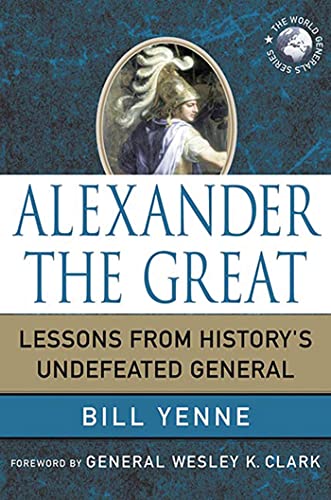
Inhaltsangabe
Alexander the Great is considered one of the most successful commanders of all time and was known to be undefeated in battle. He is mentioned in the Bible as well as the Qur'an, and is on the shortest of short lists whenever the world's best military leaders are cataloged. When asked to name other great military leaders, Caesar reportedly said Alexander was the only great one. Born in 356 BC, the son of Philip II of Macedonia, Alexander was educated by Aristotle, became a consummate horseman, and commanded a wing of his father's army in the victory over the Thebans and Athenians at the Battle of Chaeronea - all when he was still a teenager. By the time of his death at age 32, he had united Greece and had amassed an empire that stretched from the Adriatic Sea to the Indus River and included all of Persia and most of Egypt. He ruled as both the Shah of Persia and as a Pharaoh of Egypt by right of conquest, and he was also crowned King of Asia. As Yenne shows in this masterful biography, Alexander's influence on the course of cultural and political history and the scope of his military prowess remains awe-inspiring to this day.
The leadership, strategy, and legacy of the most celebrated military figure of classical antiquity
Die Inhaltsangabe kann sich auf eine andere Ausgabe dieses Titels beziehen.
Über die Autorin bzw. den Autor
Bill Yenne is the author of over three dozen books on military and historical topics, including his critically-acclaimed biography of Sitting Bull. He was a contributor to encyclopedias of both world wars, and is a member of the American Society of Journalists & Authors. He also co-authored a book with Air Force commander General Curtis E. LeMay. He lives in San Francisco, CA. General Wesley K. Clark (ret.) served in the United States Army for thirty-four years and rose to the rank of four-star general as NATO's Supreme Allied Commander, Europe. He is the author of A Time to Lead, as well as the best selling books Waging Modern War and Winning Modern Wars. He lives in Little Rock, Arkansas.
Auszug. © Genehmigter Nachdruck. Alle Rechte vorbehalten.
Alexander the Great
Lessons from History's Undefeated General
By Bill YennePalgrave Macmillan
Copyright © 2010 Bill Yenne
All rights reserved.
ISBN: 978-0-230-61915-9All rights reserved.
Contents
Foreword,
General Wesley K. Clark,
Prologue,
Introduction: Born into a State of War,
1. Auspicious Beginnings,
2. Long Live the King,
3. From Granicus to Gordium,
4. Turning Point at Issus,
5. The Takedown of Tyre,
6. From Gaza to Alexandria,
7. Decision at Gaugamela,
8. To the Victor Go the Spoils,
9. Last Stand at Persian Gate,
10. From Persepolis to the Caspian Gates,
11. The King of Asia,
12. The Crossroads at Syr Darya,
13. On the Frontier,
14. Men Fly over Sogdian Rock,
15. Into the Headwaters of the Indus,
16. Siege at Aornos,
17. Triumph at Hydaspes,
18. Ever Eastward,
19. The End of the Road,
20. A Macedonian against the Malhi,
21. From Great Rivers to Waterless Wilderness,
22. Back to Persis,
23. Final Days in Babylon,
24. What Was and What Might Have Been,
Epilogue: Lasting Legacy,
Note on Sources,
Index,
CHAPTER 1
Auspicious Beginnings
In July 356 bc, a horse owned by Philip of Macedonia won its race at the Olympic Games. When the good news reached the monarch, it was just one element in a trifecta of glad tidings that arrived that day. Philip had also learned that his able commander Parmenio had triumphed in a great battle against the Illyrians, and that Olympias had finally borne him a son. This especially pleased him because his favorite soothsayer, Aristander of Telmessos, had earlier told him that the child within the womb of Olympias was a son who would be as bold as a lion.
Philip, who had just defeated the city of Potidaea, celebrated the good news that he had received, noting it was auspicious that there were three. "These things delighted him, of course," writes the Greek historian Plutarch in his Lives of Noble Greeks and Romans. "The seers raised his hopes still higher by declaring that the son whose birth coincided with three victories [including Potidaea] would be always victorious."
By the Athenian, or Attic, calendar, Philip's son, named Alexander, was born on the sixth day of the month Hekatombaion, or Hecatombaeon, which corresponds to July 21 on the modern calendar.
As Plutarch writes, Alexander was born "on the day the temple of Ephesian Artemis was burned." This particular temple of Artemis, the goddess known to the Romans as Diana, was located at Ephesus— near Selçuk in modern Turkey—and was no obscure religious site. It was one of the Seven Wonders of the Ancient World. The fire certainly got the attention of all present on that dark July 21. Plutarch writes that "all the Magi who were then at Ephesus, looking upon the temple's disaster as a sign of further disaster, ran about beating their faces and crying aloud that woe and great calamity for Asia had that day been born."
Writing with twenty-twenty hindsight, Plutarch certainly saw the boy child of Olympias as the future manifestation of "woe and great calamity" for the Persian Empire in Asia.
Hindsight colors much of what has been written about Alexander's youth. The stories that were handed down orally, and later penned by his biographers, tend to seem more like allegories that support the better-documented facts of his later life. They paint a portrait of a smart, skillful boy, the kind of person that we would expect to grow into the man that Alexander became. Conversely, one can conclude that many of the stories must have a basis in fact because Alexander did indeed become that sort of man.
Some stories show a boy so sure of himself that his confidence borders on arrogance. For instance, when invited to run in the Olympic Games as a teenager, he replied that he would do so only if the other runners on the track were kings.
To educate the young prince, Philip hired some of the best minds in Greece. The Macedonians had defeated Athens militarily, but remained in awe of Athenian arts and sciences. In 343, Philip brought Aristotle to Macedonia from Athens to educate Alexander. Philip was so pleased with the results of Aristotle's tutoring that, as part of his tuition payment, he restored the city of Stagira—Aristotle's hometown—which he had destroyed during one of his campaigns.
The distinguished philosopher instilled a love of learning and literature in the boy, instructing him in science and healing arts. He also gave Alexander a copy of Homer's Iliad, which he kept with him through his travels as an adult. Some claim that Alexander loved Aristotle more than he loved his father. Philip had given him life, but Aristotle "taught him a noble life."
One of the best-known anecdotes of Alexander as a boy, and one that is considered to have a basis in fact, concerns the horse Bucephalas. This animal, who would be Alexander's favorite for most of his adult life, was brought to the court of King Philip when Alexander was about ten years old by a Thessalian named Philoneicus. Plutarch describes Bucephalas as "savage and altogether intractable, neither allowing any one to mount him, nor heeding the voice of any of Philip's attendants, but rearing up against all of them."
Considering the colt too wild to be of any use, Philip dismissed Philoneicus and told him to take Bucephalas away. According to Plutarch, at this point, Alexander piped up, observing "What a horse they are losing, because, for lack of skill and courage, they cannot manage him!"
Philip was naturally skeptical of the boy's impertinence, but Alexander proceeded to bet his father the sale price of the horse that he could ride him. Naturally, the story would not have been memorialized as part of the Alexander legend if Bucephalas had bucked him off. When Alexander dismounted after a successful ride, Plutarch tells that Philip told him "My son, seek thee out a kingdom equal to thyself; Macedonia has not room for thee."
As with the wails of the magi at Ephesus ten years earlier, it is a prophetic statement that may or may not have been spoken, but that illustrates the direction that young Alexander was headed.
* * *
Whatever notional kingdom Philip may have imagined for Alexander on that day in 346 BC, it is certainly true that Philip was still imagining a bigger kingdom for himself. It was in the same year that he successfully subdued the Phocians and that Athens finally succumbed to Philip. He was also consolidating his control over the regions to the north from Illyria to Thrace, planning attacks still farther afield against the ancient Greek city of Byzantium, and dreaming of eventually attacking the Persian Empire.
Later the center of the great Byzantine Empire, Byzantium, now Istanbul, is located on the Bosporus, which, along with the Dardanelles (known as the Hellespont in the ancient world), is one of the crossing points between Europe and Asia Minor, and a gateway on the water route between the Black Sea and the Mediterranean. As Justinus writes in his Epitoma Historiarum Philippicarum, or Epitome of Philippic History, this "noble city and seaport ... would be a station for his forces by land and sea."
In the same paragraph, Justinus adds that the ambitious Philip "made an expedition, too, into Scythia, to get plunder, that, after the practice of traders, he might make up for the expenses of one war by the profits of another." Scythia was the umbrella term used by the Greeks...
„Über diesen Titel“ kann sich auf eine andere Ausgabe dieses Titels beziehen.
Suchergebnisse für Alexander the Great: Lessons from History's Undefeated...

Beispielbild für diese ISBN
Alexander the Great: Lessons from History's Undefeated General (World Generals Series)
Anbieter: World of Books (was SecondSale), Montgomery, IL, USA
Verkäuferbewertung 5 von 5 Sternen

Zustand: Good. Item in good condition. Textbooks may not include supplemental items i.e. CDs, access codes etc. Artikel-Nr. 00109047114
Gebraucht kaufen
EUR 4,48
Versand gratis
Versand innerhalb von USA
Versand innerhalb von USA
Anzahl: 1 verfügbar
Beispielbild für diese ISBN
Alexander the Great: Lessons from History's Undefeated General (World Generals Series)
Anbieter: World of Books (was SecondSale), Montgomery, IL, USA
Verkäuferbewertung 5 von 5 Sternen
Zustand: Very Good. Item in very good condition! Textbooks may not include supplemental items i.e. CDs, access codes etc. Artikel-Nr. 00107006605
Gebraucht kaufen
EUR 4,48
Versand gratis
Versand innerhalb von USA
Versand innerhalb von USA
Anzahl: 1 verfügbar
Beispielbild für diese ISBN
Alexander the Great
Anbieter: ThriftBooks-Atlanta, AUSTELL, GA, USA
Verkäuferbewertung 5 von 5 Sternen
Hardcover. Zustand: Good. No Jacket. Missing dust jacket; Pages can have notes/highlighting. Spine may show signs of wear. ~ ThriftBooks: Read More, Spend Less. Artikel-Nr. G0230619150I3N01
Gebraucht kaufen
EUR 7,77
Versand gratis
Versand innerhalb von USA
Versand innerhalb von USA
Anzahl: 1 verfügbar
Beispielbild für diese ISBN
Alexander the Great
Anbieter: ThriftBooks-Dallas, Dallas, TX, USA
Verkäuferbewertung 5 von 5 Sternen
Hardcover. Zustand: Good. No Jacket. Missing dust jacket; Pages can have notes/highlighting. Spine may show signs of wear. ~ ThriftBooks: Read More, Spend Less. Artikel-Nr. G0230619150I3N01
Gebraucht kaufen
EUR 7,77
Versand gratis
Versand innerhalb von USA
Versand innerhalb von USA
Anzahl: 1 verfügbar
Beispielbild für diese ISBN
Alexander the Great
Anbieter: ThriftBooks-Atlanta, AUSTELL, GA, USA
Verkäuferbewertung 5 von 5 Sternen
Hardcover. Zustand: Very Good. No Jacket. May have limited writing in cover pages. Pages are unmarked. ~ ThriftBooks: Read More, Spend Less. Artikel-Nr. G0230619150I4N00
Gebraucht kaufen
EUR 7,77
Versand gratis
Versand innerhalb von USA
Versand innerhalb von USA
Anzahl: 1 verfügbar
Beispielbild für diese ISBN
Alexander the Great
Anbieter: ThriftBooks-Dallas, Dallas, TX, USA
Verkäuferbewertung 5 von 5 Sternen
Hardcover. Zustand: Very Good. No Jacket. May have limited writing in cover pages. Pages are unmarked. ~ ThriftBooks: Read More, Spend Less. Artikel-Nr. G0230619150I4N00
Gebraucht kaufen
EUR 7,77
Versand gratis
Versand innerhalb von USA
Versand innerhalb von USA
Anzahl: 1 verfügbar
Beispielbild für diese ISBN
Alexander the Great : Lessons from History's Undefeated General
Verlag:
St. Martin's Press, 2010
ISBN 10: 0230619150
ISBN 13: 9780230619159
Gebraucht
Hardcover
Erstausgabe
Anbieter: Better World Books, Mishawaka, IN, USA
Verkäuferbewertung 5 von 5 Sternen
Zustand: Very Good. First Edition. Pages intact with possible writing/highlighting. Binding strong with minor wear. Dust jackets/supplements may not be included. Stock photo provided. Product includes identifying sticker. Better World Books: Buy Books. Do Good. Artikel-Nr. 9285948-6
Gebraucht kaufen
EUR 8,37
Versand gratis
Versand innerhalb von USA
Versand innerhalb von USA
Anzahl: 1 verfügbar
Beispielbild für diese ISBN
Alexander the Great: Lessons from History's Undefeated General (World Generals Series)
Anbieter: Ria Christie Collections, Uxbridge, Vereinigtes Königreich
Verkäuferbewertung 5 von 5 Sternen
Zustand: New. In English. Artikel-Nr. ria9780230619159_new
Neu kaufen
EUR 28,68
EUR 13,14 Versand
Versand von Vereinigtes Königreich nach USA
Versand von Vereinigtes Königreich nach USA
Anzahl: Mehr als 20 verfügbar
Beispielbild für diese ISBN
Alexander the Great: Lessons from History's Undefeated General
Anbieter: Revaluation Books, Exeter, Vereinigtes Königreich
Verkäuferbewertung 5 von 5 Sternen
Hardcover. Zustand: Brand New. 224 pages. 8.50x5.75x0.75 inches. In Stock. Artikel-Nr. x-0230619150
Neu kaufen
EUR 37,07
EUR 11,64 Versand
Versand von Vereinigtes Königreich nach USA
Versand von Vereinigtes Königreich nach USA
Anzahl: 2 verfügbar
Foto des Verkäufers
Alexander the Great
Verlag:
St. Martin's Publishing Group Apr 2010, 2010
ISBN 10: 0230619150
ISBN 13: 9780230619159
Neu
Hardcover
Anbieter: AHA-BUCH GmbH, Einbeck, Deutschland
Verkäuferbewertung 5 von 5 Sternen
Buch. Zustand: Neu. Neuware - Alexander the Great is considered one of the most successful commanders of all time and was known to be undefeated in battle. He is mentioned in the Bible as well as the Qur'an, and is on the shortest of short lists whenever the world's best military leaders are cataloged. When asked to name other great military leaders, Caesar reportedly said Alexander was the only great one. Born in 356 BC, the son of Philip II of Macedonia, Alexander was educated by Aristotle, became a consummate horseman, and commanded a wing of his father's army in the victory over the Thebans and Athenians at the Battle of Chaeronea - all when he was still a teenager. By the time of his death at age 32, he had united Greece and had amassed an empire that stretched from the Adriatic Sea to the Indus River and included all of Persia and most of Egypt. He ruled as both the Shah of Persia and as a Pharaoh of Egypt by right of conquest, and he was also crowned King of Asia. As Yenne shows in this masterful biography, Alexander's influence on the course of cultural and political history and the scope of his military prowess remains awe-inspiring to this day. The leadership, strategy, and legacy of the most celebrated military figure of classical antiquity. Artikel-Nr. 9780230619159
Neu kaufen
EUR 42,36
EUR 30,50 Versand
Versand von Deutschland nach USA
Versand von Deutschland nach USA
Anzahl: 1 verfügbar