
Verwandte Artikel zu Rewired: Understanding the iGeneration and the Way...
Inhaltsangabe
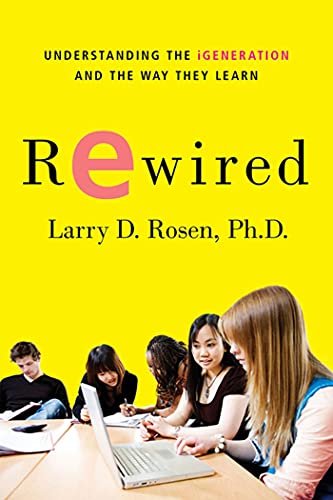
Look around at today's youth and you can see how technology has changed their lives. They lie on their beds and study while listening to mp3 players, texting and chatting online with friends, and reading and posting Facebook messages. How does the new, charged-up, multitasking generation respond to traditional textbooks and lectures? Are we effectively reaching today's technologically advanced youth? Rewired is the first book to help educators and parents teach to this new generation's radically different learning styles and needs. This book will also help parents learn what to expect from their "techie" children concerning school, homework, and even socialization. In short, it is a book that exposes the impact of generational differences on learning while providing strategies for engaging students at school and at home.
Die Inhaltsangabe kann sich auf eine andere Ausgabe dieses Titels beziehen.
Über die Autorin bzw. den Autor
Dr. Larry Rosen is a professor of Psychology and the author of Me, MySpace, and I: Parenting the Net Generation and TechnoStress: Coping with Technology @ Work @ Home @ Play. He has over 25 years of research experience on the impact of technology among children, adolescents, young adults, parents, school teachers, and business people in more than 30 countries. Dr. Rosen is often quoted in magazines and newspapers such as Newsweek, USA Today, and the Chicago Tribune; regularly appears on television and radio; and gives keynote speeches around the world regarding the psychology of technology. He lives in Dominguez Hills, CA.
Auszug. © Genehmigter Nachdruck. Alle Rechte vorbehalten.
Rewired
Understanding the iGeneration and the Way They Learn
By Larry D. Rosen, L. Mark Carrier, Nancy A. CheeverPalgrave Macmillan
Copyright © 2010 Larry D. Rosen
All rights reserved.
ISBN: 978-0-230-61478-9All rights reserved.
Contents
1. Why Tweens and Teens Hate School,
2. Welcome to the iGeneration,
3. An Explosion of WMDs: Wireless Mobile Devices,
4. Multitasking Madness,
5. Real Life or Screen Life? The Educational Opportunities of Immersive Social Networking and Virtual Worlds,
6. Tapping into a Very Creative Generation of Students,
7. Media Literacy among 21st-Century Kids,
8. Concerns, Worries, and Barriers,
9. Rewiring Education,
Acknowledgments,
Endnotes,
Index,
CHAPTER 1
Why Tweens and Teens Hate School
Despite the revolutions wrought by technology in medicine, engineering, communication, and many other fields, the classrooms, textbooks, and lectures of today are little different than those of our parents. Yet today's students use computers, mobile telephones, and other portable technical devices regularly for almost every form of communication except learning.
—National Science Foundation Task Force on Cyberlearning
I absolutely hate school. They make me sit and listen as some old, stuffy teacher drones on and on about stuff from a book written like in the dark ages. We have to read pages of facts and then barf them up on tests that will make or break whether we get into a good college or not. Oh sure, they have pretty pictures on all the pages, but the book is so one-dimensional. Geez, pictures? Don't they know anything about video and what kids like to do? We get to go to the computer lab once a week for like an hour—if that—and even then most of what I want to do is blocked. I can't wait until I am out of this place and I can go to college where they let us bring computers to class and know how to treat wired kids like me.
—Vanessa, age twelve, New York City
I was visiting my daughter's high school and decided to peek in on her Spanish class. From what was written on the blackboard, the class was working on an assignment translating a passage from English to Spanish—at least that's what they were supposed to be doing. I counted nearly half the students clearly doing something else. They appeared distracted. When I looked more carefully I discovered that many had their cell phones in their laps and were rapidly moving their fingers. After class, my daughter and her friends told me they were bored with the lesson and were texting each other across the room. Two of her friends bragged that they could text blindfolded.
Fast forward to the same day, after dinner: I see my daughter, sitting on her bed with the television on, iPod earbuds firmly implanted, her laptop showing one window with a school report beside a browser window open to Facebook, several instant messaging alerts flashing at the bottom of the screen, and her phone vibrating, signaling a text message. Can she really study with all these distractions? How can she possibly get good grades while she is chatting the night away?
Welcome to the iGeneration. While the previous generation, referred to as the Net (as in Internet) Generation, was born in the 1980s and 1990s, the iGeneration children and teens are in elementary school, middle school, and high school. They spend their days immersed in a "media diet," devouring entertainment, communication, and, well, any form of electronic media. They are master multitaskers, social networkers, electronic communicators and the first to rush to any new technology. They were born surrounded by technology, and with every passing year they add more tools to their electronic repertoire. They live in social networks such as Facebook, MySpace, and Second Life gathering friends; they text more than they talk on the phone; and they Twitter (or tweet) the night away, often sleeping with their cell phones vibrating by their sides.
On the one hand it may seem like they are just using too much technology. In the research my associates and I have conducted with thousands of parents, children, tweens, and teens, parents tell us that they are very worried that their children don't seem to want to go outside and play anymore. They would rather chat online than visit with their friends at the mall. They are happiest when their cell phone is vibrating and their computer is beeping. It troubles their parents who grew up playing in the street, hanging out with friends, and having a life outside of the cyberspace cocoon their children have created in their rooms. On the other hand, their children achieve higher grades in school, create tech businesses before they even graduate from high school, and apply to and enter college at unprecedented rates.
So, what is the problem? They hate school. Why? Education has not caught up with this new generation of tech-savvy children and teens. It is not that they don't want to learn. They just learn differently. Gone are the days when students would sit quietly in class, reading a book or doing a math worksheet. Literally, their minds have changed—they have been "rewired." With all the technology that they consume, they need more from education. The educational content is not the problem. It is the delivery method and the setting. Today's youth thrive on multimedia, multitasking, social environments for every aspect of their lives except education. As aptly put by Professor Paul Gee, a member of the National Academy of Education, "Given that the digital age is enveloping our world, and its influence is not likely to decrease, educators need to meet the emerging challenges on two fronts. Educators must determine the new learning styles of students and develop educational methodology and teaching strategies to meet the learning needs."
In the United States 56 million K–12 students are being taught by nearly 4 million teachers. A whopping 25 percent of the U.S. population is currently under seventeen years old. More than 8 in 10 schools have computers with Internet access, with an average of four students per computer. Sounds great, doesn't it? The problem lies not in the number of computers, but rather in how they are being used. Schools have the tools to provide a good, motivating education for our children. The problem is that schools are using educational strategies that worked fine for their students' parents and teachers. They are forgetting that this is a whole new generation of learners, with a host of qualities that are drastically different from those of previous generations. They are simply not happy learning the way we are teaching them. They want—and need— something different to spark their imaginations. That is our challenge as parents and educators: to create a match between students' technological interests and skills, their sociological—often virtual—environments, and the educational system that propels their performance to higher levels and is, at the same time, engaging enough to rekindle a love of school and learning.
Parents are well aware that technology needs to play a larger role in their children's education. In my recent interviews, more than half of the 1,200 parents of children and preteens who I interviewed felt that it was very important that schools provide technology for classroom teaching, have both teachers and administrators who embrace technology, and invest significant money in classroom technology. Parents of preteens felt the strongest...
„Über diesen Titel“ kann sich auf eine andere Ausgabe dieses Titels beziehen.
Suchergebnisse für Rewired: Understanding the iGeneration and the Way...

Beispielbild für diese ISBN
Rewired: Understanding the IGeneration and the Way They Learn
Anbieter: World of Books (was SecondSale), Montgomery, IL, USA
Verkäuferbewertung 5 von 5 Sternen

Paperback. Zustand: Fair. How does the new, charged-up, multitasking generation respond to traditional textbooks and lectures? Are we effectively reaching today's technologically advanced youth? Rewired is the first book to help educators and parents teach to this new generation's radically different learning styles and needs. Artikel-Nr. 00109134826
Gebraucht kaufen
EUR 5,02
Versand gratis
Versand innerhalb von USA
Versand innerhalb von USA
Anzahl: 1 verfügbar
Beispielbild für diese ISBN
Rewired: Understanding the IGeneration and the Way They Learn
Anbieter: World of Books (was SecondSale), Montgomery, IL, USA
Verkäuferbewertung 5 von 5 Sternen
Paperback. Zustand: Good. How does the new, charged-up, multitasking generation respond to traditional textbooks and lectures? Are we effectively reaching today's technologically advanced youth? Rewired is the first book to help educators and parents teach to this new generation's radically different learning styles and needs. Artikel-Nr. 00108738340
Gebraucht kaufen
EUR 5,02
Versand gratis
Versand innerhalb von USA
Versand innerhalb von USA
Anzahl: 1 verfügbar
Beispielbild für diese ISBN
Rewired: Understanding the IGeneration and the Way They Learn
Anbieter: World of Books (was SecondSale), Montgomery, IL, USA
Verkäuferbewertung 5 von 5 Sternen
Paperback. Zustand: Very Good. How does the new, charged-up, multitasking generation respond to traditional textbooks and lectures? Are we effectively reaching today's technologically advanced youth? Rewired is the first book to help educators and parents teach to this new generation's radically different learning styles and needs. Artikel-Nr. 00082969203
Gebraucht kaufen
EUR 5,02
Versand gratis
Versand innerhalb von USA
Versand innerhalb von USA
Anzahl: 2 verfügbar
Beispielbild für diese ISBN
Rewired: Understanding the iGeneration and the Way They Learn
Verlag:
St. Martin's Griffin (edition 1), 2010
ISBN 10: 0230614787
ISBN 13: 9780230614789
Gebraucht
Paperback
Anbieter: BooksRun, Philadelphia, PA, USA
Verkäuferbewertung 5 von 5 Sternen
Paperback. Zustand: Very Good. 1. It's a well-cared-for item that has seen limited use. The item may show minor signs of wear. All the text is legible, with all pages included. It may have slight markings and/or highlighting. Artikel-Nr. 0230614787-8-1
Gebraucht kaufen
EUR 5,03
Versand gratis
Versand innerhalb von USA
Versand innerhalb von USA
Anzahl: 1 verfügbar
Beispielbild für diese ISBN
Rewired: Understanding the iGeneration and the Way They Learn
Verlag:
St. Martin's Griffin (edition 1), 2010
ISBN 10: 0230614787
ISBN 13: 9780230614789
Gebraucht
Paperback
Anbieter: BooksRun, Philadelphia, PA, USA
Verkäuferbewertung 5 von 5 Sternen
Paperback. Zustand: Very Good. 1. It's a well-cared-for item that has seen limited use. The item may show minor signs of wear. All the text is legible, with all pages included. It may have slight markings and/or highlighting. Artikel-Nr. 0230614787-11-18
Gebraucht kaufen
EUR 5,14
Versand gratis
Versand innerhalb von USA
Versand innerhalb von USA
Anzahl: 1 verfügbar
Beispielbild für diese ISBN
Rewired: Understanding the iGeneration and the Way They Learn
Anbieter: Wonder Book, Frederick, MD, USA
Verkäuferbewertung 5 von 5 Sternen
Zustand: Good. Good condition. A copy that has been read but remains intact. May contain markings such as bookplates, stamps, limited notes and highlighting, or a few light stains. Artikel-Nr. L07C-02339
Gebraucht kaufen
EUR 6,43
Versand gratis
Versand innerhalb von USA
Versand innerhalb von USA
Anzahl: 1 verfügbar
Beispielbild für diese ISBN
Rewired: Understanding the iGeneration and the Way They Learn
Anbieter: Wonder Book, Frederick, MD, USA
Verkäuferbewertung 5 von 5 Sternen
Zustand: Very Good. Very Good condition. A copy that may have a few cosmetic defects. May also contain light spine creasing or a few markings such as an owner's name, short gifter's inscription or light stamp. Artikel-Nr. K15B-02163
Gebraucht kaufen
EUR 6,43
Versand gratis
Versand innerhalb von USA
Versand innerhalb von USA
Anzahl: 2 verfügbar
Beispielbild für diese ISBN
Rewired: Understanding the Igeneration and the Way They Learn
Anbieter: ThriftBooks-Atlanta, AUSTELL, GA, USA
Verkäuferbewertung 5 von 5 Sternen
Paperback. Zustand: Good. No Jacket. Pages can have notes/highlighting. Spine may show signs of wear. ~ ThriftBooks: Read More, Spend Less. Artikel-Nr. G0230614787I3N00
Gebraucht kaufen
EUR 7,03
Versand gratis
Versand innerhalb von USA
Versand innerhalb von USA
Anzahl: 1 verfügbar
Beispielbild für diese ISBN
Rewired : Understanding the iGeneration and the Way They Learn
Anbieter: Better World Books, Mishawaka, IN, USA
Verkäuferbewertung 5 von 5 Sternen
Zustand: Good. Pages intact with minimal writing/highlighting. The binding may be loose and creased. Dust jackets/supplements are not included. Stock photo provided. Product includes identifying sticker. Better World Books: Buy Books. Do Good. Artikel-Nr. GRP90701694
Gebraucht kaufen
EUR 8,35
Versand gratis
Versand innerhalb von USA
Versand innerhalb von USA
Anzahl: 1 verfügbar
Beispielbild für diese ISBN
Rewired : Understanding the iGeneration and the Way They Learn
Anbieter: Better World Books, Mishawaka, IN, USA
Verkäuferbewertung 5 von 5 Sternen
Zustand: Good. Former library copy. Pages intact with minimal writing/highlighting. The binding may be loose and creased. Dust jackets/supplements are not included. Includes library markings. Stock photo provided. Product includes identifying sticker. Better World Books: Buy Books. Do Good. Artikel-Nr. GRP76708159
Gebraucht kaufen
EUR 8,35
Versand gratis
Versand innerhalb von USA
Versand innerhalb von USA
Anzahl: 1 verfügbar