
Verwandte Artikel zu The Edge: 50 Tips from Brands That Lead: 50 Tips from...
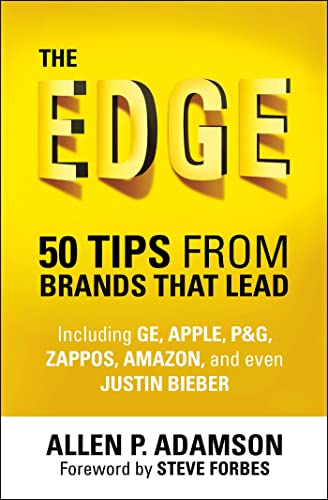
The Edge: 50 Tips from Brands That Lead: 50 Tips from Brands that Lead. Foreword By Steve Forbes. Including GE, Apple, P&G, ZAPPOS, AMAZON, and even Justin Bieber - Hardcover
Inhaltsangabe
In the digital age, the old rules of marketing and branding are in desperate need of overhaul. Word of mouth has evolved to word of type as customers promote or deride products and services to a massive Internet audience at a moments notice.Any misstep away from the brand message becomes a catastrophe as companies are no longer afforded the luxury of tweaking their message as a commercial, ad, or story develops, resulting in damage control that not only costs the brand money, but also costs customer support, hurting a brand's image and integrity.
In The Edge , Allen Adamson examines how the leading brands of today maintain their dominance in the market utilizing the strategies put forth in his previous books BrandSimple and BrandDigital . Adamson succinctly accounts specific challenges facing the biggest brands of today, from major companies like Apple and General Mills to celebrity brands like Lady Gaga and Jay Z. He reveals the guiding principles employed to ensure the message stays focused, remains clear, and continues to drive a brand to the top of the market.
A leading expert explains how global brands stay at the top and demonstrates how to follow their lead to maintain and advance your brand's identity.
Die Inhaltsangabe kann sich auf eine andere Ausgabe dieses Titels beziehen.
Über die Autorin bzw. den Autor
Allen P. Adamson is managing director of the New York office of Landor Associates, one of the world's leading strategic brand consulting and design firms. He is also author of BrandDigital: Simple Ways Top Brands Succeed in the Digital World and BrandSimple: How the Best Brands Keep it Simple and Succeed. Adamson has partnered with a wide array of clients, including Diageo, Sephora, GE, Procter & Gamble, PepsiCo, Pfizer, and Verizon. He is a sought-after industry commentator, appearing on CNBC, FOX Business Network, and The Today Show, and quoted in The New York Times, The Wall Street Journal, Advertising Age, and USA Today
Auszug. © Genehmigter Nachdruck. Alle Rechte vorbehalten.
The Edge
50 Tips from Brands that Lead
By Allen P. AdamsonSt. Martin's Press
Copyright © 2013 Allen P. Adamson
All rights reserved.
ISBN: 978-0-230-34224-8All rights reserved.
Contents
Acknowledgments,
Foreword Steve Forbes,
Introduction,
ONE To Have an Edge, a Brand Has to Be Different, Relevant — and Have Energy,
TWO To Have an Edge, a Brand Must Start with a Simple Idea Based on "Who" and "Why," Not Just "What" and "How",
THREE To Have an Edge, a Brand's Actions Must Tell Its Story,
FOUR To Have an Edge, a Brand's Customers Should Want to Tell Its Story,
FIVE To Have an Edge, Gear Up for a Marathon, Not a Sprint,
SIX To Have an Edge, a Brand Must Know Where It Can Play and Win,
Index,
CHAPTER 1
To Have an Edge, a Brand Has to Be Different, Relevant — and Have Energy
Kevin Plank knows how to build a brand, and he knows how brands get built. No, these thoughts are not redundant. They each, in their own way, have something to do with what it takes to gain an edge in the marketplace. Let me explain.
For those who may not be into sports, or even sporting goods, Kevin Plank is the founder and president of Under Armour, a company he launched in 1995 when he was a walk-on special-teams football player for the University of Maryland. Tired of constantly having to change during the course of a game when the T-shirt he wore under his jersey would become heavy and sweat-soaked, he noticed that his compression shorts stayed cool and dry — they were made of a polyester blend that wicked away moisture. Like many brand entrepreneurs, he had an "aha!" moment. Or, as Jerry Seinfeld might put it, "Ever wonder why no one's ever developed a T-shirt using the same moisture-wicking fabric out of which the shorts are made?" Working in his grandmother's basement, Plank set out to see if he could come up with a shirt that would remain drier and lighter and perform well under the most extreme conditions. After a year of fabric sourcing and product testing, he created just what he was looking for — times three: a shirt, a new category of sporting apparel called performance apparel, and a brand that would rocket in revenue from $17,000 in 1996 to more than $1 billion today. Under Armour now holds nearly 3 percent of the sports apparel market in the United States, holds a significant place in the global market, and sells everything from shirts (of course) and shorts to cleats, to underwear and outerwear, to gloves and shoes. Its clothing is worn by teams at more than 100 universities, and by professional players of football, baseball, basketball, golf, rugby, ice hockey, and even mixed martial arts, and its products have been proudly placed in movies, including Any Given Sunday, and television shows, including Friday Night Lights. The Under Armour logo, an interlocking "U" and "A," is fast becoming as recognizable as the Nike swoosh.
Plank launched a new sportswear brand that is now among the category's fastest-growing sectors. He did it by identifying something different that people, specifically athletes, really cared about. He saw the opportunity to fill a gap in the sportswear market to which no other company, not even Nike or Reebok, had laid claim. And he did it with products that don't just promise to be relevantly different but are different — they perform like champs. More than this, Plank is determined not to become a one-hit wonder. His product development teams are focused on coming up with new fabrics, applications, and designs that will keep the brand in the center of its field. Athletes of both the professional and weekend variety swear by this brand of gear, and they're fierce advocates. Under Armour's trademarked rallying cry "Protect This House" can not only be heard at athletic events worldwide, it's the heart of the brand's bold idea.
Kevin Plank built a brand on a relevantly different idea. And from a procedural point of view, he understood that this is how great brands get built. Unlike the premise pitched by The Pitch, and assumed by many folks, building a brand does not start with awareness — a great advertising campaign or promotion that alerts consumers to the fact that you're out there. In terms of building a brand, this is backward. To achieve success in brand building, the first thing you need to do is identify a differentiated meaning for your brand and determine if it really matters to anyone. Is there a large enough audience of people who will care? It's only after you do this that you can think about generating awareness. Consumers need a way to make a distinction between one brand and another. This is how they form preferences and make choices.
One of the most respected proprietary tools in the industry proves this point. Named Brand Asset Valuator (BAV), it was created by Y&R, an agency that is part of the same communications family as Landor, the company for which I work. BAV is an incredible diagnostic tool for figuring out how your brand is performing relative to all other brands in the market — not just the brands in your category. More important, however, is that, unlike many other brand valuation tools that attempt to place a current dollar value on the brand, BAV indicates what you must do to keep your brand strong. BAV can gauge the current health of your brand, project its future health, and indicate prescriptive actions. Why is this important? Ask Kevin Plank or the leaders of any other brands with an edge. Odd as it may sound, Wall Street doesn't just care about the value of your brand today. It cares about whether you can increase its value tomorrow.
The key challenge for brands has always been the ability to increase their dominance. BAV is a great indicator of whether this will happen and how this will happen, and the way it works is actually pretty simple. It's based on the interrelationship of what started out as four criteria, but as the result of how the marketplace has changed over the past few years, now includes a fifth.
• Differentiation — what makes your brand unique
• Relevance — how meaningful this difference is to the people who matter
• Esteem — how well regarded your brand is in the marketplace
• Knowledge — how well consumers know and understand your brand
• Energy — how dynamic the brand is, reflective of its ability to adapt and evolve
Brands generally get built one dimension at a time, with differentiation being the first, most critical step, and relevance an obvious second. A healthy brand has high levels of both difference and relevance. It's unique in a way that's meaningful to lots of people. Target is a perfect example, as are Dove, Clorox, and Gatorade. A strong niche brand has a high degree of differentiation and is relevant to a smaller group of people. This might be a brand like lululemon athletica, which with almost no advertising has cultivated a devoted group of yoga enthusiasts, or a luxury brand, such as Rolex, whose devotees are likely to have deep pockets and an appreciation of fine timepieces. If a brand stays relevant but starts to lose what made it different, it will become a commodity. Wall Street begins to worry. If it loses what made it relevant, same story. All healthy brands have a greater degree of differentiation than relevance, which gives them room to expand both their offerings and their audience.
Esteem and knowledge, the second pair of criteria, make up a brand's stature. If a brand has a higher level of...
„Über diesen Titel“ kann sich auf eine andere Ausgabe dieses Titels beziehen.
Suchergebnisse für The Edge: 50 Tips from Brands That Lead: 50 Tips from...

Beispielbild für diese ISBN
The Edge: 50 Tips from Brands That Lead
Anbieter: World of Books (was SecondSale), Montgomery, IL, USA
Verkäuferbewertung 5 von 5 Sternen

Hardback. Zustand: Very Good. In the digital age, the old rules of marketing and branding are in desperate need of overhaul. Word of mouth has evolved to word of type as customers promote or deride products and services to a massive Internet audience at a moments notice.Any misstep away from the brand message becomes a catastrophe as companies are no longer afforded the luxury of tweaking their message as a commercial, ad, or story develops, resulting in damage control that not only costs the brand money, but also costs customer support, hurting a brand's image and integrity. In The Edge, Allen Adamson examines how the leading brands of today maintain their dominance in the market utilizing the strategies put forth in his previous books BrandSimple and BrandDigital. Adamson succinctly accounts specific challenges facing the biggest brands of today, from major companies like Apple and General Mills to celebrity brands like Lady Gaga and Jay Z. He reveals the guiding principles employed to ensure the message stays focused, remains clear, and continues to drive a brand to the top of the market. Artikel-Nr. 00109981265
Gebraucht kaufen
EUR 5,24
Versand gratis
Versand innerhalb von USA
Versand innerhalb von USA
Anzahl: 1 verfügbar
Beispielbild für diese ISBN
The Edge: 50 Tips from Brands that Lead
Verlag:
Palgrave Macmillan (edition ), 2013
ISBN 10: 0230342248
ISBN 13: 9780230342248
Gebraucht
Hardcover
Anbieter: BooksRun, Philadelphia, PA, USA
Verkäuferbewertung 5 von 5 Sternen
Hardcover. Zustand: Fair. The item might be beaten up but readable. May contain markings or highlighting, as well as stains, bent corners, or any other major defect, but the text is not obscured in any way. Artikel-Nr. 0230342248-7-1
Gebraucht kaufen
EUR 6,88
Versand gratis
Versand innerhalb von USA
Versand innerhalb von USA
Anzahl: 1 verfügbar
Foto des Verkäufers
The Edge: 50 Tips from Brands That Lead
Anbieter: WeBuyBooks, Rossendale, LANCS, Vereinigtes Königreich
Verkäuferbewertung 5 von 5 Sternen
hardcover. Zustand: Very Good. Most items will be dispatched the same or the next working day. A copy that has been read, but is in excellent condition. Pages are intact and not marred by notes or highlighting. The spine remains undamaged. Artikel-Nr. rev8164862028
Gebraucht kaufen
EUR 4,25
EUR 7,74 Versand
Versand von Vereinigtes Königreich nach USA
Versand von Vereinigtes Königreich nach USA
Anzahl: 1 verfügbar
Beispielbild für diese ISBN
The Edge: 50 Tips from Brands that Lead
Anbieter: Pearlydewdrops, Streat, Vereinigtes Königreich
Verkäuferbewertung 5 von 5 Sternen
Hardcover. Zustand: Very Good. Very good, pages are clean and unread, however there is some shelf wear on cover, including some marking and creasing Shipped from the UK within 2 business days of order being placed. Artikel-Nr. mon0000212303
Gebraucht kaufen
EUR 7,24
EUR 25,76 Versand
Versand von Vereinigtes Königreich nach USA
Versand von Vereinigtes Königreich nach USA
Anzahl: 3 verfügbar
Beispielbild für diese ISBN
The Edge
Anbieter: Majestic Books, Hounslow, Vereinigtes Königreich
Verkäuferbewertung 4 von 5 Sternen

Zustand: New. pp. 288. Artikel-Nr. 44822369
Neu kaufen
EUR 25,94
EUR 7,61 Versand
Versand von Vereinigtes Königreich nach USA
Versand von Vereinigtes Königreich nach USA
Anzahl: 1 verfügbar