
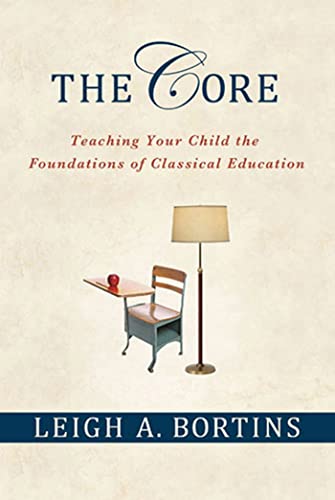
Verwandte Artikel zu CORE: Teaching Your Child the Foundations of Classical...
Inhaltsangabe
A specific, common sense answer, to the crisis in education
Die Inhaltsangabe kann sich auf eine andere Ausgabe dieses Titels beziehen.
Über die Autorin bzw. den Autor
Leigh A. Bortins is the founder and CEO of Classical Conversations, Inc., whose enrollment is 20,000. She hosts a weekly radio show, Leigh! for Lunch and lectures widely about the importance of home education at nationwide conferences and seminars. She lives in West End, NC.
Auszug. © Genehmigter Nachdruck. Alle Rechte vorbehalten.
The Core
Teaching Your Child the Foundations of Classical Education
By Leigh A. BortinsPalgrave Macmillan
Copyright © 2010 Leigh A. Bortins
All rights reserved.
ISBN: 978-0-230-10035-0All rights reserved.
Contents
Acknowledgments,
Preface,
Foreword,
Introduction,
PART ONE The Classical Model,
Chapter One What's Wrong with Education Today?,
Chapter Two Why We Need Classical Education,
Chapter Three How Classical Education Can Help You,
PART TWO The Core of a Classical Education,
Chapter Four Reading,
Chapter Five Writing,
Chapter Six Math,
Chapter Seven Geography,
Chapter Eight History,
Chapter Nine Science,
Chapter Ten Fine Arts,
Chapter Eleven Schedules and Resources for Classical Education,
Epilogue How a Classical Education Gives Us Skills We Need as Adults,
Resources,
Index,
CHAPTER 1
WHAT'S WRONG WITH EDUCATION TODAY?
"If you approve, headmaster, I will stay as I am here as long as any boy wants to read the classics. I think it would be very wicked indeed to do anything to fit a boy for the modern world."
"It's a short-sided view, Scott-King."
"There, headmaster, with all respect, I differ from you profoundly. I think it the most long-sighted view it is possible to take."
—Evelyn Waugh, "Scott-King's Modern Europe"
THE PURPOSE OF CLASSICAL EDUCATION
There are many practical purposes for schooling: vocational skills, hobbies, earning a living, social interaction, or just enlarging perspectives. The purpose of a classical education is to equip students to discover the way our universe works. Understanding the physical universe requires a foundational knowledge of math and science. Understanding human nature requires a foundational knowledge of language, history, economics, and literature. To learn foundational information from any field of knowledge, students need to be trained in reading, writing, communication, and analysis of qualitative information. At their highest level, the humanities are studied because they embody the ideas that make us human.
We exchange knowledge, information, and ideas through words, spoken or symbolic. Words are processed, weighed, and analyzed through other words, even if they originated in a picture or image or experience. Words are used to share concrete and abstract ideas. Words allow us to build great cities, negotiate peace between countries, and share a pleasant meal with friends and family. The goal of education is to teach children to become adults who can handle complex ideas, in uncertain situations, with confidence. We feel confident when we can competently manage words and ideas.
Successful education ought to propel a student to want to learn more. Learning should inspire joy bound with constant astonishment at the marvels of creation. Learning should breathe life into us—ignite our imaginations and inspire us to share the ideas we learn with people we love. The joy of learning begins in the home, with the entire world as our classroom. I believe children learn best when their parents and teachers are their heroes.
Classical education consists of teaching the skills of grammar, logic (also called dialectic), and rhetoric. These skills are called the trivium, which is Latin for "three roads," or a place where three ways meet. In the Middle Ages, the trivium was the lower division of the seven liberal arts, before the quadrivium. (More about that in Chapter Six.) Although modern education purports to teach the liberal arts, it has unknowingly neglected the benefits of the various classical arts that form a good education, especially its rigors.
The foundation of a classical education begins with parents teaching children the art of memorization and grammar studies. Some educators might dismiss rote memorization, but I argue that it is beneficial because it trains your brain to hold information. It is the most organic way of learning ever devised and goes hand in hand with the way we naturally relate to our children.
This is a process that starts at the beginning. From the moment that parents hold their baby in their arms a bonding process begins. They talk to the child; they introduce the sounds and names of the world around them to the baby through repetition. ("Look at the puppy. See the puppy?") The mother and father of a newborn find no hardship in saying words like "I love you," or "Yes, I'm your mommy," in patient intonations over and over, a thousand times. By doing so, the baby begins to identify big ideas like warmth, hunger, kindness, and dinner with specific words and actions, thus developing a vocabulary. Many pediatricians agree that the best thing for a child's neurological development is for parents to engage the child's mind by using a multitude of words and touches. Yet somehow, in recent years educational theory has come to reject repetition as a good educational tool when it comes to mastering our multiplication tables or identifying geographic locations or learning the correct spelling of words. We accept that to be good at sports or music you must practice over and over until your fine motor skills become your gross motor skills, meaning that you can play Tchaikovsky in your sleep! Over-practice implies enough repetition to make new skills seem easy and natural. Yet contemporary educational philosophies consider large amounts of rote practice to be unnecessary in academics. And so our modern educational system is weak.
The purpose of a classical education is to strengthen one's mind, body, and character in order to develop the ability to learn anything. This requires consistent discipleship or mentoring by a concerned adult over a long period of time with very specific academic goals. For eventually, the child wants to know why she must learn so much terminology and what to do with what she has learned. These natural questions lead children into dialectic and rhetorical studies.
Before we examine the restoration of the classical model as the core for every child's education, let's explore the ideology that caused us to lose the classical model after 2,500 years of success. The main culprits that have reduced our ability to engage in reasonable discourse are professionalism, federal mandates, "edutainment," and the desertion of memorization skills.
PROFESSIONALISM REPLACES PARENTING
Specialization and division of labor are hallmarks of professionalism in any field. Just like doctors and lawyers, modern educators mimic the efficiencies of the assembly line by specializing in a very particular field such as fourth-grade science or pre-reading development. Specialization may be helpful in teaching adults who want to learn a specific skill and it can be very helpful for overcoming a particular learning disability, but it is not particularly helpful in fostering a love for learning in children who are just trying to please their teacher so they can get back to the important business of playing with their toys.
Schooling is now equally professionalized. Instead of parents who guide their children through home, community, and work life, we now assign students to professional educators charged with teaching each child a specialty for an hour a day for fifteen weeks, and then the students move on to a new subject led by a different teacher. Students have no time to bond with their mentor or to discover and appreciate the wisdom of their instructor. Students are given no opportunity to watch their instructor struggle with learning, to copy the teacher's...
„Über diesen Titel“ kann sich auf eine andere Ausgabe dieses Titels beziehen.
Suchergebnisse für CORE: Teaching Your Child the Foundations of Classical...

Beispielbild für diese ISBN
CORE
Anbieter: World of Books (was SecondSale), Montgomery, IL, USA
Verkäuferbewertung 5 von 5 Sternen

Zustand: Acceptable. Item in acceptable condition! Textbooks may not include supplemental items i.e. CDs, access codes etc. Artikel-Nr. 00104433496
Gebraucht kaufen
EUR 4,16
Versand gratis
Versand innerhalb von USA
Versand innerhalb von USA
Anzahl: 5 verfügbar
Beispielbild für diese ISBN
CORE
Anbieter: World of Books (was SecondSale), Montgomery, IL, USA
Verkäuferbewertung 5 von 5 Sternen
Zustand: Good. Item in good condition. Textbooks may not include supplemental items i.e. CDs, access codes etc. Artikel-Nr. 00105763277
Gebraucht kaufen
EUR 4,16
Versand gratis
Versand innerhalb von USA
Versand innerhalb von USA
Anzahl: Mehr als 20 verfügbar
Foto des Verkäufers
CORE
Anbieter: Dream Books Co., Denver, CO, USA
Verkäuferbewertung 5 von 5 Sternen
Zustand: acceptable. This copy has clearly been enjoyedâ"expect noticeable shelf wear and some minor creases to the cover. Binding is strong, and all pages are legible. May contain previous library markings or stamps. Artikel-Nr. DBV.023010035X.A
Gebraucht kaufen
EUR 4,17
Versand gratis
Versand innerhalb von USA
Versand innerhalb von USA
Anzahl: 1 verfügbar
Beispielbild für diese ISBN
CORE: Teaching Your Child the
Anbieter: World of Books (was SecondSale), Montgomery, IL, USA
Verkäuferbewertung 5 von 5 Sternen
Zustand: Good. Item in good condition and has highlighting/writing on text. Used texts may not contain supplemental items such as CDs, info-trac etc. Artikel-Nr. 00103463225
Gebraucht kaufen
EUR 4,26
Versand gratis
Versand innerhalb von USA
Versand innerhalb von USA
Anzahl: 1 verfügbar
Foto des Verkäufers
CORE
Anbieter: Dream Books Co., Denver, CO, USA
Verkäuferbewertung 5 von 5 Sternen
Zustand: good. Gently used with minimal wear on the corners and cover. A few pages may contain light highlighting or writing, but the text remains fully legible. Dust jacket may be missing, and supplemental materials like CDs or codes may not be included. May be ex-library with library markings. Ships promptly! Artikel-Nr. DBV.023010035X.G
Gebraucht kaufen
EUR 5,78
Versand gratis
Versand innerhalb von USA
Versand innerhalb von USA
Anzahl: 1 verfügbar
Beispielbild für diese ISBN
The Core: Teaching Your Child the Foundations of Classical Education: Teaching Your Child the Foundations of Classical Education
Anbieter: ThriftBooks-Phoenix, Phoenix, AZ, USA
Verkäuferbewertung 5 von 5 Sternen
Paperback. Zustand: Good. No Jacket. Pages can have notes/highlighting. Spine may show signs of wear. ~ ThriftBooks: Read More, Spend Less. Artikel-Nr. G023010035XI3N00
Gebraucht kaufen
EUR 5,82
Versand gratis
Versand innerhalb von USA
Versand innerhalb von USA
Anzahl: 13 verfügbar
Beispielbild für diese ISBN
The Core: Teaching Your Child the Foundations of Classical Education: Teaching Your Child the Foundations of Classical Education
Anbieter: ThriftBooks-Dallas, Dallas, TX, USA
Verkäuferbewertung 5 von 5 Sternen
Paperback. Zustand: Good. No Jacket. Pages can have notes/highlighting. Spine may show signs of wear. ~ ThriftBooks: Read More, Spend Less. Artikel-Nr. G023010035XI3N00
Gebraucht kaufen
EUR 5,82
Versand gratis
Versand innerhalb von USA
Versand innerhalb von USA
Anzahl: 14 verfügbar
Beispielbild für diese ISBN
The Core: Teaching Your Child the Foundations of Classical Education: Teaching Your Child the Foundations of Classical Education
Anbieter: ThriftBooks-Reno, Reno, NV, USA
Verkäuferbewertung 5 von 5 Sternen
Paperback. Zustand: Fair. No Jacket. Readable copy. Pages may have considerable notes/highlighting. ~ ThriftBooks: Read More, Spend Less. Artikel-Nr. G023010035XI5N00
Gebraucht kaufen
EUR 5,82
Versand gratis
Versand innerhalb von USA
Versand innerhalb von USA
Anzahl: 2 verfügbar
Beispielbild für diese ISBN
The Core: Teaching Your Child the Foundations of Classical Education: Teaching Your Child the Foundations of Classical Education
Anbieter: ThriftBooks-Atlanta, AUSTELL, GA, USA
Verkäuferbewertung 5 von 5 Sternen
Paperback. Zustand: Fair. No Jacket. Former library book; Readable copy. Pages may have considerable notes/highlighting. ~ ThriftBooks: Read More, Spend Less. Artikel-Nr. G023010035XI5N10
Gebraucht kaufen
EUR 5,82
Versand gratis
Versand innerhalb von USA
Versand innerhalb von USA
Anzahl: 1 verfügbar
Beispielbild für diese ISBN
The Core: Teaching Your Child the Foundations of Classical Education: Teaching Your Child the Foundations of Classical Education
Anbieter: ThriftBooks-Dallas, Dallas, TX, USA
Verkäuferbewertung 5 von 5 Sternen
Paperback. Zustand: Good. No Jacket. Missing dust jacket; Pages can have notes/highlighting. Spine may show signs of wear. ~ ThriftBooks: Read More, Spend Less. Artikel-Nr. G023010035XI3N01
Gebraucht kaufen
EUR 5,82
Versand gratis
Versand innerhalb von USA
Versand innerhalb von USA
Anzahl: 1 verfügbar