
Verwandte Artikel zu Listening to People: A Practical Guide to Interviewing,...
Listening to People: A Practical Guide to Interviewing, Participant Observation, Data Analysis, and Writing It All Up (Chicago Guides to Writing, Editing, and Publishing) - Softcover
Buch 46 von 93: Chicago Guides to Writing, Editing, and Publishing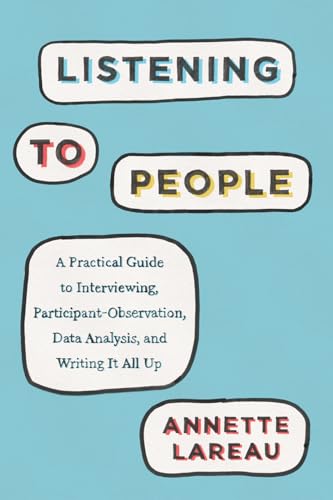
Inhaltsangabe
A down-to-earth, practical guide for interview and participant observation and analysis.
In-depth interviews and close observation are essential to the work of social scientists, but inserting one’s researcher-self into the lives of others can be daunting, especially early on. Esteemed sociologist Annette Lareau is here to help. Lareau’s clear, insightful, and personal guide is not your average methods text. It promises to reduce researcher anxiety while illuminating the best methods for first-rate research practice.
As the title of this book suggests, Lareau considers listening to be the core element of interviewing and observation. A researcher must listen to people as she collects data, listen to feedback as she describes what she is learning, listen to the findings of others as they delve into the existing literature on topics, and listen to herself in order to sift and prioritize some aspects of the study over others. By listening in these different ways, researchers will discover connections, reconsider assumptions, catch mistakes, develop and assess new ideas, weigh priorities, ponder new directions, and undertake numerous adjustments—all of which will make their contributions clearer and more valuable.
Accessibly written and full of practical, easy-to-follow guidance, this book will help both novice and experienced researchers to do their very best work. Qualitative research is an inherently uncertain project, but with Lareau’s help, you can alleviate anxiety and focus on success.
Die Inhaltsangabe kann sich auf eine andere Ausgabe dieses Titels beziehen.
Über die Autorin bzw. den Autor
Annette Lareau is the Edmund J. and Louise W. Kahn Endowed Term Professor in the Social Sciences at the University of Pennsylvania. She is the author of a number of award-winning works including Unequal Childhoods and Home Advantage. She is the past president of the American Sociological Association.
Auszug. © Genehmigter Nachdruck. Alle Rechte vorbehalten.
Interviews and participant observation studies deepen our knowledge of people, institutions, and social processes. These approaches draw us into the meaning of events in the everyday lives of individuals, showing how people are affected by social structural forces. Well-crafted studies can make us feel as if we are close to the social events being vividly described. For example, while surveys of victims document the size and scope of disasters, in-depth interviews and participant observation can help us grasp unexpected ramifications...
Many people want to learn how to do high-quality in-depth interviews and participant observation. In my case, when I was beginning to learn how to do this kind of research, the literature I read left me feeling stumped. I could not find the advice I needed. The books seemed overly prescriptive. They informed me that I should sensitively “probe” in interviews, but they didn’t describe what that looked like, nor did they seem to recognize sufficiently the difficulties inherent in probing. As I read methodological appendices, I was especially frustrated when researchers who had carried out a participant observation study described gaining entry into a field setting as the result of a serendipitous event. How was I supposed to replicate such serendipity as I sought to break into a setting? Books about interviews and observation made it seem like doing a study would be relatively smooth sailing, but in my experience, it was not. I yearned to read a book that was more realistic and practical...
These challenges—that methods books are not practical enough and that potentially wonderful studies can flounder—led me to write this book. In Listening to People, I give concrete, practical advice for actually doing a wide variety of studies including class projects, theses, articles, and books... As the title of this book suggests, I consider listening to be the core of in-depth interviewing and participant observation. You must listen to people as you collect data, listen to feedback from others as you describe what you are learning during data collection, “listen” to the findings of others as you delve into the existing literature on topics that interest you, and “listen” to yourself as you sort through and prioritize some aspects of your study over others. As you engage in listening in these different ways, you will discover connections, reconsider assumptions, catch mistakes, develop and assess new ideas, weigh priorities, ponder new directions, and undertake numerous adjustments, all of which ultimately will make your contribution clearer and more valuable.
In analog photography, the film is developed, and prints are made in a darkroom. There, you use a machine to enlarge and then briefly expose the image onto white photographic paper, and subsequently you immerse the paper in a chemical bath. At first, the paper is completely blank. But then your photograph begins to take shape—very gradually and unevenly. It may even be hard to recognize the image when it is beginning to emerge, but very slowly the picture comes to life. If the image is too light or too dark, you return to the machine and change the amount of time you “burn” (give the image more light) or “dodge” (withhold light on part of the picture) to create a balanced photograph. Then, you put the new paper into the chemical bath, watch for the image to emerge, and finally plunge it into a “stop bath” when you are satisfied with the picture.
There are important differences between developing pictures and allowing insights to emerge from your interviews and participant observation research, but the slow taking shape of focus is similar. In addition, in interviews and participant observation, there is a lot of adjusting and changing as you go along—particularly in the first half of the study process. Thus, it is common for interviewers and participant observers to not really know what they are doing for a long time. If this happens, you may feel confused and uncertain. You may not quite understand how your study fits into the intellectual debates in the field. You may not know what is new and exciting. Or, you may feel overwhelmed and be convinced that your study is a big mess. All of this uncertainty and worry is normal. As you do interviews or hang out in a setting, many new questions surface. You have to make many decisions based on incomplete information—should you probe this or that, should you spend time with this person or that person, why are you doing this study, and what do you hope to learn? Since social life is complex, there are always multiple intellectual pathways present within any given study. As a result, you need to be constantly “thinking as you go.”
[...]
Why is focus so important? It is hard for readers (or for any audience) to absorb a story that is really four or five different stories. When a writer hops from point to point, or when a speaker presents a lot of examples that are interesting but don’t fit together clearly, the audience can become confused, bored, or impatient. As a reader, you may have had the experience of reading a long paper and not really understanding why the author wrote it. (Was there a key idea? What was it?) Or, you may have read something with so many different ideas and examples it was hard to get the overall argument straight. Do not underestimate how difficult it can be for readers to simply follow an argument. If you have a clear focus, it helps your audience understand what key idea you are trying to convey.
When you first start doing interviews and participant observation, however, finding a clear focus is difficult. Sometimes it is impossible—even if you have read other relevant studies very carefully and thought a great deal about your topic. Normally it is only by collecting data, and thinking about the literature, honing your question, and collecting more data, that your focus slowly takes shape. Similar to the image in a darkroom, your focus emerges over time.
„Über diesen Titel“ kann sich auf eine andere Ausgabe dieses Titels beziehen.
Suchergebnisse für Listening to People: A Practical Guide to Interviewing,...

Beispielbild für diese ISBN
Listening to People: A Practical Guide to Interviewing, Participant Observation, Data Analysis, and Writing It All Up (Chicago Guides to Writing, Editing, and Publishing)
Verlag:
University of Chicago Press, 2021
ISBN 10: 022680643X
ISBN 13: 9780226806433
Gebraucht
Paperback
Anbieter: WorldofBooks, Goring-By-Sea, WS, Vereinigtes Königreich
Verkäuferbewertung 5 von 5 Sternen

Paperback. Zustand: Fair. A readable copy of the book which may include some defects such as highlighting and notes. Cover and pages may be creased and show discolouration. Artikel-Nr. GOR014964446
Gebraucht kaufen
EUR 12,81
EUR 6,63 Versand
Versand von Vereinigtes Königreich nach USA
Versand von Vereinigtes Königreich nach USA
Anzahl: 1 verfügbar
Beispielbild für diese ISBN
Listening to People: A Practical Guide to Interviewing, Participant Observation, Data Analysis, and Writing It All Up (Chicago Guides to Writing, Editing, and Publishing)
Verlag:
University of Chicago Press, 2021
ISBN 10: 022680643X
ISBN 13: 9780226806433
Gebraucht
Paperback
Anbieter: WorldofBooks, Goring-By-Sea, WS, Vereinigtes Königreich
Verkäuferbewertung 5 von 5 Sternen
Paperback. Zustand: Very Good. The book has been read, but is in excellent condition. Pages are intact and not marred by notes or highlighting. The spine remains undamaged. Artikel-Nr. GOR014346638
Gebraucht kaufen
EUR 12,81
EUR 6,63 Versand
Versand von Vereinigtes Königreich nach USA
Versand von Vereinigtes Königreich nach USA
Anzahl: 1 verfügbar
Beispielbild für diese ISBN
Listening to People: A Practical Guide to Interviewing, Participant Observation, Data Analysis, and Writing It All Up (Chicago Guides to Writing, Editing, and Publishing)
Verlag:
University of Chicago Press, 2021
ISBN 10: 022680643X
ISBN 13: 9780226806433
Gebraucht
paperback
Anbieter: Books From California, Simi Valley, CA, USA
Verkäuferbewertung 4 von 5 Sternen

paperback. Zustand: Good. Minimal markings. Artikel-Nr. mon0004264333
Gebraucht kaufen
EUR 15,99
EUR 4,47 Versand
Versand innerhalb von USA
Versand innerhalb von USA
Anzahl: 1 verfügbar
Beispielbild für diese ISBN
Listening to People: A Practical Guide to Interviewing, Participant Observation, Data Analysis, and Writing It All Up
Verlag:
The University of Chicago Press, 2021
ISBN 10: 022680643X
ISBN 13: 9780226806433
Gebraucht
Paperback
Anbieter: World of Books (was SecondSale), Montgomery, IL, USA
Verkäuferbewertung 5 von 5 Sternen
Paperback. Zustand: Very Good. A down-to-earth, practical guide for interview and participant observation and analysis. Artikel-Nr. 00109861168
Gebraucht kaufen
EUR 33,32
Versand gratis
Versand innerhalb von USA
Versand innerhalb von USA
Anzahl: 2 verfügbar
Beispielbild für diese ISBN
Listening to People
Anbieter: PBShop.store UK, Fairford, GLOS, Vereinigtes Königreich
Verkäuferbewertung 5 von 5 Sternen
PAP. Zustand: New. New Book. Shipped from UK. Established seller since 2000. Artikel-Nr. GB-9780226806433
Neu kaufen
EUR 29,04
EUR 5,94 Versand
Versand von Vereinigtes Königreich nach USA
Versand von Vereinigtes Königreich nach USA
Anzahl: 1 verfügbar
Beispielbild für diese ISBN
Listening to People: A Practical Guide to Interviewing, Participant Observation, Data Analysis, and Writing It All Up
Verlag:
The University of Chicago Press, 2021
ISBN 10: 022680643X
ISBN 13: 9780226806433
Neu
Softcover
Anbieter: Kennys Bookstore, Olney, MD, USA
Verkäuferbewertung 5 von 5 Sternen
Zustand: New. 2021. Paperback. . . . . . Books ship from the US and Ireland. Artikel-Nr. V9780226806433
Neu kaufen
EUR 30,72
EUR 9,41 Versand
Versand innerhalb von USA
Versand innerhalb von USA
Anzahl: Mehr als 20 verfügbar
Beispielbild für diese ISBN
Listening to People: A Practical Guide to Interviewing, Participant Observation, Data Analysis, and Writing It All Up (Chicago Guides to Writing, Editing, and Publishing) Paperback ? September 10, 2021
Anbieter: Majestic Books, Hounslow, Vereinigtes Königreich
Verkäuferbewertung 4 von 5 Sternen
Zustand: New. Artikel-Nr. 379309439
Neu kaufen
EUR 32,57
EUR 7,69 Versand
Versand von Vereinigtes Königreich nach USA
Versand von Vereinigtes Königreich nach USA
Anzahl: 3 verfügbar
Beispielbild für diese ISBN
Listening to People A Practical Guide to Interviewing, Participant Observation, Data Analysis, and Writing It All Up
Anbieter: Revaluation Books, Exeter, Vereinigtes Königreich
Verkäuferbewertung 5 von 5 Sternen
Paperback. Zustand: Brand New. 304 pages. 9.25x6.25x0.75 inches. In Stock. Artikel-Nr. __022680643X
Neu kaufen
EUR 29,45
EUR 11,84 Versand
Versand von Vereinigtes Königreich nach USA
Versand von Vereinigtes Königreich nach USA
Anzahl: 2 verfügbar
Beispielbild für diese ISBN
Listening to People: A Practical Guide to Interviewing, Participant Observation, Data Analysis, and Writing It All Up (Chicago Guides to Writing, Editing, and Publishing)
Anbieter: Ria Christie Collections, Uxbridge, Vereinigtes Königreich
Verkäuferbewertung 5 von 5 Sternen
Zustand: New. In English. Artikel-Nr. ria9780226806433_new
Neu kaufen
EUR 35,17
EUR 13,36 Versand
Versand von Vereinigtes Königreich nach USA
Versand von Vereinigtes Königreich nach USA
Anzahl: Mehr als 20 verfügbar
Beispielbild für diese ISBN
Listening to People A Practical Guide to Interviewing, Participant Observation, Data Analysis, and Writing It All Up
Anbieter: Revaluation Books, Exeter, Vereinigtes Königreich
Verkäuferbewertung 5 von 5 Sternen
Paperback. Zustand: Brand New. 304 pages. 9.25x6.25x0.75 inches. In Stock. Artikel-Nr. x-022680643X
Neu kaufen
EUR 45,79
EUR 11,84 Versand
Versand von Vereinigtes Königreich nach USA
Versand von Vereinigtes Königreich nach USA
Anzahl: 1 verfügbar