
Verwandte Artikel zu Meatless Days
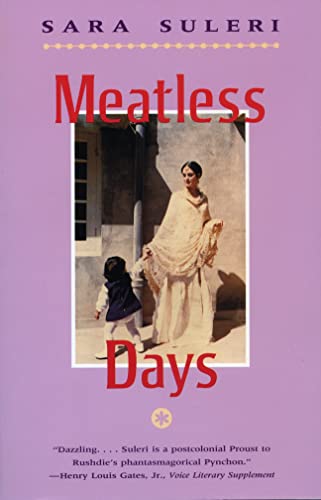
Inhaltsangabe
Sara Suleri Goodyear is a professor of English at Yale University. She is the author of Meatless Days and Boys Will Be Boys.
Die Inhaltsangabe kann sich auf eine andere Ausgabe dieses Titels beziehen.
Über die Autorin bzw. den Autor
Sara Suleri Goodyear is a professor of English at Yale University. She is the author of Meatless Days and Boys Will Be Boys.
Auszug. © Genehmigter Nachdruck. Alle Rechte vorbehalten.
Meatless Days
By Sara SuleriThe University of Chicago Press
Copyright © 1989 The University of Chicago
All rights reserved.
ISBN: 978-0-226-77981-2All rights reserved.
Contents
Excellent Things in Women,
Meatless Days,
Mustakori, My Friend: A Study of Perfect Ignorance,
Goodbye to the Greatness of Tom,
The Right Path; or, They Took the Wrong Road,
Papa and Pakistan,
The Immoderation of Ifat,
What Mamma Knew,
Saving Daylight,
CHAPTER 1
EXCELLENT THINGS IN WOMEN
Leaving Pakistan was, of course, tantamount to giving up the company of women. I can tell this only to someone like Anita, in all the faith that she will understand, as we go perambulating through the grimness of New Haven and feed on the pleasures of our conversational way. Dale, who lives in Boston, would also understand. She will one day write a book about the stern and secretive life of breastfeeding and is partial to fantasies that culminate in an abundance of resolution. And Fawzi, with a grimace of recognition, knows because she knows the impulse to forget.
To a stranger or an acquaintance, however, some vestigial remoteness obliges me to explain that my reference is to a place where the concept of woman was not really part of an available vocabulary: we were too busy for that, just living, and conducting precise negotiations with what it meant to be a sister or a child or a wife or a mother or a servant. By this point admittedly I am damned by my own discourse, and doubly damned when I add yes, once in a while, we naturally thought of ourselves as women, but only in some perfunctory biological way that we happened on perchance. Or else it was a hugely practical joke, we thought, hidden somewhere among our clothes. But formulating that definition is about as impossible as attempting to locate the luminous qualities of an Islamic landscape, which can on occasion generate such aesthetically pleasing moments of life. My audience is lost, and angry to be lost, and both of us must find some token of exchange for this failed conversation. I try to lay the subject down and change its clothes, but before I know it, it has sprinted off evilly in the direction of ocular evidence. It goads me into saying, with the defiance of a plea, "You did not deal with Dadi."
Dadi, my father's mother, was born in Meerut toward the end of the last century. She was married at sixteen and widowed in her thirties, and by her latter decades could never exactly recall how many children she had borne. When India was partitioned, in August of 1947, she moved her thin pure Urdu into the Punjab of Pakistan and waited for the return of her eldest son, my father. He had gone careening off to a place called Inglestan, or England, fired by one of the several enthusiasms made available by the proliferating talk of independence. Dadi was peeved. She had long since dispensed with any loyalties larger than the pitiless give-and-take of people who are forced to live together in the same place, and she resented independence for the distances it made. She was not among those who, on the fourteenth of August, unfurled flags and festivities against the backdrop of people running and cities burning. About that era she would only say, looking up sour and cryptic over the edge of her Quran, "And I was also burned." She was, but that came years later.
By the time I knew her, Dadi with her flair for drama had allowed life to sit so heavily upon her back that her spine wilted and froze into a perfect curve, and so it was in the posture of a shrimp that she went scuttling through the day. She either scuttled or did not: it all depended on the nature of her fight with the Devil. There were days when she so hated him that all she could do was stretch herself out straight and tiny on her bed, uttering most awful imprecation. Sometimes, to my mother's great distress, Dadi could berate Satan in full eloquence only after she had clambered on top of the dining-room table and lain there like a little molding centerpiece. Satan was to blame: he had after all made her older son linger long enough in Inglestan to give up his rightful wife, a cousin, and take up instead with a white-legged woman. Satan had stolen away her only daughter Ayesha when Ayesha lay in childbirth. And he'd sent her youngest son to Swaziland, or Switzerland; her thin hand waved away such sophistries of name.
God she loved, and she understood him better than anyone. Her favorite days were those when she could circumnavigate both the gardener and my father, all in the solemn service of her God. With a pilfered knife, she'd wheedle her way to the nearest sapling in the garden, some sprightly poplar or a newly planted eucalyptus. She'd squat, she'd hack it down, and then she'd peel its bark away until she had a walking stick, all white and virgin and her own. It drove my father into tears of rage. He must have bought her a dozen walking sticks, one for each of our trips to the mountains, but it was like assembling a row of briar pipes for one who will not smoke: Dadi had different aims. Armed with implements of her own creation, she would creep down the driveway unperceived to stop cars and people on the street and give them all the gossip that she had on God.
Food, too, could move her to intensities. Her eyesight always took a sharp turn for the worse over meals—she could point hazily at a perfectly ordinary potato and murmur with Adamic reverence "What is it, what is it called?" With some shortness of manner one of us would describe and catalog the items on the table. "Alu ka bhartha," Dadi repeated with wonderment and joy; "Yes, Saira Begum, you can put some here." "Not too much," she'd add pleadingly. For ritual had it that the more she demurred, the more she expected her plate to be piled with an amplitude her own politeness would never allow. The ritual happened three times a day.
We pondered it but never quite determined whether food or God constituted her most profound delight. Obvious problems, however, occurred whenever the two converged. One such occasion was the Muslim festival called Eid—not the one that ends the month of fasting, but the second Eid, which celebrates the seductions of the Abraham story in a remarkably literal way. In Pakistan, at least, people buy sheep or goats beforehand and fatten them up for weeks with delectables. Then, on the appointed day, the animals are chopped, in place of sons, and neighbors graciously exchange silver trays heaped with raw and quivering meat. Following Eid prayers the men come home, and the animal is killed, and shortly thereafter rush out of the kitchen steaming plates of grilled lung and liver, of a freshness quite superlative.
It was a freshness to which my Welsh mother did not immediately take. She observed the custom but discerned in it a conundrum that allowed no ready solution. Liberal to an extravagant degree on thoughts abstract, she found herself to be remarkably squeamish about particular things. Chopping up animals for God was one. She could not locate the metaphor and was uneasy when obeisance played such a truant to the metaphoric realm. My father the writer quite agreed: he was so civilized in those days.
Dadi didn't agree. She pined for choppable things. Once she made the mistake of buying a baby goat and bringing him home months in advance of Eid. She wanted to guarantee the texture of his festive flesh by a daily feeding of tender peas and clarified butter. Ifat, Shahid, and I greeted a goat into the family with boisterous rapture, and soon after he ravished us completely when we found him at the...
„Über diesen Titel“ kann sich auf eine andere Ausgabe dieses Titels beziehen.
Suchergebnisse für Meatless Days

Beispielbild für diese ISBN
Meatless Days
Verlag:
The University of Chicago Press, 1991
ISBN 10: 0226779815
ISBN 13: 9780226779812
Gebraucht
Paperback
Anbieter: World of Books (was SecondSale), Montgomery, IL, USA
Verkäuferbewertung 5 von 5 Sternen

Paperback. Zustand: Good. In this finely wrought memoir of life in postcolonial Pakistan, Suleri intertwines the violent history of Pakistan's independence with her own most intimate memories--of her Welsh mother; of her Pakistani father, prominent political journalist Z.A. Suleri; of her tenacious grandmother Dadi and five siblings; and of her own passage to the West. "Nine autobiographical tales that move easily back and forth among Pakistan, Britain, and the United States. . . . She forays lightly into Pakistani history, and deeply into the history of her family and friends. . . . The Suleri women at home in Pakistan make this book sing."--Daniel Wolfe, New York Times Book Review "A jewel of insight and beauty. . . . Suleri's voice has the same authority when she speaks about Pakistani politics as it does in her literary interludes."--Rone Tempest, Los Angeles Times Book Review "The author has a gift for rendering her family with a few, deft strokes, turning them out as whole and complete as eggs."--Anita Desai, Washington Post Book World "Meatless Days takes the reader through a Third World that will surprise and confound him even as it records the author's similar perplexities while coming to terms with the West. Those voyages Suleri narrates in great strings of words and images so rich that they left this reader . . . hungering for more."--Ron Grossman, Chicago Tribune "Dazzling. . . . Suleri is a postcolonial Proust to Rushdie's phantasmagorical Pynchon."--Henry Louise Gates, Jr., Voice Literary Supplement. Artikel-Nr. 00106849867
Gebraucht kaufen
EUR 5,91
Versand gratis
Versand innerhalb von USA
Versand innerhalb von USA
Anzahl: 2 verfügbar
Beispielbild für diese ISBN
Meatless Days
Verlag:
University of Chicago Press, 1991
ISBN 10: 0226779815
ISBN 13: 9780226779812
Gebraucht
Softcover
Anbieter: World of Books (was SecondSale), Montgomery, IL, USA
Verkäuferbewertung 5 von 5 Sternen
Zustand: Acceptable. Item in acceptable condition! Textbooks may not include supplemental items i.e. CDs, access codes etc. Artikel-Nr. 00109688604
Gebraucht kaufen
EUR 5,91
Versand gratis
Versand innerhalb von USA
Versand innerhalb von USA
Anzahl: 1 verfügbar
Beispielbild für diese ISBN
Meatless Days
Verlag:
University of Chicago Press, 1991
ISBN 10: 0226779815
ISBN 13: 9780226779812
Gebraucht
Paperback
Anbieter: ThriftBooks-Atlanta, AUSTELL, GA, USA
Verkäuferbewertung 5 von 5 Sternen
Paperback. Zustand: Good. No Jacket. Pages can have notes/highlighting. Spine may show signs of wear. ~ ThriftBooks: Read More, Spend Less. Artikel-Nr. G0226779815I3N00
Gebraucht kaufen
EUR 5,99
Versand gratis
Versand innerhalb von USA
Versand innerhalb von USA
Anzahl: 1 verfügbar
Beispielbild für diese ISBN
Meatless Days
Verlag:
University of Chicago Press, 1991
ISBN 10: 0226779815
ISBN 13: 9780226779812
Gebraucht
Paperback
Anbieter: ThriftBooks-Dallas, Dallas, TX, USA
Verkäuferbewertung 5 von 5 Sternen
Paperback. Zustand: Very Good. No Jacket. Former library book; May have limited writing in cover pages. Pages are unmarked. ~ ThriftBooks: Read More, Spend Less. Artikel-Nr. G0226779815I4N10
Gebraucht kaufen
EUR 5,99
Versand gratis
Versand innerhalb von USA
Versand innerhalb von USA
Anzahl: 1 verfügbar
Beispielbild für diese ISBN
Meatless Days
Verlag:
University of Chicago Press, 1991
ISBN 10: 0226779815
ISBN 13: 9780226779812
Gebraucht
Paperback
Anbieter: ThriftBooks-Dallas, Dallas, TX, USA
Verkäuferbewertung 5 von 5 Sternen
Paperback. Zustand: Very Good. No Jacket. May have limited writing in cover pages. Pages are unmarked. ~ ThriftBooks: Read More, Spend Less. Artikel-Nr. G0226779815I4N00
Gebraucht kaufen
EUR 5,99
Versand gratis
Versand innerhalb von USA
Versand innerhalb von USA
Anzahl: 1 verfügbar
Beispielbild für diese ISBN
Meatless Days
Verlag:
University of Chicago Press, 1991
ISBN 10: 0226779815
ISBN 13: 9780226779812
Gebraucht
Paperback
Anbieter: ThriftBooks-Atlanta, AUSTELL, GA, USA
Verkäuferbewertung 5 von 5 Sternen
Paperback. Zustand: Good. No Jacket. Former library book; Pages can have notes/highlighting. Spine may show signs of wear. ~ ThriftBooks: Read More, Spend Less. Artikel-Nr. G0226779815I3N10
Gebraucht kaufen
EUR 5,99
Versand gratis
Versand innerhalb von USA
Versand innerhalb von USA
Anzahl: 1 verfügbar
Beispielbild für diese ISBN
Meatless Days
Verlag:
University of Chicago Press, 1991
ISBN 10: 0226779815
ISBN 13: 9780226779812
Gebraucht
Softcover
Anbieter: Wonder Book, Frederick, MD, USA
Verkäuferbewertung 5 von 5 Sternen
Zustand: Very Good. Very Good condition. A copy that may have a few cosmetic defects. May also contain light spine creasing or a few markings such as an owner's name, short gifter's inscription or light stamp. Bundled media such as CDs, DVDs, floppy disks or access codes may not be included. Artikel-Nr. X01G-01360
Gebraucht kaufen
EUR 6,45
Versand gratis
Versand innerhalb von USA
Versand innerhalb von USA
Anzahl: 1 verfügbar
Beispielbild für diese ISBN
Meatless Days
Verlag:
University of Chicago Press, 1991
ISBN 10: 0226779815
ISBN 13: 9780226779812
Gebraucht
Softcover
Anbieter: Better World Books, Mishawaka, IN, USA
Verkäuferbewertung 5 von 5 Sternen
Zustand: Good. Former library copy. Pages intact with minimal writing/highlighting. The binding may be loose and creased. Dust jackets/supplements are not included. Includes library markings. Stock photo provided. Product includes identifying sticker. Better World Books: Buy Books. Do Good. Artikel-Nr. 7882314-6
Gebraucht kaufen
EUR 7,24
Versand gratis
Versand innerhalb von USA
Versand innerhalb von USA
Anzahl: 1 verfügbar
Beispielbild für diese ISBN
Meatless Days
Verlag:
University of Chicago Press, 1991
ISBN 10: 0226779815
ISBN 13: 9780226779812
Gebraucht
Softcover
Anbieter: Better World Books: West, Reno, NV, USA
Verkäuferbewertung 5 von 5 Sternen
Zustand: Good. Pages intact with minimal writing/highlighting. The binding may be loose and creased. Dust jackets/supplements are not included. Stock photo provided. Product includes identifying sticker. Better World Books: Buy Books. Do Good. Artikel-Nr. 4764999-75
Gebraucht kaufen
EUR 7,24
Versand gratis
Versand innerhalb von USA
Versand innerhalb von USA
Anzahl: 1 verfügbar
Beispielbild für diese ISBN
Meatless Days
Verlag:
University of Chicago Press, 1991
ISBN 10: 0226779815
ISBN 13: 9780226779812
Gebraucht
Softcover
Anbieter: Better World Books, Mishawaka, IN, USA
Verkäuferbewertung 5 von 5 Sternen
Zustand: Good. Pages intact with minimal writing/highlighting. The binding may be loose and creased. Dust jackets/supplements are not included. Stock photo provided. Product includes identifying sticker. Better World Books: Buy Books. Do Good. Artikel-Nr. 4764999-75
Gebraucht kaufen
EUR 7,24
Versand gratis
Versand innerhalb von USA
Versand innerhalb von USA
Anzahl: 1 verfügbar