
Verwandte Artikel zu The Handle: A Parker Novel
Inhaltsangabe
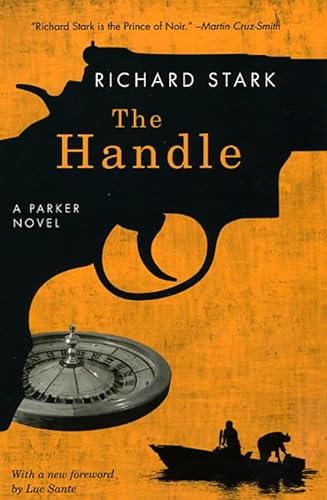
Parker takes down a whole illegal casino in this action-packed entry in the classic hard-boiled crime series
Richard Stark's Parker novels are the hardest of hard-boiled, classic crime novels where the heists are huge, the body counts are high, and the bad guys usually win.
The Parker novels have been a huge influence on countless writers and filmmakers, including Quentin Tarantino, Stephen King, George Pelecanos, Colson Whitehead, Lucy Sante, John Banville, and many more. Their stripped-down language and hard-as-nails amorality create an unforgettable world where the next score could be the big one, but your next mistake could also be your last. There's nothing else like them.
In The Handle, Parker is enlisted by the mob to knock off an island casino guarded by speedboats and heavies, forty miles from the Texas coast. Working with his trusted colleague Alan Grofield, but dealing with double-crosses and double-dealings by others from the word go, Parker knows the line between success and failure on this score would be exactly the length of the barrel of a .38.
Die Inhaltsangabe kann sich auf eine andere Ausgabe dieses Titels beziehen.
Über die Autorin bzw. den Autor
Richard Stark was one of the many pseudonyms of Donald E. Westlake (1933-2008), a prolific author of noir crime fiction. In 1993 the Mystery Writers of America bestowed the society’s highest honor on Westlake, naming him a Grand Master.
Auszug. © Genehmigter Nachdruck. Alle Rechte vorbehalten.
The Handle
By RICHARD STARKThe University of Chicago Press
Copyright © 1966 Richard StarkAll right reserved.
ISBN: 978-0-226-77106-9
Chapter One
When the engine stopped, Parker came up on deck for a lookaround. The mainland was nearly out of sight now, just a graysmudge on the horizon between the dark blue of the water andthe lighter blue of the sky.The man who called himself Yancy was sitting in one of thetwo chairs astern, and the man whose name Parker didn't knowwas standing at the controls. They both wore white trousers,navy blue jackets and yachting caps and sunglasses, but theyboth had the faces and voices and hands of New York orChicago hoods.
Yancy raised the hand with the glass in it and motionedforward. "There it is," he said.
Parker turned and looked out past the spray-flecked windshield,over the top of the rest of the boat, and out over the waterto the island. It was still about half a mile away, and all he couldmake out was a mound of jungle greenery bulging up out of thewater over there.
"Get in closer," he said. "I can't see anything from here."
The one at the wheel said, "We don't want to take chances."
Yancy said, "He's right. Move in closer."
The guy at the wheel didn't like it, but he had nothing more tosay. He just frowned behind his sunglasses, shrugged hisshoulders, and started the engine.
Yancy waved the hand with the bottle in it. "Come on and sitdown. Why stay below all the time?"
Parker had gone down into the cabin before they'd left thedock and had stayed there until just now. He had no fear ofwater, but he didn't like boats and he didn't like the ocean.Coming out away from land like this was like sticking yourself ina cage; there was no way out. From a practical point of view hewas stuck on this boat, imprisoned on it, till it touched landagain. So long as he stayed down below in the cabin, a place thatlooked like half the motel rooms in the southwest, he wasn't soaware of the caged feeling, but up here, surrounded by the flatblue water of the Gulf of Mexico, he was reminded of it all thetime.
Still, the island was in sight, and that's what he'd come outhere to see, so he went back and sat in the other white chair nextto Yancy. The boat was pushing through the waves again, notvery fast, heading toward the island.
Parker supposed it was a good boat, as boats go. It was anOwens cabin cruiser, forty feet long, sleek and gleaming, mostlywhite, with a blond wood deck. There were three rooms below,plus two baths, and space enough with convertible sofa andhideaway bed to sleep eight. The area up here where he andYancy were sitting could probably be easily fixed up withfastened seats for deep-sea fishing.
Yancy said, "The main building's around the other side ofthe island."
"What's on this side?"
"Storage sheds, power plant, few guest cottages."
"Guest cottages? Customers stay over?" He hadn't been toldthat.
Yancy shrugged. "Sometimes. Just one night, you knowwhat I mean?"
Parker said, "It's a whorehouse, too, is that it?"
"Not very much." Yancy grinned and spread his hands."Just sometimes, on a special request, for some good friend ofBaron's." Parker said, "You know Baron?"
Smiling, Yancy shook his head. "I know about Baron. That'swhat counts." He was better than his partner at the wheel inmaking his speech suit his playboy clothing; only the hard linesof his face gave the lie away.
Parker had been with Yancy off and on the last two days andat all times Yancy carried a glass in one hand and a bottle in theother. Now, discovering the current bottle was empty, he got tohis feet and said, "Blast." He flipped the bottle over the side."Be right back."
Parker watched him go. Yancy moved as though the boatwere on dry land and he himself was sober. He went down theladder into the cabin below and out of sight. Parker watched theisland coming closer; he could make out buildings in among thegreenery now, small pink cottages near the water and some sortof brick construction farther back.
As Yancy was coming back up on deck with a fresh bottle, theguy at the wheel said, "Somebody coming."
Parker got to his feet. A small boat was chopping through thewater toward them, leaving a white Y in its wake.
Yancy said, "No problem, no problem." As though hewanted to soothe his partner at the wheel.
Parker knew the other two looked all right out here, but he inhis suit wouldn't ring true. He said, "I'll wait down below."
"Fine, fine." Yancy, distracted, waved the hand with theglass in it. He was watching the little boat speeding towardthem.
Parker went below. He was in a fair-sized but crowded room,furnished with a sectional sofa, a chair and table, and acombination kitchenette-bar. Curtained windows lined bothsides, giving the interior a dim and bluish light.
Parker went into the aft cabin, more crowded and with alower ceiling. In one of the closets he found a white yachting capand a blue jacket like those worn by the two men up on deck. Hestripped off his suitcoat and tie, opened his shirt collar, and puton the cap and jacket. Then he went back up on deck.
The smaller boat was just pulling alongside. Three men werein it, all young and hard-looking, wearing dungarees and T-shirts.One of them called, "You people lost?"
Yancy, smiling, holding his bottle and glass, called back,"Not us. Just out for a spin around the park."
The trio in the other boat couldn't be close enough to see thetruth on Yancy's face, so they'd have to think they were justlooking at an amiable clown. The one that talked said, "Youdon't want to get too close to the island. Dangerous rocks, thingslike that. You could ruin your boat."
"Thanks so much." Yancy gestured with bottle and glass."We'll just sweep around it and hurry on home. Thanks foryour concern."
"Remember. Don't get too close."
"I'll remember."
The little boat veered off, heading back for the island. Yancyturned and said, "Very nice. The jacket's a little small, but thecap looks quite sporty."
Parker said, "How many of those has Baron got?"
"What? Boats?"
"Torpedoes."
"Oh." Yancy brushed them aside with an airy wave of thebottle. "Half a dozen, maybe ten. Beach bums."
Parker took the cap and jacket off, dropped them on the chairnext to the guy at the wheel. "So far," he said, "it don't lookgood."
"Love will find a way," Yancy said.
Parker looked at him. Sometimes it seemed as though the facewas a lie and the rest was the truth. Yancy was somebody youcould underestimate.
The guy at the wheel said, "They still hangin' around, in byshore."
Parker told him, "Go around the island to the left." To Yancyhe said, "The brick building there, up behind the cottages.What's that?"
Yancy squinted, behind his sunglasses. "Power plant," hesaid. "Storage sheds the other side of it, on the far slope. You'llbe able to see it better as we go around."
The part of the island Parker had seen so far had no beach, nocove, no pier, no place at all for a boat to come in to shore.Tangled trees and undergrowth clogged the ground right downto the shoreline, and vines and branches overhung the water.The half dozen or so cottages scattered along the slope were allhalf hidden by the foliage. From not very far away the islandwould look both uninhabited and uninviting.
The guy at the wheel said, "They're still watching us."
"As we do," Yancy told him, "what I announced we woulddo. Don't worry about it."
They had started now to make their swing around the island.In close against the island lay the little boat, in the island'sshadow, nearly...
„Über diesen Titel“ kann sich auf eine andere Ausgabe dieses Titels beziehen.
Suchergebnisse für The Handle: A Parker Novel

Beispielbild für diese ISBN
The Handle: A Parker Novel
Verlag:
The University of Chicago Press, 2009
ISBN 10: 0226771067
ISBN 13: 9780226771069
Gebraucht
Paperback
Anbieter: World of Books (was SecondSale), Montgomery, IL, USA
Verkäuferbewertung 5 von 5 Sternen

Paperback. Zustand: Good. Parker is enlisted by the mob to knock off an island casino guarded by speed-boats and heavies, forty miles from the Texas coast. Artikel-Nr. 00110695287
Gebraucht kaufen
EUR 12,78
Versand gratis
Versand innerhalb von USA
Versand innerhalb von USA
Anzahl: 2 verfügbar
Beispielbild für diese ISBN
The Handle: A Parker Novel (Parker Novels)
Verlag:
University Of Chicago Press, 2009
ISBN 10: 0226771067
ISBN 13: 9780226771069
Gebraucht
Paperback
Anbieter: Books From California, Simi Valley, CA, USA
Verkäuferbewertung 4 von 5 Sternen

Paperback. Zustand: Fine. Artikel-Nr. mon0004147447
Gebraucht kaufen
EUR 10,81
EUR 4,44 Versand
Versand innerhalb von USA
Versand innerhalb von USA
Anzahl: 1 verfügbar
Foto des Verkäufers
The Handle
Verlag:
The University of Chicago Press, US, 2009
ISBN 10: 0226771067
ISBN 13: 9780226771069
Neu
Paperback
Anbieter: Rarewaves USA, HEBRON, KY, USA
Verkäuferbewertung 5 von 5 Sternen
Paperback. Zustand: New. Parker, the ruthless antihero of Richard Stark's eponymous mystery novels, is one of the most unforgettable characters in hardboiled noir. Lauded by critics for his taut realism, unapologetic amorality, and razor-sharp prose style - and adored by fans who turn each intoxicating page with increasing urgency - Stark is a master of crime writing, his books as influential as any in the genre. The University of Chicago Press has embarked on a project to return the early volumes of this series to print for a new generation of readers to discover - and become addicted to. This season's offerings include volumes 7-9 in the series: "The Seventh", "The Handle", and "The Rare Coin Score". In "The Handle", Parker is enlisted by the mob to knock off an island casino guarded by speed-boats and heavies, forty miles from the Texas coast. Artikel-Nr. LU-9780226771069
Neu kaufen
EUR 16,27
Versand gratis
Versand innerhalb von USA
Versand innerhalb von USA
Anzahl: Mehr als 20 verfügbar
Beispielbild für diese ISBN
The Handle: A Parker Novel
Verlag:
University of Chicago Press, 2009
ISBN 10: 0226771067
ISBN 13: 9780226771069
Gebraucht
Paperback
Anbieter: WorldofBooks, Goring-By-Sea, WS, Vereinigtes Königreich
Verkäuferbewertung 5 von 5 Sternen
Paperback. Zustand: Very Good. The book has been read, but is in excellent condition. Pages are intact and not marred by notes or highlighting. The spine remains undamaged. Artikel-Nr. GOR005241981
Gebraucht kaufen
EUR 12,01
EUR 6,72 Versand
Versand von Vereinigtes Königreich nach USA
Versand von Vereinigtes Königreich nach USA
Anzahl: 1 verfügbar
Foto des Verkäufers
The Handle
Verlag:
The University of Chicago Press, US, 2009
ISBN 10: 0226771067
ISBN 13: 9780226771069
Neu
Paperback
Anbieter: Rarewaves.com USA, London, LONDO, Vereinigtes Königreich
Verkäuferbewertung 5 von 5 Sternen
Paperback. Zustand: New. Parker, the ruthless antihero of Richard Stark's eponymous mystery novels, is one of the most unforgettable characters in hardboiled noir. Lauded by critics for his taut realism, unapologetic amorality, and razor-sharp prose style - and adored by fans who turn each intoxicating page with increasing urgency - Stark is a master of crime writing, his books as influential as any in the genre. The University of Chicago Press has embarked on a project to return the early volumes of this series to print for a new generation of readers to discover - and become addicted to. This season's offerings include volumes 7-9 in the series: "The Seventh", "The Handle", and "The Rare Coin Score". In "The Handle", Parker is enlisted by the mob to knock off an island casino guarded by speed-boats and heavies, forty miles from the Texas coast. Artikel-Nr. LU-9780226771069
Neu kaufen
EUR 19,87
Versand gratis
Versand von Vereinigtes Königreich nach USA
Versand von Vereinigtes Königreich nach USA
Anzahl: Mehr als 20 verfügbar
Beispielbild für diese ISBN
The Handle: A Parker Novel (Parker Novels)
Verlag:
University of Chicago Press 2009-08-15, 2009
ISBN 10: 0226771067
ISBN 13: 9780226771069
Neu
Paperback
Anbieter: Chiron Media, Wallingford, Vereinigtes Königreich
Verkäuferbewertung 5 von 5 Sternen
Paperback. Zustand: New. Brand new book, sourced directly from publisher. Dispatch time is 24-48 hours from our warehouse. Book will be sent in robust, secure packaging to ensure it reaches you securely. Artikel-Nr. 6666-GRD-9780226771069
Neu kaufen
EUR 15,17
EUR 5,39 Versand
Versand von Vereinigtes Königreich nach USA
Versand von Vereinigtes Königreich nach USA
Anzahl: 2 verfügbar
Beispielbild für diese ISBN
The Handle: A Parker Novel
Anbieter: California Books, Miami, FL, USA
Verkäuferbewertung 5 von 5 Sternen
Zustand: New. Artikel-Nr. I-9780226771069
Neu kaufen
EUR 18,34
EUR 2,67 Versand
Versand innerhalb von USA
Versand innerhalb von USA
Anzahl: Mehr als 20 verfügbar
Beispielbild für diese ISBN
The Handle
Anbieter: PBShop.store UK, Fairford, GLOS, Vereinigtes Königreich
Verkäuferbewertung 5 von 5 Sternen
PAP. Zustand: New. New Book. Shipped from UK. Established seller since 2000. Artikel-Nr. WG-9780226771069
Neu kaufen
EUR 19,54
EUR 3,95 Versand
Versand von Vereinigtes Königreich nach USA
Versand von Vereinigtes Königreich nach USA
Anzahl: 15 verfügbar
Beispielbild für diese ISBN
The Handle
Anbieter: Majestic Books, Hounslow, Vereinigtes Königreich
Verkäuferbewertung 4 von 5 Sternen
Zustand: New. pp. 176. Artikel-Nr. 8246939
Neu kaufen
EUR 20,48
EUR 7,80 Versand
Versand von Vereinigtes Königreich nach USA
Versand von Vereinigtes Königreich nach USA
Anzahl: 3 verfügbar
Beispielbild für diese ISBN
The Handle: A Parker Novel
Verlag:
The University of Chicago Press, 2009
ISBN 10: 0226771067
ISBN 13: 9780226771069
Neu
Softcover
Anbieter: Kennys Bookshop and Art Galleries Ltd., Galway, GY, Irland
Verkäuferbewertung 5 von 5 Sternen
Zustand: New. Parker is enlisted by the mob to knock off an island casino guarded by speed-boats and heavies, forty miles from the Texas coast. Num Pages: 176 pages, black & white illustrations. BIC Classification: FF. Category: (G) General (US: Trade). Dimension: 203 x 133 x 13. Weight in Grams: 181. . 2009. Reprint. Paperback. . . . . Artikel-Nr. V9780226771069
Neu kaufen
EUR 19,28
EUR 9,50 Versand
Versand von Irland nach USA
Versand von Irland nach USA
Anzahl: Mehr als 20 verfügbar