
Verwandte Artikel zu The Raj Quartet, Volume 4: A Division of Spoils (Phoenix...
The Raj Quartet, Volume 4: A Division of Spoils (Phoenix Fiction) - Softcover
Buch 4 von 4: The Raj Quartet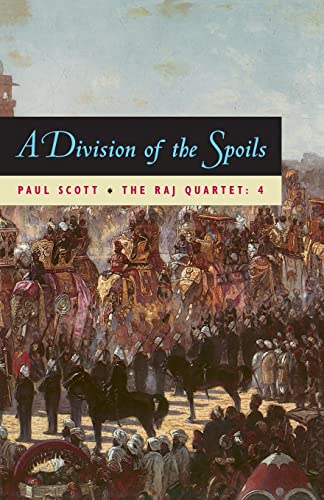
Inhaltsangabe
After exploiting India's divisions for years, the British depart in such haste that no one is prepared for the Hindu-Muslim riots of 1947. The twilight of the raj turns bloody. Against the backdrop of the violent partition of India and Pakistan, A Division of the Spoils illuminates one last bittersweet romance, revealing the divided loyalties of the British as they flee, retreat from, or cling to India.
Die Inhaltsangabe kann sich auf eine andere Ausgabe dieses Titels beziehen.
Über die Autorin bzw. den Autor
Paul Scott (1920-78), born in London, held a commission in the Indian army during World War II. His many novels include Johnnie Sabib, The Chinese Love Pavilion, and Staying On.
Auszug. © Genehmigter Nachdruck. Alle Rechte vorbehalten.
A Division of the Spoils
The Raj Quartet: 4
By Paul ScottThe University of Chicago Press
Copyright © 1976 Paul Scott
All rights reserved.
ISBN: 978-0-226-74344-8All rights reserved.
Contents
BOOK ONE: 1945,
An Evening at the Maharanee's,
Journeys into Uneasy Distances,
The Moghul Room,
The Dak Bungalow,
The Circuit House,
BOOK TWO: 1947,
Pandora's Box,
Note,
CHAPTER 1
An Evening at the Maharanee's
I
Hitler was dead, the peace in Europe almost a month old; only the Japanese remained to be dealt with. In June the Viceroy left London, flew back to Delhi, said nothing in public for nearly two weeks and then announced a conference of Indian leaders at Simla to discuss proposals which he hoped would ease the political situation, hasten final victory and advance the country towards her goal of full self-government. To enable all the leaders to be there he had to issue several orders of release from imprisonment.
The conference opened on June 25 and did not break down until July 14, an unexpectedly long time in the opinion of many English officials for Congress and Muslim League views on the composition of a new Indianised Executive Council or interim government to prove irreconcilable. The Viceroy, Lord Wavell, admitting failure, blamed himself and begged that there should be no recriminations. Subsequently, in press conference, the leader of the All-India Congress Party, a Muslim, blamed the leader of the Muslim League for the unbending nature of his claim for the League's right to nominate all Muslim members of the proposed Executive Council and blamed the British Government for not having foreseen that the conference would break down if one party were given the right of veto on nominations and therefore the opportunity to hold up the country's progress to autonomy. The leader of the Muslim League spoke disapprovingly of a combination of Hindu interests supported by the 'latest exponent of geographical unity' – the Viceroy – whose plan in his opinion was a snare for Muslim interests. Mr Nehru described the Muslim League as mediaeval in conception, and warned that the real problem facing a free India would not be communal and religious differences but economic backwardness.
The members of the conference then left Simla to consider the situation in private. Among the first to go was Mr Mohammed Ali Kasim, a Muslim Congressman and ex-chief minister of the prewar government of the province of Ranpur, who, if Jinnah had his way, could expect no portfolio in the higher council. Like several other prominent Congress politicians Mr Kasim had not been seen in public for nearly three years. Guarded from reporters by a small but efficient entourage headed by his younger son Ahmed, he ignored the questions shouted at him as he left the Cecil Hotel and concentrated on helping Ahmed to support a frail old man later identified by onlookers as his aged and ailing secretary – Mr Mahsood. Safe in his car at last he snubbed the young man from the Civil and Military Gazette who got close enough to the window to say, 'Minister, is Pakistan now inevitable?' by commanding Ahmed to put up the glass and pull down the blinds.
The lowering of the blinds caught the imagination of an Indian cartoonist who portrayed the car (identified as that of the ex-chief minister by the initials MAK on one of its doors) with all its windows, including the driver's, shuttered and making off at high speed (smoke-rings from the exhaust) from a once imposing but now crumbling portal inscribed 'Congress' towards a distant horizon with a sun marked 'Hopes of Office' rising behind a broken-down bungalow on whose rickety verandah the leader of the Muslim League, Mr Jinnah, could be seen conferring with several of his associates.
The cartoon annoyed adherents of Congress. They objected both to the inference that Mr Kasim was about to betray them and join the League and to the representation of their party as a derelict doorway with nothing behind it. Similarly, Muslim Leaguers objected to the portrayal of the Qaid-e-Azam as the occupier of a squalid little property such as the one depicted.
By the time the cartoon appeared (two days after the end of the conference) the liberals and middle-of-the-road men in Indian politics – who might have protested at the lampooning of a man whose legal skills and political integrity had commanded wide respect for a quarter of a century – could not help wondering whether Mr Kasim had after all shown himself as capable as men of lesser merit of acting with an eye to the main chance. What else, they asked, but an intention to shift his allegiance to the League, in the hope of securing his political future with a party that had grown strong enough to wreck a viceregal conference, could better explain his subsequent mysterious behaviour?
Between Delhi and Ranpur Mr Kasim seemed to have succeeded not only in evading the journalists but in disappearing together with his entire entourage. He was not on the train when it arrived in Ranpur and he never turned up at the old Kasim house on the Kandipat road. This house had been closed since Mr Kasim's wife (and then Mr Mahsood) had left it in the middle of 1944 to join him after his release from the Fort at Premanagar in the protective custody of his distant kinsman, the Nawab of Mirat. The reason given for that release had been Mr Kasim's reported ill-health, but it was Mrs Kasim who, some six month later, died.
The journalists who waited outside the still-locked gates of the house on the Kandipat road to greet the distinguished Muslim Congressman on his return home after three years detention and restriction, found themselves joined, towards evening, by colleagues who had waited just as uselessly at the station, and then by a growing crowd of spectators who eventually tangled with a truck-load of police sent to disperse them. A running battle developed between the lathi-armed constables and the quicker-tempered of Mr Kasim's admirers (students). The peaceful pleasures of families taking the air in the Sir Ahmed Kasim Memorial Gardens opposite were disturbed. A number of arrests were made and rumours then spread through the Koti bazaar and out to the suburb of Kandipat that Mr Kasim had been arrested by the British on the train from Delhi, had been abducted by Hindu extremists, had been murdered by the communists, had succumbed to poison administered by agents of the Viceroy. The shop of an unpopular merchant, a Hindu who gave short weight, was broken into and looted and that of another, a Muslim, ransacked in retaliation. The following day students of the Ranpur Government College demonstrated in the area of the Civil Lines carrying placards asking 'Where is MAK?' and hartal was observed in the Koti bazaar by Hindus and Muslims alike for fear of riot, arson and the consequent loss of profits.
At this stage it was discreetly leaked by the Inspector-General of Police to the Municipal Board that Mr Kasim was alive and well and back in the Nawab of Mirat's summer palace in the Nanoora Hills, and this information was simultaneously confirmed by a telephone call from a correspondent in Mirat to his editor in Ranpur. It seemed that Mr Kasim and his party had left the Delhi-Ranpur train at a wayside halt some miles outside the provincial capital and had then been driven to another wayside halt where the Nawab's private train awaited him and carried him back to the scene of his protective custody, although in this case it had to be assumed that his return was voluntary and caused by...
„Über diesen Titel“ kann sich auf eine andere Ausgabe dieses Titels beziehen.
Suchergebnisse für The Raj Quartet, Volume 4: A Division of Spoils (Phoenix...

Beispielbild für diese ISBN
The Raj Quartet, Volume 4 : A Division of Spoils
Verlag:
University of Chicago Press, 1998
ISBN 10: 0226743446
ISBN 13: 9780226743448
Gebraucht
Softcover
Anbieter: Better World Books, Mishawaka, IN, USA
Verkäuferbewertung 5 von 5 Sternen

Zustand: Good. Former library copy. Pages intact with minimal writing/highlighting. The binding may be loose and creased. Dust jackets/supplements are not included. Includes library markings. Stock photo provided. Product includes identifying sticker. Better World Books: Buy Books. Do Good. Artikel-Nr. GRP95738075
Gebraucht kaufen
EUR 6,29
Versand gratis
Versand innerhalb von USA
Versand innerhalb von USA
Anzahl: 1 verfügbar
Beispielbild für diese ISBN
The Raj Quartet, Volume 4 : A Division of Spoils
Verlag:
University of Chicago Press, 1998
ISBN 10: 0226743446
ISBN 13: 9780226743448
Gebraucht
Softcover
Anbieter: Better World Books: West, Reno, NV, USA
Verkäuferbewertung 5 von 5 Sternen
Zustand: Very Good. Former library copy. Pages intact with possible writing/highlighting. Binding strong with minor wear. Dust jackets/supplements may not be included. Includes library markings. Stock photo provided. Product includes identifying sticker. Better World Books: Buy Books. Do Good. Artikel-Nr. 4721373-6
Gebraucht kaufen
EUR 6,29
Versand gratis
Versand innerhalb von USA
Versand innerhalb von USA
Anzahl: 1 verfügbar
Beispielbild für diese ISBN
The Raj Quartet, Volume 4 : A Division of Spoils
Verlag:
University of Chicago Press, 1998
ISBN 10: 0226743446
ISBN 13: 9780226743448
Gebraucht
Softcover
Anbieter: Better World Books: West, Reno, NV, USA
Verkäuferbewertung 5 von 5 Sternen
Zustand: Good. Pages intact with minimal writing/highlighting. The binding may be loose and creased. Dust jackets/supplements are not included. Stock photo provided. Product includes identifying sticker. Better World Books: Buy Books. Do Good. Artikel-Nr. 6346309-6
Gebraucht kaufen
EUR 6,29
Versand gratis
Versand innerhalb von USA
Versand innerhalb von USA
Anzahl: 1 verfügbar
Beispielbild für diese ISBN
The Raj Quartet, Volume 4 : A Division of Spoils
Verlag:
University of Chicago Press, 1998
ISBN 10: 0226743446
ISBN 13: 9780226743448
Gebraucht
Softcover
Anbieter: Better World Books, Mishawaka, IN, USA
Verkäuferbewertung 5 von 5 Sternen
Zustand: Very Good. Pages intact with possible writing/highlighting. Binding strong with minor wear. Dust jackets/supplements may not be included. Stock photo provided. Product includes identifying sticker. Better World Books: Buy Books. Do Good. Artikel-Nr. 4584780-6
Gebraucht kaufen
EUR 6,29
Versand gratis
Versand innerhalb von USA
Versand innerhalb von USA
Anzahl: 2 verfügbar
Beispielbild für diese ISBN
The Raj Quartet, Volume 4 : A Division of Spoils
Verlag:
University of Chicago Press, 1998
ISBN 10: 0226743446
ISBN 13: 9780226743448
Gebraucht
Softcover
Anbieter: Better World Books, Mishawaka, IN, USA
Verkäuferbewertung 5 von 5 Sternen
Zustand: Good. Pages intact with minimal writing/highlighting. The binding may be loose and creased. Dust jackets/supplements are not included. Stock photo provided. Product includes identifying sticker. Better World Books: Buy Books. Do Good. Artikel-Nr. 6346309-6
Gebraucht kaufen
EUR 6,29
Versand gratis
Versand innerhalb von USA
Versand innerhalb von USA
Anzahl: 2 verfügbar
Beispielbild für diese ISBN
A Division of Spoils (Repr of 1975 Ed) (Raj Quartet/Paul Scott, 4) (Phoenix Fiction)
Verlag:
University of Chicago Press (edition Univ of Chicago), 1998
ISBN 10: 0226743446
ISBN 13: 9780226743448
Gebraucht
Paperback
Anbieter: BooksRun, Philadelphia, PA, USA
Verkäuferbewertung 5 von 5 Sternen
Paperback. Zustand: Fair. Univ of Chicago. The item might be beaten up but readable. May contain markings or highlighting, as well as stains, bent corners, or any other major defect, but the text is not obscured in any way. Artikel-Nr. 0226743446-7-1-13
Gebraucht kaufen
EUR 6,81
Versand gratis
Versand innerhalb von USA
Versand innerhalb von USA
Anzahl: 1 verfügbar
Beispielbild für diese ISBN
The Raj Quartet, Volume 4: A Division of Spoils
Verlag:
University of Chicago Press, 1998
ISBN 10: 0226743446
ISBN 13: 9780226743448
Gebraucht
Paperback
Anbieter: WorldofBooks, Goring-By-Sea, WS, Vereinigtes Königreich
Verkäuferbewertung 5 von 5 Sternen
Paperback. Zustand: Very Good. The book has been read, but is in excellent condition. Pages are intact and not marred by notes or highlighting. The spine remains undamaged. Artikel-Nr. GOR014232521
Gebraucht kaufen
EUR 15,29
EUR 6,52 Versand
Versand von Vereinigtes Königreich nach USA
Versand von Vereinigtes Königreich nach USA
Anzahl: 1 verfügbar
Beispielbild für diese ISBN
A Division of Spoils (Repr of 1975 Ed) (Raj Quartet/Paul Scott, 4) (Phoenix Fiction)
Anbieter: Revaluation Books, Exeter, Vereinigtes Königreich
Verkäuferbewertung 5 von 5 Sternen
Paperback. Zustand: Brand New. reprint edition. 597 pages. 8.50x5.75x1.75 inches. In Stock. Artikel-Nr. x-0226743446
Neu kaufen
EUR 30,32
EUR 14,55 Versand
Versand von Vereinigtes Königreich nach USA
Versand von Vereinigtes Königreich nach USA
Anzahl: 2 verfügbar
Foto des Verkäufers
The Raj Quartet, Volume 4 : A Division of Spoils
Verlag:
University Of Chicago Press Mai 1998, 1998
ISBN 10: 0226743446
ISBN 13: 9780226743448
Neu
Taschenbuch
Anbieter: AHA-BUCH GmbH, Einbeck, Deutschland
Verkäuferbewertung 5 von 5 Sternen
Taschenbuch. Zustand: Neu. Neuware - The powerful, dramatic final volume of Paul Scott's classic account of the last days of British rule in India. After exploiting India's divisions for years, the British depart in such haste that no one is prepared for the Hindu-Muslim riots of 1947. The twilight of the raj turns bloody. Against the backdrop of the violent partition of India and Pakistan, A Division of the Spoils illuminates one last bittersweet romance, revealing the divided loyalties of the British as they flee, retreat from, or cling to India. Artikel-Nr. 9780226743448
Neu kaufen
EUR 31,00
EUR 30,50 Versand
Versand von Deutschland nach USA
Versand von Deutschland nach USA
Anzahl: 2 verfügbar
Foto des Verkäufers
The Raj Quartet, Volume 4, 4: A Division of Spoils
Anbieter: moluna, Greven, Deutschland
Verkäuferbewertung 5 von 5 Sternen
Zustand: New. Against the backdrop of the violent partition of India and Pakistan, this volume sketches one last bittersweet romance, revealing the divided loyalties of the British as they flee, retreat from, or cling to India.Über den AutorP. Artikel-Nr. 594443417
Neu kaufen
EUR 26,00
EUR 48,99 Versand
Versand von Deutschland nach USA
Versand von Deutschland nach USA
Anzahl: Mehr als 20 verfügbar