
Inhaltsangabe
A masterful, authoritative account of the scientists and discoveries that enabled us to understand the age of the earth
In 1650, Archbishop James Ussher of Armagh joined the long-running theological debate on the age of the earth by famously announcing that creation had occurred on October 23, 4004 B.C. Although widely challenged during the Enlightenment, this belief in a six-thousand-year-old planet was only laid to rest during a revolution of discovery in the late eighteenth and early nineteenth centuries. In this relatively brief period, geologists reconstructed the immensely long history of the earth-and the relatively recent arrival of human life. Highlighting a discovery that radically altered existing perceptions of a human's place in the universe as much as the theories of Copernicus, Darwin, and Freud did, Bursting the Limits of Time is a herculean effort by one of the world's foremost experts on the history of geology and paleontology to sketch this historicization of the natural world in the age of revolution.
Addressing this intellectual revolution for the first time, Rudwick examines the ideas and practices of earth scientists throughout the Western world to show how the story of what we now call "deep time" was pieced together. He explores who was responsible for the discovery of the earth's history, refutes the concept of a rift between science and religion in dating the earth, and details how the study of the history of the earth helped define a new branch of science called geology. Rooting his analysis in a detailed study of primary sources, Rudwick emphasizes the lasting importance of field- and museum-based research of the eighteenth and nineteenth centuries.
Bursting the Limits of Time, the culmination of more than three decades of research, is the first detailed account of this monumental phase in the history of science.
Die Inhaltsangabe kann sich auf eine andere Ausgabe dieses Titels beziehen.
Über die Autorin bzw. den Autor
Martin J. S. Rudwick is research associate in the department of History and Philosophy of Science at the University of Cambridge and professor emeritus of history at the University of California, San Diego. He is the author of The Meaning of Fossils, The Great Devonian Controversy, Scenes from Deep Time, and Georges Cuvier, all published by the University of Chicago Press.
Auszug. © Genehmigter Nachdruck. Alle Rechte vorbehalten.
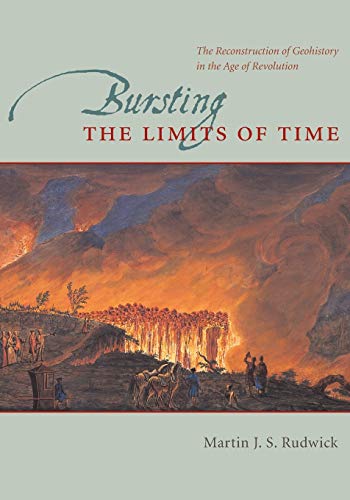
Bursting THE LIMITS OF TIME
The Reconstruction of Geohistory in the Age of RevolutionBy Martin J. S. RudwickThe University of Chicago Press
Copyright © 2005 The University of ChicagoAll right reserved.
ISBN: 978-0-226-73113-1
Contents
List of illustrations.......................................xiiiAcknowledgments.............................................xixA note on footnotes.........................................xxiiiIntroduction................................................11 Naturalists, philosophers, and others.....................152 Sciences of the earth.....................................593 The theory of the earth...................................1334 Transposing history into the earth........................1815 Problems with fossils.....................................2396 A new science of "geology"?...............................2957 Denizens of a former world................................3498 Geognosy enriched into geohistory.........................4179 The gateway to the deep past..............................47110 Earth's last revolution..................................557Coda: retrospect and prospect...............................639Sources.....................................................653Index.......................................................701
Chapter One
Naturalists, philosophers, and others
1.1 A SAVANT ON TOP OF THE WORLD
First ascents of Mont Blanc
At eleven o'clock on the morning of 3 August 1787, a party of twenty men climbed wearily through the snow onto the summit of Mont Blanc. All were wearing boots studded with iron nails to improve their grip on the snow, and all held long metal-tipped staffs to help them keep their balance. But one member of the party was distinguished from the rest by his elegant clothing and by the absence of a heavy load on his back. He was clearly a gentleman, one of the others was his personal servant, and the remainder were men from the village of Chamonix far below (Fig. 1.1).
The gentleman was Horace-Bénédict de Saussure (1740–99), a forty-seven-year-old member of a prominent and wealthy family in the city of Geneva, some forty miles to the northwest. He was a "savant"—it would be anachronistic to call him a scientist—who was already famous throughout the scientific world for his Alpine Travels [Voyages dans les Alpes], of which a second handsome volume had been published in Geneva the previous year, with the promise of another still to come. In his Travels he was setting new standards for the scientific description of mountain regions, and providing others with a fine model to emulate. To set foot on what was believed to be the highest point in the Alps, and therefore in Europe, was not only a moment of personal triumph; it was also an event of great symbolic significance for the sciences of nature. It was an even more striking achievement in Saussure's century than the first ascent of Everest was in the twentieth; as remarkable in its time as the first successful expeditions to the north and south poles.
Saussure and his party were not quite the first to stand on the summit of Mont Blanc. He was guided there by Jacques Balmat, a villager from Chamonix, who had reached the peak the previous summer with the local physician, Michel-Gabriel Paccard. Balmat had already been dubbed "le Mont Blanc" for his achievement; and when Saussure wrote an account of his own ascent, he praised the local pair for their courage in climbing to the summit "without even being certain that men could live in the places they aspired to reach". There had in fact been a series of attempts on the mountain during the previous decade, by Saussure himself among others, and some of the villagers had become quite experienced at scaling the slopes of ice and snow. After his first success, Balmat had been commissioned by Saussure to try again in 1787, and he had duly made a second ascent in July, accompanied this time by two other villagers. Saussure had been on his way to Chamonix when they did so, but had not got there in time to go with them. Then the weather had closed in for almost a month, and he had had to wait in patience for another opportunity. When at last the clouds cleared, he had been ready to make it a truly scientific expedition.
Saussure and his party found the ascent arduous. After a relatively simple first day's climb over grassy slopes and easy rocks, they camped 779 toises or fathoms (about 1,500m) above Chamonix. But the second day took them up across a glacier, where they had to negotiate dangerous crevasses—one man fell in, but was saved by being roped to others—and when they stopped for the night Saussure had to assure them that they would not die of cold if they camped on snow. At an altitude of 1,995 toises (about 3,900m) above sea level, even such fit men were exhausted by the effort of digging the snow to make level ground for the tents. Leaving them to such manual labor, Saussure the gentleman contemplated the scene around him: as he recalled later, "no living being was to be seen there, no trace of vegetation; it is a realm of cold and silence". After a fine clear night, during which they were alarmed by the sound of an avalanche, the party toiled slowly up steep slopes of snow, pausing frequently for breath; and two hours after they passed the last outcrop of solid rock they stood on the highest point in Europe (Fig. 1.2).
Science on the summit
Once they were on the summit, a flag was unfurled; but this was no nationalistic exercise, and Saussure did not record what form the flag took. Its purpose was simply to be a sign of their successful arrival, visible from below. His first action on reaching the peak was to look down to Chamonix, where he knew his wife and her sisters would be watching the summit through a telescope. Then he looked out to the horizon, but it was too hazy to see the distant plains of Piedmont (now in northern Italy) to the southeast, or those of France to the northwest beyond Geneva and the hills of the Jura. Still less could he see the Mediterranean some 56 lieues or leagues (about 200km) away, although he later calculated that it was possible in principle to do so, even allowing for the curvature of the earth and for the Apennines rising above the coastline. However, as he recalled, any disappointment in that respect was amply compensated by the spectacular views of the Alps all around him:
What I saw with the greatest clarity was the ensemble of all the high peaks, the arrangement of which I had for so long wanted to understand. I could not believe my eyes, and it seemed to me as if it were a dream ... I was seeing their relationships, their connections and their structure; and a single glance relieved the doubts that years of work had not been able to resolve.
In other words, the view enabled him to improve—at least in his mind's eye—the map of the western Alps that he had published the previous year and to gain a better understanding of the complex physical geography of the environs of Mont Blanc (Fig. 1.3).
While Saussure was enjoying his waking dream, his porters were erecting a tent and a table nearby. Then he set to work with his battery of scientific instruments, for this was no mere sporting trip. The most important of his observations were with the two barometers he had brought: each nearly three feet of glass tubing filled with mercury, carried precariously to the summit on the backs of the porters (see Fig. 1.4). A third...
„Über diesen Titel“ kann sich auf eine andere Ausgabe dieses Titels beziehen.
Weitere beliebte Ausgaben desselben Titels

Suchergebnisse für Bursting the Limits of Time: The Reconstruction of...

Beispielbild für diese ISBN
Bursting the Limits of Time Th
Verlag:
University of Chicago Press, 2007
ISBN 10: 0226731138
ISBN 13: 9780226731131
Gebraucht
Softcover
Anbieter: World of Books (was SecondSale), Montgomery, IL, USA
Verkäuferbewertung 5 von 5 Sternen

Zustand: Good. Good condition ex-library book with usual library markings and stickers. Artikel-Nr. 00104211675
Gebraucht kaufen
EUR 20,85
Versand gratis
Versand innerhalb von USA
Versand innerhalb von USA
Anzahl: 1 verfügbar
Beispielbild für diese ISBN
Bursting the Limits of Time: The Reconstruction of Geohistory in the Age of Revolution
Verlag:
University of Chicago Press, 2007
ISBN 10: 0226731138
ISBN 13: 9780226731131
Gebraucht
Softcover
Anbieter: medimops, Berlin, Deutschland
Verkäuferbewertung 5 von 5 Sternen
Zustand: very good. Gut/Very good: Buch bzw. Schutzumschlag mit wenigen Gebrauchsspuren an Einband, Schutzumschlag oder Seiten. / Describes a book or dust jacket that does show some signs of wear on either the binding, dust jacket or pages. Artikel-Nr. M00226731138-V
Gebraucht kaufen
EUR 32,58
EUR 10,00 Versand
Versand von Deutschland nach USA
Versand von Deutschland nach USA
Anzahl: 1 verfügbar
Beispielbild für diese ISBN
Bursting the Limits of Time
Anbieter: PBShop.store US, Wood Dale, IL, USA
Verkäuferbewertung 5 von 5 Sternen
PAP. Zustand: New. New Book. Shipped from UK. Established seller since 2000. Artikel-Nr. FW-9780226731131
Beispielbild für diese ISBN
Bursting the Limits of Time
Anbieter: PBShop.store UK, Fairford, GLOS, Vereinigtes Königreich
Verkäuferbewertung 5 von 5 Sternen
PAP. Zustand: New. New Book. Shipped from UK. Established seller since 2000. Artikel-Nr. FW-9780226731131
Neu kaufen
EUR 41,43
EUR 8,83 Versand
Versand von Vereinigtes Königreich nach USA
Versand von Vereinigtes Königreich nach USA
Anzahl: 15 verfügbar
Beispielbild für diese ISBN
Bursting the Limits of Time
Anbieter: Majestic Books, Hounslow, Vereinigtes Königreich
Verkäuferbewertung 4 von 5 Sternen

Zustand: New. pp. 732 Illus. Artikel-Nr. 8246706
Neu kaufen
EUR 46,25
EUR 7,53 Versand
Versand von Vereinigtes Königreich nach USA
Versand von Vereinigtes Königreich nach USA
Anzahl: 3 verfügbar
Beispielbild für diese ISBN
Bursting the Limits of Time: The Reconstruction of Geohistory in the Age of Revolution
Anbieter: Kennys Bookstore, Olney, MD, USA
Verkäuferbewertung 5 von 5 Sternen
Zustand: New. Examines the ideas and practices of earth scientists throughout the Western world to show how the story of what we call "deep time" was pieced together. This title explores who was responsible for the discovery of the earth's history, and details how the study of the history of the earth helped define a new branch of science called geology. Num Pages: 732 pages, 145 halftones, 34 line drawings. BIC Classification: PDX; RB. Category: (P) Professional & Vocational. Dimension: 256 x 178 x 49. Weight in Grams: 2182. . 2007. Paperback. . . . . Books ship from the US and Ireland. Artikel-Nr. V9780226731131
Neu kaufen
EUR 45,26
EUR 9,11 Versand
Versand innerhalb von USA
Versand innerhalb von USA
Anzahl: Mehr als 20 verfügbar
Foto des Verkäufers
Bursting the Limits of Time: The Reconstruction of Geohistory in the Age of Revolution
Verlag:
University of Chicago Press, 2005
ISBN 10: 0226731138
ISBN 13: 9780226731131
Gebraucht
paperback
Anbieter: Fireside Bookshop, Stroud, GLOS, Vereinigtes Königreich
Verkäuferbewertung 5 von 5 Sternen
paperback. Zustand: Very Good. Light shelf wear to extremities. Slight fading to spine with light dent. Artikel-Nr. 729951
Gebraucht kaufen
EUR 35,78
EUR 28,95 Versand
Versand von Vereinigtes Königreich nach USA
Versand von Vereinigtes Königreich nach USA
Anzahl: 1 verfügbar
Beispielbild für diese ISBN
Bursting the Limits of Time The Reconstruction of Geohistory in the Age of Revolution
Anbieter: Revaluation Books, Exeter, Vereinigtes Königreich
Verkäuferbewertung 5 von 5 Sternen
Paperback. Zustand: Brand New. 708 pages. 9.75x7.00x2.00 inches. In Stock. Artikel-Nr. x-0226731138
Neu kaufen
EUR 79,17
EUR 23,16 Versand
Versand von Vereinigtes Königreich nach USA
Versand von Vereinigtes Königreich nach USA
Anzahl: 2 verfügbar
Foto des Verkäufers
Bursting the Limits of Time
Verlag:
The University of Chicago Press, 2007
ISBN 10: 0226731138
ISBN 13: 9780226731131
Neu
Kartoniert / Broschiert
Anbieter: moluna, Greven, Deutschland
Verkäuferbewertung 5 von 5 Sternen
Kartoniert / Broschiert. Zustand: New. Examines the ideas and practices of earth scientists throughout the Western world to show how the story of what we call deep time was pieced together. This title explores who was responsible for the discovery of the earth s history, and details how the st. Artikel-Nr. 594443243
Neu kaufen
EUR 60,29
EUR 48,99 Versand
Versand von Deutschland nach USA
Versand von Deutschland nach USA
Anzahl: Mehr als 20 verfügbar
Foto des Verkäufers
Bursting the Limits of Time : The Reconstruction of Geohistory in the Age of Revolution
Verlag:
University Of Chicago Press Apr 2007, 2007
ISBN 10: 0226731138
ISBN 13: 9780226731131
Neu
Taschenbuch
Anbieter: AHA-BUCH GmbH, Einbeck, Deutschland
Verkäuferbewertung 5 von 5 Sternen
Taschenbuch. Zustand: Neu. Neuware - A masterful, authoritative account of the scientists and discoveries that enabled us to understand the age of the earth. Artikel-Nr. 9780226731131
Neu kaufen
EUR 79,95
EUR 66,88 Versand
Versand von Deutschland nach USA
Versand von Deutschland nach USA
Anzahl: 2 verfügbar