
Verwandte Artikel zu Emblems of Mind: The Inner Life of Music and Mathematics
Inhaltsangabe
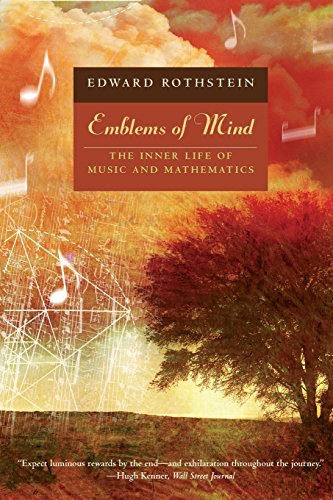
One is a science, the other an art; one useful, the other seemingly decorative, but mathematics and music share common origins in cult and mystery and have been linked throughout history. Emblems of Mind is Edward Rothstein’s classic exploration of their profound similarities, a journey into their “inner life.” Along the way, Rothstein explains how mathematics makes sense of space, how music tells a story, how theories are constructed, how melody is shaped. He invokes the poetry of Wordsworth, the anthropology of Lévi-Strauss, the imagery of Plato, and the philosophy of Kant. Math and music, Rothstein shows, apply comparable methods as they create their abstractions, display similar concerns with ratio and proportion, and depend on metaphors and analogies to create their meanings. Ultimately, Rothstein argues, they reveal the ways in which we come to understand the world. They are images of the mind at work and play; indeed, they are emblems of Mind itself.
Jacques Barzun called this book “splendid.” Martin Gardner said it was “beautifully written, marvelous and entertaining.” It will provoke all serious readers to think in new ways about the grand patterns in art and life.
“Lovely, wistful. . . . Rothstein is a wonderful guide to the architecture of musical space, its tensions and relations, its resonances and proportions. . . . His account of what is going on in the music is unfailingly felicitous.”—New Yorker
“Provocative and exciting. . . . Rothstein writes this book as a foreign correspondent, sending dispatches from a remote and mysterious locale as a guide for the intellectually adventurous. The remarkable fact about his work is not that it is profound, as much of the writing is, but that it is so accessible.”—Christian Science Monitor
Die Inhaltsangabe kann sich auf eine andere Ausgabe dieses Titels beziehen.
Über die Autorin bzw. den Autor
Edward Rothstein is cultural critic-at-large for the New York Times. He also has served as chief music critic for the Times and as music critic for the New Republic. The recipient of a Guggenheim fellowship, Rothstein has written for Commentary, Vanity Fair, and the New York Review of Books.
Auszug. © Genehmigter Nachdruck. Alle Rechte vorbehalten.
EMBLEMS OF MIND
The Inner Life of Music and MathematicsBy Edward RothsteinThe University of Chicago Press
Copyright © 2006 Edward RothsteinAll right reserved.
ISBN: 978-0-226-72954-1
Contents
Preface to the 2006 Edition........................................ixAcknowledgments....................................................xiiIntroduction.......................................................xvI PRELUDE: THE NEED FOR METAPHOR...................................3II PARTITA: THE INNER LIFE OF MATHEMATICS..........................33III SONATA: THE INNER LIFE OF MUSIC...............................81IV THEME AND VARIATIONS: THE PURSUIT OF BEAUTY.....................135V FUGUE: THE MAKING OF TRUTH.......................................191VI CHORALE: THE TEXTURE OF THOUGHT.................................229Selected Bibliography..............................................243Index..............................................................249
Chapter One
PRELUDE: THE NEED FOR METAPHORTen ... This number was of old held high in honor, for such is the number of fingers by which we count. OVID
INTENT ON SEEING THE SUN RISE FROM THE TOP OF MT. SNOWDON, the young William Wordsworth set out on a climb one evening two centuries ago with a friend and a shepherd guide. It was a close, warm summer night, the fog hanging low, air dripping with moisture. Beginning from a cottage at the mountain's base, the trio climbed in silence as the mists surrounded them. The poet's head was bent earthward, as if, he writes, it were set against an enemy. He was lost in thought, negotiating rocks and paths, panting breathlessly, leading the way through the midnight hours. Gradually, though dawn had not yet come, the ground at the poet's feet began to brighten. With each step the light increased. There was hardly time to ask or learn the cause, when suddenly—"Lo!" the poet cries in biblical fashion—he looked up and there was the moon
hung naked in a firmament
Of azure without cloud, and at my feet
Rested a silent sea of hoary mist.
From the mountain peak, the poet saw a vast sea of vapors below him, stretching out to the ocean, while the sky above was unclouded, the full moon illuminating the "ethereal vault." All was silent, save for a breach in the mist, a blue chasm not far off, a "breathing-place" whence came a "roar of waters, torrents, streams / Innumerable, roaring with one voice!" heard over the whole earth and sea and seemingly felt by the starry heavens.
When the scene dissolved and the poet thought about what he had seen, it seemed to him to be an image,
the type
Of a majestic intellect, its acts
And its possessions, what it has and craves,
What in itself it is, and would become.
The moon hanging over the mists, the light above, the sound below, the dark abyss and the silent sky—"There I beheld," the poet writes, "the emblem of a mind." The poet spins out his image of the mind, the relations of its parts represented by the moon and the waters, its powers resembling those of human imagination, and exerting profound influence on its thoughts and creations. The mind's creations can possess such mastery, he asserts, that they can catch even the creators by surprise,
Like angels stopped upon the wing by sound
Of harmony from Heaven's remotest spheres.
The journey of the poet, the laborious climb through darkness and silence, should be familiar to anyone who has attempted to understand what seems first clouded in mist: the discomfort of the still air, the awkward pace on narrow paths, the isolated broodings of the climb. This book promises no less, but it hopes to provide something more, some hint of brightening by journey's end, some vision of the expanse and vistas that have opened to those who have made such journeys their lifework, some inkling of the powers and forms that compose these emblems of mind.
There are two paths to be negotiated here—each with its own twists and treacherous turns, each with its separate maps and resting places. The paths are those of music and mathematics, and the claim that they are similar, or at the very least related, has become a commonplace—as has the claim for the vast illumination they offer to those who pledge themselves to the climb. But it is a commonplace shrouded in mystery. Connections between the two have had almost no importance for the development either of math or of music; mostly any relationships have been irrelevant to their practitioners and creators, and mystically vague to everyone else. They are simply accepted without explanation or discussion, without even realizing what an unlikely pairing these two arts are. Why should there be any links at all? What do these activities really share? Do they share meanings or techniques or ideas? Why should we even suspect that they lead to a similar destination, let alone reveal similar visions? And if they are similar, is it simply because they are alike in the way all human creations are?
Music, after all, is amorphous: it shifts its texture and character from place to place and time to time. It can be crystalline or cloudy, sentimental or bombastic. It is transitory: when played it dissolves into memory. Mathematics, by contrast, is straightforward: it never alters its character, and it seems to soar above both place and time. Music is in the fray of things, played on grass reeds or gut strings, through brass tubes or hollowed bamboo, using all kinds of materials, natural and otherwise. Mathematics is, above all, spun from abstraction, not even requiring pencil and paper, which only record thought the way a tape recorder records music.
Unlike mathematics, music seems useless. A world without music would still provide food and clothing and shelter and uncounted luxuries; aside from the absence of such awkward and mechanically tortured contraptions as the piano and the clarinet, that world would be physically identical to our own. Music's main function seems to be as accompaniment for shamans and magicians and the sales pitches of Muzak contractors. But mathematics has left no part of our world untouched. It is used in drawing property lines, building submarines, predicting the curvature of space, solving algebra problems ("If two men can paint a room in three hours, how long will it take for three men to paint a room?"), and routing city traffic. A world without mathematics would be utterly different from our own.
Music seems steeped in affect; we commonly talk about music as sad or happy or angry or gentle. Music is spiritual, aesthetic, religious. Mathematicians couldn't care less about the emotions suggested by a theorem's proof. Has anybody ever encountered a "sad" theorem, or presented an "angry" proof, or inspired a courtship through abstract musings about topological spaces?
Mathematicians insist they are concerned only with the true, which under their glinting eyes increases in quantity with each generation. A problem unsolved in one generation is penetrated in the next; issues which gave Descartes sleepless nights are now tackled by high school students for homework. Music is another story. In what way is Stockhausen a step forward compared with Bach? When we learn a piece of music, what more do we learn other than the music itself? Musical...
„Über diesen Titel“ kann sich auf eine andere Ausgabe dieses Titels beziehen.
Suchergebnisse für Emblems of Mind: The Inner Life of Music and Mathematics

Beispielbild für diese ISBN
Emblems of Mind ? The Inner Life of Music and Mathematics
Verlag:
The University of Chicago Press, 2006
ISBN 10: 0226729540
ISBN 13: 9780226729541
Gebraucht
Paperback
Anbieter: World of Books (was SecondSale), Montgomery, IL, USA
Verkäuferbewertung 5 von 5 Sternen

Paperback. Zustand: Good. One is a science, the other an art; one useful, the other seemingly decorative, but mathematics and music share common origins in cult and mystery. This work explains how mathematics makes sense of space, how music tells a story, how theories are constructed, how melody is shaped. It argues that they are images of the mind at work and play. Artikel-Nr. 00106652436
Gebraucht kaufen
EUR 3,47
Versand gratis
Versand innerhalb von USA
Versand innerhalb von USA
Anzahl: 1 verfügbar
Beispielbild für diese ISBN
Emblems of Mind: The Inner Life of Music and Mathematics
Verlag:
University of Chicago Press (edition First Edition), 2006
ISBN 10: 0226729540
ISBN 13: 9780226729541
Gebraucht
Paperback
Erstausgabe
Anbieter: BooksRun, Philadelphia, PA, USA
Verkäuferbewertung 5 von 5 Sternen
Paperback. Zustand: Very Good. First Edition. It's a well-cared-for item that has seen limited use. The item may show minor signs of wear. All the text is legible, with all pages included. It may have slight markings and/or highlighting. Artikel-Nr. 0226729540-11-1
Gebraucht kaufen
EUR 5,11
Versand gratis
Versand innerhalb von USA
Versand innerhalb von USA
Anzahl: 1 verfügbar
Beispielbild für diese ISBN
Emblems of Mind: The Inner Life of Music and Mathematics
Verlag:
University of Chicago Press, 2006
ISBN 10: 0226729540
ISBN 13: 9780226729541
Gebraucht
Paperback
Anbieter: ThriftBooks-Reno, Reno, NV, USA
Verkäuferbewertung 5 von 5 Sternen
Paperback. Zustand: As New. No Jacket. Pages are clean and are not marred by notes or folds of any kind. ~ ThriftBooks: Read More, Spend Less. Artikel-Nr. G0226729540I2N00
Gebraucht kaufen
EUR 6,07
Versand gratis
Versand innerhalb von USA
Versand innerhalb von USA
Anzahl: 1 verfügbar
Beispielbild für diese ISBN
Emblems of Mind: The Inner Life of Music and Mathematics
Verlag:
University of Chicago Press, 2006
ISBN 10: 0226729540
ISBN 13: 9780226729541
Gebraucht
Paperback
Anbieter: ThriftBooks-Dallas, Dallas, TX, USA
Verkäuferbewertung 5 von 5 Sternen
Paperback. Zustand: Good. No Jacket. Pages can have notes/highlighting. Spine may show signs of wear. ~ ThriftBooks: Read More, Spend Less. Artikel-Nr. G0226729540I3N00
Gebraucht kaufen
EUR 6,07
Versand gratis
Versand innerhalb von USA
Versand innerhalb von USA
Anzahl: 1 verfügbar
Beispielbild für diese ISBN
Emblems of Mind: The Inner Life of Music and Mathematics
Verlag:
University of Chicago Press, 2006
ISBN 10: 0226729540
ISBN 13: 9780226729541
Gebraucht
Paperback
Anbieter: ThriftBooks-Atlanta, AUSTELL, GA, USA
Verkäuferbewertung 5 von 5 Sternen
Paperback. Zustand: Very Good. No Jacket. May have limited writing in cover pages. Pages are unmarked. ~ ThriftBooks: Read More, Spend Less. Artikel-Nr. G0226729540I4N00
Gebraucht kaufen
EUR 6,07
Versand gratis
Versand innerhalb von USA
Versand innerhalb von USA
Anzahl: 1 verfügbar
Beispielbild für diese ISBN
Emblems of Mind: The Inner Life of Music and Mathematics
Verlag:
University of Chicago Press, 2006
ISBN 10: 0226729540
ISBN 13: 9780226729541
Gebraucht
Paperback
Anbieter: ThriftBooks-Dallas, Dallas, TX, USA
Verkäuferbewertung 5 von 5 Sternen
Paperback. Zustand: Very Good. No Jacket. Former library book; May have limited writing in cover pages. Pages are unmarked. ~ ThriftBooks: Read More, Spend Less. Artikel-Nr. G0226729540I4N10
Gebraucht kaufen
EUR 6,07
Versand gratis
Versand innerhalb von USA
Versand innerhalb von USA
Anzahl: 1 verfügbar
Beispielbild für diese ISBN
Emblems of Mind: The Inner Life of Music and Mathematics
Verlag:
University of Chicago Press, 2006
ISBN 10: 0226729540
ISBN 13: 9780226729541
Gebraucht
Paperback
Anbieter: ThriftBooks-Dallas, Dallas, TX, USA
Verkäuferbewertung 5 von 5 Sternen
Paperback. Zustand: Very Good. No Jacket. May have limited writing in cover pages. Pages are unmarked. ~ ThriftBooks: Read More, Spend Less. Artikel-Nr. G0226729540I4N00
Gebraucht kaufen
EUR 6,07
Versand gratis
Versand innerhalb von USA
Versand innerhalb von USA
Anzahl: 1 verfügbar
Beispielbild für diese ISBN
Emblems of Mind: The Inner Life of Music and Mathematics
Verlag:
University of Chicago Press, 2006
ISBN 10: 0226729540
ISBN 13: 9780226729541
Gebraucht
Paperback
Anbieter: ThriftBooks-Atlanta, AUSTELL, GA, USA
Verkäuferbewertung 5 von 5 Sternen
Paperback. Zustand: As New. No Jacket. Pages are clean and are not marred by notes or folds of any kind. ~ ThriftBooks: Read More, Spend Less. Artikel-Nr. G0226729540I2N00
Gebraucht kaufen
EUR 6,07
Versand gratis
Versand innerhalb von USA
Versand innerhalb von USA
Anzahl: 1 verfügbar
Beispielbild für diese ISBN
Emblems of Mind: The Inner Life of Music and Mathematics
Verlag:
University of Chicago Press, 2006
ISBN 10: 0226729540
ISBN 13: 9780226729541
Gebraucht
Paperback
Anbieter: ThriftBooks-Atlanta, AUSTELL, GA, USA
Verkäuferbewertung 5 von 5 Sternen
Paperback. Zustand: Fair. No Jacket. Missing dust jacket; Readable copy. Pages may have considerable notes/highlighting. ~ ThriftBooks: Read More, Spend Less. Artikel-Nr. G0226729540I5N01
Gebraucht kaufen
EUR 6,07
Versand gratis
Versand innerhalb von USA
Versand innerhalb von USA
Anzahl: 1 verfügbar
Beispielbild für diese ISBN
Emblems of Mind : The Inner Life of Music and Mathematics
Verlag:
University of Chicago Press, 2006
ISBN 10: 0226729540
ISBN 13: 9780226729541
Gebraucht
Softcover
Anbieter: Better World Books, Mishawaka, IN, USA
Verkäuferbewertung 5 von 5 Sternen
Zustand: Good. Pages intact with minimal writing/highlighting. The binding may be loose and creased. Dust jackets/supplements are not included. Stock photo provided. Product includes identifying sticker. Better World Books: Buy Books. Do Good. Artikel-Nr. 7579887-6
Gebraucht kaufen
EUR 6,19
Versand gratis
Versand innerhalb von USA
Versand innerhalb von USA
Anzahl: 1 verfügbar