
Verwandte Artikel zu I Feel So Good: The Life and Times of Big Bill Broonzy
Inhaltsangabe
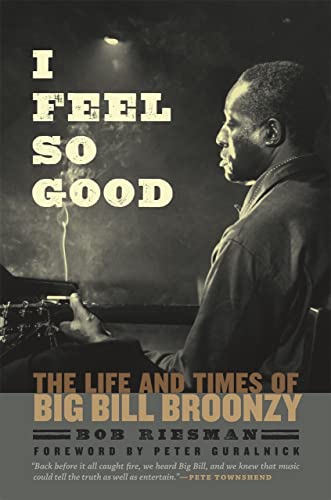
A major figure in American blues and folk music, Big Bill Broonzy (1903–1958) left his Arkansas Delta home after World War I, headed north, and became the leading Chicago bluesman of the 1930s. His success came as he fused traditional rural blues with the electrified sound that was beginning to emerge in Chicago. This, however, was just one step in his remarkable journey: Big Bill was constantly reinventing himself, both in reality and in his retellings of it. Bob Riesman’s groundbreaking biography tells the compelling life story of a lost figure from the annals of music history.
I Feel So Good traces Big Bill’s career from his rise as a nationally prominent blues star, including his historic 1938 appearance at Carnegie Hall, to his influential role in the post-World War II folk revival, when he sang about racial injustice alongside Pete Seeger and Studs Terkel. Riesman’s account brings the reader into the jazz clubs and concert halls of Europe, as Big Bill's overseas tours in the 1950s ignited the British blues-rock explosion of the 1960s. Interviews with Eric Clapton, Pete Townshend, and Ray Davies reveal Broonzy’s profound impact on the British rockers who would follow him and change the course of popular music.
Along the way, Riesman details Big Bill’s complicated and poignant personal saga: he was married three times and became a father at the very end of his life to a child half a world away. He also brings to light Big Bill’s final years, when he first lost his voice, then his life, to cancer, just as his international reputation was reaching its peak. Featuring many rarely seen photos, I Feel So Good will be the definitive account of Big Bill Broonzy’s life and music.
Die Inhaltsangabe kann sich auf eine andere Ausgabe dieses Titels beziehen.
Über die Autorinnen und Autoren
Bob Riesman is coeditor of Chicago Folk: Images of the Sixties Music Scene: The Photographs of Raeburn Flerlage. He produced and co-wrote the television documentary American Roots Music: Chicago, and was a contributor to Routledge’s Encyclopedia of the Blues.
Bob Riesman is coeditor of Chicago Folk: Images of the Sixties Music Scene: The Photographs of Raeburn Flerlage. He produced and co-wrote the television documentary American Roots Music: Chicago, and was a contributor to Routledge's Encyclopedia of the Blues.
Auszug. © Genehmigter Nachdruck. Alle Rechte vorbehalten.
I FEEL SO GOOD
THE LIFE AND TIMES OF BIG BILL BROONZYBy Bob RiesmanTHE UNIVERSITY OF CHICAGO PRESS
Copyright © 2011 The University of ChicagoAll right reserved.
ISBN: 978-0-226-71745-6
Contents
Foreword by Peter Guralnick................................................ixAppreciation by Pete Townshend.............................................xiiiPreface....................................................................xvAcknowledgments............................................................xvii1 Swing Low, Sweet Chariot.................................................12 My Name Is William Lee Conley Broonzy....................................63 When Will I Get to Be Called a Man?......................................214 Let's Go Away from Here!.................................................395 "I'm Gonna Play This Guitar Tonight from A to Z!"........................556 Serve It to Me Right.....................................................707 State Street Boys........................................................838 Just a Dream.............................................................919 Big Bill and Josh Are Here to Play the Blues for You.....................9810 Preachin' the Blues.....................................................11511 Blues at Midnight.......................................................12412 "That's the Nicest Guy I Ever Met in My Life"...........................13913 Stranger in a Strange Land..............................................14714 Nourish Yourself on Big Bill............................................15615 "Be Proud of What You Are!".............................................16716 Too Many Isms...........................................................18617 Low Light and Blue Smoke................................................20418 "A Requiem for the Blues"...............................................225Epilogue...................................................................247Afterword..................................................................257Selected Discography.......................................................259Bill on Film...............................................................263Notes......................................................................265Index......................................................................307
Chapter One
Swing Low, Sweet Chariot
In the end, it was Win Stracke who made the arrangements. In the weeks before he died, Big Bill Broonzy had pleaded with his wife Rose to let him stay home instead of returning to the hospital. But when Win arrived at the apartment after getting the phone call at 3 a.m. that Bill was failing, he decided that it would be too difficult for the family members gathered at the bedside to witness the final painful moments, and he called the ambulance. He also made sure that a room was waiting at Billings Hospital on the University of Chicago campus, only two miles away. But by the time Bill arrived there in the early hours of Friday, August 15, 1958, he had already passed.
There was, of course, a lot more to do once Bill was dead: coordinating the memorial service, selecting the location of the grave at the cemetery, and raising the money so these events could take place. The life insurance payout from the Local 208 black musicians' union wouldn't be enough by itself to cover the funeral, although the $500 that Win collected from friends and admirers over the weekend would help close the gap.
Win had known Bill for a dozen years, since 1946. Win's broad face and deep, warm, bass voice were familiar to Chicago television audiences from his appearances as a working-class singer of operatic arias and folk ballads on Studs Terkel's popular show Studs' Place and as the genial host of the children's program Animal Playtime. Bill and Win had traveled together through the Midwest in a folk song revue called "I Come for to Sing," playing Big Ten college campuses and Chicago nightclubs. It was Win who had launched Bill on the European tours that made him an internationally known name. When Win fulfilled his longtime dream by opening a folk music school in Chicago in December 1957, Bill performed at the opening-night concert, strumming as the school's first teacher diagrammed his technique on the blackboard for the first class. Bill had trusted Win enough to name him as the executor of his estate.
Win wanted to make sure that Bill would be honored in ways that underscored his importance to his various constituencies. He started by arranging for several musicians to perform at the funeral at the Metropolitan Funeral Parlors, located at Forty-fifth and South Parkway, two blocks from Bill and Rose's apartment. There was no shortage of talent at the service, with offerings from gospel star Mahalia Jackson, who had performed overseas with Bill in 1952; her informally adopted son, Brother John Sellers, who had appeared with Bill during his last tour of England in 1957; and Studs Terkel, whose connection with Bill went back to the earliest "I Come for to Sing" shows in the late 1940s. Win himself picked up his guitar and sang for the several hundred mourners as well, choosing the recently written but seemingly ageless folk song "Passing Through," whose chorus stressed that "We're all brothers and we're only passing through."
But the leads in the next day's newspapers told of something unusual and probably unprecedented: "Big Bill Broonzy sang at his own funeral," wrote the reporters for the Chicago Daily News and the Chicago Sun-Times.
It was indeed Bill, recorded barely a year earlier during his final recording session, before a doctor's scalpel had nicked his vocal cords during surgery on what turned out to be the lung cancer that killed him. He sang "Swing Low, Sweet Chariot" in a slow tempo, stretching out the words, strumming almost to himself, as if the guitar were an organic part of him and the playing was like inhaling as he gathered his strength for the next phrase. The effect, not surprisingly, was powerful, bringing many of those in attendance to tears. As they cried, they could see Bill in an open casket surrounded by an impressive array of flowers that featured a huge arrangement in the shape of a guitar.
After the service, at the cemetery, two more of Win's ideas combined to leave a lasting imprint. He had written to a friend that "the pallbearers will be four white and four colored singers," and that he had hired a professional photographer. So Mickey Pallas, whose photos had appeared in Ebony and Sepia, was there to document Bill's final journey. One of Pallas's images of Bill's casket, borne by the pallbearers, succeeded in capturing the image that Win had worked hard to create.
At the head of the procession, white handkerchief in breast pocket, eyes downcast, his face a somber mask, walked Muddy Waters. Not long after Muddy had arrived in Chicago in the mid-1940s, Bill had reached out to him, and Muddy always spoke of Bill with admiration, affection, and respect. To Muddy's left was Brother John Sellers, and in sequence behind him was a trio of Chicago blues musicians: Tampa Red, who, along with Bill, ruled the Chicago blues world of the 1930s and '40s; Otis Spann, Muddy's gifted piano player, his eyes fixed on the ground; and pianist Sunnyland Slim, whose most visible feature was the balding top of his bowed head as he brought up the rear. "Little Walter" Jacobs would have been included among the pallbearers if the harmonica star had not been shot in the leg earlier that year....
„Über diesen Titel“ kann sich auf eine andere Ausgabe dieses Titels beziehen.
Suchergebnisse für I Feel So Good: The Life and Times of Big Bill Broonzy

Beispielbild für diese ISBN
I Feel So Good: The Life and Times of Big Bill Broonzy
Verlag:
University of Chicago Press, 2011
ISBN 10: 0226717453
ISBN 13: 9780226717456
Gebraucht
Hardcover
Anbieter: ThriftBooks-Atlanta, AUSTELL, GA, USA
Verkäuferbewertung 5 von 5 Sternen

Hardcover. Zustand: Fair. No Jacket. Former library book; Readable copy. Pages may have considerable notes/highlighting. ~ ThriftBooks: Read More, Spend Less. Artikel-Nr. G0226717453I5N10
Gebraucht kaufen
EUR 7,73
Versand gratis
Versand innerhalb von USA
Versand innerhalb von USA
Anzahl: 1 verfügbar
Beispielbild für diese ISBN
I Feel So Good: The Life and Times of Big Bill Broonzy
Verlag:
University of Chicago Press, 2011
ISBN 10: 0226717453
ISBN 13: 9780226717456
Gebraucht
Hardcover
Anbieter: ThriftBooks-Dallas, Dallas, TX, USA
Verkäuferbewertung 5 von 5 Sternen
Hardcover. Zustand: Very Good. No Jacket. Former library book; May have limited writing in cover pages. Pages are unmarked. ~ ThriftBooks: Read More, Spend Less. Artikel-Nr. G0226717453I4N10
Gebraucht kaufen
EUR 7,73
Versand gratis
Versand innerhalb von USA
Versand innerhalb von USA
Anzahl: 1 verfügbar
Beispielbild für diese ISBN
I Feel So Good: The Life and Times of Big Bill Broonzy
Verlag:
University of Chicago Press, 2011
ISBN 10: 0226717453
ISBN 13: 9780226717456
Gebraucht
Hardcover
Anbieter: ThriftBooks-Atlanta, AUSTELL, GA, USA
Verkäuferbewertung 5 von 5 Sternen
Hardcover. Zustand: As New. No Jacket. Pages are clean and are not marred by notes or folds of any kind. ~ ThriftBooks: Read More, Spend Less. Artikel-Nr. G0226717453I2N00
Gebraucht kaufen
EUR 7,73
Versand gratis
Versand innerhalb von USA
Versand innerhalb von USA
Anzahl: 1 verfügbar
Beispielbild für diese ISBN
I Feel So Good - The Life and Times of Big Bill Broonzy
Verlag:
University of Chicago Press, Chicago and London, 2011
ISBN 10: 0226717453
ISBN 13: 9780226717456
Gebraucht
Hardcover
Erstausgabe
Anbieter: Voyageur Book Shop, Milwaukee, WI, USA
Verkäuferbewertung 5 von 5 Sternen
Hardcover. Zustand: As New. Zustand des Schutzumschlags: As New. 1st Edition. Complete printing number line. L13. Artikel-Nr. 018949
Gebraucht kaufen
EUR 16,48
EUR 4,22 Versand
Versand innerhalb von USA
Versand innerhalb von USA
Anzahl: 1 verfügbar
Foto des Verkäufers
I Feel So Good â" The Life and Times of Big Bill Broonzy
Verlag:
University of Chicago Press, 2011
ISBN 10: 0226717453
ISBN 13: 9780226717456
Gebraucht
Hardcover
Anbieter: WeBuyBooks, Rossendale, LANCS, Vereinigtes Königreich
Verkäuferbewertung 5 von 5 Sternen
hardcover. Zustand: Very Good. Most items will be dispatched the same or the next working day. A copy that has been read, but is in excellent condition. Pages are intact and not marred by notes or highlighting. The spine remains undamaged. Artikel-Nr. rev3196875490
Gebraucht kaufen
EUR 17,50
EUR 9,09 Versand
Versand von Vereinigtes Königreich nach USA
Versand von Vereinigtes Königreich nach USA
Anzahl: 1 verfügbar
Beispielbild für diese ISBN
I Feel So Good
Verlag:
The University of Chicago Press, 2011
ISBN 10: 0226717453
ISBN 13: 9780226717456
Neu
Hardcover
Anbieter: PBShop.store US, Wood Dale, IL, USA
Verkäuferbewertung 5 von 5 Sternen
HRD. Zustand: New. New Book. Shipped from UK. Established seller since 2000. Artikel-Nr. FW-9780226717456
Beispielbild für diese ISBN
I Feel So Good
Verlag:
The University of Chicago Press, 2011
ISBN 10: 0226717453
ISBN 13: 9780226717456
Neu
Hardcover
Anbieter: PBShop.store UK, Fairford, GLOS, Vereinigtes Königreich
Verkäuferbewertung 5 von 5 Sternen
HRD. Zustand: New. New Book. Shipped from UK. Established seller since 2000. Artikel-Nr. FW-9780226717456
Neu kaufen
EUR 36,38
EUR 5,92 Versand
Versand von Vereinigtes Königreich nach USA
Versand von Vereinigtes Königreich nach USA
Anzahl: 14 verfügbar
Beispielbild für diese ISBN
I Feel So Good
Anbieter: Majestic Books, Hounslow, Vereinigtes Königreich
Verkäuferbewertung 4 von 5 Sternen

Zustand: New. pp. 366. Artikel-Nr. 4407747
Neu kaufen
EUR 36,50
EUR 7,66 Versand
Versand von Vereinigtes Königreich nach USA
Versand von Vereinigtes Königreich nach USA
Anzahl: 3 verfügbar
Beispielbild für diese ISBN
I Feel So Good The Life and Times of Big Bill Broonzy
Anbieter: Revaluation Books, Exeter, Vereinigtes Königreich
Verkäuferbewertung 5 von 5 Sternen
Hardcover. Zustand: Brand New. 366 pages. 9.30x6.30x1.20 inches. In Stock. Artikel-Nr. __0226717453
Neu kaufen
EUR 30,61
EUR 14,74 Versand
Versand von Vereinigtes Königreich nach USA
Versand von Vereinigtes Königreich nach USA
Anzahl: 2 verfügbar
Beispielbild für diese ISBN
I Feel So Good: The Life and Times of Big Bill Broonzy
Anbieter: Kennys Bookstore, Olney, MD, USA
Verkäuferbewertung 5 von 5 Sternen
Zustand: New. A major figure in American blues and folk music, Big Bill Broonzy (1903-58) left his Arkansas Delta home after World War I, headed north, and became the leading Chicago blues-man of the 1930s. This title traces Big Bill's career from his rise as a nationally prominent blues star, including his historic 1938 appearance at Carnegie Hall. Num Pages: 328 pages, Illustrations. BIC Classification: AVGK; BGF. Category: (G) General (US: Trade). Dimension: 228 x 156 x 28. Weight in Grams: 660. . 2011. First Edition. Hardcover. . . . . Books ship from the US and Ireland. Artikel-Nr. V9780226717456
Neu kaufen
EUR 37,06
EUR 9,33 Versand
Versand innerhalb von USA
Versand innerhalb von USA
Anzahl: 14 verfügbar